eBook - ePub
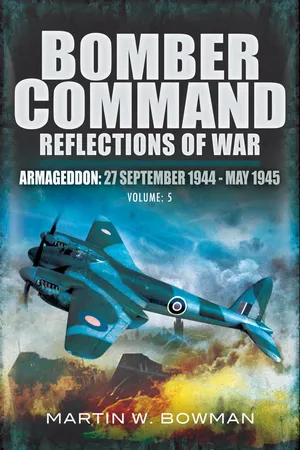
Bomber Command: Reflections of War, Volume 5
Armageddon, 27 September 1944–May 1945
- 256 pages
- English
- ePUB (mobile friendly)
- Available on iOS & Android
eBook - ePub
About this book
This is the fifth release in a series that provides a comprehensive insight into all aspects of RAF Bomber Command in World War Two. It begins in late September 1944 when the Allied Bomber Offensive was at its height, and takes us through to the end of the conflict. The crews' personal narrative puts you at the centre of each intense, isolated and harrowing episode of aerial combat as the pilots of Bomber Command attempted to stave off fears of tragic injury and death from fighters, flak and incessant operational pressure during raids on German cities, waterways, ports and oil installations. This continued until the Luftwaffe and the Nachtjagd effectively ceased to exist, their fuel supplies exhausted, their losses in airmen reaching an unsustainable level, and their aircraft and airfields decimated as a result of 24-hour Allied bombing.Often, it was the most exciting feats of bravery, determination and daring that were marked by the most catastrophic losses. Approximately 62 per cent of the 125,000 men who served as aircrew in Bomber Command during the war became casualties. Of these, 52 per cent were sustained while flying operations and a further ten per cent while on non-operational flights in Britain. It should never be forgotten that RAF Bomber Command played a hugely significant role in securing victory for the Allies, carrying out mass raids by day and night that eventually culminated in them 'beating the life out of Germany'. Yet its crews were denied the campaign medal that they so richly deserved, until very recently. Here, Martin Bowman attempts to provide an adequate tribute to the men of Bomber Command, using first-hand accounts to capture an authentic commentary of the times at hand in a release that is sure to capture the imaginations of all aviation enthusiasts.
Trusted by 375,005 students
Access to over 1.5 million titles for a fair monthly price.
Study more efficiently using our study tools.
Information
CHAPTER 1
Beating The Life Out Of Germany
‘Hell’s bells’, yelled Skipper. ‘Mac, get us outta here!’
The first intimation that anything was wrong came suddenly, when anti-aircraft shells began to burst all around us. I can still see the port wing dissecting a hideous ball of black smoke tinged with wicked orange flame and I can still smell the cordite. But, with the roar of our engines in my ears, it was like watching with the sound turned off.
I’d become used to being scared but this was different. This was real fear and there was nothing I could do. The next few seconds would be in the hands of our pilot. It was our twelfth op – eighteen more to go.
Peter Bone, Lancaster mid-upper gunner, 626 Squadron
‘It seems rather a makeshift place, out in the wilderness but I guess we’ll get used to it’ Ernest Peter Bone noted rather gloomily in his diary on the night of 27 September 1944. The bomb aimer and the rest of Squadron Leader Richard Lane’s crew had just been posted to 626 Squadron at Wickenby, about ten miles north-east of Lincoln. In time they did more than just get used to Wickenby; in the ensuing nine months they would become part of it. Peter Bone recalls:
Wickenby had been carved out of farmland in September 1942 to accommodate 12 Squadron, veteran of the Battle of France but latterly based at nearby Binbrook. A year later its ‘C’ flight had, like Adam’s rib, been taken away to form the nucleus of a new squadron, number 626. Its first operation had been on the night of 10/11 November 1943 when 313 Lancasters bombed railway yards on the main line to Italy at Modane in Southern France. Wickenby was typical of many wartime bomber squadrons, appearing like mushrooms almost overnight in the flat countryside of Eastern England. With two squadrons, each comprising of two flights of eight Lancasters apiece, flown by a total of 224 aircrew, it was serviced by hundreds of ground personnel of both sexes, working in shifts on aircraft maintenance, air traffic control, motor transport, parachute packing and, not least in importance, in the cookhouse, because as Napoleon once observed, an army marches on its stomach. Not for Wickenby the imposing red brick buildings of the pre-war bases. We made do with prefabricated huts. But it was to be our home for the time being.
But what circuitous chain of circumstances had conspired to put the former junior reporter behind two Browning .303in machine guns in a Lancaster bomber at the age of twenty-two and sit in a gun turret on 25 bombing operations, 16 by night and nine by day? Once back in England after his training in Canada, Peter Bone’s immediate destination had been Harrogate in West Yorkshire.
We were billeted for a few days in a requisitioned girls’ college, during which time we were issued the flying kit we would begin using at our next base, an Operational Training Unit ‘somewhere in England’. To remind the more thoughtless of us, we were given a talk on security. It was all too easy, we were warned, especially after a few beers, to let slip information that could jeopardize the forthcoming invasion of occupied Europe. Then we were all given three weeks’ leave; our first opportunity to see our loved ones at home for about a year. There were long cycle rides with Geoff and sometimes with my sister and brother, boating on the Thames, movies to see locally with my girlfriend and plays to see in London. The high spot was seeing my favourite dance band at a music hall in North London.
But early in May I received a telegram to return to Harrogate forthwith. I learned I was to be posted to 83 OTU at a place called Peplow in Shropshire, not far from where I had spent an uncomfortable week or so under canvas nearly two years before. Then I had been a lowly AC2 – Aircraftsman Second Class – a rookie, the butt of good-natured ribbing from the old hands. But, now I was a sergeant with the half-wing of an air gunner on my tunic and quite, at home in this, the youngest of the three services and, in the eyes of the public, the most glamorous. Not for nothing were we dubbed ‘The Brylcreem Boys’ by envious sailors and soldiers. I was very proud to be a member of the Royal Air Force. Frank Broome, whom I had got to know well since the Gunnery course in Canada, was also posted to Peplow and as the train drew into the station, we caught sight of black-painted bombers on the airfield across the fields. They were Wellington bombers and that meant – Bomber Command. Fleeting dismay – perhaps I was thinking of the disastrous Nürnburg operation just five weeks earlier, was soon forgotten as we scrambled off the train with all our kit. A rather sharp-faced Flight Lieutenant seemed to appear from nowhere and briskly took charge. A transport took us to the airfield. Next morning, the Station Commander addressed us. We were several hundred would-be pilots, navigators, bomb-aimers, wireless operators and gunners. ‘Right chaps, you see that big hangar over there? I want you all to go there every day until you’ve sorted yourselves into crews. Take your time and choose your companions carefully, because you’ll be flying together, with luck, for the next year. Off you go!’ It all seemed very casual and it wasn’t until the end of the two months course that I really understood the wisdom that lay behind this exercise in democracy.
Frank and I agreed that we might as well stick together as we seemed to hit it off quite well and we set out to find a pilot. Frank had little luck with the several flight-sergeants he approached. They already had gunners. It was after noticing that a flight lieutenant pilot and flying officer navigator were still standing around on their own that we realized that the pilot was the sharp-faced officer who had taken charge of the new intake at the railway station. Frank and I looked dubiously at each other. An officer pilot was heady stuff indeed but a Flight Lieutenant? I decided to take the plunge, Frank hard behind me. Saluting smartly, I asked him if he was still looking for a crew, in particular, two gunners. His stern features broke into a grin. ‘I was beginning to think no-one would ask’, he replied. Frank and I introduced ourselves. ‘I’m Dick Lane’ was the rejoinder ‘and this is my navigator Freddie Dirs’.
Flight Lieutenant Lane’s tunic bore some ribbons. ‘I’ve done one tour in Coastal Command’ he went on ‘and I don’t want to break my neck on this one.’ We said that went for us too. ‘How did you do at gunnery school then?’ he asked. ‘We both had average assessments’ we replied. ‘Well, all I’m looking for right now is keenness,’ said Flight Lieutenant Lane. We were feeling keener by the second to fly with this obviously experienced officer and hoped we exuded the keenness that he was looking for. ‘Skill will come later. That’s what we are all here for, isn’t it?’ Completely bowled over, we chorused ‘Yessir.’ ‘Well, we’ve still got to find a bomb-aimer and a wireless operator, so we’ll see you here tomorrow, then – Cheerio!’
Cheerio! No officer had spoken to us in such familiar terms before! Our pride knew no bounds in the mess that evening. Next day we spotted a short round figure whose battledress bore the half-wing of a bomb-aimer. He was standing apart from the crowd with a rather diffident expression on his face. He looked older than most of us. ‘Well, I was hoping to get a few days leave to see the wife and kids,’ he admitted ‘but I’ll join you.’ Freddy Till, it turned out, was 33 and probably could have been exempted from military service because he was a master plumber. His quiet Sussex burr however, masked a fierce independence and determination. He had already teamed up with a wireless operator-air gunner, Bert Bray, a 20-year old Hereford lad with a shock of unruly black hair and a friendly grin that exposed some broken teeth. Bert had done some boxing in his time. Although he had worked on the land, he proved to be no slouch when it came to radio and electronics.
For operational flying on four-engined Lancasters and Halifaxes, our team was not yet complete. We wouldn’t pick up a flight engineer until our next course. But for the purposes of our training here on the twin-engined Wellington bombers, now almost obsolete, we were a team, an aircrew. We practised dinghy drill, watched as Skipper became disoriented from lack of oxygen in a compression chamber and learned how to activate a parachute. I had expected, with considerable trepidation, to have to do some jumps but, as they told us reassuringly, all we needed to know was ‘It don’t mean a thing if you don’t pull that string.’
When we started our flying exercises, long cross country flights up and down England, our navigator was hampered by air sickness and had to be replaced. His successor was a Canadian flight sergeant who, however, didn’t meet the high standard demanded by Skipper, himself no mean navigator. So he too went. While we waited for a replacement, we all went on leave, an unexpected bonus. It was the middle of June, just a week after D-Day and there was great excitement everywhere at the news that the landings in Normandy had been successful. But what the British public didn’t know was that for a year the Germans had been experimenting with what Hitler called his ‘Vengeance Weapons’, designed partly to retaliate for our increasingly heavy air attacks on their industrial cities by American Flying Fortresses and Liberators by day and Bomber Command of the RAF by night, and partly to disrupt the flow of supplies to the Allied armies arriving in Northern France. The first of these unmanned missiles, the V-1s, began to arrive in Southern England on 12 June. About the size of a fighter aircraft, it was made of steel and had a one-tonne explosive warhead. It was programmed to exhaust its fuel somewhere over London, whereupon it dived to earth, on whatever happened to lie beneath.
I arrived home on the evening of 14 June. On the following night I was awakened in the early hours by what sounded like a harsh motorcycle engine just above the house accompanied by an eerie orange light that lit up the room I was sharing with my brother. Then there was a flash and a deafening explosion. Glass flew everywhere and ceilings came down. The flying bomb – we quickly dubbed it the Buzz-bomb or the doodlebug – had hit the hut in the field behind our house, killing the night watchman whose job it was to guard the ‘Dig for Victory’ allotments that had been tennis courts in happier days. About one hundred houses in our street were damaged. Some of the residents, including my father, were slightly injured. As she had done on countless nights during the Blitz, my mother made a pot of tea and everyone went back to work as usual next morning. For perhaps the first time I realized that my parents, my sister and my brother were as much in the front line, if not more so, than I would soon be. It was a sobering thought. About 5,800 V-1s fell on Southern England from now until six weeks before the war ended.
Back at OTU Skipper’s rank now came in useful. He was able to choose the most skilled navigator in the new intake that had just arrived. Duncan MacLean, a 21-year-old Scotsman, turned out to be just the man Skipper was looking for. Mac was rather taciturn, not very tidy and never happier than when he was gambling in the mess with a bottle of beer at his elbow. When we knew we wouldn’t be flying the next day, he was sometimes wheeled back from the mess in a wheelbarrow; but he never let beer interfere with his work. He proved to be a first-rate navigator and was cheerfully unruffled under stress, as we were to find out.
The training exercises were designed to give each crew member an introduction to the equipment he would be using on operations. Skipper of course was a second tour man but even he had to learn new techniques. Mac, in his curtained-off cubicle immersed himself in the complexities of electronic navigational aids which were now standard equipment. Although extremely useful, they were subject to gremlins, those mythical hobgoblins that were the bane of the lives of all fliers in World War II. Freddy, lying full-length in the nose of the Wellington, concentrated on his bomb-sight in practice bombing with twenty-five pounders on the bombing range. Bert, in his cubicle, busied himself receiving and transmitting messages on his receiver, while Frank and I practised air-to-air and air-to-sea firing.
The air-to-air exercises entailed the use of a camera gun while a single-engined fighter plane simulated attacks from the rear. Frank and I learned just when to order Skipper to take appropriate evasive action by throwing the Wellington into a corkscrew manoeuvre, to port or starboard depending on which side the attack was coming from but always on the side of the attack so that the fighter would, in theory, fly right over the bomber and be lost in the darkness. So when Frank or I ordered Skipper to ‘Corkscrew port’ for example, he would without a second’s hesitation thrust the bomber into a steep dive to port for a thousand feet, making sure that he didn’t exceed a certain speed, because above that speed the wings would break off. Then, Skipper would level off, climb steeply for a thousand feet and then, if necessary, repeat the manoeuvre until it seemed certain the attacker had been thrown off.
The force of gravity was of course very great during this manoeuvre. On the descent one would be pinioned to the dome of the turret and on the ascent one would be pressed to the floor and in each case it was almost impossible to move. To make matters worse, for me at any rate, in the Corkscrew manoeuvre each gunner had to use the rear turret, which, by virtue of its position, was, even in straight and level flying, subject to a considerable see-sawing motion, which my stomach objected to pretty quickly. The Corkscrew manoeuvre, therefore, made me violently sick and I would invariably end up sliding around miserably in my own vomit. I was greatly relieved when Frank, well aware of my discomfort, opted for the rear turret in our fledgling aircrew and I became the mid-upper gunner. But as the Wellington had no mid-upper turret, I kept watch through the astrodome, normally used by the navigator for taking star shots, when I wasn’t in the hated rear turret. I had been wondering if I would be dropped from the crew as had our previous navigator, because of airsickness but I was reassured when Skipper was overheard telling the training pilot officer in no uncertain terms that he could have demonstrated the Corkscrew quite well without throwing the aircraft around so wildly. As I found later, the Corkscrew would only be resorted to on ops in the event of an actual attack. But in the meantime our on-going training meant that I would have to endure airsickness during many more Corkscrews.
Before we could graduate we were required to take part in two exercises in enemy patrolled air space, designed to give us a relatively risk-free introduction to what is now termed ‘being in harm’s way’. The first, in mid-July, was to drop illustrated French language leaflets over Laval, in north-west France, to inform its citizens of the progress of the Allied armies since the Normandy landings six weeks earlier. We were naturally keyed up – a Wellington bomber from our own OTU had been lost a few weeks earlier in a similar exercise but ours was uneventful. Two nights later, we took part in what was called a diversion exercise. We were among a small number of training aircraft that flew within 15 miles of the Dutch coast to delude the enemy defences into thinking that we were the spearhead of an impending attack. The motive was to draw enemy fighters towards us and away from the main force which was on its way to a target much farther south. I kept watch through the astrodome while Frank sat behind his four guns. We would of course be no match in a chance meeting with a Focke-Wulf 190 or a Junkers 88, with their formidable 20mm cannon, but this was a risk that the Air Ministry deemed worth taking. In the event, all we saw was some flak and searchlights on the Dutch coast before we turned for home.
Both Frank and I graduated with an ‘average’ assessment and after a few more days’ leave, we were posted to a short gunnery course at Ingham near Lincoln, now known as the aircrew city, because it was the Mecca for hundreds of aircrew based in the flat Lincolnshire countryside that was so suitable for the long runways the heavily-laden bombers needed for take-off. It was now August and as I noted in my diary, ‘ruddy earwigs keep crawling up the curved walls of our Nissen hut and dropping on us in bed.’ Despite this diversion, we both graduated in category ‘A’ in the use of the camera gun and I still possess a twenty-second strip of film I took of a simulated attack, a reminder of uncomfortable sessions in the rear turret of a Wellington bomber on hot, sweaty summer afternoons, being seesawed up and down and trying to concentrate on the incoming fighter while at the same time fighting down the urge to be sick. And of course, like other gunners so afflicted, I had to clean out the turret on landing. How I got an ‘A’ I’ll never know.
While Frank and I were on the gunnery course, Skipper, Frank and Bert were at what was called Heavy Conversion Unit, at Sandtoft in Yorkshire. Here they began to familiarize themselves with a four-engined bomber, the Handley-Page Halifax, which had entered service in Bomber Command in 1941. Frank and I arrived at Sandtoft, as...
Table of contents
- Cover
- Title Page
- Copyright
- Contents
- Acknowledgements
- Chapter 1: Beating The Life Out Of Germany
- Chapter 2: Down In The Drink
- Chapter 3: Out For Blood
- Chapter 4: Flying Into The Flames of Hell
- Chapter 5: This Is Your Victory
- Appendices
Frequently asked questions
Yes, you can cancel anytime from the Subscription tab in your account settings on the Perlego website. Your subscription will stay active until the end of your current billing period. Learn how to cancel your subscription
No, books cannot be downloaded as external files, such as PDFs, for use outside of Perlego. However, you can download books within the Perlego app for offline reading on mobile or tablet. Learn how to download books offline
Perlego offers two plans: Essential and Complete
- Essential is ideal for learners and professionals who enjoy exploring a wide range of subjects. Access the Essential Library with 800,000+ trusted titles and best-sellers across business, personal growth, and the humanities. Includes unlimited reading time and Standard Read Aloud voice.
- Complete: Perfect for advanced learners and researchers needing full, unrestricted access. Unlock 1.5M+ books across hundreds of subjects, including academic and specialized titles. The Complete Plan also includes advanced features like Premium Read Aloud and Research Assistant.
We are an online textbook subscription service, where you can get access to an entire online library for less than the price of a single book per month. With over 1.5 million books across 990+ topics, we’ve got you covered! Learn about our mission
Look out for the read-aloud symbol on your next book to see if you can listen to it. The read-aloud tool reads text aloud for you, highlighting the text as it is being read. You can pause it, speed it up and slow it down. Learn more about Read Aloud
Yes! You can use the Perlego app on both iOS and Android devices to read anytime, anywhere — even offline. Perfect for commutes or when you’re on the go.
Please note we cannot support devices running on iOS 13 and Android 7 or earlier. Learn more about using the app
Please note we cannot support devices running on iOS 13 and Android 7 or earlier. Learn more about using the app
Yes, you can access Bomber Command: Reflections of War, Volume 5 by Martin W. Bowman in PDF and/or ePUB format, as well as other popular books in History & Military Biographies. We have over 1.5 million books available in our catalogue for you to explore.