eBook - ePub
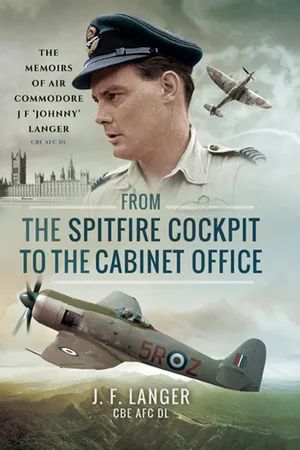
From the Spitfire Cockpit to the Cabinet Office
The Memoirs of Air Commodore J F 'Johnny' Langer CBE AFC DL
- 304 pages
- English
- ePUB (mobile friendly)
- Available on iOS & Android
eBook - ePub
From the Spitfire Cockpit to the Cabinet Office
The Memoirs of Air Commodore J F 'Johnny' Langer CBE AFC DL
About this book
Air Commodore John Langer's career has been eventful to say the least. During the Second World War he flew gliders in India in preparation for airborne assaults in Burma, one of the most perilous landscapes to pass across during this time. Post-war, he served on a fighter squadron in Germany and in Malaya, where he was recommended for an AFC. Later on, he commanded No 43 (F) Squadron, the famous 'Fighting Cocks', and was awarded the AFC. As a Group Captain, he commanded RAF Valley and was awarded the CBE. He ended his RAF career as director of Flying Training where he set up the first team of the Red Arrows. By careers end, he had flown fifty-six different types of aircraft.On leaving the RAF, he became the Civil Aviation Security Adviser to the UK Government, serving for eight years as a Crown Servant and a further seven years as a consultant. He was a frequent advisor to the Cabinet Office Briefing Room 'A' (Cobra), consulting with members of the cabinet on national and international aviation matters in the wake of a series of security and terrorist emergencies. In 1993 he was appointed Duty Lieutenant for Greater London, with responsibilities for the borough of Hillingdon, location of both Heathrow and Northolt airport. He looked after members of the Royal Family in their departures from these airports and became a good friend of Princess Diana, chaperoning her on a number of solo outings. Interesting details relating to some of their exchanges are included here. This is a unique autobiography, taking in a vast spectrum of events and experiences. It is also an important record of political, aviation and social history and should appeal to enthusiasts of all these areas of interest.
Information
Chapter 1
Schooldays
I cannot remember much of my early childhood although a few incidents come readily to mind. For example, one day, when I was about three or four, my elder sister Jean and I were playing in the garden when we heard a screech of brakes and a yelp. Our nanny rushed out and took us into the house where our mother told us later that the family’s much loved Scottish terrier had been run over and killed and was now buried in the back garden under an apple tree.
I also remember vividly that, when I was about six or seven, our mother would take Jean and me to the garden parties held in the grounds of the Putney Home for Incurables (a horrible name, still engraved on the building) which was on the opposite side of the road when we lived in West Hill. These were fundraising events and the ladies would dress up as if for Ascot with large hats, elegant dresses and pretty parasols. But what sticks in my mind was the horrific state of most of the inmates. Many of them were blind as a result of gas attacks, most of them had had limbs amputated and a few had neither arms nor legs. But the worst cases were those who had part of their faces blown away and were left with gaping holes. After these visits, and I can recall at least three or four, I had nightmares for several days.
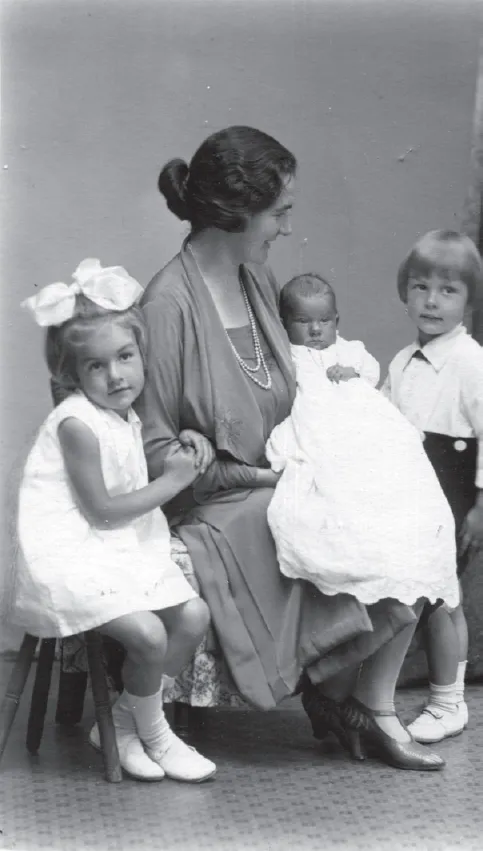
The Langer family: Mother with Jean, baby Elizabeth and the author, John Francis.
* * *
My first school was of the nursery variety run by the Putney High School for Girls. I cannot recall any formal lessons: we spent most of the time doing clever things with plasticine or painting pictures of our houses, our mummies or our pets – to order. The school was very keen on eurythmics and free expression and whenever the weather allowed we were made to prance around the garden and to dance like trees or elephants or old men. I often wondered if I looked as foolish as I felt. It was all very Joyce Grenfell! My second school was the Convent of the Sacred Heart where Jean was already a pupil. The Convent took boys from five to seven years old but I stayed until I was nine. It was there that I was introduced to the three Rs. It was also at the Convent that I had my first fifteen minutes of fame.

The Langer family home, 12 St Simon’s Avenue, Putney, London, SW15.
One day the Reverend Mother Superior came to early morning prayers to address the school. After stressing the importance of religion in education she started asking questions about their faith to the assembled pupils. Hands shot up and satisfactory answers were given until she asked ‘How much bread do we receive at Holy Communion?’ Some of the girls hazarded answers in ounces and it was clear that the Reverend Mother was getting agitated. Thinking laterally I put up my hand and said ‘We don’t get any bread …’. Before I could go on she beckoned me towards her, and gave me a hug and enveloped me in her habit – which smelt strongly of mothballs and incense. Then addressing the audience she said ‘Of course we do not receive any bread because during the Mass it was turned into the Body of Christ and I am surprised that it has taken someone as young as John to see that truth.’ She then gave me a kiss on the forehead and swept out. If I blushed it was not because of the kiss in front of all those girls but because I was going on to say that the Communion wafer was not bread but biscuit.
From the Convent I went on to Donhead Lodge which was the preparatory school for Wimbledon College, the grounds of which were on the opposite side of Edge Hill. It had been a large private house so it had a homely feel about it which made it an excellent place in which to gently introduce us youngsters to the rigours of public school life. It was there that a few of us first met the dreaded ferrula, a thick piece of leather shaped something like the sole of a shoe. It was administered sharply to the palms of one’s hands and hurt like hell. I remember clearly that I was awarded ‘three of the best’ for persistently confusing Britain with Briton and vice-versa. I never ever got that wrong again! Our form master was Father Millar, a grey-haired, tall, avuncular man who was much respected and well liked, except when he reluctantly decided that a little painful correction was necessary.
In 1936, when I was eleven, my class, all ten of us, moved across the road to Wimbledon College which had been founded in the mid-nineteenth century with the purpose of preparing Catholic boys for service as officers in the Armed Forces. Many served in the Crimea, the Boer War and the First World War, and the school’s Roll of Honour was quite impressive. The College was run by the Society of Jesus, often referred to as the Catholic mafia. Founded in Rome in the sixteenth century but with houses and colleges around the world, the SJs were one of the strictest, most learned and influential of all the religious orders. Wimbledon College was a public day school, the associated boarding school being Beaumont College near Windsor.
The school was well endowed with sports facilities in that there were three tennis courts, a large gymnasium, a heated indoor swimming pool, two cricket pitches with practice nets, all in the grounds, as well as a separate sports field and pavilion at Raynes Park where there were three rugby pitches. The assembly hall, which was also the refectory, was quite grandiose, the chapel was beautiful, the science laboratories were well equipped but the classrooms were very spartan. The worst aspect of the school was the toilets, all with the original mid-Victorian plumbing which really deserved the schoolboy name of ‘the bogs’.

Father Murray’s class, Wimbledon College; the author is first left, back row.
Two years passed without significant incidence until, in second summer term, our form master became ill and was replaced by Father Rousel, who was on loan from Beaumont. He was a mild mannered, ineffectual man of whom we boys took full advantage: paper aeroplanes, chalk and rubber bands flew around his classes and the form became rather ill-disciplined. That all changed at the start of the following term when a new teacher took over.
When Father Murray arrived for the first class he entered the classroom amidst the usual babble of conversation with many of the boys lounging around. He walked up to the dais, turned and faced the class and waited until there was an awkward silence. He then said, ‘I am going out of the room and when I re-enter you will all stand behind your desks in silence. I will go to the front and say “Good morning, boys” and you will say “Good morning, Father” and then sit down.’ In that simple but firm manner Father Murray made it clear that he would stand no nonsense. Thereafter our class became the best behaved in the school. I was most impressed by the episode as it showed how easy it was for a group of boys to become an unruly mob when lacking firm direction and, more importantly, how all that was needed to knock them into shape was good leadership. It was a lesson I never forgot, especially when eventually I was in a position of authority.
By way of introductions Father Murray started by telling us a little of his own background. He then asked each of us to stand up, starting from the front row, to give our names, where we lived, our fathers’ professions and what careers we intended to follow when we left school. And so it progressed towards the back row where I sat with my friends Mickey Hampshire and Robbie Burns. Most boys appeared to have little imagination and many simply opted to follow in father’s footsteps: accountancy, banking, family firm, teaching and the Civil Service seemed to be the favourite occupations. Only Bernard O’Neil showed any originality by saying that he wanted to become a cricketer; which he did, playing for and eventually captaining Hertfordshire, one of the minor counties.
I was in a difficult position, firstly because my parents were divorced and secondly because, at the age of thirteen, I had given my future career absolutely no thought whatsoever. However I was an avid reader of Captain W. E. Johns’ novels about that intrepid aviator, Biggles, and had recently seen an item on the Pathé News in the cinema about the Hendon Air Show and had been fascinated by the formation aerobatics. So when it was my turn I stood up and said ‘John Langer, I live on Putney Hill, my father was a builder and I am going to be a fighter pilot in the Royal Air Force’. Whereas everyone else’s statements had been well received, mine caused a bit of a titter and several boys actually laughed. My face went red and I hoped the ground would swallow me up.
At the end of the lesson Father Murray summoned me and asked why I thought the boys had laughed. I said that it was probably because I was not very bright and that they knew that entry standards for the RAF were very high. Father Murray then said, ‘Pay no attention to them: it is now up to you to show that they were wrong. I am sure that you will prove to have what it takes.’ When I left the classroom I felt ten feet tall.
The more I thought about it the more I became convinced that my choice of career was the right one. It was now 1938 and the threat of war was looming: so the chances were that, if it lasted long enough, many of us would be called up anyway. The possibility of a watery grave in mid-Atlantic did not appeal to me, nor did I wish to be blown to bits in the trenches, so the Royal Navy and the Army were out. I was determined to be a pilot but the transport, bomber and maritime roles had no attractions for me. I saw fighter pilots as being the last of the white knights engaging their opponents in an honourable and chivalrous manner – and usually getting back to base in time for tea.
Thus convinced I asked the Careers Master to find out what educational attainments were required before one could apply for entry to the RAF College at Cranwell. The answer was a good school certificate with a minimum of five subjects at credit level – and therein lay a problem. There was little doubt that I was not one of the brightest pupils in our class of twenty-one. In the end of term exams, Mickey and Robbie always vied for last place and I had never been far behind. Robbie was a bit dim, Mickey was rather lazy whilst, although not stupid, I was a day-dreamer with a short attention span. Clearly I would have to pull my socks up.
Fuelled by my newly-found ambition my class marks started climbing slowly but surely, especially in those subjects such as geography, Latin, science and geometry which I had always enjoyed: my least favourite subjects were French and algebra which I loathed. However, my attempts to forge ahead were becoming affected by problems at home. Although my parents had been divorced before I went to prep school, my mother had been able to manage reasonably well on the income from taking paying guests. But our family fortunes started to plunge when she married Billy Doe and lost most of her capital by funding his unsuccessful building company which went bankrupt

The author with his elder sister Jean Rosemary in 1928.
By 1938 my mother had had to sell our lovely big house for a mere £2,850, most of which went to pay off debts. Our fairy godmother was Mrs Warren who lived opposite us in St Simon’s Avenue and whose daughter, Doune, was a classmate and best friend of my sister Jean. Mrs Warren put up all five of us for several months until my mother found a suitable house to rent in Tideswell Avenue, a little farther down the hill, where she could resume taking paying guests. But worse was to come when the war started in September 1939 and her supply of foreign PGs completely dried up.
She now had no income whatsoever, could no longer pay the rent, had to vacate our rented house and we had become both penniless and homeless. By this time Mrs Warren had moved to Stoke Poges as her partner had moved his factory from Fulham to Slough Trading Estate where there were better facilities – so she could not help us. My mother was at her wits end and sought the advice of her old friend, the Mother Superior of the Convent at West Hill.
Strangely it was the advent of the war which most helped us to overcome our problems. Firstly, the pupils and teaching staff of the Convent had all been evacuated to a sister school in the country, taking Jean and my younger sister Elizabeth out of London. They could even stay there for the school holidays, so that was one less worry. Secondly, Linda Doe, Billy’s step-sister, agreed to take my half-sister Edwina (Tweeny) into her home in Sussex as an evacuee: so that just left my mother and I with nowhere to go. Luckily the Reverend Mother and some of the other nuns had remained at West Hill: when she heard of my mother’s plight she offered her the use of two offices in a building near the main gate which housed the gymnasium and domestic science classroom as well as a maisonette which housed Mr and Mrs Cheeseman, who both worked for the Convent, as gatekeeper/handyman and domestic servant respectively, along with their daughter Peggy who had been a pupil there and was now waiting to go to university.
The two offices now became our bedrooms, furnished by Reverend Mother with rather spartan iron-framed beds and, in my case, a desk so I could do my homework. These makeshift bedrooms were at the far end of the gymnasium on the first floor whilst downstairs the classroom was fitted with ovens, hobs and refrigerators and, thankfully, there was a toilet so we had all the necessary facilities to be able to live there. The only thing we did not have was any money. This was nothing new because we had been stoney-broke many times before. Indeed in the summer of 1938 Mater, Jean and myself, then aged thirteen, worked for two months in a seafront hotel in Shanklin on the Isle of Wight; Mater as the assistant housekeeper, Jean as a chambermaid and myself as the scullery boy. This was Mater’s idea of a working holiday. I have no idea how much I was paid as Jean and I handed over our pay-packets to our mother. Jean sometimes worked as a waitress in the hotel’s restaurant and was allowed to keep any tips but, as a backroom boy, I got nothing.
For the following Christmas holiday I managed to get a job as a porter at the Oatlands Park Hotel near Weybridge and I worked there every holiday until I left school. I was only paid £1 per week, with one shilling and four pence deducted for the ‘stamp’, but I was given accommodation and three meals a day. Oatlands Park was a very posh hotel with extensive landscaped grounds including a large lake. Many of the guests were wealthy permanent residents and most were quite famous. My favourite was a delightful old lady called Lady de Frece who, as Vesta Tilley, had been the leading male impersonator in the Victorian music-halls, most famous for her song ‘Burlington Bertie from Bow’. Another was an even older gentleman, whose name I have forgotten, who was in his nineties and sadly going blind. Although very fragile and somewhat tottery, he was very mentally alert and asked me if I could read certain sections of The Daily Telegraph to him every afternoon, for which enjoyable chores he gave me a half-crown each time I did so – a small fortune!
Perhaps because I spoke ‘posh’, I soon became a favourite with the regulars who, when they knew my circumstances, were very generous whenever I did anything for them. But the best money earner was when I started looking after the cloakroom for the Saturday night dances in the hotel ballroom, which were open to the public and much frequented by officers from nearby units and their ladies. On special occasions, such as New Year’s Eve, it was not unusual to collect up to £5 in tips. By now Mater was quite happy for me to keep most of the money I earned but on the understanding that it was to be spent on items of school uniform, my bus fares, such necessary books which were not provided by the school, etc. I even bought a second-hand bicycle for five shillings which saved on bus fares until I pranged it – but that is another story.
When we had settled in at the Convent, Mater tried to get a steady job but the only work readily available was as a temporary cleaning lady. It was very sad that in less than a decade she had gone from being a fashionable socialite with a big house and several servants to cleaning other peoples’ homes but she coped remarkably well with no recriminations about her two husbands who had landed her in this financial mess.
It was remarkable how well Mater had coped from the time that the family’s fortunes had started to wane. Her priority had always been to ensure that we children should have a good education. She had started to keep us at private schools by selling jewellery, pictures and silver to pay our fees and other expenses. When those resources began to run out she took in paying guests and now that our fortunes had plumbed the depths she was rolling up her sleeves and taking on even the most menial of tasks. I had, and still have, the utmost admiration and respect for her determination and courage.
One Saturday she told me that she was going for an interview and had high hopes of landing a job at a reasonable wage which would make life easier for us. She told me she would be away for about two hours, leaving me to get on with my homework.
No sooner had she gone than I heard footsteps clattering on the wooden floor of the gym: at first I thought Mater had forgotten something but it turned out to be Peggy Cheeseman with whom we had become quite friendly. Looking over my shoulder she saw that I was struggling with algebraic equations and offered to show me where I was going wrong. Within a very short time she had completed all the equations on rough paper so I could copy them into my book. She then asked what else I had to do and promptly translated one of Ovid’s poems from the Latin into English and a passage from English into French, leaving me to do the remaining geography homework which I said was no problem. I was most impressed but, of course, she was much older than me and about to go to university. Having helped me cover at least two hours work in about thi...
Table of contents
- Cover
- Dedication
- Title Page
- Copyright
- Contents
- Chapter 1: Schooldays
- Chapter 2: Pilot Training
- Chapter 3: ‘Wot! No Engines?’
- Chapter 4: India
- Chapter 5: Peace
- Chapter 6: Fighters at Last
- Chapter 7: The Far East
- Chapter 8: Flying Instruction
- Chapter 9: Singapore and Malaya
- Chapter 10: Back On Fighters
- Chapter 11: In the Doldrums
- Chapter 12: Totally Becalmed
- Chapter 13: How Green Was My Valley
- Chapter 14: A Short Intermission at the Ministry
- Chapter 15: The Far East Again
- Chapter 16: The Last Post
- Chapter 17: My Second Career
- Chapter 18: Winding Down
- Appendix A: Aircraft Flown
- Appendix B: Naming the HS 1182 AJ
- Epilogue
Trusted by 375,005 students
Access to over 1.5 million titles for a fair monthly price.
Study more efficiently using our study tools.
Frequently asked questions
Yes, you can cancel anytime from the Subscription tab in your account settings on the Perlego website. Your subscription will stay active until the end of your current billing period. Learn how to cancel your subscription
No, books cannot be downloaded as external files, such as PDFs, for use outside of Perlego. However, you can download books within the Perlego app for offline reading on mobile or tablet. Learn how to download books offline
Perlego offers two plans: Essential and Complete
- Essential is ideal for learners and professionals who enjoy exploring a wide range of subjects. Access the Essential Library with 800,000+ trusted titles and best-sellers across business, personal growth, and the humanities. Includes unlimited reading time and Standard Read Aloud voice.
- Complete: Perfect for advanced learners and researchers needing full, unrestricted access. Unlock 1.5M+ books across hundreds of subjects, including academic and specialized titles. The Complete Plan also includes advanced features like Premium Read Aloud and Research Assistant.
We are an online textbook subscription service, where you can get access to an entire online library for less than the price of a single book per month. With over 1.5 million books across 990+ topics, we’ve got you covered! Learn about our mission
Look out for the read-aloud symbol on your next book to see if you can listen to it. The read-aloud tool reads text aloud for you, highlighting the text as it is being read. You can pause it, speed it up and slow it down. Learn more about Read Aloud
Yes! You can use the Perlego app on both iOS and Android devices to read anytime, anywhere — even offline. Perfect for commutes or when you’re on the go.
Please note we cannot support devices running on iOS 13 and Android 7 or earlier. Learn more about using the app
Please note we cannot support devices running on iOS 13 and Android 7 or earlier. Learn more about using the app
Yes, you can access From the Spitfire Cockpit to the Cabinet Office by J. F. Langer in PDF and/or ePUB format, as well as other popular books in History & Military Biographies. We have over 1.5 million books available in our catalogue for you to explore.