A lively account of medical practices in early modern England: "Superb . . . an essential piece of social history." —
Books Monthly
It was an era when tooth cavities were thought to be caused by tiny worms and smallpox by an inflammation of the blood, and cures ranged from herbal potions, cooling cordials, blistering the skin, and of course letting blood.
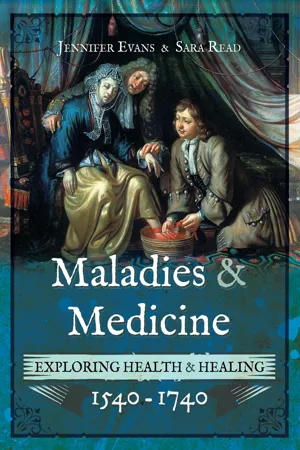
Maladies and Medicine tells the story of how the body was understood before the major advances of modern medicine, covering the theory of the four humors and the ways that male and female bodies were conceptualized. It also explains the hierarchy of healers, from university-trained physicians to the women who traveled the country offering cures based on inherited knowledge of homemade remedies, as well as the print explosion of medical health guides, which began to appear in the sixteenth century, from more academic medical textbooks to cheap almanacs.
In twenty chapters discussing attitudes toward, and explanations of, some of the most common diseases and medical conditions of the period, the book reveals the ways people understood them and the steps they took to get better. It examines the body from head to toe, from migraines to gout. Case studies and personal anecdotes taken from doctors' notes, personal journals, diaries, letters, and even court records show the reactions of individuals to their illnesses and treatments, bringing us into close proximity with people who lived roughly four centuries ago. This richly illustrated study will fascinate those curious about the history of the body and the way our ancestors lived.
- 208 pages
- English
- ePUB (mobile friendly)
- Available on iOS & Android
eBook - ePub
About this book
Information
Topic
MedicinaSubtopic
Historia británicaPart One
HEAD COMPLAINTS
Chapter 1
Migraine and Headache: A Laborious and Dull Sense
‘My head is pounding. It feels like it’ll break into twenty pieces
– William Shakespeare
On 26 January 1653, the Viscountess Anne Conway wrote to her good friend Henry More, discussing a book he had written and wearily recounting that she had ‘been extremely troubled with a violent fit of the headache these 3 or 4 days’. Anne suffered terrible headaches throughout her adult life, which she considered to be a consequence of a fever when she was 12, and sought the help of some of the country’s most eminent physicians including Royal physicians Theodore Turquet de Mayerne, and William Harvey, as well as Robert Boyle and Thomas Willis. At the time of writing this letter she explained that her headaches continued ‘for all that Harvey hath hitherto done to me’.
Henry More thought that Lady Anne was partly to blame for her own suffering because she engaged extensively in study and intellectual endeavours, for which she was well known. He wrote to her in April 1653 to let her know that he had spoken to a new doctor, whom she wished to try on his recommendation, but noted that he thought Dr Ridsley would agree that:
you increase your disease by over much meditation. And for my own part I know it by experience, that intension of thoughts, and anxious considerations of things, will extremely heat a man’s spirits, and call them up into the head. From whence it must needs follow, that those that are liable to the head-ache […] must needs increase that malady, by over much intending their brain.
Lady Anne had apparently already countered this argument by telling More that she refrained from study and intellectual pursuits when she was feeling unwell. Yet her headaches continued.
As her string of physicians and second opinions suggests, Lady Anne tried a succession of remedies including opiates, tobacco, and mercurial treatments, which were nearly fatal. In 1656, forced by desperation and the severity of her pain, Lady Anne travelled to France to undergo trepanation. Again, sadly for her, this brought no relief. Just two years later her symptoms were so severe that both her relatives and her physicians thought she might not survive. Rather than lose her life though, it turned out that Anne was creating life – she was pregnant, although even this bodily change did not alter her sufferings.
In 1665 Lady Anne took a new approach. She made overtures to the healer Valentine Greatrakes, asking – through the Earl of Orrery – for him to come to her home, Ragley Hall in Warwickshire, to treat her. Greatrakes had gained renown for being able to cure people by touch alone. After the Restoration of the monarchy in 1660 he had ‘discovered’ that he had the power to cure the King’s Evil (scrofula – see Chapter 16), a disease which had traditionally been cured by the thaumaturgic divine touch of the monarch – hence the name the King’s Evil. In January 1665 Greatrakes was convinced to leave his native Ireland and travel to Ragley Hall. On his arrival he treated some of her tenants, his successes impressing both her husband and Henry More. Yet despite his fame and initial successes, Greatrakes repeatedly failed to cure Lady Anne’s headaches. Her husband wrote to a friend ‘Mr. Greatrakes hath been here a fortnight tomorrow, and my wife is not the better for him.’
In many ways Lady Anne was lucky, her privileged position and renown gave her access to a range of medical practitioners and headache medicines. But not everyone could afford such help, and for many a lie down was the best hope of getting through a headache. This had awful consequences for one 16-year-old Martha Gilbert. She told the Old Bailey in 1720 that she ‘was much troubled with the Headache’ on 30 September 1719 and so had gone to bed for a lie down ‘about three or four in the afternoon’. While in bed, Thomas Belsenger went upstairs looking for the pot in order to relieve himself. On spying the teenager resting, he forced himself on her. This case was prosecuted at the central criminal court and several women spoke in Martha’s case, but Belsenger successfully argued that the girl had flirted with him before, and with examinations of Martha’s body leading to conflicting medical opinions by a midwife and a surgeon about what had transpired, he was acquitted. In the absence of effective treatments Martha had resorted to rest and relaxation in a bid to ease her head, leaving herself vulnerable.
Understanding Headaches
The surgeon and medical writer Philip Barrough explained in the Practice of Physick that there was a clear distinction between headaches and migraines. There were, he stated, three types of head pain described by Galen: inveterate headaches, or Cephalea in Latin, such as those suffered by Lady Anne, ‘an old pain that hath long continued’; Cephalalgia, a headache, which was ‘nothing else but a laborious and dull sense, and feeling newly begun in the whole head’; and Hemicrania or ‘migrime’. He was careful to note that headaches, of all three kinds, applied to the skull and parts of the head covered in hair, rather than the face, but conceded that sometimes headaches affected the skull, sometimes inside the skull, and sometimes only half of the head.
Barrough explained that while different types of headache might have different causes, they were usually attributed to humoral disruption or an evil quality of the humours. An abundance of humours gathering in the head caused many headaches, or a blockage that stopped the passage of the humours away from the head and brain. Robert Johnson agreed that ‘vapours, and humours, fuming up [from the stomach and other parts] to the Head’ were the predominant cause of headaches. Headaches caused by excess heat or coldness were, he explained, more vehement, while those caused by dryness were more moderate. If these humours were of a biting quality, then the pains would be ‘pricking and shooting’.
As today, headaches were also a known consequence of excessive libations and drunkenness. Levinus Lemnius’s treatise on the Secret Miracles of Nature explained to readers that drinking usually ended in either sleep or vomiting, but that in both scenarios ‘the head will ache the next day’. Drink was thought to cause excess vapours that afflicted the head and the brain. On the 8 February 1660 Samuel Pepys recorded in his diary that having drunk ‘a great deal’ with his ‘old friend Dick Scobell’ he had come home to bed with his head aching.
What does appear to be absent from these descriptions of the causes of headaches is head trauma. But the wider populace did acknowledge that such accidents caused headaches. Poor Pepys noted on 21 July 1663 that his head was aching all day because he had knocked it ‘against a low door in Mr Castle’s house’. This added insult to injury as his head already ached as a result of a restless night’s sleep. Yet others, like Yorkshire gentlewoman Alice Thornton, did not relate head traumas to headaches. She recorded in her autobiography that when she was just 3 years old she had been walking along holding her nurse’s ‘coats’ (skirts) because her nurse was occupied with holding Alice’s infant brother. Being unable to keep up, she wrote, I ‘stumbled against the threshold & fell upon the corner stone of the hearth […] At which time I broke the Skull of my forehead in the very top.’
The injury was serious enough for her to be in ‘great danger of death, being like to have bleed to death’, but Alice noted that her mother’s careful ministrations and remedies allowed her to recover, with only a ‘great Scar’ to remind her of God’s mercy at allowing her to live. Despite the severity of the injury Alice made no mention of any headaches that occurred as a result.
Hats for Headaches
As with most diseases, patients could attempt to cure headaches by rebalancing their humours. At least one writer argued that applying leeches to the temples (or haemorrhoids) to remove or draw excess blood away from the head could ease ‘old and stubborn’ pain. Herbals, and other botanical works, also described several plants that were thought to ease the pain and tension of headaches. Robert Lovell’s 1659 herbal suggested that the juice of the plant houseleek eased headaches, as did chickweed drunk in mead. Another medical text suggested that the herb rue placed up the nostrils or sodden in wine and then eaten, eased headaches by clearing the brain and removing phlegm. Robert Johnson recommended a medicinal white wine, but only ‘For the Rich’, which contained elecampane, rue, sage, vervain, sweet marjoram, aniseed, sweet fennel seed, and orange peel.
A number of medical practitioners, usually unlicensed, also advertised cures through handbills. These single-sheet advertisements generally listed all of the ailments that a physician could cure, or advertised a particular medicine, normally a panacea that worked marvellous and wonderful effects in a range of disorders. One advert, possibly produced in the 1690s, offered the ‘Grand Balsamin’ pill for sale. This, the author assured readers, eradicated all ‘Aches, and Twinging Pains, and other Distempers of the Head’. Likewise, sellers of ‘Saffold’s pills’ noted that they removed ‘Pain in the Head’ and the sellers of the ‘Excellent Universal PILL’ claimed that it cured headaches. It was not always clear in the adverts what ingredients such pills and potions contained, but the effusive language and relative cheapness perhaps made these drugs an attractive option.
Many remedies suggested for headaches and migraines took the form of plasters and hats, which applied medicinal herbs and plants directly to the head. Some of these plasters were relatively simple mixtures of ingredients spread over linen and applied to the forehead. Elizabeth Okeover’s handwritten recipe book, for example, suggested a plaster that was made as follows, ‘take the juice of Betony & vinegar with crumbs of brown bread make it into a plaster & lay to the forehead as hot as it can be endured: pro:’. The final note here, ‘pro’, is an abbreviation for probatum est, the Latin phrase for ‘it has been proved’, which suggests that at some point this remedy was made, used, and was believed to have had a beneficial effect. Thomas Vicary’s Englishman’s Treasure (1641) included a similar remedy, except it recommended red mints and leavened wheat bread mixed with vinegar.
Recipes like this included a variety of ingredients. The book of Mary Chantrell (and others) claimed to have ‘the best thing as ever was for a hot burning headache’ – a ‘pennyworth’ of oil of pompilion (black poplar) rubbed into the temples and crown of the head with warm burdock leaves then placed on the top of the head and the temples. While Mrs Corlyon’s book included a remedy made from a handful of wild daisies mixed with a ‘dozen great earth worms’ and an egg white, this was then spread upon a forehead-sized piece of linen, taking care that it reached the eyebrows and the temples. Alternatively, the book attributed to Sir Thomas Osborne advised taking ox gall with dragon’s blood (the gum or resin derived from the dragon tree), nutmeg and egg white, again applied to the forehead and temples as a plaster.
Lady Ayscough’s recipe book dated to 1692 recommended a slightly more complex procedure, which produced a medicinal cap rather than a plaster:
For the Megrim or giddiness of the Head, Take Betty sweet marjoram rosemary of each one handful dry them to powder put to it white frankincense mastic cloves nutmegs cinnamon of each half a spoonful cast the powder upon the scarlet flocks carded quilt them in taffeta sarc [a garment worn next to the skin like a chemise] next make a cap & wear it.
Johnson also suggested a quilted cap filled with the powder of sweet marjoram, vervain, betony, sage, chamomile flowers, nutmeg, cloves, aloes and galangal, amongst other ingredients. Before application the patient’s head had to be shaved and the scalp rubbed gently to better open the pores. This created a more permeable bodily boundary for the healing ingredients to cross more easily to ensure efficacy.
For those who did not want to sit with a cap on their heads, or who had need of greater mobility (although who is to say these caps couldn’t be worn outside) there were other options. John Locke noted of his travels in France that a man there made silver and iron rings, which people wore to ease their migraines. He claimed that ‘He sells many and therefore […] they may have some effect.’ In Italy there were reports that one Giuseppe Rosaccio sold a ring made from bone, of hippopotamus tooth as it was claimed, which was good for headaches.
Prognosis
As headaches varied in their cause, intensity and duration there were difficulties for healers trying to offer a prognosis. However, one Hippocratic aphorism printed in a collection in 1610 claimed that ‘Those which are in health being suddenly taken with headache and thereupon presently become dumb, and snort, do die within seven days, unless a fever come upon them in the meanwhile’. Robert Johnson repeated this same caution in 1684.
A shedding of watery matter or blood from the nostrils or eyes, Johnson said, signalled a sudden recovery. This was a ‘crisis’ point, looked for in most diseases as a sign that the party was overcoming the illness and so the patient was likely to survive. There was a caveat to this though, that if the pain was violent but suddenly vanished without this shedding of matter, recovery was very doubtful.
Headaches were also a sign that other diseases might be on their way. A headache accompanied by noise in the ears, deafness, or a numbness in the limbs could be a forewarning of apoplexy (a condition characterised by its suddenness and which robbed people of their sense and motion – akin to a palsy or a stroke), or an epileptic fit. A headache in someone prone to a choleric stomach might also be a sign of impending eye problems or foreshadow a loss of sight.
Like a Hole in the Head
One of the treatments Lady Anne Conway experimented with is perhaps one of the most famous medical treatments in the popular mind-set – trepanation. Drilling a hole in the head – using a trepan, or trepanning – is popularly assumed to have been undertaken to allow evil spirits to ‘escape’ through the head. But early modern surgeons were somewhat more pragmatic and used the operation principally in cases of skull fractures. It was not really then, according to medical manuals, of use in headache cases, but clearly some people, Lady Anne included, thought that it might bring some relief.
Drilling into the skull was, obviously, a serious operation. It was therefore important to identify whether it was really necessary. There is evidence that people tried to diagnose skull fractures at home, before seeking the help of a surgeon. The recipe book attributed to Johanna Saint John included a method ‘To know a Fracture or whither the scull be broke’. This involved placing a knotted thread between the patient’s teeth. The tester held the other end taught and then twanged, or ‘twitch[ed]’ the thread ‘as you do the string of a viol when you try if it be in tune’. It was important to twitch the string very vigorously. If the patient could not endure two twitches of the string, but instead felt ‘like a Dagger in his Head’ then it was a sure sign that the skull was fractured. Corroborating signs were a pain when putting the teeth together or chewing meat, and a propensity to vomit.
The trepan was a round saw which cut the bone in a circular motion. They came in a range of sizes to make greater or smaller holes. The image that accompanied Ambroise Paré’s description of these saws reveals that they were rather imposing, with a central pointed tip and a circle of sharp serrated teeth. An English translation of the French text A Complete Body of Chirurgical Operations (1699) explained that using a trepan allowed for splinters and shards of the skull bone to be removed from the brain, could facilitate the movement of depressed parts of the bone back into their original position, and made an opening that allowed medicines to be applied directly to the brain.
The operation was a dangerous one and medical writers discussed at length where on the skull it was safe to drill. One surgeon warned that the thick membrane surrounding the brain adhered very firmly to the coronal (the coronal suture runs across the top of the skull towards the front of the head) and the occipital bone (the bone at the back of the skull) and so these should never be drilled. Likewise readers were warned that the eyebrows were an unsuitable place for the trepan because the cavities beneath made the operation ‘difficult and troublesome’. Establishing a safe place to trepan was only half the story though; surgeons were advised to think long and hard about whether it was best to proceed. Charles Gabriel Le Clerc advised that:
The Surgeon is to have recourse to his own conscientious Discretion, which ought to serve as a Guide, and requires that we should always act according to the known Rules of Art; insomuch that after having well considered the Accidents with all the Circumstances of the Wound, if there be no good grounds for undertaking the Operation, it is expedient to desist.
Preferably a surgeon would seek the advice of a colleague rather than relying on his own judgement alone. Importantly for Le Clerc, this would protect the surgeon and keep them ‘always secure from all manner of Blame’, if something went wrong. Protection for the surgeon and patient was paramount because, as with all surgery, the stakes could be very high.
Sometimes though, the surgeon’s choice was not the one that mattered. The surgeon Richard Wiseman recounted in one of his published observations how he treated a 10-year-old boy who had bruised his head falling from a horse. The accident stunned th...
Table of contents
- Cover
- Title
- Copyright
- Contents
- Acknowledgements
- Introduction
- PART ONE HEAD COMPLAINTS
- PART TWO ABDOMINAL MALADIES
- PART THREE WHOLE BODY AILMENTS
- PART FOUR REPRODUCTIVE MALADIES
- Afterword
- List of Illustrations
- Bibliography
- Plate section
Trusted by 375,005 students
Access to over 1.5 million titles for a fair monthly price.
Study more efficiently using our study tools.
Frequently asked questions
Yes, you can cancel anytime from the Subscription tab in your account settings on the Perlego website. Your subscription will stay active until the end of your current billing period. Learn how to cancel your subscription
No, books cannot be downloaded as external files, such as PDFs, for use outside of Perlego. However, you can download books within the Perlego app for offline reading on mobile or tablet. Learn how to download books offline
Perlego offers two plans: Essential and Complete
- Essential is ideal for learners and professionals who enjoy exploring a wide range of subjects. Access the Essential Library with 800,000+ trusted titles and best-sellers across business, personal growth, and the humanities. Includes unlimited reading time and Standard Read Aloud voice.
- Complete: Perfect for advanced learners and researchers needing full, unrestricted access. Unlock 1.5M+ books across hundreds of subjects, including academic and specialized titles. The Complete Plan also includes advanced features like Premium Read Aloud and Research Assistant.
We are an online textbook subscription service, where you can get access to an entire online library for less than the price of a single book per month. With over 1.5 million books across 990+ topics, we’ve got you covered! Learn about our mission
Look out for the read-aloud symbol on your next book to see if you can listen to it. The read-aloud tool reads text aloud for you, highlighting the text as it is being read. You can pause it, speed it up and slow it down. Learn more about Read Aloud
Yes! You can use the Perlego app on both iOS and Android devices to read anytime, anywhere — even offline. Perfect for commutes or when you’re on the go.
Please note we cannot support devices running on iOS 13 and Android 7 or earlier. Learn more about using the app
Please note we cannot support devices running on iOS 13 and Android 7 or earlier. Learn more about using the app
Yes, you can access Maladies & Medicine by Jennifer Evans,Sara Read in PDF and/or ePUB format, as well as other popular books in Medicina & Historia británica. We have over 1.5 million books available in our catalogue for you to explore.