eBook - ePub
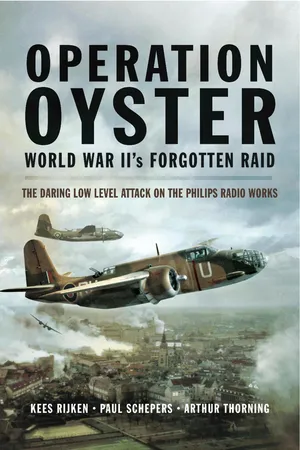
Operation Oyster World War II's Forgotten Raid
The Daring Low Level Attack on the Philips Radio Works
- 227 pages
- English
- ePUB (mobile friendly)
- Available on iOS & Android
eBook - ePub
Operation Oyster World War II's Forgotten Raid
The Daring Low Level Attack on the Philips Radio Works
About this book
Operation Oyster was carried out on the 6th December, 1942 by 2 Group RAF. Considered to be a notable success for the allies, it cost the Germans an estimated six months of lost production time at a critical point in the conflict. It is arguable, according to the authors, that the operation was in fact rather more significant than Operation Chastise, the Dambuster raid, while accepting that was a remarkable feat of arms. Operation Oyster struck at the very heart of what Churchill termed 'the wizard war' against German radio navigational technology by attacking a central hub of activity; the Philips Radio Works in Eindhoven, The Netherlands. The development of electronics in WWII was the most significant technical aspect of weaponry over the course of the conflict. On both sides, there were great advances in radar and communications which, at that time, depended on the wide- scale use of high frequency radio valves few companies had the technology to produce these, but the leading one in Europe was Philips in Eindhoven. Thus it was determined that Philips was the most important target. Ninety-three allied aircraft took part and a total of fourteen were lost. But the result in terms of damages to the enemy was considerable, hindering the German war effort significantly and consequently aiding the allies. Despite these facts however, the story of the raid has been underreported, and the efforts of the aircrew who took part have been little recognized. By comparison, the Dambuster raid which came six months later has entered into folklore. Here, for the first time, the overlooked Oyster raid is afforded the attention it deserves.
Trusted by 375,005 students
Access to over 1.5 million titles for a fair monthly price.
Study more efficiently using our study tools.
Information
Chapter One
Eindhoven and the Philips Company
Eindhoven
Eindhoven, which has its origins in the middle ages, is now a growing industrial centre in the Dutch province of Noord-Brabant and is the fifth largest city of The Netherlands after Amsterdam, Rotterdam, The Hague and Utrecht – it lies in the south of the Netherlands near the Belgian border. In the second half of the nineteenth century the town had about 3,000 residents and covered only 140 acres, but there was already developing industrial activity. Textile, cigar and match factories had developed in the nineteenth century but by 1900 they had been supplanted by the Philips electrical works as the main industry, and later (1928) the vehicle manufacturer van Doorne’s Aanhangwagen Fabrieken started in the city (in 1938 the company started producing lorries and was renamed van Doorne’s Automobiel Fabrieken: DAF). Because of its industrial importance Eindhoven was bombed several times during the Second World War and, so, few historic buildings survived. It was this strategic industrial importance which gave rise to the gallant operation described in this book. Eindhoven has subsequently been redeveloped with a modern urban plan including attractive pedestrian precincts.
Philips
Eindhoven owes its spectacular expansion mainly to Philips which grew from a simple electric light bulb factory – giving rise to the popular reference as ‘The City of Light’ – into an international electronics giant. Philips now makes audio, video and medical equipment, household appliances and all kinds of electronic components (and still bulbs, or rather lighting in general).
In 1891 Gerard Philips set up a light bulb assembly plant on the Emmasingel. The young engineer, Ir Gerard Philips, who had just graduated from the Glasgow College of Science and the University of Delft, bought a 1,200 square metre piece of ground upon which was a factory building measuring eighteen by twenty metres. Within the factory there was a 45bhp steam engine and boiler with matching chimney. It was in this former woollen mill that Gerard Philips started the production of an American invention by Thomas Alva Edison: the electrical incandescent lamp. Setting up such a factory in The Netherlands was at that time very attractive because foreign patents were not recognized. During the first year of its existence the company Philips & Co. manufactured about 11,000 incandescent lamps (a technically more accurate description than ‘light bulb’) with a workforce of thirty employees. At the time electric lamps were mainly sold for the illumination of factories, major shops, government agency buildings and the slowly emerging civic street lighting. Widespread domestic use was to come later but, in spite of this, the new product was very successful. Just four years later the production reached 200,000 incandescent lamps and at the end of the year 1900 (barely nine years after foundation) the lamp factory already had four hundred employees.
The popularity, rapid acceptance and international spread of electric lighting resulted in the explosive growth of the Philips Gloeilampen (incandescent lamp) factory. In parallel to this growth and the increasing number of employees came the need for more housing. The small city of Eindhoven was not prepared for house-building on the necessary scale. Thus the Philips Company took the initiative to study possibilities including consideration of the surrounding villages. This resulted in the company acquiring a leased farm complete with surrounding pastures in 1909. The goal was to build a modern housing complex providing all necessary facilities. This was modelled after the British factory village Port Sunlight (Wirral, Merseyside), following the example of the famous soap-making business Lever Brothers. Consequently a pretty and modern factory village was built in a short time span. In 1923 five surrounding villages were acquired by the city of Eindhoven, among them the village Strijp and the new ‘Philipsdorp’ (Philips village), after which Eindhoven was now officially referred to as Greater Eindhoven.
After the first five difficult years Gerard’s brother Anton (whose statue stands at the railway station) came to his aid, and from then onwards the business took off in a big way. The factory began making radio valves, X-ray tubes and medical equipment, exporting across Europe. In 1914 Gerard set up the natural sciences laboratory Natlab, which has since been responsible for many important new technologies, including the video recorder and the Compact Disc (CD). Later, in collaboration with DAF, Philips established a Technical College, now Eindhoven Technical University.
By 1929 Philips had 20,000 employees and provided jobs for 70 per cent of the local workforce. It opened new factories and offices on the Emmasingel and Mathildelaan, with names like De Witte Dame (The White Lady), De Bruine Heer (The Brown Man) (remark: the name De Bruine Heer was never an official name for this building, and has never been associated as such by citizens of Eindhoven. It seems that the name originated from recent project development to give each large building in Eindhoven an official name) and De Lichttoren (The Lighthouse). Philips provided medical care for its employees, as well as transportation to and from their work. The company also set up its own sports club, Philips Sport Vereniging, whose football club (PSV Eindhoven) is one of the country’s best known.
The close ties between Philips and Eindhoven were reduced when the company moved its headquarters to Amsterdam in 1998. New uses were sought for many of its buildings. However, the small light bulb factory where it all began is now open to the public as a museum.
The Netherlands, Philips and the War
It is worth putting the situation in The Netherlands in 1942 into perspective, as a background to this book. Officially the country is the Kingdom of The Netherlands although it is often conveniently, but incorrectly, called Holland. Strictly, North and South Holland are two provinces in the northwest part of the kingdom, but Dutch people themselves, especially in those provinces, often use Holland for the whole country. The reason behind this originates from the era of the Dutch Vereenigde Oost-Indische Compagnie (VOC, United East Indies Company) sailing ships. These ships departed from the province of Holland, and since they travelled all across the globe the name of Holland has stuck ever since. The sailors introduced themselves as coming from Holland rather than from The Netherlands. To add to the confusion, the whole region of mostly low-lying country including Belgium and Luxembourg has traditionally been known as the ‘Low Countries’, which is another way of saying the ‘Netherlands’. The Low Countries are situated within the delta of the Rijn/Rhine, Maas/Meuse and Schelde/Sheldt rivers, and much of the land is below sea level.
Before the German invasion in 1940 The Netherlands had maintained its neutrality for over a century and was one of the most prosperous countries in the world. The expectation of life was among the longest and the average real income per head was among the highest in Europe; indeed The Netherlands was one of the few countries able to lend money abroad. With a population of about eight and a half million it was one of the most densely populated in Europe. The Dutch were, and still are, one of the most highly educated peoples in the world. As a small nation surrounded by larger ones they are among the best linguists, in the sense that a large proportion of them read, speak and write foreign languages. They regard their universities and other institutions of higher education with well-founded pride – the Philips Company made a notable contribution in the technical field.
At dawn on 10 May 1940 the Germans invaded The Netherlands, Belgium, Luxembourg and France by land and air. The Dutch resisted bravely but they were overcome by the large and well-equipped German Army. Eventually, after the bombardment of Rotterdam, the main Dutch forces had no choice but to surrender. Queen Wilhelmina and her Government evacuated to London from where they could direct the war effort of the Dutch Navy and free Dutchmen around the world.
At first the German occupation offered a pretence of mildness, but from the beginning the press was controlled and there were widespread requisitions of goods and property. The Dutch people may never have had much love for the Germans but soon they began to hate them. Some bold spirits organized resistance and executions began. Thus the Dutch people were encouraged when they saw British aircraft on their way to attack their mutual enemy, even if they sometimes caused harm to their country – they still hold the sacrifices of Allied airmen over their country close to their hearts and hold remembrance services each May on their Liberation Day, in Eindhoven and many other places.
At the outbreak of the Second World War the original Philips lamp factory had grown as ‘Philips Electronics’ into one of the leading electronic factories in the world with 22,000 employees. Philips meanwhile had establishments in a large number of countries worldwide.
During the German occupation the Philips factories in the Netherlands were forced to contribute to the German war industry, ample reason for the Allies to eliminate the factories as soon as possible. Accordingly the Germans established an extensive network of searchlights and anti-aircraft batteries surrounding the factory buildings. For the inhabitants of Philipsdorp, directly adjacent to the factories, this meant that during the war they had to live with continual fear that sooner or later the Philips factories would become a bombing target. To take the best possible care for its employees and the people living in the Philipsdorp, shelters were constructed and pupils of the schools within the Philipsdorp were sent to classes in – it was hoped – less dangerous areas of the city.
Chapter Two
Choice of Target
Main Targets in Occupied Countries
The sixty-first meeting of the Bomb Targets Information Committee, held at the Air Ministry in London on 9 April 1942, requested that consideration should be given to the selection of a limited number of objectives of outstanding importance in enemy occupied countries. Accordingly a memorandum, with the above title, was prepared. (National Archives AIR40/232 – note that this document is quoted as written, with Holland instead of The Netherlands and Stryp compared with the Dutch spelling Strijp.)
Information with regard to the economic and industrial importance of various objectives was compiled in collaboration with the Ministry of Economic Warfare, who suggested eight possible targets as the most important in occupied countries within reach of the RAF. The eight targets were:
NORWAY – Aluminium, magnesium, nitrates and fertiliser plants at Heroya, approximately 600 miles from the RAF bases.
DENMARK – Shipyards and diesel engine works near Copenhagen, some 550 miles from base.
HOLLAND – two targets:
Rotterdam, port area and shipyards, 170 miles from base.
Eindhoven, Philips wireless valve and radio works, 230 miles from base
BELGIUM – four targets:
Liège, heavy engineering works, blast furnaces and chemical plants, 240 miles.
Tertre, coke ovens, chemical plants, 190 miles.
Gent-Terneuzen Canal and adjacent works, 160 miles
Antwerp, Ford and General Motors plants, 190 miles.
The memorandum concluded that only the two Dutch targets compared in economic importance with targets of the first priority in Germany.
Given the increasing importance of electronics in the development of communications and weapon systems, especially radar, it is understandable that plans were put in train for an attack on the Philips factories at Eindhoven. An appendix to the memorandum gave more details of the two Philips works, namely:
The STRYP (Northern) block of factories, the larger of the two, making all types of material for lamp and valve manufacture (as well as wireless sets) and includes some experimental laboratories.
The EMMASINGEL (Southern) block of factories, smaller and some 500 metres from STRYP, comprises the lamp and valve manufacturing plant, rare gases department, offices etc.
The memorandum continued:

The Strijp Complex from the air in 1934. (Aviodrome Ref 13377)

The Emmasingel site in 1939. The ‘Light Tower’, at the extreme left of the photograph, is still a prominent feature in Eindhoven with the 2011 Memorial adjacent. In 1942 the tower had a flak battery on top. (Aviodrome Ref 2055)
Since the occupation the Dutch plants have been under German management and in view of the large demand for radio valves and of the fact the less important valve factories in France are known to be working to capacity on German orders, the Germans are doubtless utilising the extensive production facilities of the EINDHOVEN factories. The EINDHOVEN Works produce components for other smaller factories at HILVERSUM and DORDRECHT.
The EINDHOVEN WORKS are in close proximity to the town of EINDHOVEN and the bombing of this target would inevitably be attended with considerable risk of casualties to the civilian population unless some prior steps are taken to avoid this. The Works are not situated adjacent to any particular landmark such as water, but the size of the Works should render them reasonably easily distinguishable.
The most vital part of the Works [is] in the EMMASINGEL BLOCK which should prove very vulnerable to bombing owing to the special natures and extreme delicacy of the plant.

Frits Philips statue in Eindhoven city centre. (Arthur Thorning)
This appreciation, written in London, was necessarily based on a combination of pre-war information and rather limited current intelligence. In his book 45 jaar met Philips Frits Philips, the Director General of the Phili...
Table of contents
- Front Cover
- Dedication
- Title Page
- Copyright Page
- Contents
- Maps
- Introduction: Eyewitness Accounts and Acknowledgements
- Chapter 1: Eindhoven and the Philips Company
- Chapter 2: Choice of Target
- Chapter 3: Forces Available for the Attack
- Chapter 4: Planning and Training for the Raid
- Chapter 5: The Raid
- Chapter 6: Success Achieved
- Chapter 7: The Cost to Philips and Eindhoven
- Chapter 8: Aftermath and Hindsight
- Chapter 9: Monument: Memorial in Eindhoven
- Chapter 10: Postscript: Comments on Appendices
- Appendix I: No. 2 Group Operation Order 82
- Appendix II: Low level navigation to Eindhoven
- Appendix III: Operation Oyster Evaluation
- Appendix IV: American Diversionary Raid
- Appendix V: RAF Casualties
- Appendix VI: Civilians Killed
- Appendix VII: German Soldiers Killed
- Appendix VIII: Philips Fire Service Report
- Glossary
- Bibliography
- Notes
Frequently asked questions
Yes, you can cancel anytime from the Subscription tab in your account settings on the Perlego website. Your subscription will stay active until the end of your current billing period. Learn how to cancel your subscription
No, books cannot be downloaded as external files, such as PDFs, for use outside of Perlego. However, you can download books within the Perlego app for offline reading on mobile or tablet. Learn how to download books offline
Perlego offers two plans: Essential and Complete
- Essential is ideal for learners and professionals who enjoy exploring a wide range of subjects. Access the Essential Library with 800,000+ trusted titles and best-sellers across business, personal growth, and the humanities. Includes unlimited reading time and Standard Read Aloud voice.
- Complete: Perfect for advanced learners and researchers needing full, unrestricted access. Unlock 1.5M+ books across hundreds of subjects, including academic and specialized titles. The Complete Plan also includes advanced features like Premium Read Aloud and Research Assistant.
We are an online textbook subscription service, where you can get access to an entire online library for less than the price of a single book per month. With over 1.5 million books across 990+ topics, we’ve got you covered! Learn about our mission
Look out for the read-aloud symbol on your next book to see if you can listen to it. The read-aloud tool reads text aloud for you, highlighting the text as it is being read. You can pause it, speed it up and slow it down. Learn more about Read Aloud
Yes! You can use the Perlego app on both iOS and Android devices to read anytime, anywhere — even offline. Perfect for commutes or when you’re on the go.
Please note we cannot support devices running on iOS 13 and Android 7 or earlier. Learn more about using the app
Please note we cannot support devices running on iOS 13 and Android 7 or earlier. Learn more about using the app
Yes, you can access Operation Oyster World War II's Forgotten Raid by Kees Rijken,Paul Schepers,Arthur G. Thorning in PDF and/or ePUB format, as well as other popular books in History & Military & Maritime History. We have over 1.5 million books available in our catalogue for you to explore.