- 224 pages
- English
- ePUB (mobile friendly)
- Available on iOS & Android
eBook - ePub
About this book
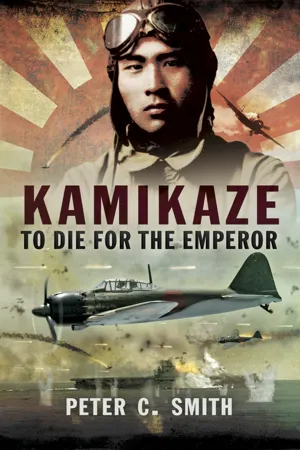
In this brand new publication from eminent historian Peter C. Smith, we are regaled with the engaging and often incredibly disturbing history of the Kamikaze tradition in Japanese culture. Tracing its history right back to the original Divine Wind (major natural typhoons) that saved Japan from invaders in ancient history, Smith explores the subsequent resurrection of the cult of the warrior in the late nineteenth century. He then follows this tradition through into the Second World War, describing the many Kamikaze suicide attacks carried out by the Emperor's pilots against Allied naval vessels in the closing stages of the Pacific campaign.These pilots were at the mercy of an overriding cultural tradition that demanded death over defeat, capture or perceived shame. Despite often being under-trained and ill-prepared psychologically for the sacrifices they were about to make, they were nonetheless expected to make them. The dedication of sacrifice for the Emperor and the Nation is explored by dissecting the traces left behind by these pilots. Smith provides a detailed look at the heartbreak of the pilot's families and the men themselves, the notes they left and the effects on those who did not share their philosophy. The views of individuals under attack are also included in this balanced history.Countless attacks carried out over the Philippine Islands (including the sinking of the St Lo) are analyzed and the Okinawa campaign is afforded particularly strong coverage, with the sinking of HMAS Australia explored in detail. The collective sacrifice is then summed up, with reflections from survivors on both sides appraising events in a humane historical context. A detailed appendices then follows, featuring units formed, sorties mounted, ships sunk and damages inflicted.
Information
Chapter One
The Spirit of Bushido?
‘In the tradition of the Bushido he spoke of the glory of death, saying, I go to die for my country, it fills me with humility to have been selected by the Emperor’
Kuwahara, Rear-Admiral Torao, IJN,
Commander Third Carrier Division.
Commander Third Carrier Division.
In the October of 1944, just three years after the opening of the Pacific War with the attack on the US Fleet at Pearl Harbor, Japan was facing a bleak prospect. Whereas in the opening six months of the conflict the Navy and Army of the Chrysanthemum Empire had swept all before it, humbling the western powers, the United States, Great Britain and the Netherlands with ease in a succession of easy victories, now these victories were but distant memories. The speed and completeness of Japan’s initial assault had been dazzling; they had reduced the US Navy’s battle line in one blow, taken the Philippines, Wake and Guam, and similarly humiliated the British Empire by rapidly sinking the capital ships Prince of Wales and Repulse with disdainful ease before conquering Hong Kong, Borneo, Malaya, Singapore and Burma, and had threatened India and raided Ceylon [Sri Lanka], and sortied across the Indian Ocean to Vichy-French ruled Madagascar, having already secured the cooperation of that same nation’s colonies in Indo-China. They had destroyed all the hastily assembled American, British and Dutch naval squadrons, occupied the oil-rich Dutch East Indies, Sumatra, Java and the Celebes, invaded New Guinea and threatened Australia.
This tidal wave of easy victories had made Japan’s armed forces appear invulnerable, but they were not. That illusion was first shattered by the air/sea Battle of Midway in June 1942 which had marked a turning point in Japan’s fortunes1, and the grinding attrition of the Guadalcanal and Solomon Islands campaign revealed the fragility that lay behind the cutting edge blade that was the Imperial Japanese Navy. For the truth was that, although led by an unequalled martial elite, and with the backing of an indoctrinated nation of one hundred million people dedicated to their Emperor and expanding Empire, which in recent times had known only victory and never defeat, Japan was not able to compete with the industrial might of the United States of America, whose capacity for innovation, invention and mass-production was unequalled and overwhelming.
The oft-quoted remarks of Admiral Isoroku Yamamoto, Imperial Japanese Navy (IJN), that he would guarantee six months of victory but that beyond that time could guarantee nothing were not isolated comments. In their heart-of-hearts most knowledgeable Japanese knew they ultimately could not win. That dour warrior Admiral Chūichi Nagumo, IJN, the man who led the Carrier Task Force that represented the best of Japanese naval power, but which was destroyed in a few moments of carelessness at Midway, was himself to state: ‘It is agreed that if we do not fight now, our nation will perish. But it may well perish even if we do fight. In this hopeless situation, survival can be accomplished only by fighting to the last man. Then, even if we lose, posterity will have the heritage of our loyal spirit to inspire them in turn to the defence of our country. We will fight to the last drop of blood.’2
Forced into a war that most did not want as the only alternative to a humiliating acceptance of American and British sanctions of essential oil and material supplies,3 Japan did indeed choose war rather than bend the knee, and their astonishingly easy early victories only fed the illusion, almost universally accepted after decades of indoctrination, that they were a chosen people and that divine intervention would somehow aid their admitted expertise, and compensate for their lack of industrial power on the scale that the United States was capable of. It was wistful thinking, and doomed to failure, but few proud nations would have accepted the alternative.
Now had come the reckoning. A strange lack of resolution had taken hold of the Japanese Navy in the period 1942–43. Having won their greatest victory over a foreign power at the Battle of Tşushima in 1905, and having been frozen at 60% of the strength of the British and American navies since the American stage-managed Washington Naval Conference of 1921, the Japanese naval high command had been fixated on the concept of ‘one final battle’ – a colossal once-and-for-all make-or-break naval battle (as Tşushima had been and Jutland ought to have been) that would decide the nation’s fate. This policy led to a determination to husband their naval strength for this one decisive moment. Thus later victories like Savo Island in August 1942 were not pressed home. The United States was in the process of building an awesome ‘Two-Ocean’ Fleet, a Navy that would equal that of all the other navies of the world, including the next two largest, Britain and Japan, combined. When that fleet entered service nothing would prevail against it. If the Japanese hope of a major fleet action in which the US Navy was so defeated that her people would become war-weary and sue for peace were to be achieved, then it had to be done in the period 1942–43 at the latest. After that Japan would be swamped. But the nettle had not been grasped and as the Allies took the offensive, all the Pacific outposts had been re-conquered steadily and at great cost, but remorselessly. As islands steadily fell it was the IJN that was whittled down, ship-by-ship, plane-by-plane, while American power waxed mightily. Finally, with the outer bastion of the Marianas threatened, the air-sea battle of the Philippine Sea had been fought, and in the space of two days what remained of Japanese naval air power afloat had been utterly smashed. Not for nothing was that battle known as the Great Marianas Turkey Shoot – ten Japanese planes were lost for every American. Her carrier fleet, essentially carriers without aircraft, (which are themselves merely larger, expensive and vulnerable targets) was from then on reduced to the role of ‘live bait’, lures to draw away American air power while what remained of her battleship strength finally fought that long-awaited showdown battle. But it was all too late. At the Battle of Leyte Gulf, what had happened to Japanese naval air power at the Marianas re-occurred with her surface fleet – it was utterly beaten, many battleships and heavy cruisers that had been husbanded for years were sunk and crippled, and only a few managed to escape the debacle. Japan as a naval power was done.
And yet even as finis was being writ large in the waters of the Philippines, an event occurred that took the victorious Americans totally by surprise. What battleships had failed to achieve off Samar, a few single-engined fighter aircraft with bombs attached carried out the sinking of American carriers. The planes were frail and fragile, but their pilots were dedicated to giving their lives to achieve such results. They were volunteers choosing to die by crashing their aircraft on Allied ships. They were the Kamikazes. So successful were they deemed to have been, when the chances of conventional air attacks achieving similar results were almost zero, that this method of attack soon grew from a handful of volunteers to whole units adopting this course. And soon it was not just volunteers but whole units that were being ‘volunteered’ by shame, order or cohesion. Rapidly this ‘unthinkable’ method of warfare grew to be Japan’s guiding principal and sole beacon of hope that somehow defeat could be staved off by self-sacrifice.
Earlier precedents
Japan’s fighting forces had long had a reputation of fighting almost to the last man with the Banzai charge ending many a hopeless struggle from Guadalcanal onward. In the air specifically, there were many precedents in the form of pilots deliberately crashing their aircraft into enemy warships. Let us cite a few:
Off the coast of the Island of Luzon, an invasion convoy had been reported and an American heavy bomber was despatched from Clark Field to deal with it. Arriving over the target at 22,000 feet it dropped three 600lb bombs. Two were near misses while one, ‘went right down the stack bringing their target ship, an enemy battleship, to a halt on fire and with oil spilling out of her hull’. This was electrifying news and the official Air Force Command issued the following day confirmed that a, ‘29,000–ton battleship’ had been sunk. Furthermore the heroic pilot had deliberately smashed his heavy bomber into the ship to achieve this great feat. The press back home in the States took the story and made headlines of it. The pilot was a national hero and the fact that he sacrificed his life for his nation was accorded a mark of respect and honour.
The date was 9 December 1941, the battleship claimed sunk was the Haruna (Captain Takama Tomotsu, IJN), the pilot made a national hero was Lieutenant Colin Kelly, United States Army Air Force! Despite the official hype it was all a complete fabrication. The Japanese invasion convoy attacked had no battleship escorts, just one very small light cruiser, the Nagara (Captain Naoi Toshio, IJN). Far from being bombed, crashed into and sunk, she was not even scratched – while the Haruna, which was 1,500 miles away in the Gulf of Siam (and would be claimed ‘sunk’ by the USAAF many more times during the war), survived in fact until July 1945 and the very last days of the conflict. It was all totally untrue.
A certain Lieutenant Sam Marret, piloting a P-35 fighter plane earlier that same day, made a heroic attack against a Japanese transport and was killed when his target ship exploded. Again, reports released indicated that he had deliberately smashed his aircraft into the transport ship, thus sacrificing himself. Again it was all a myth and totally untrue, but back home in the States the press merged the two stories and an unstoppable legend was begun. It was not that the story was so distorted as to be farcical, that is not the point, which is, that these ‘suicide’ missions were regarded, when carried out by American pilots, as gallant sacrifices.
We can quote other examples; the United States Marine Corps pilot Captain Richard E Fleming, USMC, at the Battle of Midway, is alleged to have crashed his aircraft into the heavy cruiser Mikuma (Captain Shakao Sakiyama, IJN). Again this did not happen; he was shot down into the sea and no plane, either deliberately, or accidently, dove into Mikuma. However, that did not stop yet another legend, one that endures to this day. Fleming, like Kelly and Marret, were very brave men and did not commit suicide, but the American press and public thought all the more of them when they believed that they had made suicide attacks!
A rather different portrait was painted when Japanese pilots chose to crash their damaged aircraft into Allied ships. Taking as an example, the much-publicised photograph of the carrier Shokaku’s flight leader, Lieutenant (jg) Mamoru Seki, deliberately crashing his Val dive-bomber into the signal bridge of the carrier Hornet, comments were far from favourable, ‘fiercely determined’ was the least offensive.
A final example of the ‘non-Kamikaze’ or Jibaku, a spontaneous and individual suicide attack, can be cited. This time the unit involved was an Army Air Force one, and this is important as the general impression given is that all Japanese aerial suicide attacks were conducted by Navy pilots alone. This was far from the case and over 40% of Kamikaze attackers between October 1944 and the end of the war were carried out by Army pilots.
On 27 May the Allies made a surprise landing at Biak, one of the Schouten Islands off north-west New Guinea (Operation Globetrotter), where the Japanese had a strategic airfield, with 6th Division, US Army, being put ashore supported by US Navy Task Force 77. Ashore the Japanese Army had few aircraft available for defence, but those they had, four Kawasaki Ki-45 Toryu (Dragon Slayer, codenamed Nick) Type 2 twin-engined fighter aircraft armed with light 110lb bombs, under the command of Major Katsuhige Takada, IJA, Commander of 5th Hiko Sentai, immediately took off from Muni and made attacks on the ships offshore. Although a gallant effort, none of the four survived. Takada was reported in official Japanese reports as having attacked a cruiser and then a destroyer, and died in a suicide attack. The Japanese post-war account states that Takada, ‘fearlessly crashed into an enemy warship in a ‘suicide’ attack. This was the first of the Tokkou attacks.’4 Most American sources are totally dismissive of this claim although Professor S. E. Morison wrote in his multi-volume history5 that the object of Takada’s suicide dive was the destroyer Sampson (DD-394, Commander Thomas Martin Fleck, USN), ‘The Japanese pilot made a deliberate effort to suicide crash Sampson; but anti-aircraft fire clipped off part of the wing, and the plane passed over the bridge and struck the water 400 yards beyond.’ The crash damaged the nearby submarine chaser SC-699 which had to be towed away with casualties. Takada’s crewman, Sergeant-Major Motomiya, apparently survived the crash.
The difference between being hit by a Japanese suicide aircraft before the ‘official’ date of 21 October 1944, and after it, might, to most of us, seem rather academic! Others deem that 25 October was the real ‘official’ start date of the Kamikaze campaign. Certainly the crews of such ships might consider that armchair warriors who insist on what they deem to be a vital difference of a few days, or even a few hours, being of paramount importance, is rather bizarre. However, the crew of one ship that was struck by a suicide aircraft on exactly that first date, but unfortunately early in the morning and not at the ‘official’ time of later that same afternoon, felt rather bemused by the whole debate. Especially as Japanese sources do not agree.
On 13 October 1944 Rear Admiral Masafumi Arima, IJN, a noted a...
Table of contents
- Cover
- Title Page
- Copyright
- Contents
- Foreword & Acknowledgements
- Chapter 1: The Spirit of Bushido?
- Chapter 2: The Kamikazes Make their Mark
- Chapter 3: The Rising Tide
- Chapter 4: A Mauling at Mindoro
- Chapter 5: Taking Stock
- Chapter 6: Trapped Below Decks
- Chapter 7: The Tan 2 Operation
- Chapter 8: Okinawa the First Phase
- Chapter 9: Okinawa the Second Phase
- Chapter 10: Two Notable Radar Picket Actions
- Chapter 11: Okinawa – Fight to the Finish
- Chapter 12: On To Japan?
- Chapter 13: Reflections and Reactions
- Chapter 14: Learning the Lessons
- Appendix 1: Statistics and Estimates
- Appendix 2: Glossary
- Appendix 3: The Aircraft
- Appendix 4: A Conversion of Selected Measurements Aide
Trusted by 375,005 students
Access to over 1.5 million titles for a fair monthly price.
Study more efficiently using our study tools.
Frequently asked questions
Yes, you can cancel anytime from the Subscription tab in your account settings on the Perlego website. Your subscription will stay active until the end of your current billing period. Learn how to cancel your subscription
No, books cannot be downloaded as external files, such as PDFs, for use outside of Perlego. However, you can download books within the Perlego app for offline reading on mobile or tablet. Learn how to download books offline
Perlego offers two plans: Essential and Complete
- Essential is ideal for learners and professionals who enjoy exploring a wide range of subjects. Access the Essential Library with 800,000+ trusted titles and best-sellers across business, personal growth, and the humanities. Includes unlimited reading time and Standard Read Aloud voice.
- Complete: Perfect for advanced learners and researchers needing full, unrestricted access. Unlock 1.5M+ books across hundreds of subjects, including academic and specialized titles. The Complete Plan also includes advanced features like Premium Read Aloud and Research Assistant.
We are an online textbook subscription service, where you can get access to an entire online library for less than the price of a single book per month. With over 1.5 million books across 990+ topics, we’ve got you covered! Learn about our mission
Look out for the read-aloud symbol on your next book to see if you can listen to it. The read-aloud tool reads text aloud for you, highlighting the text as it is being read. You can pause it, speed it up and slow it down. Learn more about Read Aloud
Yes! You can use the Perlego app on both iOS and Android devices to read anytime, anywhere — even offline. Perfect for commutes or when you’re on the go.
Please note we cannot support devices running on iOS 13 and Android 7 or earlier. Learn more about using the app
Please note we cannot support devices running on iOS 13 and Android 7 or earlier. Learn more about using the app
Yes, you can access Kamikaze by Peter C. Smith in PDF and/or ePUB format, as well as other popular books in History & Asian History. We have over 1.5 million books available in our catalogue for you to explore.