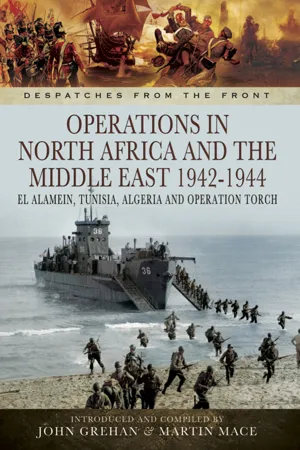
eBook - ePub
Operations in North Africa and the Middle East, 1942–1944
El Alamein, Tunisia, Algeria and Operation Torch
- 264 pages
- English
- ePUB (mobile friendly)
- Available on iOS & Android
eBook - ePub
Operations in North Africa and the Middle East, 1942–1944
El Alamein, Tunisia, Algeria and Operation Torch
About this book
Despatches in this volume include the despatch fo the campaign from Alamein to Tunis, by Field Marshal the Viscount Alexander of Tunis. Deputy Commander-in-Chief Allied Forces North Africa; despatch on operation in the Western Desert December 1940 to February 1941, by General Sir Archibald P. Wavell, Commander-in-Chief British land Forces, Middle East; despatch on Operation Torch, the landings in North Africa, by Admiral of the Fleet Sir Andrew B. Cunningham; and the despatch in operations in North Africa November 1942 to May 1943, by Lieutenant-General K.A.N. Anderson, General Officer Commander-in-Chief, 1st Army. This unique collection of original documents will provide to be an inevitable resource for historians, students and all those interested in what was one of the most significant periods in British Military history.
Information
1
FIELD MARSHAL VISCOUNT ALEXANDER OF TUNIS’ DESPATCH ON THE AFRICAN CAMPAIGN FROM EL ALAMEIN TO TUNIS, 10 AUGUST 1942 TO 13 MAY 1943
The following Despatch was submitted to the Secretary of State for War on the 23rd May, 1947, by HIS EXCELLENCY FIELD-MARSHAL THE VISCOUNT ALEXANDER OF TUNIS, K.G., G.C.B., G.C.M.G., C.S.I., D.S.O., M.C., former Commander-in-Chief the Middle East Forces and Eighteenth Army Group.
PART I. THE CONQUEST OF LIBYA
Situation in August 1942
The summer months of 1942 formed the most critical period in the history of the war on all fronts. They witnessed the greatest exertion of strength, both on the part of the European Axis powers and of the Japanese, of which our enemies were ever capable and when these great efforts were nullified by the Allied victories of that winter, although it was clear that the struggle would be hard and long before complete victory could be attained, we could feel confident that the possibility of an Allied defeat had now been excluded. It was a tremendous change in the whole climate of the war from the days when the Japanese were hammering at the eastern gates of India, the German armies in Russia were lapping round the northern bulwarks of the Caucasus and a tired and battered British army turned at bay among the sandhills of El Alamein, only sixty miles from Alexandria.
At the centre of these three thrusts stood the British Middle East Forces. For over two years this small but battle-hardened army had stood on guard at the centre of communications of the three great continents of Europe, Africa and Asia. It was originally intended as part only of a larger Anglo-French force, under command of General Weygand; but with the defeat of France and the entry of Italy into the war the defence of the Middle East had become a purely British responsibility and the forces commanded by General Wavell1 and, later, by General Auchinleck,2 were in the nature of a beleaguered garrison, connected with the mother country by a perilous sea route of twelve thousand miles. During those two years the garrison, though always outnumbered, had made many sorties; northwards to clear up their defensive flank in Syria, Iraq and Persia, southwards to overrun the Italian Empire in East Africa and safeguard the vital life-line through the Red Sea and, above all, westwards to destroy the closest enemy threat to their positions and to lay the first foundations for the reopening of the Mediterranean. Twice these westward sorties had cleared Cyrenaica and twice the call of other theatres, the Balkans in 1941, and the Far East in early 1942, had robbed us of the strength to exploit further or to retain our conquests. On the second occasion the simultaneous reduction in our strength and increase in the enemy’s had been too great and before the necessary reinforcements in men and, above all, in tanks could arrive the enemy had taken the offensive, defeated the Eighth Army at Gazala and Tobruk and driven it back to El Alamein. There it stood and, on the critical day of 2nd July, defeated the enemy’s most desperate efforts to break through. By this stand the survivors of the old Desert Army gained the vital time necessary for the arrival of the fresh divisions and improved tanks which were to turn the scale of battle.
I arrived in Cairo by air on 8th August, 1942 and on the morning of the same day I had a private interview with the Prime Minister, Mr. Winston Churchill, and General Sir Alan Brooke,3 Chief of the Imperial General Staff who had arrived there from Moscow some days previously. At this interview I was notified that I was to assume command of the Middle East Forces. Shortly afterwards I was informed that my commitments were to be reduced by the creation of a separate command, to be known as Persia and Iraq Force, which would assume responsibility for defending the northern frontier of the Middle East block against the threat from the German armies in the Caucasus. I remained responsible for the defence of Syria, Palestine, Trans-Jordan and Cyprus but the threat of a German advance through Anatolia was now considered remote and it was reasonably certain, at the worst, that Germany would not present an ultimatum to Turkey before the spring of 1943. I was free, therefore, to concentrate all my attention on the threat to Egypt from the west and my task is best described in the words of the Directive, written in his own hand, which the Prime Minister handed to me at a subsequent interview on 10th August:
“1. Your prime and main duty will be to take or destroy at the earliest opportunity the German-Italian Army commanded by Field-Marshal Rommel together with all its supplies and establishments in Egypt and Libya.
2. You will discharge or cause to be discharged such other duties as pertain to your Command without prejudice to the task described in paragraph 1, which must be considered paramount in His Majesty’s interests.”
I assumed command of the Middle East Forces from General Auchinleck on 15th August. I selected as my Chief of General Staff Lieut.-General McCreery who had been my GSO 1 when I commanded 1 Division at Aldershot and in France in 1939 and 1940. His scientific grasp of the whole sphere of military matters made him of the greatest assistance to me throughout my period of command in Africa. My General Headquarters continued to be located in Cairo, but I established an advanced Tactical Headquarters at Burg el Arab,4 adjoining the Headquarters of the Eighth Army. My predecessor had, as a temporary measure, assumed personal command of Eighth Army but it was intended that he should be succeeded in that capacity by Lieut.-General Gott, previously General Officer Commanding 13 Corps. Before he could assume command the aircraft in which he was flying to Cairo was shot down by enemy fighters over its airfield and he was killed by machine-gun fire on the ground while assisting the rescue of the other occupants. General Gott had been in every battle in the desert since the beginning; he had commanded 7 Support Group in the first campaign, 7 Armoured Division in 1941 and 13 Corps since February, 1942. It was particularly tragic that, having survived the early days of triumph and disaster when skill and endurance alone could be thrown into the balance against the inadequacy of our resources he should now be robbed of the chance of the high command he had so well deserved at a moment when the balance of power had at last swung favourably to our side. I was fortunate in being able to replace him at once by Lieut.-General Montgomery,5 who arrived in Egypt on 12th August from the United Kingdom. General Montgomery was an old comrade in arms from the French campaign and, had served under me in Southern Command in 1941; I well knew his capacities as an inspiring leader and an outstanding trainer of men. He soon won the confidence and the affection of the men of the Eighth Army, many of whom, in particular the newly arrived formations, had already served under him in England. He rapidly made himself familiar with the situation in the desert, and by his frequent visits to the various units disposed along the battle front he brought to all ranks the inspiration of his cheerfulness, enthusiasm and confidence.
The Alamein position had been constructed in 1941 though it had been recognized long before that as offering the best defensive line in the Western Desert. Its strength lay in the fact that its southern flank could be covered by the Qattara Depression. This is the dried-up bed of a former inland sea which stretches from the neighbourhood of Siwa oasis, on the Egyptian frontier, to end at a point about a hundred and sixty miles northwest of Cairo and ninety miles south-west of Alexandria; the bed of the depression consists of quicksands and salt marshes, almost everywhere impassable even for a loaded camel, and on the northern side it is surrounded by steep cliffs which descend precipitously from an average height of over six hundred feet above to more than two hundred feet below sea level. At its eastern end the depression approaches to within about forty miles of the coast of the Mediterranean which here has a southerly trend in the large bight known as Arabs Gulf.
This was, for the desert, a very short line and it had the enormous advantage that it could not be outflanked to the south which was true of no other position we had ever held.6 The prepared defences, which had been constructed by 2 South African Division, were based on four defended localities: at El Alamein itself on the coast road, Deir el Shein, Qaret el Abd and the Taqa Plateau on the edge of the Depression.7 These four strong positions, thickly surrounded by minefields and wire entanglements, with prepared gun positions and cleared fields of fire, extended right across the belt of good going from the Mediterranean to the Depression; but when I arrived in Egypt only one was still in our possession, the so called Alamein “box”. The last success of the German drive into Egypt, on 1st July, had been the capture of the Deir el Shein position. The loss of this position had opened a great gap in the line as planned. It seriously isolated the much stronger fortress of Qaret el Abd, held by the New Zealand Division, and the latter had therefore to be abandoned; as a result the position on the Taqa plateau had also to be evacuated, largely owing to the fact that there was no source of water within the position and even a temporary isolation would have meant inevitable surrender from thirst.
The line, therefore, on which the enemy was finally halted was not the Alamein line as it originally existed; only in the extreme north did we occupy the prepared defences. More serious to all appearance was the fact that our left flank no longer rested on the Depression; instead it had been taken back to a point just northwest of Qaret el Himeimat, a conspicuous peak from the neighbourhood of which a track, known as the “Barrel Track”, led direct to Cairo. This track had been reconnoitred before the outbreak of hostilities in the desert and, before the construction of the desert road from Cairo to Alexandria, it had been the principal route from Cairo to the Western Desert. Fortunately its surface proved worse than had been expected and it was badly cut up by the large numbers of supply vehicles which had used it during the operation so that our left flank though not so impressively protected as had been intended, proved firmly based. Between the sea and the Barrel Track the country over which our defended line ran was a bewildering mixture of ridges and depressions with many patches of soft sand providing some of the worst going our forces ever encountered in the desert. The shore line was fringed with saltmarshes inland from which, in a narrow strip of less than two miles, the road and railway from Alexandria to Mersa Matruh ran parallel to each other.
Just south of the railway we had extended our front in July beyond the original line by a westward thrust which had captured the two small ridges of Tell el Eisa and Tell el Makhkhad. From this salient the line bent back south-easterly to the perimeter of the Alamein position. Twelve miles south of the shore line rise the slopes of the Ruweisat ridge, a long, narrow elevation about two hundred feet above sea level; at its western end it runs almost due east and west but as it extends eastwards it increases in height and alters its course slightly to north-east, pointing towards El Imayid station, fifteen miles east of El Alamein. It offers an avenue of reasonably firm going, outflanking the Alamein position, and it was here that the decisive battle of 2nd July had been fought; as a memento of that battle the enemy still held the western end. From here to the south our line trended roughly south by west over ground mainly flat but interrupted here and there by steepsided depressions of which the Deir el Munassib was the most important. In rear of this part of the front, south-east of the Ruweisat ridge, was a second and higher ridge trending in a north-easterly direction called, from the cairn on its highest point (four hundred and thirty feet), the Alam el Halfa ridge. A strong position for a brigade had been built on the ridge in July defended by wire and minefields. From this position we could command the country to the south, if the enemy, however, succeeded in occupying it, it offered him another corridor of good going by which he could outflank all our positions to the north and drive direct on Alexandria.
In July the initiative had passed to Eighth Army and three attacks on various parts of the line had caused the enemy to disperse his forces and gained us time to improve our own defences. This was the more vital since when these attacks failed it became obvious that the enemy would take the offensive once more. He was quick to recover from the disorganization caused by the rapid advance from Gazala and the scrambling and incoherent battles of July and for the moment his build-up, particularly in tanks, was faster than ours, the construction of defences was therefore our main preoccupation. The front was covered by a triple minefield from the coast almost to the Taqa plateau. A number of positions were built behind this but their weakness was that, except in the north where we still retained part of the old line, they had been hastily prepared and were not dug deeply enough. More serious was the fact that our mobile reserve was small. In the desert a string of positions, however strong, can be rendered useless unless the defence possesses a mobile reserve strong in armour which can manoeuvre round these fixed positions and engage any enemy who may penetrate between or round them; when I arrived in Egypt, our armour had been so reduced that there was only 7 Armoured Division available with one medium armoured brigade, below strength in tanks, a light armoured brigade of “Stuart” tanks and armoured cars, and a motor brigade.
The plan was to hold as strongly as possible the area between the sea and Ruweisat ridge and to threaten from the flank any enemy advance south of the ridge from a strongly defended prepared position on the Alam el Halfa ridge. General Montgomery, now in command of Eighth Army, accepted this plan in principle, to which I agreed, and hoped that if the enemy should give us enough time, he would be able to improve our positions by strengthening the left or southern flank. At the moment the northern area, down to and including Ruweisat ridge, was held by 30 Corps with under command from north to south 9 Australian, 1 South African and 5 Indian Divisions, reinforced by 23 Armoured Brigade in an infantry support role. These forces I judged to be adequate, the more so as our defences in this sector were stronger than elsewhere. 13 Corps, in the southern sector, consisted of 2 New Zealand and 7 Armoured Divisions, the former of only two brigades. In the prepared positions on Alam el Halfa ridge there was one infantry brigade, and a second brigade occupied the reserve positions on Ruweisat ridge.
In my visits to the front to inspect our positions and prepare for the coming battle I paid particular attention to the morale and bearing of the troops. I found Eighth Army, in Mr. Churchill’s phrase, “brave but baffled.” A retreat is always a disheartening manoeuvre and the feeling of frustration which it naturally engenders was made the stronger by the fact that many of the troops, particularly in the infantry divisions, could not fully understand the reasons why they had been forced to withdraw from positions which they had stoutly and successfully defended; in many cases the reason had been a battle lost by our armour many miles from those positions. A more serious cause of discouragement was the knowledge that our defeat had been due in part to inferiority of equipment; there is nothing so sure to cause lack of confidence. The soldier who has been forced to retreat through no fault of his own loses confidence in the higher command and the effect of a retreat is cumulative; because he has withdrawn already from several positions in succession he tends to look upon retreat as an undesirable but natural outcome of a battle. It was in any case fairly generally known that, in the last resort, the Army would retreat again, in accordance with the theory that it must be kept in being. My first step in restoring morale, therefore, was to lay down the firm principle, to be made known to all ranks, that no further withdrawal was contemplated and that we would fight the coming battle on the ground on which we stood. General Montgomery, on his arrival, fully concurred in this policy and expressed his confidence in being able to fight a successful defensive battle in our present positions.
At the moment the five divisions which I have already enumerated were the only battle-worthy formations available and with the exception of 9 Australian and 2 New Zealand Divisions they had all been engaged since the battle of Gazala opened at the end of May. We were, however, potentially stronger now than then and in a few weeks I should be able to increase my strength to more than twice that number of formations. I had in reserve four divisions which had not as yet seen action: 8 and 10 Armoured and 44 and 51 Infantry, and two veteran divisions refitting, 1 Armoured and 50 Infantry. These were in the meantime disposed for the defence of the Delta together with other non-divisional forces, including strong elements of the Sudan Defence Force.
When I took over, the plan for the defence of the Delta had been to hold the western edge of cultivation. Along this line the Rosetta Branch of the Nile and the Nubariya Canal, which takes off from it midway between Cairo and Alexandria, form in combination a continuous tank obstacle extending from Cairo almost to Lake Maryut, which covers Alexandria on the south. The defence consisted of denying the three principal crossings at Alexandria, Khatatba and Cairo with infantry and employing armour in the gaps. The Cairo defences were complete and held by the equivalent of six infantry brigades, while another infantry brigade guarded the open southern flank with patrols operating from Bahariya Oasis to give warning of enemy approach to the south of the Qattara Depression. An extensive position was being prepared round the Wadi Natrun to deny the water sources there to the enemy and to act as an advanced position covering the Khatatba crossing. This position had been intended for the infantry of Eighth Army in the event of a withdrawal, 1 and 10 Armoured Divisions were lying at Khatatba itself, engaged in re-equipping, together with 44 Infantry Division, now almost ready for action. The Inner defences of Alexandria were complete but the outer defences, consisting of extensive field works, were still unfinished. The equivalent of six infantry brigades were deployed in this area. Two more infantry brigades were held in reserve.
The original intention, based mainly as I have mentioned, on the necessity of preserving our forces to meet a possible threat from the north, had been to withdraw in the last resort in two directions: eastwards into Palestine with the greater part of the forces and southwards up the Nile valley with the remainder. Command had accordingly been divided between 10 Corps, which was responsible for Alexandria and the Delta, and Headquarters, British Troops in Egypt, which was responsible for Cairo and the Nile valley. Since I had now been relieved of responsibility for the north-eastern front and was in any case determined to stand on the Alamein position I altered this arrangement on 20th August to the extent of making Lieut.-General Stone, commanding British Troops in Egypt, responsible for the defence of the whole of the Delta, and made 10 Corps Headquarters available for Eighth Army. I cancelled the construction of defences at the Wadi Natrun but instructed General Stone to continue working on the outer defences of Alexandria and improving communications between the Nile valley and the Red Sea; I also gave instructions for certain areas round Alexandria, on the banks of the Rosetta Branch and north of Cairo to be flooded. Cairo, Khatatba and Alexandria were to be defended by 51, 1 Armoured and 50 Divisions respectively. These troops would serve to protect vital installations against raids which might penetrate the Alamein position, or against airbo...
Table of contents
- Cover
- Title Page
- Copyright
- Contents
- List of Plates
- Introduction
- Abbreviations
- Chapter 1: Field Marshal Viscount Alexander of Tunis’ Despatch on the African Campaign from El Alamein to Tunis, 10 August 1942 to 13 May, 1943
- Chapter 2: Admiral Sir Andrew Cunningham’s Despatch on Operation Torch, the landings in North Africa, 22 October 1942 to 17 November 1942
- Chapter 3: Lieutenant General K.A.N. Anderson’s Despatch on operations in North West Africa, 8 November 1942 to 13 May 1943
- Chapter 4: General Wilson’s Despatch on operations, 16 February 1943 to 8 January 1944
- Chapter 5: Admiral Sir Andrew Cunningham’s Despatch on Control of the Sicilian Straits during the final stages of the North Africa Campaign
Trusted by 375,005 students
Access to over 1.5 million titles for a fair monthly price.
Study more efficiently using our study tools.
Frequently asked questions
Yes, you can cancel anytime from the Subscription tab in your account settings on the Perlego website. Your subscription will stay active until the end of your current billing period. Learn how to cancel your subscription
No, books cannot be downloaded as external files, such as PDFs, for use outside of Perlego. However, you can download books within the Perlego app for offline reading on mobile or tablet. Learn how to download books offline
Perlego offers two plans: Essential and Complete
- Essential is ideal for learners and professionals who enjoy exploring a wide range of subjects. Access the Essential Library with 800,000+ trusted titles and best-sellers across business, personal growth, and the humanities. Includes unlimited reading time and Standard Read Aloud voice.
- Complete: Perfect for advanced learners and researchers needing full, unrestricted access. Unlock 1.5M+ books across hundreds of subjects, including academic and specialized titles. The Complete Plan also includes advanced features like Premium Read Aloud and Research Assistant.
We are an online textbook subscription service, where you can get access to an entire online library for less than the price of a single book per month. With over 1.5 million books across 990+ topics, we’ve got you covered! Learn about our mission
Look out for the read-aloud symbol on your next book to see if you can listen to it. The read-aloud tool reads text aloud for you, highlighting the text as it is being read. You can pause it, speed it up and slow it down. Learn more about Read Aloud
Yes! You can use the Perlego app on both iOS and Android devices to read anytime, anywhere — even offline. Perfect for commutes or when you’re on the go.
Please note we cannot support devices running on iOS 13 and Android 7 or earlier. Learn more about using the app
Please note we cannot support devices running on iOS 13 and Android 7 or earlier. Learn more about using the app
Yes, you can access Operations in North Africa and the Middle East, 1942–1944 by John Grehan,Martin Mace in PDF and/or ePUB format, as well as other popular books in History & British History. We have over 1.5 million books available in our catalogue for you to explore.