eBook - ePub
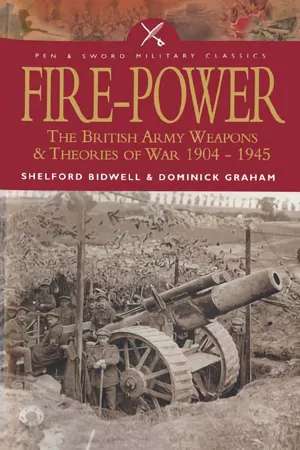
Fire-Power
The British Army Weapons & Theories of War 1904–1945
- 344 pages
- English
- ePUB (mobile friendly)
- Available on iOS & Android
eBook - ePub
About this book
The great siege of Gibraltar was the longest recorded in the annals of the British army. Between 1779 and 1783 a small British force defended the Rock against the Spanish and the French who were determined take this strategically vital point guarding the entrance to the Mediterranean. The tenacity and endurance shown by the attackers and defenders alike, and the sheer ingenuity of the siege operations mounted by both sides, make the episode an epic of military history, and the story gives us a fascinating insight into the realities of siege warfare. In this, the first full study of the siege for over 40 years, James Falkner draws on a wide range of contemporary sources to tell the exciting tale of a huge and complex operation.
Information
Contents
List of Illustrations
Acknowledgements
List of Abbreviations
Prologue
Book I The Fire-Tactics of the Old Army: 1904–1914
1 The Artillery as an Accessory
2 The Tactics of Separate Tables
3 The Still and Mental Parts
Book II One Great and Continuous Engagement: 1914–1918
4 Prologue and Retrospect
5 Many a Doubtful Battle
6 Ubique
7 Queen of the Battlefield?
8 A Technical Knock Out
Book III The Years Between the Wars: 1919–1939
9 The Swingletree Factor
10 Policies, Theories and Weapons
11 A Fairly New Model Army
Book IV The Second Round: 1939–1945
12 Blitzkrieg
13 The Sand Model
14 A Cybernetic Solution – I: The Artillery on the Ground
15 A Cybernetic Solution – II: The Artillery of the Air
Interlude. Fire-plan statistics: 1940–45
16 Ends and Means
Epilogue
Notes
Bibliography
Index
Illustrations
Photographs
1 General Sir Noel Birch (Royal Artillery Institution)
2 Major-General Sir Herbert Uniacke (Royal Artillery Institution)
3 Lieutenant-General Sir Arthur Holland (Royal Artillery Institution)
4 Major-General C. E. D. Budworth (Royal Artillery Institution)
5 18-pounder stuck in the mud, 1917 (Imperial War Museum)
6 18-pounder in action, March 1918 (Imperial War Museum)
7 Three-man portable ‘wireless’ station (Imperial War Museum)
8 British Mark V tanks and Canadian infantry (Imperial War Museum)
9 Self-propelled field/AA 18-pounder ‘Birch’ gun (Royal Artillery Institution)
10 Early experiments in mechanised, tracked draught (Royal Artillery Institution)
11 General Sir John Woodall (Kindly lent by the subject)
12 Major-General J. H. Parham (Mrs J. H. Parham)
13 General Sir Brian Horrocks (Kindly lent by the subject)
14 Air Chief Marshal Sir Harry Broadhurst (Kindly lent by the subject)
15 Model 68R portable radio (Imperial War Museum)
16 Vickers .303-inch medium machine-gun (Imperial War Museum)
17 The 25-pounder Mark I with turntable platform
18 The 5.5-inch gun (Imperial War Museum)
19 Hurricane ‘tank-busters’ of the Desert Air Force (Imperial War Museum)
20 HMS Warspite bombarding the Normandy coastal defences (Imperial War Museum)
Diagrams
1 Direct and indirect fire
2 Why the machine-gun is deadly
3 The battle of Neuve Chapelle, March 1915
4 Loos, 1915. The stages of the battle
5 The situation on the Western Front, June 1916
6 Schematic example of barrage
7 Shrapnel
8 The Somme, 1916
9 The Flanders Campaign
10 Example of grid reference
11 Eighth Army defence layout, May 1942
12 Panzer tactics in the desert
13 ASSU communication diagram
Acknowledgements
We wish to acknowledge our gratitude to all those who gave us advice, lent us papers and photographs, answered many questions and read various chapters in typescript, and whose assistance has been invaluable: Correlli Barnett, Brian Bond, Air Chief Marshal Sir Harry Broadhurst, Major-General W. D. E. Brown, Martin Blumenson, Air Vice-Marshal S. Bufton, Lieutenant-Colonel C. E. Carrington, Field Marshal the Lord Carver, Lieutenant-Colonel Ralph Eastwood, Major-General N. L. Foster, Major-General J. D. Frost, Brigadier P. C. Graves-Morris,\Group-Captain E. B.\Haslam, Brigadier P. H. C. Hayward, Colonel S. M. W. Hickey, Ian V. Hogg, Colonel P. Hordern, Richard Holmes, John Keegan, Ronald Lewin, Major Kenneth Macksey, Lieutenant-Colonel J. Marriott, Major-General J. M. McNeill, J. R. S. Peploe, Mrs Parham, Peter Simkin, Keith Simpson, Major-General E. K. G. Sixsmith, Roderick Suddaby, T. H. E. Travers, John Terraine, Lieutenant-Colonel P. S. Turner, P. H. Vigor, Brent Wilson and Lieutenant-General Sir John Woodall.
We are also indebted to the librarians of the Bodleian Library; the library of Churchill College, Cambridge; the Imperial War Museum; the Liddell Hart Centre for Military Archives, in King’s College London; the Ministry of Defence (Army); the Staff College, Camberley; the Royal Armoured Corps Museum, Bovington; the Royal Engineers Institute; the Royal Signals Institution and the Royal United Services Institution for Defence Studies.
Miss B. D. Wood, Assistant Secretary of the Royal Artillery Institution, has given us unflagging and omniscient support throughout our researches. Carole Hines, Phyllis Miller and Mrs Jean Walter copied our often chaotic and much amended typescripts with unerring accuracy.
Lastly but first in other respects, our wives who cherished us while we wrote and chapters crossed and recrossed the Atlantic for mutual comment, and who listened patiently and critically to us while we read them aloud. Valerie Graham drew the maps.
In making these acknowledgements we must add that all the opinions expressed and any errors of fact are ours alone.
Shelford Bidwell
Dominick Graham
Dominick Graham
List of Abbreviations
| AACC | Army Air Control Centre |
| AASC | Army Air Support Control |
| ACT | Air Contact Team |
| ADC | Aide de Camp to a general officer |
| AG | Adjutant General |
| AGRA | Army Group, Royal Artillery |
| ALO | Air Liaison Officer |
| ASSU | Air Support Signals Unit |
| BAFF | British Air Forces in France |
| BEF | British Expeditionary Force |
| BGS | Brigadier General Staff (to a corps commander) |
| BGS (I) | Brigadier General Staff responsible for Intelligence |
| BGS (Ops) | Brigadier General Staff responsible for operations at GHQ |
| Cab | Cabinet Office paper at the PRO |
| CID | Committee of Imperial Defence |
| CIGS | Chief of the Imperial General Staff |
| C-in-C | Commander-in-Chief |
| CRA | Commander Royal Artillery |
| DMT | Director of Military Training |
| DSD | Director of Staff Duties |
| FAC | Forward Air Controller |
| FAT | Field Artillery Training (manual) |
| FCP | Forward Control Post |
| FOO | Forward Observation Officer (artillery) |
| GHQ | General Headquarters |
| GOC | General Officer Commanding |
| GOCRA | General Officer (Royal Artillery) at Corps |
| CCRA (term used in the Second World War) | |
| CRA brigadier commanding artillery of a division | |
| MGRA major-general advising the C-in-C at GHQ or the GOC at Army headquarters | |
| GSO | General Staff Officer (category 1 etc) |
| HE | High explosive |
| I | Intelligence (branch) |
| IWM | Imperial War Museum |
| LHC | Liddeil Hart Centre for Historical Research, the Library, King’s College, London |
| MGGS | Major-General General Staff (to an Army Commander) |
| MGO | Master-General of the Ordnance |
| m.v. | Muzzle velocity |
| OH | The Official History of the Great War: military operations in France and Belgium |
| Ops | Operations |
| PRO | Public Record Office |
| p.s.c. | Passed staff college |
| QF | Quick-firing |
| QMG | Quartermaster-General |
| RA | Royal Artillery |
| RAF | Royal Air Force |
| RAJ | Journal of the Royal Artillery |
| RE | Royal Engineers |
| RFA | Royal Field Artillery |
| RFC | Royal Flying Corps |
| RGA | Royal Garrison Artillery |
| RHA | Royal Horse Artillery |
| RUSI | Journal of the Royal United Services Institute |
| SD | Staff Duties (branch of general staff) |
| SLE | Short Lee Enfield |
| TA | Territorial Army |
| TF | Territorial Force |
| WO | War Office |
Prologue
During the first two hundred years of its existence the British Army was chiefly engaged in small wars in remote territories. Its rôle was to acquire an overseas empire and then police it, varied from time to time by expeditions to Europe, where its contingents formed part of Allied armies. Britain was never deeply involved on land, the forces concerned were small and their casualties low, for her position as a sea-power permitted her to play as great or as small a part in a land war as she chose. This privilege ended in 1914, when she sent an expeditionary force to France on the same principle and in the same hope, only to be drawn inexorably into making a major effort in the bloodiest and most destructive war in her history.
General Sir John French led abroad a force consisting of seven divisions, whose heavy artillery consisted of twenty-four 5-inch guns. In 1918 General Sir Douglas Haig could dispose of over sixty divisions supported by six and a half thousand field pieces from three to eighteen inches in calibre. In addition he had a new form of artillery in the shape of armoured motorised gun-platforms, the ‘tanks’, and also an air force able to intervene with machine-gun fire and bombs in the land battle. Both these innovations were to dominate future wars.
With these resources Haig was able to play a leading rôle in ending the war. In ninety-five electrifying days from 8 August to 11 November 1918, the British Army in France fought nine great battles, equal to or exceeding any of its operations of the Second World War, capturing as many guns and prisoners as the French, Americans and Belgians put together. It was not these victories, however, that became imprinted on the national consciousness, but the terrible cost of the battles of attrition that preceded them.
The British sacrifice had indeed been great and grievous, but they were by no means the principal sufferers. Their losses were exceeded by those of the Germans and Austrians, who fought on two fronts, the Russians and the French. There is no need to search far for the cause of this slaughter. The generals of that war were men whose military outlook had been formed in the nineteenth century and they were faced with the weapon technology of the twentieth. Modern agriculture provided a surplus of food to put in the mouths of unproductive soldiers, modern medicine preserved the unhygienic masses of soldiery from decimation by epidemic disease, and modern transportation enabled millions of men to be concentrated in the theatre of war. Then modern science and engineering enabled factories to turn out modern weapons to kill them in equally large numbers.
There had been portents. It had been discerned that the killing power of modern weapons would lead to a revival on a large scale of the use of obstacles and entrenchments, and that attacks in the old fashion by means of gunpowder and the arme blanche, would be difficult if not impossible. (Not that this was the sole cause of casualties on the horrific scale that were to be inflicted in both World Wars. There was ample room for manoeuvre in the vast spaces of Russia, but even there, where divisions by the hundred grappled with each other, using tanks by the thousand and guns by the tens of thousands, there were losses beside which even those of the earlier war paled.) The American Civil War was the first to presage the bloody nature of future mass warfare. In South Africa Boer marksmen showed the damage rifle-fire could inflict on infantry and that it could even silence the artillery. It was clear that machine-guns could multiply this effect many times. The Russo-Japanese War of 1904–5 emphasised the following points: the importance of machine-guns and heavy artillery; that artillery had to adopt the new technique of indirect fire from covered positions instead of assembling long lines of guns wheel to wheel in the open; the utility of hand grenades and mortars and the importance of signal communications. It was one thing, however, to read the omens correctly, but quite another to change the ideas of men so traditionally conservative as soldiers.
The British, in fact, made good use of their painful lessons in South Africa. It had not been their equipment that had been mainly at fault. The infantry, on whom British generals had always relied, could not shoot straight, its fire discipline was rotten, and its old fashioned reliance on drill precluded the use of field-craft and battle-craft. This was all put right, and the accuracy and intensity of the rifle-fire of the ‘Old Contemptibles’ of 1914 became a legend, but what was easy to instil into long-service volunteers after much careful training was not possible for the mass armies raised after the outbreak of war. In 1916 a battalion commander, speaking of his New Army soldiers during the battle of the Somme, asserted that they were less effective than the arch...
Table of contents
- Cover
- Half Title Page
- Series Page
- Title Page
- Copyright Page
- Dedication
- Contents
Trusted by 375,005 students
Access to over 1.5 million titles for a fair monthly price.
Study more efficiently using our study tools.
Frequently asked questions
Yes, you can cancel anytime from the Subscription tab in your account settings on the Perlego website. Your subscription will stay active until the end of your current billing period. Learn how to cancel your subscription
No, books cannot be downloaded as external files, such as PDFs, for use outside of Perlego. However, you can download books within the Perlego app for offline reading on mobile or tablet. Learn how to download books offline
We are an online textbook subscription service, where you can get access to an entire online library for less than the price of a single book per month. With over 1.5 million books across 990+ topics, we’ve got you covered! Learn about our mission
Look out for the read-aloud symbol on your next book to see if you can listen to it. The read-aloud tool reads text aloud for you, highlighting the text as it is being read. You can pause it, speed it up and slow it down. Learn more about Read Aloud
Yes! You can use the Perlego app on both iOS and Android devices to read anytime, anywhere — even offline. Perfect for commutes or when you’re on the go.
Please note we cannot support devices running on iOS 13 and Android 7 or earlier. Learn more about using the app
Please note we cannot support devices running on iOS 13 and Android 7 or earlier. Learn more about using the app
Yes, you can access Fire-Power by Shelford Bidwell,Dominick Graham in PDF and/or ePUB format, as well as other popular books in History & Military & Maritime History. We have over 1.5 million books available in our catalogue for you to explore.