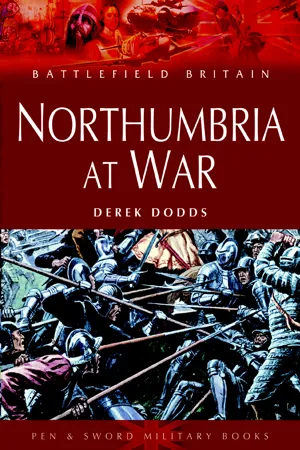
Northumbria at War explores war and conflict in Northumberland and Durham from the Celtic age to modern times.
Rebellion, feud and civil disorder have smoldered and crackled across the North, destroying powerful families and local communities alike. Derek Dodds reconstructs these epic struggles, setting them in the context of their tumultuous times and recalling the human bravery and frailty that influenced their outcome.
This account is based on Dodds' research, providing up-to-date information on the battlegrounds so that readers can see for themselves the evocative sites where these clashes of arms took place.
Includes maps and more than 100 illustrations
- 160 pages
- English
- ePUB (mobile friendly)
- Available on iOS & Android
eBook - ePub
Northumbria at War
About this book
Information
Chapter 1
KINGDOM IN CONFLICT 43—1066
On then into battle and as you go think both of your ancestors
and your descendants. Tacitus, 2nd century AD
and your descendants. Tacitus, 2nd century AD
From the early history of Northumbria, little evidence remains of any large-scale military conflict. As Imperial Rome strengthened its grip on the green and damp isle of Britannia, any resistance in the North was probably spasmodic and regarded more as an irritation than a threat to the viability of the Roman presence. Even so, the British warrior established a reputation for toughness and a reckless determination which caused major setbacks to the Roman conquest.
Isolated and lightly armed northern tribes were more likely to engage in opportunist guerrilla raids but were eventually reconciled to Roman domination. Trade has always been a less dangerous pursuit than terror, and any impulse from the indigenous population towards resistance must have often seemed futile in the face of iron-clad infantry, bristling with weapons, who tramped in formation across their tribal lands.
Certainly Tacitus, the eloquent chronicler of Imperial expansion in this period, dismissed the severity of any north-eastern threat and concentrated instead on the opposition of woad-daubed Picts, who were finally crushed in a decisive battle as they retreated desperately to the ramparts of their Caledonian stronghold. It was only when the Legions had left to defend their crumbling empire in the east that the northern region began to struggle fitfully towards a separate identity. It was an identity forged in the burning crucible of battle.
By the sixth century, a tribe of Danish Angles led by Ida had braved the North Sea to eventually colonise parts of the north-east coast and occupy the forbidding shoreline defences at Bamburgh. Most of these ancient chiefdoms depended for their survival on the sword arm of their leader, and his death in combat consequently marked the collapse of his regime and the loss of his territory. However, Ida fought skilfully enough to successfully resist the Celtic threat which surrounded him and he lived long enough to lay down the foundations for the Kingdom of Northumbria, a vast area stretching from the Humber to the Forth.
Warriors mustered. They met together,
With a single intention they attacked.
Celtic Heroic Poem, eighth century
With a single intention they attacked.
Celtic Heroic Poem, eighth century
Only vague and legendary memories remain of this battle for survival. These embryonic British states had few established literary traditions. Their history was instead woven into bardic stories which were passed down through the generations. Local place-names such as Battleshield Haugh may now bear a last faint echo of long-distant clashes of arms. But Heavenfield in Northumberland is a battlefield grounded on firmer historical foundations.
At Heavenfield, in the shadow of Hadrian’s great Wall, a threatened Northumbrian kingdom was given life and a chance to prosper. The battle site crowns a small plateau on the gently rising slopes of the broad Tyne valley, barely five miles directly north of the modern market town of Hexham. The battlefield was largely unscathed by the construction of General Wade’s military road which skirts closely past it and is a serenely peaceful spot with sweeping views towards a Northumberland upland of wild beauty. Yet once, it seems that this place of solitude was torn by the raucous din of battle horns and bellowing war chants.
The place is near the wall in the North by which the Romans once shut off the whole of Britain from the sea to prevent the attacks of the barbarians. Bede, eighth century
In 635 at Heavenfield, pagan banners were unfurled, sword hilts were hammered on shields, and two native war bands faced each other to settle their fate in blood. Three years earlier at the battle of Hatfield Chase near Doncaster, the ferocious Welsh chieftain Cadwallon had smashed a Northumbrian army and killed Edwin its king. Military prowess combined with astute dynastic alliances had allowed Edwin to establish a kingdom which he oversaw from a warren of hill forts at Gefrin, known now as Yeavering, in the Cheviot Hills. But his untimely death meant that the kingdom of Northumbria now lay outstretched and vulnerable before the mighty Celtic warlord Cadwallon.
Leading the defence of his country was the new young king Oswald, a remarkable member of the Northumbrian aristocratic warrior caste who appears to have been as schooled in the Gospels as he was in sword play. If accounts of his greatest battle are to be accepted, Oswald’s strategic guile and prowess as a military commander far outweighed his tender years, for it is claimed he selected his fighting ground before giving battle. By assessing the battlefield today, his good judgement can still be appreciated. Resting on a high ramp of land, Heavenfield is an ideal battle location. It is wedged between rocky outcrops on the northern and western flanks, and protected to the south by Hadrian’s Wall and its defensive ditch which in the seventh century would still have presented a formidable barrier.
BATTLE OF HEAVENFIELD
635
635
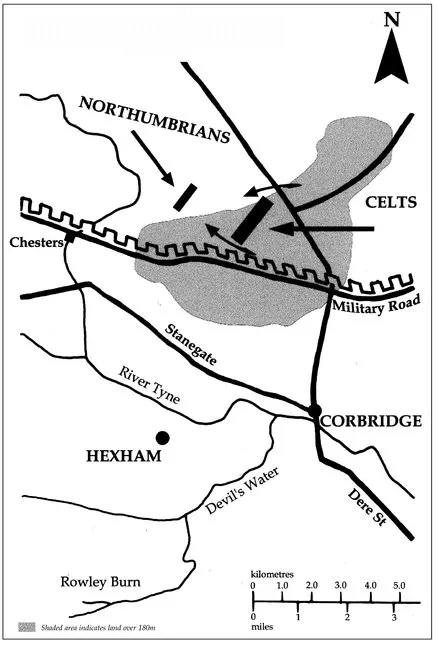
Another legacy of Roman occupation may have played a significant role in this battle. Their sophisticated network of roads continued in use long after their departure and would have been vital for relatively speedy troop movements. Stanegate from the west, Dere Street from the south, and particularly the sinisterly named ‘Devil’s Causeway’ which sliced diagonally across the region, were arteries of communication which led to Heavenfield. Cadwallon probably advanced north from his York stronghold along Dere Street, approaching its crossroads with Stanegate at the Northumbrian settlement of Corbridge where the River Tyne could be forded. His objective may have been to strike at the Northumbrian military base at Bamburgh as he continued north, crossing the Wall before becoming aware of an enemy force in the vicinity.
Seeking to draw Cadwallon away, Oswald’s troops could then move from their encampment to form up on Heavenfield, where they prepared to withstand the shock of the Welsh onslaught. In this battlefield scenario the trap was sprung and Oswald held open its jaws. Turning westward, the battle-hardened Cadwallon then bore eagerly down upon his waiting adversary.
Oswald advanced with an army small, but strengthened with the faith of Christ. Bede, eighth century
As far as can be known, Dark Age battles were probably short but extremely savage clashes with no hint of quarter. Before fighting began, however, both sides may have faced each other to trade insults instead of blows, enacting a ritual still observed in the behaviour of urban street gangs today. It remains as effective as ever to instil collective confidence and intimidate opponents into hasty and uncoordinated attacks.
Scenting victory against an outnumbered opponent and an untried leader, Cadwallon’s warriors could then hurl themselves forward. Prior to this, to open the battle, there was possibly an exchange of slingshot and spears, weapons likely to have been favoured by most ordinary tribesmen of this period. Judging by the finely wrought sword blades that have been unearthed, metal working was a highly developed skill during this period. It is likely, though, that heavy battle swords, long axes and rudimentary but still expensive armoured protection would have been available only to the elite cadre of warriors who gathered around their leader. Most of the remaining war band would have been equipped with spears, axes and even simple farming implements. Some of these weapons may have been light and seemingly innocuous, but without doubt they would prove to be just as lethal in the brutal close-quarter combat into which these murderous encounters doubtless descended.
But as the Celts swarmed towards the Northumbrian line of battle, Oswald’s choice of battleground was vindicated. A broad mass of Welsh tribesmen would be squeezed into a narrow front by the contours of the land over which they charged. As with many sites of battle, topography could decisively affect the final outcome. At Heavenfield, Cadwallon’s momentum would be checked and his warriors tired by their ascent of the long rising slope which was defended by Oswald’s army. Because of this it was possibly here, on the crest where a small church now stands, that the first wave of the Celtic attack broke upon a wall of closely packed Northumbrian defenders.
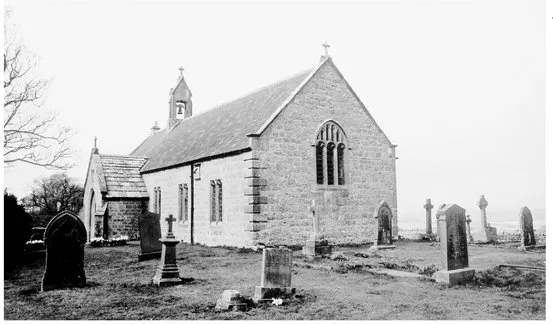
St Oswald’s at Heavenfield. On the site of early Northumbria’s most important battle.
Powerful but increasingly desperate Celtic attacks could then be blunted by the Northumbrian shield wall. To be effective it had to be locked tightly against the wedge of struggling warriors who slashed and cut at it. Shields of this period were robustly constructed from hide-covered wood and many of them may have been strengthened significantly by the addition of a central iron boss. This was probably smaller than the Roman model but it was equally effective in deflecting sword blows and forcing back opponents.
Steadily, Oswald’s men must have gained the upper hand as their assailants began to falter. Seizing the moment, the Northumbrian front rank could then spring forward and cut down the tiring warriors before them. At some stage of the bitter fighting, as always in battle, a critical turning point undoubtedly arrived. But whatever had caused the fatal loss of impetus, for Cadwallon the fight was effectively lost.
His routed men were said to have streamed away from the battlefield pursued by a bloodthirsty enemy. Many Celts were overtaken and killed in their headlong flight towards the south, including Cadwallon and his clansmen, who were overwhelmed as they attempted to escape across a stream. Two local waterways are associated with the death of the legendary Celtic warlord: Devil’s Water, a fast-flowing tributary of the River Tyne, and Deniseburn or Rowley Burn which is further to the south in what is now County Durham.
Scant evidence other than local tradition has set the death of Cadwallon in these locations. A near contemporary description of the battle itself was written by Bede, the monkish scholar and first truly English historian. Although it was written barely within a century of Heavenfield, and closely follows an earlier narrative by an Ionian abbot, Bede’s brief account should be treated with cautionary respect. Oswald’s victory is described in Bede’s famed Ecclesiastical History as the divinely inspired triumph of a Christian king over a satanic heathen. In fact Cadwallon was baptised, and the enmity between him and the Northumbrian kingdom was intensified by the rivalry between different strands of early British Christianity. As far as Bede was concerned, the Celtic chief was irredeemable, ‘an impious man’ who deserved an ignominious end. This is hinted at in the account, but given Cadwallon’s martial reputation it is just as likely that the Welsh leader was defiant to the end and died in the midst of his slain bodyguard.
Bede exploited the victory at Heavenfield as a eulogy to the princely state of Northumbria and a reinforcement of the cult of the warlike Oswald and his brother northern saints. Despite this, it is highly likely that across these now gentle acres of Northumberland there was once a furious struggle. Although there have been no recent archaeological surveys, for centuries after that decisive day of Northumbrian victory, the battle site gained a reputation for splintered human bone and twisted fragments of sword blades which were turned over by the plough. A field opposite the battle site, to the south of the road, is referred to as ‘Moulds Close’, well named because of its dark associations with burial and decay:
The place is still pointed out to this day and held in great veneration where Oswald raised the sign of the Holy Cross when about to engage in this battle. Bede, eighth century
As Oswald began to celebrate his great achievement and mourn his fallen comrades, the site of their death became a place of pilgrimage. Monks from the nearby religious settlement of Hexham quickly began to raise a permanent memorial to the day of their salvation. A small chapel may have shared the site with a simple wooden cross, said to have been erected by Oswald as a battle standard before fighting began. His crude cross was soon whittled away by pilgrims greedy for relics and miraculous cures, but it has been replaced over the centuries by a succession of others. One stands there today, carved at now only by wind and rain, but still proudly facing out across the Northumbrian battle line.
By destroying the Welsh invasion at Heavenfield, Oswald had saved his homeland, which prospered briefly until he too died in a storm of slashing blades and piercing arrows. A tiny church dedicated to Oswald now occupies the field of his greatest and most unexpected victory. It is modest yet inspiring. Perhaps it shares something with the plain Christian symbol that he was said to have used successfully as a call to arms so long ago. Beyond question, at any rate, Heavenfield is a seductive place for modern pil...
Table of contents
- Title Page
- Copyright Page
- Table of Contents
- Introduction & Acknowledgements
- Chronology
- Chapter 1 - KINGDOM IN CONFLICT 43—1066
- Chapter 2 - THE NORTH IN REVOLT 1066—1093
- Chapter 3 - NORTHUMBERLAND BESIEGED 1093—1097
- Chapter 4 - BISHOPS, CASTLES AND KINGS 1135—1174
- Chapter 5 - ANVIL OF BATTLE 1215—1333
- Chapter 6 - RED HILLS AND MOORS 1333—1402
- Chapter 7 - HOUSES AT WAR 1402—1496
- Chapter 8 - FLOWER OF SCOTLAND 1503—1603
- Chapter 9 - GOD, KING AND COUNTRY 1603-1644
- Chapter 10 - HOME FRONT 1644-1918
- VISITOR GUIDE
- GUIDE TO SOURCES AND FURTHER READING
- INDEX
Trusted by 375,005 students
Access to over 1.5 million titles for a fair monthly price.
Study more efficiently using our study tools.
Frequently asked questions
Yes, you can cancel anytime from the Subscription tab in your account settings on the Perlego website. Your subscription will stay active until the end of your current billing period. Learn how to cancel your subscription
No, books cannot be downloaded as external files, such as PDFs, for use outside of Perlego. However, you can download books within the Perlego app for offline reading on mobile or tablet. Learn how to download books offline
Perlego offers two plans: Essential and Complete
- Essential is ideal for learners and professionals who enjoy exploring a wide range of subjects. Access the Essential Library with 800,000+ trusted titles and best-sellers across business, personal growth, and the humanities. Includes unlimited reading time and Standard Read Aloud voice.
- Complete: Perfect for advanced learners and researchers needing full, unrestricted access. Unlock 1.5M+ books across hundreds of subjects, including academic and specialized titles. The Complete Plan also includes advanced features like Premium Read Aloud and Research Assistant.
We are an online textbook subscription service, where you can get access to an entire online library for less than the price of a single book per month. With over 1.5 million books across 990+ topics, we’ve got you covered! Learn about our mission
Look out for the read-aloud symbol on your next book to see if you can listen to it. The read-aloud tool reads text aloud for you, highlighting the text as it is being read. You can pause it, speed it up and slow it down. Learn more about Read Aloud
Yes! You can use the Perlego app on both iOS and Android devices to read anytime, anywhere — even offline. Perfect for commutes or when you’re on the go.
Please note we cannot support devices running on iOS 13 and Android 7 or earlier. Learn more about using the app
Please note we cannot support devices running on iOS 13 and Android 7 or earlier. Learn more about using the app
Yes, you can access Northumbria at War by Derek Dodds in PDF and/or ePUB format, as well as other popular books in History & British History. We have over 1.5 million books available in our catalogue for you to explore.