- 208 pages
- English
- ePUB (mobile friendly)
- Available on iOS & Android
eBook - ePub
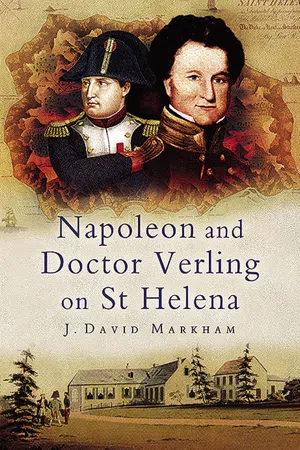
Napoleon and Doctor Verling on St Helena
About this book
Many books have been written about St Helena and its most famous resident, the exiled Emperor Napoleon Bonaparte. The episode has been so intensively researched that it is rare for a fresh, unpublished account to come to light. Yet Dr James Verling's St Helena journal is just such a source. Verling was based on St Helena during Napoleon's imprisonment and he was even appointed as Napoleon's official physician. Throughout his stay, this young doctor kept a vivid diary of his experiences. Through Verling's eyes we get a fresh view of daily life on the island and of the suspicion-filled society that grew up around Napoleon during his last years.
Information
Subtopic
19th Century HistoryIndex
HistoryPart One
End of a Career, Beginning of a Legend
Chapter 1
Napoleon’s Last Campaigns
Napoleon Bonaparte was born of modest parentage on the island of Corsica on 15 August 1769. Through hard work and good fortune he had risen to the heights of power, leading armies to victory after victory and becoming, in 1804, Emperor of the French. At its height in 1810–12, his empire and alliances gave him control of virtually all of Europe.
Napoleon brought liberal reforms to much of his empire and he was wildly popular in France. He was less popular in the halls of power in London and in the ancient courts of Europe. In time, these forces wore him down. In Spain, Napoleon misjudged the feelings of the common people and the determination of the British. Over a period of years, the ‘Spanish Ulcer’ cost Napoleon valuable soldiers and, more important, his aura of invincibility.
In 1812, war with Russia had become inevitable. Napoleon chose to fight on Russian soil rather than wait for them to attack, so he led his Grande Armée (Great Army) of 600,000 men into Russia, hoping to force one great, decisive battle. He got his victory at Borodino, but his capture of Moscow would prove useless. In the end, numerous delays led to the disastrous winter withdrawal from Russia. He had lost 90 per cent of his army and any remaining reputation of being unbeatable.
By the beginning of 1813, Napoleon was in Paris raising an army and seeing to it that his Russian misadventure had no domestic repercussions. Tsar Alexander of Russia had moved his armies into the Grand Duchy of Warsaw and encouraged Prussia to switch sides. By March, the Prussians had done exactly that, and declared war on France. A new alliance was in the works and Napoleon was in trouble.
Even so, Napoleon had a number of important cards to play. He was already organizing a new army and his marriage to Marie Louise, a daughter of the Emperor of Austria, gave him an important alliance. Napoleon could not imagine that Emperor Francis would declare war on his own daughter, and on the grandson born of that marriage.
Napoleon moved quickly against the Russian and Prussian threat, soon defeating them at the battles of Lützen and Bautzen. But promised Austrian troops never arrived to support Napoleon. Instead, Francis proposed mediation with Russia and Prussia, led by Austrian Foreign Minister Count Clemens Metternich. The resulting talks were little more than a sham, with Austria, Prussia and Russia essentially wanting Napoleon to give up all of his gains since coming to power. This would never be acceptable to the French people and was certainly not acceptable to Napoleon. In the end, the armistice and negotiations gained Napoleon nothing and in August Austria switched sides and declared war on France. So much for family ties! England, sensing an opportunity to defeat her old foe, opened her coffers in support of the new coalition against Napoleon. Napoleon, no longer feared, was on the defensive.
The armies drawn up against Napoleon were better trained and more modern than those he had faced earlier. His enemies had learned from the master of warfare. Still, Napoleon himself was formidable. The allied armies planned to avoid him when possible and concentrate on defeating his subordinates. This approach worked. Napoleon was generally successful but his subordinates were not. Former allies began to desert Napoleon, and even his marshals were beginning to lose heart and question the advisability of continued fighting. When Napoleon lost the Battle of Leipzig in October 1813, the rout was on. Stunned by the treachery of the Saxons and Marshal Bernadotte and devastated by the premature destruction of a bridge, costing him 20,000 soldiers and the life of Marshal Prince Poniatowski, Napoleon was forced to withdraw into France. His empire gone, deserted even by his sister Caroline and her husband, Marshal Murat, the King of Naples, Napoleon was now fighting for his very survival. He had not done well in the campaign of 1813. In 1814, in the Campaign of France, he would be more like his old self.
After arranging for the defence of Paris (and further peace negotiations), Napoleon struck at the approaching armies with a fury. He quickly defeated a Russian corps and followed that with several other successes. Stunned, the allies suggested an armistice.
In Paris, the treacherous foreign minister Talleyrand was deserting Napoleon’s cause in favour of that of the Bourbons, the ruling family of France until the overthrow of Louis XVI by the French Revolution. Groundwork was being laid to replace Napoleon with a Bourbon king. On the battlefield, the allies were approaching Paris. Napoleon decided to race them to Paris. Marshal Marmont was already being pushed in that direction and the rest of the marshals insisted on joining him there. It was a reasonable approach to take, offering the possibility of presenting the allies with a fortified Paris with Marmont’s troops in their front and Napoleon at their rear. As Napoleon later told Count Montholon ‘they [the Allies] would never have given battle on the left bank of the Seine with Paris in their rear.’1
Paris, however, was in no mood to resist and suffer the consequences. The defeat and subsequent defection of Marshal Augereau at Lyons on 23 March did nothing to stiffen their backbone. Countermanding Napoleon’s instructions, Napoleon’s brother Joseph, who had been placed in charge of the defence of Paris, sent the government, along with Marie Louise and her son, out of the city, leaving the political future of Paris, and France, largely in the hands of Talleyrand, who remained behind. Marie Louise tried to intercede with her father, the Emperor of Austria, but to no avail. Joseph was of little use to Napoleon in Paris and he left at the end of March. When Tsar Alexander arrived in Paris, he stayed at Talleyrand’s home. Napoleon’s future was bleak.
Talleyrand led the provisional government and prepared the way for the return of the monarchy that so many had died to remove. Tsar Alexander was willing to consider passing the throne to Napoleon’s son, but it was not to be.
On 3 April, Marshals Ney, Berthier, Oudinot and Lefebvre told Napoleon that he had to abdicate in favour of his son and leave the area. Napoleon reluctantly agreed and the next day abdicated in favour of his son, with Marie Louise as Regent. Tsar Alexander was prepared to accept this proposal. However, Marshal Marmont, under the influence of Talleyrand, marched his 11,000 soldiers into the Austrian camp, thus ending any hope for Napoleon or his son. Without those soldiers, Napoleon no longer had any bargaining power.
On 11 April 1814, Napoleon abdicated unconditionally, saying, ‘there is no sacrifice, not even that of life, which he is not ready to make for the interests of France.’2 Louis Stanislas Xavier, brother to the deposed and executed Louis XVI, became King Louis XVIII. Napoleon was exiled to the island of Elba, just off the coast of Italy, where he would be given the title of Emperor of Elba. It was to be an honourable exile to a pleasant island where they even spoke Napoleon’s native Italian. But the good faith of the allies was brought into question when they refused to allow his wife and son to join him there. Napoleon, awaiting his fate at the chateau of Fontainebleau, was so distraught that he attempted suicide with poison that he always carried with him. The poison had lost much of its potency, though, and the effort failed.
On 20 April, Napoleon said goodbye to the soldiers of his Old Guard, and left for Elba with a personal guard of 1,000 personally selected soldiers.
Elba
Arriving in Elba, he was saddened by the unexpected death of his first wife, Josephine; another tie to the past was gone. However, Napoleon engaged in a serious effort to improve conditions on Elba. He revised the legal and tax system and built new roads and fortifications. His mother joined him, as did his sister, Pauline. Countess Walewska, his Polish mistress, made a final visit, bringing their young son with her. Napoleon held court to many foreign visitors and was generally seen as busy and happy.
All was not as well as it seemed, however. Louis XVIII refused to give Napoleon his pension, leading to financial difficulties. Worse, it was clear that Talleyrand was interested in arranging an entirely different fate for the Emperor of Elba, perhaps prison, perhaps worse. The powers of Europe were meeting at what was called the Congress of Vienna, and there was no telling what they would do. Napoleon began to hear of French dissatisfaction with Louis XVIII and negative moves toward Napoleon by Talleyrand in Vienna. These two factors led Napoleon to decide to leave Elba and attempt to regain control of France.
The One Hundred Days
Napoleon landed in France on 1 March 1815. After a slow start, he began to make his way north. He was determined not to fire a single shot on his way to Paris, fearing that would lead to disaster. He therefore took the mountain road to Grenoble, off the main road. This route, now known as the Route Napoléon, was through difficult terrain and Napoleon was not sure what kind of reception he would receive along the way. But things went well, and after winning over troops sent to capture him at Laffrey, Napoleon entered Grenoble to the cheers of its citizens. He later wrote, ‘On my march from Cannes to Grenoble I was an adventurer; in Grenoble I once more became a sovereign.’3
On his way to Paris Napoleon also picked up the support of Marshal Michel Ney, who had promised Louis XVIII he would bring back Napoleon in an iron cage. Ney had been the King’s last hope, and Louis left Paris just hours before Napoleon entered the city.
Napoleon had two problems to solve. First, he had to reorganize the government and gain the political support of all of the various factions. Second, he had to try to get the rest of Europe to let him reign in peace. If he could get even a few of them to agree – his father-in-law Francis of Austria, for example – his gambit might just work. Along the Route Napoléon he had repeatedly professed his desire for peace and promised no more war. But would the rest of Europe believe him? It was his only hope.
Napoleon moved quickly to organize the government and gain support of the factions. He convinced Benjamin Constant, the leader of Parisian liberals, to join in writing a new constitution. It was a brilliant political move, though the two-chamber legislative body established by that constitution would prove problematic.
Dealing with the governments of Europe was far more difficult and far less successful. Had the governments been safely in their respective capitals, Napoleon’s efforts might have worked. He could divide and conquer, starting with Austria. But they were still all in Vienna, and so was Talleyrand. Louis XVIII had signed a secret treaty with England and Austria, a treaty that Napoleon hoped to use to avoid war with those two countries and perhaps with all of Europe. But Talleyrand, aided by King Murat’s absurd military moves against Austria, was able to convince the allies that Napoleon simply could not be trusted. Peace was out of the question, and the allies began to mobilize their forces.
Napoleon moved quickly, planning to attack the English and Prussian armies that were in Belgium. He rapidly organized the government and mobilized the country, and was able to raise an army of 300,000 soldiers. But staffing his leadership proved to be disastrous. His old friend and chief of staff, Louis Alexander Berthier, fell or was pushed to his death from a window in his estate, depriving Napoleon of the one person who could have filled that job adequately. Marshal Soult, Berthier’s replacement, was an outstanding general but not up to the job of chief of staff.
Napoleon left Marshal Davout as Minister of War in Paris, appointed Marshal Michel Ney to command the left wing of the army and Marshal Emmanuel Grouchy to command the right wing. All of these appointments were disasters.
Faced with the European powers against him, Napoleon had to take the first action. He could not afford to wait until a combined force of perhaps 600,000 moved in from two directions across the borders of France. The English and Prussians were in Belgium: Napoleon would march to meet them, hoping to keep them apart and to defeat each in their turn. It was his only chance. It was a good choice, and it nearly worked.
On 12 June, Napoleon’s army of about 125,000 men marched toward Charleroi, in Belgium. On the morning of the 15th, they routed the Prussian force, who had no idea the French were coming. As in 1805 when he marched to Ülm, Napoleon had managed to maintain a very high level of secrecy.
Wellington was at a ball in Brussels when he was given the astounding news of Napoleon’s actions so near to his army. He and the Prussians decided to make their stands a few miles south at Quatre Bras and Ligny, respectively. Wellington had some 96,000 men under his command and Blücher had about 117,000. Napoleon needed speed, secrecy and a perfect execution of his plans. He accomplished only the first two of those requirements. Almost from the beginning there were delays and confusion. Even so, by the evening of 15 June, Napoleon was in a good position. He had seized Charleroi and had kept the two allied armies apart. The normal course of action would be to turn on first one, and then the other, allowing him to have at least some level of numerical superiority.
Instead, on 16 June, Napoleon did what he almost never did. He split his forces into two wings to fight two separate battles: Ney against Wellington at Quatre Bras and Napoleon and Grouchy against Blücher at Ligny.
Both Ney and Napoleon were slow to begin their engagements. Ney should have moved right away to secure the crossroads at Quatre Bras; had he done so, Wellington would ha...
Table of contents
- Front Cover
- Title Page
- Copyright Page
- Contents
- List of Illustrations
- Acknowledgements
- Major People Mentioned in Verling’s Journal
- Major Locations Mentioned in Verling’s Journal
- Prologue: Napoleon, Verling and St Helena
- Part One: End of a Career, Beginning of a Legend
- 1 Napoleon’s Last Campaigns
- 2 Journey to Immortality
- 3 Napoleon’s Doctors on St Helena
- 4 Epilogue: Death and Immortality
- Part Two: The Journal of James Roche Verling
- 5 1818
- 6 1819
- 7 1820
- Part Three: Letters Relating to James Verling
- 8 1816
- 9 1818
- 10 1819
- 11 1821
- Select Bibliography of St Helena
- Notes
Trusted by 375,005 students
Access to over 1.5 million titles for a fair monthly price.
Study more efficiently using our study tools.
Frequently asked questions
Yes, you can cancel anytime from the Subscription tab in your account settings on the Perlego website. Your subscription will stay active until the end of your current billing period. Learn how to cancel your subscription
No, books cannot be downloaded as external files, such as PDFs, for use outside of Perlego. However, you can download books within the Perlego app for offline reading on mobile or tablet. Learn how to download books offline
Perlego offers two plans: Essential and Complete
- Essential is ideal for learners and professionals who enjoy exploring a wide range of subjects. Access the Essential Library with 800,000+ trusted titles and best-sellers across business, personal growth, and the humanities. Includes unlimited reading time and Standard Read Aloud voice.
- Complete: Perfect for advanced learners and researchers needing full, unrestricted access. Unlock 1.5M+ books across hundreds of subjects, including academic and specialized titles. The Complete Plan also includes advanced features like Premium Read Aloud and Research Assistant.
We are an online textbook subscription service, where you can get access to an entire online library for less than the price of a single book per month. With over 1.5 million books across 990+ topics, we’ve got you covered! Learn about our mission
Look out for the read-aloud symbol on your next book to see if you can listen to it. The read-aloud tool reads text aloud for you, highlighting the text as it is being read. You can pause it, speed it up and slow it down. Learn more about Read Aloud
Yes! You can use the Perlego app on both iOS and Android devices to read anytime, anywhere — even offline. Perfect for commutes or when you’re on the go.
Please note we cannot support devices running on iOS 13 and Android 7 or earlier. Learn more about using the app
Please note we cannot support devices running on iOS 13 and Android 7 or earlier. Learn more about using the app
Yes, you can access Napoleon and Doctor Verling on St Helena by J. David Markham in PDF and/or ePUB format, as well as other popular books in History & 19th Century History. We have over 1.5 million books available in our catalogue for you to explore.