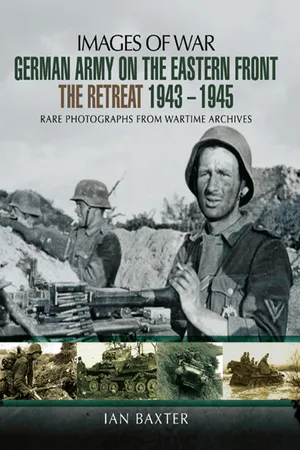
A pictorial history of the German Army retreating west from the Soviet Army in the final stages of World War II.
After the defeat at Stalingrad in January 1943, the German Army's front lines were slowly smashed to pieces by the growing might of the Soviet Army. Yet these soldiers continued to fight. Even after the failed battle of the Kursk in the summer of 1943, and then a year later when the Russians launched their mighty summer offensive, code names Operation Bagration, the German Army continued to fight on, withdrawing under constant enemy ground and air bombardments. As the final months of retreat were played out on the Eastern Front in early 1945, it depicts how the once vaunted German Army, with diminishing resources, withdrew back across the Polish/German frontier to Berlin itself.
- 144 pages
- English
- ePUB (mobile friendly)
- Available on iOS & Android
eBook - ePub
German Army on the Eastern Front: The Retreat, 1943–1945
About this book
Information
Chapter 1
Summer & Winter Battles 1943
In July 1943, the German Army launched what proved to be its last great offensive on the Eastern Front – against the Kursk salient. Despite massive losses sustained by their forces at Stalingrad, which led to the subsequent destruction of the 6th Army, Hitler was determined as ever not to give up the fight in Russia. It was here at Kursk that the Führer was confronted with a very tempting strategic opportunity that he was convinced could yield him victory. Within the huge salient, measuring some 120 miles wide and 75 miles deep, he tried to persuade his generals that his forces could attack from the north and south of the salient in a huge pincer movement and encircle the Red Army. In Hitler’s view, the offensive, codenamed ‘Zitadelle’, would be the greatest armoured battle ever won by both the German Army and Waffen-SS. As with the opening phases of ‘Barbarossa’ in June 1941, a confident Hitler had predicted that ‘he only had to kick in the front door and the whole rotten edifice would come crashing down.’ Despite Hitler’s confidence, the German generals were not blind to the great difficulties facing them at Kursk. In fact, a number of them were concerned at the enemy’s growing strength. Intelligence had already confirmed that the Red Army had constructed a number of major defensive belts, each of which were subdivided into two or even three layers of almost impregnable strongholds. Although there were no accurate figures, these Soviet belts were some 150 miles deep. Each belt consisted of many anti-tank strong points and an extensive network of obstacles with a maze of intricate blockhouses and trenches. The Russian soldiers that were dug-in along these belts were well camouflaged and heavily armed with plenty of provisions to sustain them during long contact with the enemy. For three long months the Red Army had been prepared for the German attack. Improved intelligence had allowed Russian commanders to predict exactly the strategic focal point of the German attack. It was this combined collection of battlefield intelligence that proved that ‘Zitadelle’ was doomed to failure even before it had begun. The German Army were determined to rejuvenate their Blitzkrieg tactics, but the immense preparations that had gone into constructing the Soviet defences meant that the Germans were never going to succeed in penetrating deeply into the Red Army fortifications.
The battle of the Kursk was probably the first modern Soviet operation of the war. Despite the fact that the Red Army lacked the technological superiority of individual weapons, they had a well-prepared defensive programme, which included elaborate deception plans to confuse the enemy.
During the early morning of 5 July 1943, the long awaited battle began in earnest with the Germans unleashing one of their largest artillery bombardments of the war. In fact, the bombardment was so intense that in no less than one hour the Germans had hurled more shells than they had used in both Poland and the Western Campaign put together. Once the bombardments had subsided German ground attacks were ordered forward into action. Their objective was to break through the Kursk-Orel highway and railway and then drive southwards to Kursk. In order to reduce the vulnerability of the armoured vehicles that were to achieve this ambitious advance, General Walter Model, commander of the 9th Army, insisted that dismounted infantry accompany his armoured vehicles. Although Model’s tactics helped reduce tank losses on the first morning, it was at the expense of massive infantry casualties. During the rest of the first day the German 9th Army fell far short of its objectives, due to the fact that the Soviet Central Front had correctly anticipated the attack sector. Attacking on a 25-mile-wide front, the Germans found themselves trapped in the huge defensive minefields, and desperately called upon engineering units to clear them under artillery fire. Although engineering units were able to clear some of the mines, they were generally unsuccessful. As a consequence German losses in the Soviet minefields were massive.
All over the German northern front troops tried their best to push forward under relentless Russian fire. To the German soldier in this battle, it was unlike any other engagement they had previously encountered. The Russians constantly strengthened their defences through reinforcement, skilfully deploying mobile armour and anti-tank reserves to compensate for their high losses.
Within twenty-four hours of the initial attack the 9th Army’s 25-mile front had been reduced to some 20 miles. By 7 July this dropped to around 8 miles wide, and the following day only less than a mile. Not only had the front shrunk, but the depth of the German attack had been significantly reduced. By 10 July, through sheer weight of Soviet strength and stubborn combat, German mobile units of the 9th Army were finally forced to a standstill and were fighting for their lives. Everything that could go wrong for the German 9th Army had been played out on the blood-soaked plains of Kursk.
After a week of the attack the German Army had only moved some eight miles. On 12 July this prompted the Red Army to launch their offensive against the 2nd Army at Orel. With all their might they began to pulverise the German positions into the ground. The 9th Army were now compelled to withdraw or face total annihilation. Human casualties were huge, as were losses in equipment. The German Panzer divisions had lost some 300 of their trusted Pz.Kpfw.III & IVs, half a dozen Tiger Is and 50 tank destroyers.
While the northern front was continuously hampered by strong enemy resistance, in the south of the salient the Voronezh Front fared less well against the German Army and its elite SS counterparts of the II SS Panzer Corps. These units of Army Group South were very powerful and consis...
Table of contents
- Cover
- Title Page
- Copyright
- Contents
- Chapter 1: Summer & Winter Battles 1943
- Chapter 2: Winter Warfare 1944
- Chapter 3: Battle of Attrition 1944
- Chapter 4: Defending Poland
- Chapter 5: Army in Retreat
- Appendix I
- Appendix II
Trusted by 375,005 students
Access to over 1.5 million titles for a fair monthly price.
Study more efficiently using our study tools.
Frequently asked questions
Yes, you can cancel anytime from the Subscription tab in your account settings on the Perlego website. Your subscription will stay active until the end of your current billing period. Learn how to cancel your subscription
No, books cannot be downloaded as external files, such as PDFs, for use outside of Perlego. However, you can download books within the Perlego app for offline reading on mobile or tablet. Learn how to download books offline
Perlego offers two plans: Essential and Complete
- Essential is ideal for learners and professionals who enjoy exploring a wide range of subjects. Access the Essential Library with 800,000+ trusted titles and best-sellers across business, personal growth, and the humanities. Includes unlimited reading time and Standard Read Aloud voice.
- Complete: Perfect for advanced learners and researchers needing full, unrestricted access. Unlock 1.5M+ books across hundreds of subjects, including academic and specialized titles. The Complete Plan also includes advanced features like Premium Read Aloud and Research Assistant.
We are an online textbook subscription service, where you can get access to an entire online library for less than the price of a single book per month. With over 1.5 million books across 990+ topics, we’ve got you covered! Learn about our mission
Look out for the read-aloud symbol on your next book to see if you can listen to it. The read-aloud tool reads text aloud for you, highlighting the text as it is being read. You can pause it, speed it up and slow it down. Learn more about Read Aloud
Yes! You can use the Perlego app on both iOS and Android devices to read anytime, anywhere — even offline. Perfect for commutes or when you’re on the go.
Please note we cannot support devices running on iOS 13 and Android 7 or earlier. Learn more about using the app
Please note we cannot support devices running on iOS 13 and Android 7 or earlier. Learn more about using the app
Yes, you can access German Army on the Eastern Front: The Retreat, 1943–1945 by Ian Baxter in PDF and/or ePUB format, as well as other popular books in History & German History. We have over 1.5 million books available in our catalogue for you to explore.