The renowned historian "combines exhaustive research and accessible prose for this . . . definitive study" of the Mongol empire's military practices (
Publishers Weekly).
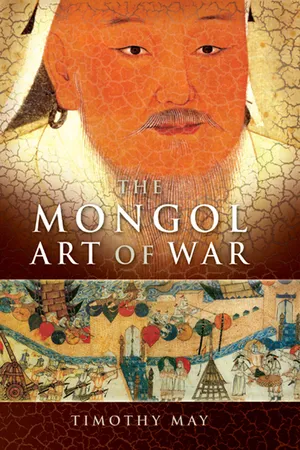
The armies of the Mongol empire are one of the most successful, yet least understood, military forces in history. Often viewed as screaming throngs of horsemen who conquered by sheer force of numbers, they were in fact highly organized regiments who blindsided their opponents with innovative tactics and combat skills. Through the leadership of brilliant military strategists, they achieved the largest land empire ever established, stretching across Asia and into eastern Europe.
In this pioneering study, historian Timothy May demonstrates how the Mongol military developed from a tribal levy into a disciplined and complex military organization. He describes the make-up of the Mongol army from its inception to the demise of the empire. With profiles of Mongol military leaders such as Chinggis Khan—also known as Genghis Khan—May shows how their strength, quality and versatility made them the pre-eminent warriors of their time.
- 224 pages
- English
- ePUB (mobile friendly)
- Available on iOS & Android
eBook - ePub
The Mongol Art of War
About this book
Information
Chapter One
The rise and expansion of the Mongol Empire, 1185–1265
The Mongol Empire founded by Chinggis Khan (also known as Genghis Khan in the West) became the largest contiguous empire in history, stretching from the Sea of Japan to the Mediterranean Sea and the Carpathian Mountains. At its peak, more than a million men were under arms and enrolled in the armies of the Khan, or the emperor of the Mongol Empire. The Mongol Khans became determined to conquer the world, and, indeed, with the resources at their disposal there was little reason why they should fail. Eventually, however, their empire collapsed, partially under its own weight. The following is a brief history of the rise of the Mongol Empire and its subsequent expansion across Asia and into Europe, until it fragmented into four smaller yet still powerful kingdoms.
The rise of Chinggis Khan
The most difficult stage in the evolution of the Mongol empire was the unification of Mongolia itself under Chinggis Khan. There was no clear reason why Temüjin, as Chinggis Khan was known, should become the supreme power in the Mongolian steppe. Indeed, there were many more significant leaders and tribes. The Mongols themselves were a broken power, having suffered defeats by their hereditary enemies – the Tatars in eastern Mongolia, and the Jin Dynasty, which ruled Northern China – in the 1160s. The ramifications of these defeats were immense, and resulted in the Mongols declining to the status of a minor power in the steppe, often requiring the support of more powerful tribes to withstand the continued aggression of the Tatars. Nonetheless, although the Mongols were now without a true khan a few clan leaders still maintained the struggle. One such leader was Yisügei Bahadur (bahadur meaning ‘hero’, ‘brave’). Not only did Yisügei prove to be an ardent enemy of the Tatars, but he was also the catalyst for many of the changes that would sweep through Mongolia for the rest of the twelfth century.
Yisügei fathered Temüjin by his wife Hö’elün, who he had acquired through the nefarious, yet traditional, means of kidnapping. Hö’elün, a member of the Onggirat tribe, had been accompanying her new husband, Chiledu of the Merkit, back to his pasturelands, when Yisügei and his brothers attacked. Chiledu escaped, but Hö’elün was abducted and became Yisügei’s first and senior wife. She gave birth to Temüjin around 1165, and then to Jochi-Kasar, Kachun, and Temüge, as well as a daughter, the youngest child, named Temülün. In addition, Yisügei had married a second wife named Ko’agchin, who gave him another two sons.1 These two boys, Bekhter and Belgütei, appear to have been slightly older than Temüjin, despite being the issue of Yisügei’s second wife.
The children knew their father for only a brief time. When Temüjin was 8 or 9 years old Yisügei took him to find a future bride. Along the way they encountered Dai-Sechen, a leader among the Onggirat, who convinced Yisügei that his own daughter, Börte, only slightly older than Temüjin, would be a good wife for the boy. Furthermore, and perhaps the deciding factor, Dai-Sechen prophesized greatness for the young Mongol lad, saying:
‘This son of yours is a boy,
Who has fire in his eyes,
Who has light in his face.’2
Dai-Sechen also described to Yisügei a dream he had had the previous night, about a white gerfalcon that clutched the sun and the moon as it flew to him. The Onggirat chieftain’s interpretation of the dream was that Temüjin was the gerfalcon, and by clutching the sun and moon it was obvious that he would rule the world.3
Yisügei accepted this as a good omen and left his son with the Onggirat before setting out for home. During his return journey he stopped at a camp to rest, since among the steppe nomads there was, and even today still is, a custom of hospitality towards wayfarers. If someone comes to your camp seeking food or shelter, you are obliged to grant it. This was typical behavior and was reciprocal. Unfortunately for Yisügei, the particular camp he had come to was that of some Tatars. Despite their animosity, the Tatars were still obligated to receive their visitor and tend to his needs. Nonetheless, these particular Tatars, having recognized the Mongol chieftain, poisoned his food and drink, and by the time Yisügei reached home he was near death. His last request was that Temüjin should be brought home, although he passed away (in 1175) before Temüjin arrived.
The death of Temüjin’s father had grave ramifications for the Mongols. Yisügei had been the leader of the Borjigid, one of the major divisions among the Mongols, but although Temüjin had returned home none of the other clans, understandably, would accept the leadership of a 10-year-old boy. Thus most of the clans that had followed Yisügei now flocked to the Tayichiut, another major Mongol group, while the rest found leadership elsewhere. As a result, Temüjin’s family became impoverished.
It was during this period that Temüjin became embroiled in a contest over seniority with his elder half-brother Bekhter. While Temüjin and his brother Jochi-Kasar killed Bekhter in an argument over food, the quarrel was ultimately about power.4 As the eldest son of Yisügei’s senior wife, Hö’elün, Temüjin was the most likely to become leader of the family when he obtained his majority at the age of 15, but Bekhter was a few years older. Thus Bekhter would naturally obtain his majority first, and as such was unlikely to accept inferior rank to his younger half-brother Temüjin. Bekhter might also assume the leadership by Levirate marriage, a common tradition among the nomads being that the sons or brothers of a deceased man could marry his wives (excluding of course, their own mother). It was consequently feasible that Bekhter might marry Hö’elün, and thus become Temüjin’s father and effectively his lord. In all likelihood Temüjin’s murder of his brother had more to do with this possibility than the theft of little a food.
While Temüjin staved off a threat to his primacy among his family, Bekhter’s death triggered a reaction among the other Mongols. The murder of his half-brother violated nomadic custom, and although Temüjin’s family was no longer a major player in steppe politics it still demanded attention. As a result, the Tayichiut raided Temüjin’s camp. While Temüjin and his brothers avoided capture for several days, he was ultimately taken prisoner and brought to the Tayichiut camp, where he was held for perhaps several years.5
Eventually escaping, Temüjin gradually established himself as leader of a small but loyal following outside of his family. It was during this period that he claimed his bride from Dai-Sechen. This was in 1182/3. In addition to marrying Börte, he used her dowry to develop a client relationship with the powerful leader of the Kereits, Toghril Ong-Qan. As ruler of the Kereit, Toghril dominated central Mongolia in the basin of the Selenge, Orkhon and Tula rivers. Temüjin demonstrated a flair for politics by using his father Yisügei’s ties to Toghril to gain his patronage, Yisügei having, on more than one occasion, assisted Toghril in gaining or regaining his throne. Furthermore, the two had been blood-brothers, or anda, and it was on the basis of this relationship that Temüjin now called for Toghril’s help.
Less than a year after gaining his bride and the protection of the powerful khan of the Kereit, the Merkits belatedly avenged the abduction of Hö’elün by raiding Temüjin’s camp. As Temüjin and the others fled, uncertain who was attacking them, Börte was inadvertently left behind and carried off by the Merkits. Temüjin therefore turned to Toghril for assistance. Although, in the grand scheme of things, Temüjin was a minor figure in Toghril’s hierarchy, the latter agreed to assist him, probably because of the opportunity it provided for plunder. Toghril also called upon another Mongol leader, Jamuqa, to join in the campaign. Jamuqa was not only a client of Toghril, and quite possibly the leader of his armies, but was also an anda (blood-brother) of Temüjin, and earlier in his life had been another victim of the depredations of the Merkit.6 The subsequent attack on the Merkit was tremendously successful, not only regaining Börte but disrupting and weakening Merkit power for several years.

Rulers of the Mongol Empire
Yet there were some unforeseen consequences. One was that by the time Börte had been rescued several months had passed, and on the return journey she gave birth to a son, named Jochi. The very name means ‘guest’, and was chosen because Jochi appears not to have been a son of Temüjin, his actual father being a Merkit to whom Börte had been given. Although Temüjin accepted Jochi as his legitimate eldest son throughout his life, it became a source of tension among his offspring.
Another ramification of the Merkit attack was that Temüjin joined Jamuqa for a year. During this time, Temüjin served as a lieutenant to Jamuqa and learned much about the techniques of steppe warfare.7 Yet rivalry between Jamuqa and Temüjin eventually drove the two apart. It is at this point that the charisma of Temüjin becomes very apparent, since when he and his followers separated from Jamuqa they were joined by several members of Jamuqa’s own forces. Although a few members of the Borjigid nobility joined Temüjin, most of those who rallied to him were commoners, many of them barely above the status of slaves. In Temüjin, they saw someone who did not cater only to the interests of the aristocracy.
His separation from Jamuqa accelerated Temüjin’s ascension to power, and in 1185 his relatives elected him Khan of the Borjigids. While his patron Toghril, and even Jamuqa, congratulated him on his new title, the election was disingenuous. Typically, a ruler in the steppe was selected from among the leading figures of the nomadic aristocracy based on experience and the ability to provide for and protect the tribe. In 1185 Temüjin was perhaps 20 years old and had relatively little experience compared to his uncles and the other relatives who elected him, but he did possess enormous charisma. In truth, those that selected him did so because he was thought to be malleable and could be manipulated to serve their needs. Much to their chagrin, they would soon find that Temüjin was no puppet.
Yet Temüjin’s troubles had only just begun. Tensions increased between Temüjin and his anda Jamuqa and eventually war broke out between them. Toghril, as patron of both, did not participate. The two armies met in 1187 at the Battle of Dalan Balzhut, where Jamuqa was victorious. Though Temüjin fled after his defeat, perhaps into China,8 in some respects the battle strengthened him, as many former followers of Jamuqa joined his ranks when the victor exacted a terrible vengeance on those who had left his following in previous years, thus alienating many of those who had remained with him.
It was not until the early 1190s that Temüjin regained enough power to be a force in the steppe again. Although Jamuqa remained a threat, Temüjin felt the time was right to deal with the Tatars, who had steadily increased in power. Indeed, even the Jin Empire in Northern China was concerned about their strength. Thus the Borjigid Mongols and the Kereit, working in concert with the Jin, launched an attack on the Tatars in 1197, and caught between the pincers of the Kereit and Mongols on one side, and the Jin armies on the other, the Tatars were defeated. Although their power was not completely destroyed, they ceased to be an immediate threat to all parties for the time being. As a result, the Jin recognized Toghril as the principal steppe ruler and Temüjin as one of his important vassals.
For the rest of the 1190s, Temüjin’s strength and influence continued to grow. He and Toghril continued to fight the Merkit, as well as the Naiman in Western Mongolia, and Temüjin developed into a capable military leader. On more than one occasion he rescued his overlord, once from the Naiman and a second time by restoring him to his throne after a rebellion. In 1200 Temüjin also established himself as the undisputed ruler of the Onan-Kerulen river basin, the territorial homeland of the Mongols. Conflict between the Borjigids and the Tayichiut was renewed and led to a major battle, from which, in the end, Temüjin emerged victorious. Typically, defeated tribes were added to the strength of the victorious tribe, and many Tayichiut were thereby added to Temüjin’s following. However, his victory was not complete, as the majority of the Tayichiut escaped.
A final confrontation between Temüjin and the Tayichiut was not long in coming. Fearing the growing power of Toghril, due partly to Temüjin’s own success, a number of smaller tribes banded together in a confederacy against the two allies. As their leader they chose Jamuqa, who in 1201 they elected Gur-Khan or Universal Ruler. They then marched against the Kereit and Mongols, but, on encountering them at Köyiten, Jamuqa was defeated. While Toghril pursued Jamuqa and brought him back to submission, Temüjin followed and overthrew the Tayichiut, although he nearly died from an arrow wound in the throat. The bulk of the Tayichiut were then incorporated into the Borjigid Mongols, but to ensure that the tribe would never threaten him again Temüjin executed its leaders. As an unexpected bonus, the Onggirat also joined Temüjin’s following.
Riding a wave of success, he then decided to finish the Tatars once and for all, as they had taken part in the confederation against the Kereit and Mongols. With the addition of the Onggirat and Tayichiut, the Mongols’ strength was greatly enhanced. Before attacking, Temüjin issued a remarkable order: that no one was to stop to plunder until he gave the order.9 Traditionally, once nomadic forces reached the enemy’s camp they plundered it and then rode off with their gains, the point of raids and attacks being not to decimate an enemy but rather to enrich themselves. Temüjin, however, saw a new purpose to war: as a means of guaranteeing security against outside threats. He saw the wisdom – or what modern observers would see as common sense – of securing complete victory over an enemy before enjoying the spoils.
In 1202, Temüjin defeated the Tatars at Dalan Nemürges in Eastern Mongolia, near the Khalkha River. Much as he had done with the Tayichiut, Temüjin ordered the destruction of the Tatar aristocracy, while the commoners were assimilated into the Mongols and distributed among the various clans to ensure that they would not prove troublesome. Having completed this, Temüjin next dealt with his relatives. Since they had elected him as ruler, the Borjigids had considered Temüjin to be their puppet and consequently paid no attention to his prohibition on plundering during the attack on the Tatars. Temüjin therefore confiscated their booty and redistributed it among the rest of the Mongols.
Although still a vassal of Toghril, Temüjin had now become master of Eastern Mongolia. His sudden rise to power began to alter his relationship with Toghril, who naturally became wary of his protégé and was increasingly concerned that Temüjin sought to oust him. Others fed his paranoia, among them Temüjin’s senior relatives, who had fled to Toghril after Temüjin had confiscated their booty. Jamuqa had also rejoined Toghril, and spoke ill of his anda. Furthermore, Toghril’s son, Senggüm saw Temüjin as a rival for the succession to Toghril’s throne. Indeed, Temüjin sought to secure his relationship with Toghril by proposing that his son Jochi should marry Senggüm’s daughter; Senggüm was outraged by his audacity. The conspirators considered using the wedding proposal as an opportunity to destroy Temüjin 10 but the Mongols saw through their designs. Nonetheless, conflict between the Kereit and the Mongols ensued. Although Temüjin suffered a defeat, he managed to rally his forces and made a surprise attack on the Kereit camp as they celebrated their victory.
With this defeat of the Kereit in 1203, Temüjin’s power and prestige increased tremendously, since it meant he now dominated both Central and Eastern Mongolia. Furthermore, assimilating the Kereit further increased the strength of his forces. He did not, however, exterminate the Kereit aristocracy. Instead many of Toghril’s relatives were treated honorably and given high positions, since, having himself served as a vassal of Toghril for a number of years, many of these men were well-known to Temüjin and there was no true animosity between t...
Table of contents
- Front Cover
- Title Page
- Copyright Page
- Contents
- List of Plates
- List of Illustrations
- Maps
- Acknowledgements
- Pronunciation and transliteration guide
- Prologue
- 1. The rise and expansion of the Mongol Empire, 1185–1265
- 2. The recruitment and organization of the Mongol Army
- 3. Training and equipping the Mongol warrior
- 4. The care of the army: logistics, supply, and medical care
- 5. Espionage, tactics, and strategy
- 6. Leadership
- 7. Opponents of the Mongols
- 8. At war with the Mongols
- 9. Legacy of the Mongols
- Glossary
- List of abbreviations used in the notes
- Notes
- Select bibliography
Trusted by 375,005 students
Access to over 1.5 million titles for a fair monthly price.
Study more efficiently using our study tools.
Frequently asked questions
Yes, you can cancel anytime from the Subscription tab in your account settings on the Perlego website. Your subscription will stay active until the end of your current billing period. Learn how to cancel your subscription
No, books cannot be downloaded as external files, such as PDFs, for use outside of Perlego. However, you can download books within the Perlego app for offline reading on mobile or tablet. Learn how to download books offline
We are an online textbook subscription service, where you can get access to an entire online library for less than the price of a single book per month. With over 1.5 million books across 990+ topics, we’ve got you covered! Learn about our mission
Look out for the read-aloud symbol on your next book to see if you can listen to it. The read-aloud tool reads text aloud for you, highlighting the text as it is being read. You can pause it, speed it up and slow it down. Learn more about Read Aloud
Yes! You can use the Perlego app on both iOS and Android devices to read anytime, anywhere — even offline. Perfect for commutes or when you’re on the go.
Please note we cannot support devices running on iOS 13 and Android 7 or earlier. Learn more about using the app
Please note we cannot support devices running on iOS 13 and Android 7 or earlier. Learn more about using the app
Yes, you can access The Mongol Art of War by Timothy May in PDF and/or ePUB format, as well as other popular books in History & Asian History. We have over 1.5 million books available in our catalogue for you to explore.