eBook - ePub
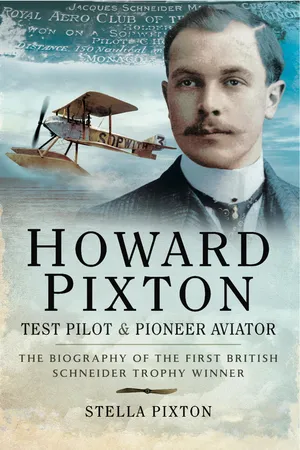
Howard Pixton
Test Pilot & Pioneer Aviator: The Biography of the First British Schneider Trophy Winner
- 230 pages
- English
- ePUB (mobile friendly)
- Available on iOS & Android
eBook - ePub
Howard Pixton
Test Pilot & Pioneer Aviator: The Biography of the First British Schneider Trophy Winner
About this book
This book is a truly remarkable account that captures the atmosphere, thrills and danger of the pioneering days of aviation. Howard Pixton was flying for A V Roe at Brooklands in 1910 when S F Cody at Laffan's Plain tried to persuade him to join him. But in 1911 he test flew A V Roe's 'tractor biplane, the forerunner of the 504. By now acknowledged as the first professional test pilot, he left A V to join Bristols and for two years demonstrated new models to dignitaries across Europe.In 1913 he joined Tommy Sopwith and in 1914 he became the first Briton in a British plane to win an international race, the coveted Schneider Trophy. This gave Britain air supremacy and Howard was feted as the finest pilot in the World. Sopwith's Tabloid aircraft developed into the 'Pup', and then into the 'Camel'. Throughout The Great War Pixton test flew many of the rapid evolving designs.For a biography of an early aviation pioneer of the top rank, this book cannot be bettered.
Information
CHAPTER ONE
Man is Not Meant to Fly
I was there… my full name is Cecil Howard Pixton, but I have always been known as Howard.
Iwas born during Queen Victoria’s reign on 14 December 1885, in ‘The Year of The Motor Car’ when, with the advent of petrol refinement Benz and Daimler, both German engineers working separately, were designing petrol-driven engines for their 3 and 4 wheeler vehicles… then during 1886 when I wasn’t yet one-year-old, the great science-fiction writer Jules Verne, was putting forward his ideas in a novel of his fictional travels in a heavier-than-air vessel, his ship in the air, as being far superior than any lighter-than-air balloon flight…
‘I wanted the air to be a solid support to me, and it is… I saw that to struggle against the wind I must be stronger than the wind, and I am… Air is what I wanted, that was all. Air surrounds me as water surrounds the submarine boat, and in it the propeller acts like the screw of a steamer… That is how I solved the problem of aviation…’
We lived in comparative comfort in quite a large house at Palatine Road in the residential district of West Didsbury, having two maids, a cook and gardener. There were four boys in the family, Dudley, Aubrey, Bert and myself the youngest. My father, a well-known stockbroker, had his business premises in Half Moon Street, St Anne’s Square, and while I was very young, formed a partnership, the firm then being known as Messrs Pixton & Coppock. Each year we went to the Isle of Man for a holiday, staying five or six weeks at the Bay Hotel, Port Erin. I spent a lot of my time in the open-air swimming pool there, taking home medals on winning various speed swimming competitions. We also spent a week or so at Llandudno where it was very quiet and suited father whenever he wanted to get away from his business for a few days. When of age my father sent me to a Manchester Grammar School as a day pupil where we had a fine headmaster who amicably referred to my youthful declarations as ‘Pixtonian Words of Wisdom’. However, a retired sergeant who came to the school from time to time and gave us wooden guns for drill instruction, was not so kindly disposed towards me, and would bellow, ‘Pin-xton. You Stoo-pid lad!’
Horse cabs were the usual form of transport and, in common with most youngsters, I used to ride on the cab’s back axle, but more than often children playing in the streets shouted up to the coachman, ‘Whip behind, Guv’nor.’ And the driver understood he had unwanted passengers and would crack his whip smartly over his head so that it caught our faces and limbs. Sometimes because of this joyriding, spikes were fitted onto the axle, thereby depriving us of our free ride and fun of daring, but with the discovery of petrol there was a new vehicle, the motor car, first known as the horseless carriage. Horses were very frightened by them and easily went out of control when one came near, but seldom was one seen. The few passing through Manchester had a man, usually a servant or friend, walking in front with a red flag to ensure a speed limit of 4 miles per hour was kept for public safety. It was illegal, otherwise, to drive, but these strange vehicles attracted us when on the rare occasions they appeared and we would run beside them for miles until exhausted. The men with the red flags were supposed to stay in front, but if the Police were not in sight and the road was quiet, they invariably jumped aboard. Unfortunately our Government held us back in the new industry with its absurd restrictions so that we were far behind European countries and America, not only in our attitude towards the motor car, but in our engineering knowledge. The few seen in Britain were imported chiefly from France which led in their manufacture. Then the red flag days were over. From 14 November 1896, motor enthusiasts were at liberty to race through the streets up to 12 miles per hour unaccompanied. Headline news – ‘Emancipation Day for Motorists’.
Aubrey gave me a bicycle made with thick steel tubes and pneumatic tyres stuck to the rims of the wheels, and one day while out cycling I saw for the first time a car travelling at the new speed of 12 miles per hour. I’d not seen a car for three years since the 4-mile limit had been lifted as so few people owned one. I jumped onto my bicycle to follow it. What a difference in speed. It was coming from the 1899 Agriculture Show at Trafford Park where it had been on display, and as I followed closely behind, doors all along the streets were flung open and people rushed out to see it pass by. Although cars were still a novelty, the public expressed unbelievable prejudice towards them. I loved them and hoped to have one of my own when I was old enough, but the Press gave their opinions and published readers’ complaints, ‘Ban them from the roads… noisy, dangerous playthings for the rich’.
Petrol was also being put to a different use. A number of balloon flights had been made in various parts of the world, but when I was 13-years-old a very practical, elongated one, steerable by the use of power derived from petrol, was headline news. It had been constructed by Santos-Dumont, a resident in Paris and son of a wealthy Brazilian. In the following years Santos-Dumont used his dirigible as an everyday means of transport. Parisians waited to see him come home by air to his apartment in the Champs Élysées, and watched his servant catch the guide rope to bring him to earth.
Just before I left school in 1901, I was the very proud possessor of a 2¾-horsepower Ariel Tricycle. I thereby became one of the first owners of a motorised vehicle in Manchester. It had no number plates but when the Motor Act was passed and car registration became law, I had to fix a plate, N78, onto it. Father and Coppock dissolved their partnership at the beginning of the century, Aubrey joined the company then registered as J.S. Pixton & Son, but not long afterwards father told us the state of his affairs. He was bankrupt. The news was unexpected and came as a terrible blow. Although I asked what happened, I never really understood what had actually gone wrong. We left Didsbury, had a short stay at the Bowdon Hydro and, still remaining in Manchester, moved into lodgings at 31 Claremont Road, Alexandra Park. Father became the manager to the Manchester Safe Deposit Company, and I was apprenticed to the Industrial Engineering Company at Newton, Hyde, a company that made a variety of things. During my short stay with them they built the first motor-horse, a steam truck on wheels with a detachable engine cab to pull it. It was a revolutionary idea, but the vehicle did not prove efficient on steep hills as the wheels spun round due to insufficient weight and lack of gripping power in the iron tyres.
Motor vehicles certainly fascinated me. What fascinated me even more was the new vehicle of the air, the Flying Machine. Up to now no one had managed to fly a heavier-than-air machine, so when the world’s first flight was announced, I was filled with avid interest. For hundreds of years man had tried to fly. It was December 1903 when two Americans, Wilbur and Orville Wright raised their flying machine, The Flyer, off the ground running it along a rail to gather speed and using a petrol-driven engine working two propellers behind the wings. It had skids, no wheels. What an achievement! A scientist some centuries ago had concluded that man could never hope to succeed to fly, ‘God would prevent such a revolution in human affairs.’ More recently, it was thought that an object heavier-than-air would never leave the ground unless lifted by gas and that balloon flight was the only means of air travel, but the brothers had flown between 200 and 300yds.
It took the brothers another year to fly three miles and they were the only two who knew how to fly by the end of 1905. By then they’d flown 24 miles in a single flight. It was incredible! Two years had passed and still no one else knew the secret of flight. France had a few designers with machines that could not fly and Britain had nothing except balloons, kites and the odd man or two who dreamt of flying. But people all over the world doubted the brothers’ achievements, believing their claims extravagant. ‘We’ve not seen them… Why don’t they show us?.. No one can fly… Man is not meant to fly!’
I served my three-year apprenticeship with the Industrial Engineering Company, and in 1905 joined another firm, the Simplex Engineering Company at Trafford Park, makers of four-spindle automatic lathes and machine tools, and was employed in the drawing office as a machine-tool draughtsman. It was a good firm to work for and while there I bought myself a 4½-horsepower Minerva motorbike, a great improvement on the Ariel Tricycle. I’d been at the company for just over a year when, in 1906, three years after the first flight, Santos-Dumont was in the news again. The well-known balloonist had flown 200yds on a flying machine in France, so becoming the second man to fly, counting the Wright brothers as one. With this latest news the French were jubilant. Of his achievement, they exclaimed ‘What a triumph. A month ago Santos flew 20yds. A fortnight ago he flew 70. Yesterday he flew still further. The air is truly conquered. Santos has flown. Everybody will fly.’
Next day the founder of the Daily Mail, Lord Northcliffe, offered £10,000 for the first man to fly between London and Manchester. Some admired him, ‘A great enthusiast’. I was just amazed by the enormity of the sum, £10,000 in 1906 was quite a fortune, but as most people still believed flight was not possible, such an offer was met with ridicule. ‘It can’t be done… It’ll never be possible… It’ll be a miracle to do a mile, never mind 183 miles… Publicity exploit of the Daily Mail!’ Their offer was ridiculed by a rival paper, The Star, who offered £10,000,000 for a lesser flight.
‘A morning paper makes the trivial offer of £10,000 to the first aeroplane that flies from London to Manchester. Our own offer of £10,000,000 to the flying machine of any description whatsoever that flies five miles from London and back to the point of departure still holds good. One offer is as safe as the other.’
The proprietors were sticking their necks out a bit, but still the Wright brothers’ flights were not believed. Had they come to England, The Star would have been placed in a very embarrassing position as the brothers could have easily flown the desired distance without much difficulty. Then Punch entertained its readers with an offer of £30,000 in three sums of £10,000 for three improbable tasks:
‘£10,000 to the first aeronaut who succeeds in flying to Mars and back within a week… £10,000 to the first person who succeeds in penetrating the centre of the Earth in a fortnight… £10,000 to the first person who succeeds in swimming from Fishguard, Wales to Sandy Hook, USA before the end of 1909.’
Following the Daily Mail’s lead, there came other serious offers, but none as great as theirs. Lord Montagu, editor of The Car, backed their offer with £1,000 or £5 for each mile flown. In addition, Lord Montagu, as President of the Brooklands Automobile Racing Club, announced that he would pay £2,000 to the first man who flew around their newly built track at Brooklands in Surrey, if accomplished before or just after the end of 1907. Thomas Holt, director of The Graphic, also offered £1,000 to the first to fly a mile at Brooklands with a passenger. Just trying to get a machine off the ground was difficult enough, never mind with a passenger.
Hoping to win the Brooklands prizes was A.V. Roe, a Manchester man like myself, and soon after the announcements he went to the race track with a biplane he had built, which had one propeller behind the wings. There, at the track, motorists offered to tow him to give his machine lift at the start of the attempted flights, but all was of little avail. For most of that year after the racing season was over, A.V. Roe was alone at Brooklands, but as much as he tried, the little 9-horsepower engine he was using had not the power to lift his machine sufficiently off the ground. He had been waiting for a French engine, a 24-horsepower Antoinette, with which he would have had a better chance, but it did not arrive in time. The prizes were withdrawn and Roe left Brooklands at the beginning of the 1908 racing season.
While a handful of British experimenters were trying to fly, a third man lifted a machine over 200yds. He was Louis Blériot, a Frenchman, and he did it in September 1907. He’d not copied the proven Wright machine, but had worked on entirely new principles regardless of peoples’ opinions, and had produced a monoplane which met with no encouragement. ‘A flying machine with only one pair of wings could never fly… It’ll not have enough lift.’ But fly he did. What was so important about Blériot’s success was that the world now had two basic designs to copy, the biplane and the monoplane. Not only that, but even more radical was the fact that he’d placed the propeller on the nose of the machine. Thus the terms ‘tractor’ and ‘pusher’ originated to distinguish the type of machine, depending on the position of the propeller, in front or behind the wings.
A couple of months later two more men flew over 200yds; Henry Farman and Delagrange had got a Voisin Box Kite to fly. It can be said that Farman was the first Briton to fly, but his successes were not considered British as his claim to British nationality was practically discounted. His father was English, the Paris correspondent of The Standard, his mother French and I believe Farman himself was born in Paris or had lived most of his life there.
A long time had elapsed since the Wright brothers were in the news. As no one had heard much about them since 1905, further doubts to the validity of their claims arose. No one had yet flown in Britain, Blériot and Farman were managing short flights, and the Wright brothers were almost forgotten when suddenly they showed themselves to the world. They arrived in France in mid-1908 and flew, to the amazement of French designers, astonishing non-stop periods of an hour or more, covering 30 to 40 miles in a single flight launched from a derrick and rail. Why had they not come forward earlier? Why had they not reaped the several thousands of pounds of French and British awards on offer? Would they now try for the Daily Mail £10,000 for the London to Manchester flight, still open to anyone of any nationality? The reason why they went to France was to discuss production with the French Government since they were not backed by their own government. They’d already approached Britain but no agreement was reached, as the War Office had not been interested in their demanding propositions.
Shortly after the Wright brothers had flown those fantastic distances in France, one man in Britain flew over 200yds. This man was Cody, an American employed since the beginning of the century at the Government Establishment, Farnborough. He’d been engaged for his kiting knowledge, and had made several man-lifting kites for the Army, from which followed the construction of a flying machine financed by Government money. So at last Britain could fly.
Cody’s flight, accomplished during the autumn of 1908 was a great British achievement, but compared with the Wright brothers’ and French standards, it rated as an insignificant flight. The machine resembled the Wright brothers’ pusher biplane but what Britain needed was more men interested in flight to catch up with the great lead of America and France. It had been just the same with the motorcar, America and France ahead of us! Roe worked quietly on his second machine, a triplane, having three pairs of wings and propeller in front. He had risen, but for no appreciable height or distance. Meanwhile, there’d been reports of a marvellous flying machine being made in secret in Glen Tilt, Scotland. Dunne, a friend of the famous writer H.G. Wells was experimenting with a machine that had its wings swept backwards in a wide V-shape. A great interest was taken in it but these early experiments were not successful, for had it flown everyone would have known about it.
During my employment at the engineering companies, I’d spent six years, from 1902 to 1908, as a day and evening student at the School of Engineering, 78 Cross Street, Manchester, and passed in the higher stages of Machine Drawing, Applied Mechanics and Practical Mathematics in various examinations. J. Firth, the principal, wrote in a recommendation, ‘He has an aptitude for the Engineering Profession generally and a liking for, and inclination towards motor-work in particular.’ I had, by now, been three years at the Simplex Engineering Company, and was assistant to the chief draughtsman, but I decided to change from my white-collar position and put on overalls in order to enter into the practical side of engineering.
I found a situation as a mechanic with the British Engineering Company of Leek, manufacturers of steam and gas engines, dynamos and motors, and left Manchester. On arriving at the small town I looked for modest accommodation and happened to go along Barngate Street. The rows of houses all looked alike, each with a front door and window alternating down the street. I went from one house to another, knocking on all doors until I found an elderly lady who had a spare room. ‘How much?’ ‘Full board, fourteen shillings.’ That was very fair. I took it. She had three rooms to let, the other two were occupied by a couple of Mormons, very nice fellows in their fifties who went around the town in search of new followers. They did not stay long in Leek as I imagine the locals were not easy to convert and two workmen took their place, staying with us while they installed a radically new type of gas engine at the local electric station, made by Mather and Platt of Manchester. The front room was the common room for guests, which also served as the dining room, but I’d not been there long when I was wandering into the kitchen and taking my meals with the landlady. I learnt that her husband had died some time ago and her only son was a chemist in London.
The firm I’d joined was owned by people called Sutcliffe and I did all sorts of jobs for them. They had a horse and trap and employed a coachman, but had just replaced them with a 20-horsepower Beeston Humber car, the more expensive of the two types, the other being the Coventry Humber. They were exceptionally nice people and during the period I was in Leek I was extremely happy, the work was pleasant, the people of Leek friendly and the surrounding countryside very beautiful.
But I was still extremely interested in flight…
CHAPTER TWO
Flying Here to Stay
Apublication, Flight founded by Stanley Spooner at the beginning of 1909, was to be a magazine entirely devoted to the new subject of the flying machine. Up to this time the Aeronautical Journal and motor magazines had carried the news on flying matters. I bought Flight each week to read of the latest developments but it was full of French news. There appeared, however, short notes on lectures taking place in Britain, the formation of flying clubs up and down the country whose members contented themselves with ballooning, kiting, model-making and model flying, none of which particularly interested me. Some readers th...
Table of contents
- Cover
- Title Page
- Copyright
- Contents
- Dedication
- Foreword
- Preface
- Previews
- Chapter 1: Man is Not Meant to Fly
- Chapter 2: Flying Here to Stay
- Chapter 3: Turning Point
- Chapter 4: With Roe at Brooklands
- Chapter 5: With Roe flying the Avro Biplane
- Chapter 6: With Bristol at Brooklands
- Chapter 7: With Bristol at Salisbury Plain
- Chapter 8: With Bristol Overseas
- Chapter 9: With Bristol as School Manager
- Chapter 10: With Sopwith Flying the Tabloid Biplane
- Chapter 11: With Sopwith winning the Schneider Trophy
- Chapter 12: With Sopwith after winning the Schneider Trophy
- Chapter 13: War 1914–1918
Trusted by 375,005 students
Access to over 1.5 million titles for a fair monthly price.
Study more efficiently using our study tools.
Frequently asked questions
Yes, you can cancel anytime from the Subscription tab in your account settings on the Perlego website. Your subscription will stay active until the end of your current billing period. Learn how to cancel your subscription
No, books cannot be downloaded as external files, such as PDFs, for use outside of Perlego. However, you can download books within the Perlego app for offline reading on mobile or tablet. Learn how to download books offline
We are an online textbook subscription service, where you can get access to an entire online library for less than the price of a single book per month. With over 1.5 million books across 990+ topics, we’ve got you covered! Learn about our mission
Look out for the read-aloud symbol on your next book to see if you can listen to it. The read-aloud tool reads text aloud for you, highlighting the text as it is being read. You can pause it, speed it up and slow it down. Learn more about Read Aloud
Yes! You can use the Perlego app on both iOS and Android devices to read anytime, anywhere — even offline. Perfect for commutes or when you’re on the go.
Please note we cannot support devices running on iOS 13 and Android 7 or earlier. Learn more about using the app
Please note we cannot support devices running on iOS 13 and Android 7 or earlier. Learn more about using the app
Yes, you can access Howard Pixton by Stella Pixton in PDF and/or ePUB format, as well as other popular books in History & Military Biographies. We have over 1.5 million books available in our catalogue for you to explore.