- 159 pages
- English
- ePUB (mobile friendly)
- Available on iOS & Android
eBook - ePub
About this book
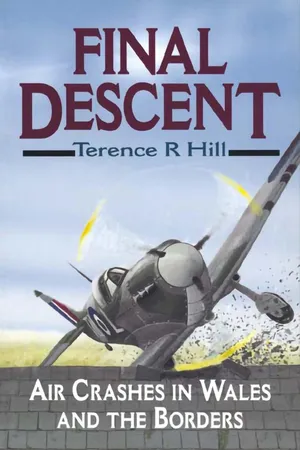
Final Descent presents detailed information on the loss of allied aircraft in the forbidding hills of Wales and the often tragic consequences.
Trusted by 375,005 students
Access to over 1.5 million titles for a fair monthly price.
Study more efficiently using our study tools.
Information
CONTENTS
Dedication
Introduction
North Wales Sector
Botha L6318
Anson N5154
Lancaster R5736
Vampire VZ874
Wellington HF519
Wellington BJ700
Oxford N4568
Anson N5130
Eastern Wales and Borders Sector
Spitfire TE210
Beaufighter NE203
Blenheim L4873
B17E 41-9098
Washington WF502
Vampire 334
Baltimore AG689
Audax K7435
Spitfire P7963
Spitfire P7280
Anson K6248
Llanbedr and Dolgellau Sector
Wellington HX433
Wellington HE872
Wellington N2866
Mid Wales Sector
Wellington L4230
Martinet HN888
Harvard N7077
Hunter XE680
Hunter XJ637
Acknowledgements
DEDICATION
This book is dedicated to all those aircrew who lost their lives in WWII, but especially to those who died during training flights over Wales and bordering counties.
I also had in mind one airman who never flew in action, or even as an aircrew member but who, nevertheless, was responsible for my interest in the RAF and aircraft in general: my late Father.
In the RNAS as a young man, he was transferred to the RAF when it was formed on 1st April 1918. As an engine fitter, he served aboard the seaplane carrier HMS Pegasus when, in 1924, the first landing by an RAF aircraft was made in Singapore. Two years later he was in South Africa, still with the same aircraft, the Fairey 111D, taking part in the historic 1926 Cape to Cairo flight – the first long distance RAF formation flight. He left the RAF soon after, but was recalled during WWII, his work at RAF Stradishall remaining the same; the engines now no longer Napier Lions but Rolls-Royce Merlins. My Father finally said goodbye to the RAF on 10th December 1945 and I joined just one week later. Between us we eventually completed forty six years service.
This book then, is dedicated also to all the unsung ground crews of the RAF both in war and peace.

Fairey IIID N9463, the first RAF aeroplane to land in Singapore 20th April 1924. My father is in the middle cockpit.

One of the first flight of aircraft taxis back to HMS Pegasus, Singapore
INTRODUCTION
A number of books have been written about air crashes in Wales, including two by myself. Why another now? Many of these books were written a number of years ago and, in the intervening period, more information has come to light whilst, conversely, the physical evidence of these events has become less obvious and, in some cases, disappeared altogether. Additionally, as with all history, looking at the evidence from a different viewpoint can give the reader a greater insight into these disasters.
The main ethos of my writing has been, and still remains, the fact that I have personally visited all the sites mentioned and have not relied totally on information given to me by other researchers. The benefit of this to the reader is that everything read here will have been collected in the three years prior to publication and the sites should have changed little during this time.

The author Abingdon 1966
Other books on the subject invariably have valuable and painstaking research included, but the photographs, sometimes over twenty five years old, frequently give a misleading idea of what the searcher might expect to find today.
Finding actual fragments has, to me, been most important. I rarely want to keep these pieces but without seeing them on site I cannot be sure that I am, indeed, at the correct location.
Sometimes, nothing whatsoever can be found and, unless I have firm documentary or other evidence, the map reference I give will be followed by an asterisk. This means that, although I have made thorough and often frequent visits to the site, no trace remains. Should, for instance, the gorse be later burnt down, or trees felled, something may, of course, yet come to light. Despite access to official documents, locations and names of crew members can still be in doubt. Take the case of Wellington L4230, which crash-landed on Great Rhos; the books I have read on the subject give the name of the pilot as one who, according to the MoD, did not exist. Have official records been mislaid, or has an incorrect name been passed down by various authors?
I myself have not been immune to such errors. In my first book I recorded the crash of a Republic P47 Thunderbolt in North Wales, giving the name of the pilot as Lieutenant Barratt. This name had been mentioned to me by several people and appeared in other books. Only after publication did I receive, from a friend in Welshpool, a copy of the USAAF official report giving the correct name as Lieutenant Beauchamp. So those in glasshouses should, I suppose, be reasonably certain of their aim before hurling missiles! Perhaps it is just as well; if any book could be totally researched to its final conclusion, not only would the cost be prohibitive but, by the time it reached publication, the sites would probably be bare and valuable records lost.
Be assured that I have taken all reasonable steps in ensuring that any information contained herein is as accurate as I can make it. Finally, although 27 crash sites are described in this book it is not, of course, a complete record. Unfortunately, many hundreds of aircraft met their end in the Principality.
*****
NOTES ON SITE FINDING
Long gone are the days when large amounts of wreckage can be found at most sites. Those in the mountains and less accessible areas naturally have the most, but this book does not venture into the highest regions. Many sites are, indeed, on level fields. The reader must be aware that permission from the landowner must be sought before proceeding; even if a marked footpath passes through a farm it is common courtesy to ask permission to use it.
It is still not unusual, fifty or so years after the event, to find witnesses to the crash, or rather those who have seen the wreckage. People who have actually seen the aircraft fall to earth are very few and far between, and the intervening years have invariably caused these memories to become distorted.
On finding a site it is a natural impulse to want to take some fragments away with you. If you must, make it just a tiny piece. It serves no purpose to remove wreckage wholesale or even to just throw it into a hedge. Put it back where it was found; far better to make a photographic record of what you discover.
Even if you are not an aircraft enthusiast, these sites can give purpose to walks in Wales and the bordering counties. Unlike golf, which someone described as a good walk spoiled, a crash site visit might be called a good walk made even better!
AIRCRAFT WRECKAGE
The ownership of the remains of British, United States and German aircraft is vested in the Ministry of Defence.
Permission of that Ministry should be sought if it is intended to recover any parts found. This is mainly intended for groups who wish to actually excavate the site, and not really aimed at someone casually picking up a small item, however, technically, no part should be removed. This may seem a trifle ridiculous when it is known that groups, local councils, and individuals have been carting away wreckage wholesale for years, and in some cases selling it.
Really, it is best not to remove parts but to photograph them for later identification; this will also have the advantage of leaving something for successive generations to find.
The contact address for those who wish to recover items is: Ministry of Defence, Room F63, Building 255, RAF Innsworth, Gloucester GL3 1EZ
MAPS
All references gi...
Table of contents
- Cover
- Half Title Page
- Title Page
- Copyright Page
- Contents
Frequently asked questions
Yes, you can cancel anytime from the Subscription tab in your account settings on the Perlego website. Your subscription will stay active until the end of your current billing period. Learn how to cancel your subscription
No, books cannot be downloaded as external files, such as PDFs, for use outside of Perlego. However, you can download books within the Perlego app for offline reading on mobile or tablet. Learn how to download books offline
Perlego offers two plans: Essential and Complete
- Essential is ideal for learners and professionals who enjoy exploring a wide range of subjects. Access the Essential Library with 800,000+ trusted titles and best-sellers across business, personal growth, and the humanities. Includes unlimited reading time and Standard Read Aloud voice.
- Complete: Perfect for advanced learners and researchers needing full, unrestricted access. Unlock 1.5M+ books across hundreds of subjects, including academic and specialized titles. The Complete Plan also includes advanced features like Premium Read Aloud and Research Assistant.
We are an online textbook subscription service, where you can get access to an entire online library for less than the price of a single book per month. With over 1.5 million books across 990+ topics, we’ve got you covered! Learn about our mission
Look out for the read-aloud symbol on your next book to see if you can listen to it. The read-aloud tool reads text aloud for you, highlighting the text as it is being read. You can pause it, speed it up and slow it down. Learn more about Read Aloud
Yes! You can use the Perlego app on both iOS and Android devices to read anytime, anywhere — even offline. Perfect for commutes or when you’re on the go.
Please note we cannot support devices running on iOS 13 and Android 7 or earlier. Learn more about using the app
Please note we cannot support devices running on iOS 13 and Android 7 or earlier. Learn more about using the app
Yes, you can access Final Descent by Terence Hill in PDF and/or ePUB format, as well as other popular books in History & Military & Maritime History. We have over 1.5 million books available in our catalogue for you to explore.