A detailed look at the day-to-day life of a pilot serving during the Persian Gulf War against Iraq.
This book is based upon a journal Jim Schreiner kept during his deployment to the Persian Gulf region for Operations Desert Shield and Desert Storm. Building upon that record and the recollections of other F-4G Wild Weasel aircrew, the authors show a slice of what life and war was like during that time. The pawns in the game, the ones that actually had to do the fighting and dying were the hundreds of thousands of men and women who left their homes and families to live for seemingly endless months in the vast, trackless desert while the world stage-play unfolded. To them, the war was deeply personal. At times, the war was scary; at other times, it was funny as hell. Usually, if you survive the former, it turns into the latter.
eBook - ePub
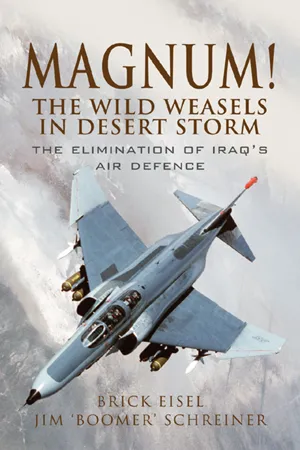
Magnum! The Wild Weasels in Desert Storm
The Elimination of Iraq's Air Defence
- 272 pages
- English
- ePUB (mobile friendly)
- Available on iOS & Android
eBook - ePub
Magnum! The Wild Weasels in Desert Storm
The Elimination of Iraq's Air Defence
About this book
Information
Chapter One
The first known US aircraft shot down by a surface-to-air missile (SAM) occurred on 1 May 1960. Francis Gary Powers, flying a more than 1,000 miles route overhead the Soviet Union in a CIA-sponsored Lockheed U-2 reconnaissance jet, saw several MiG fighters try to reach his altitude of well over 70,000 feet and fail. However, a Soviet V-750 Dvina, known to NATO as the SA-2 ‘Guideline’, the telephone pole-sized SAM that would become infamous half a decade later in the skies over North Vietnam, could almost reach him. He didn’t know about it and couldn’t see it. (Note: The NATO – North Atlantic Treaty Organization – nomenclature for Soviet-era SAMs, radars and aircraft is used throughout this work, e.g. ‘Guideline’.)
The SA-2 had a range of 25 miles and at Mach 4, could travel to its target in an incredibly short time. Not designed for low-altitude use, it was a deadly peril to anyone flying between 5,000 and 60,000 feet. Any aircraft wanting to avoid being a SAM target had to move into the low-level regime where old-fashioned guns became the biggest threat.
The SAM operator, under intense pressure coming directly from Soviet leader Nikita Kruschev, fired the instant Powers’ jet was within range. With a cloud of noxious fumes and a bright orange glow, the SA-2 salvo of three missiles quickly leapt from their launchers and rocketed skyward. The missile tracking Powers detonated close enough that although the explosive warhead did not hit him, the concussive shockwave, magnified in the thin air at such a height, tore the spindly U-2 apart.
From that day on, SAMs have become a major threat to Allied aircraft. Fielding better, more advanced SAMs and finding ways to defeat an adversary’s SAMs has become a continuing theme for air forces around the world.
In the United States’ case, in its long tangle with North Vietnam, SA-2s were first photographed in April 1965. In July of that year, the first SAM killed a US fighter. From then on, increasingly more American resources were devoted to countering and defeating the deadly missiles.
In a never-ending game of threat and counter threat, more numerous and more lethal SAM systems have evolved. From the SA-2s of Vietnam, today’s SAMs run the gamut from short-range, shoulder-fired IR (infrared – heat seeking) missiles like the SA-7 ‘Grail’ and its descendants – SA-14 ‘Gremlin’/SA-16 ‘Gimlet’ – to the extremely long-range, mammoth SA-10 ‘Grumble’, capable of ‘reaching out and touching someone’ at 200 miles and from altitudes of 50 feet up to 100,000 feet. Many more SAM designs lie between the short-range SA-7 and the long-range SA-10.
Except for the IR-guided SAMs, the rest of these deadly aircraft killers use radar to detect and track a target and at least one additional, sometimes more, radar to provide fire control and/or missile guidance. Each radar emits energy in a specific wavelength to perform its job.
Generally, early warning (EW) radars provide advanced notification that an aircraft is out there. The radar can see targets at very long range; only the curvature of the earth can hide high-flying jets from its view. To scan the vast volumes of airspace at those distances, EW radars use longer wavelength frequencies like HF – high frequency -or VHF – very high frequency – for detection.
Each sweep of the radar takes a relatively long time to accomplish but scours a huge volume of airspace. Although good at finding the evidence of an incoming aircraft, EW radar data is too vague to provide the precise location of incoming target. Since the ‘kill’ envelope of a SAM’s warhead is limited compared with the volume of the sky, much more accurate data is needed to target a SAM.
This is where the acquisition (AQ) and target tracking radars (TTR) come into play. For the Vietnam-era SA-2, the ‘Fan Song’ radar used much shorter UHF (ultra high frequency) wavelengths. Since the TTR operator knew in what area to look, he could rapidly acquire and refine the exact position of the intended target. Once the target was within the performance parameters – within the missile’s range and height capabilities – of the SA-2, the operator fired the missile, often two or three at a time in a salvo.
Using another radar to track the SAM, the operator ‘connected the dots’ on his radar scope. The SAM followed the invisible beam of its radar like a blind bloodhound and the operator steered that beam to the dot being tracked by the first radar. When the dots merged on his scope, he could either command to detonate the SAM or in later models, sensors in the missile detected the aircraft and exploded the warhead. In many cases, this ‘dot to dot’ merge meant another American jet was severely damaged if not destroyed.
What makes many SAMs even more deadly is that they are mounted on mobile launchers and no longer have to be set up at a fixed, easily targetable site like an SA-2. Some, of course, do require such a site, but truck and tracked vehicle-mounted SAMs can easily ‘shoot and scoot’ to avoid being destroyed after launching.
One of the earliest methods of defeating SAMs by a fighter has been to ‘take it down.’ By flying nap of the earth sorties, aircraft avoid being seen by the radar beams of most SAMs. Of course, the counter to this tactic is simply to spray a wall of lead into the air and wait for the jet to fly into it.
Indeed, in Vietnam, the North often employed this tactic, called a ‘flak trap’. By launching an SA-2, even if unguided, American aircraft had to honour the threat of the SAM and go low to avoid being targeted. Once the US aircraft was low enough, the Vietnamese used guns ranging from infantrymen’s rifles or machine-guns to large-calibre, radar-directed cannons to fill the airspace with deadly metal fragments. The US lost more aircraft to this than to SAMs. (Antiaircraft artillery was called ‘Triple A’ in the tactical vernacular, also sometimes written as ‘AAA’. It was labelled flak by an earlier generation.)
Additionally, having to out-manoeuvre the SAM meant the heavily laden fighter-bombers used by US Air Force, Navy, and Marine Corps usually had to jettison their bombs to make their jets nimble enough to react. Of course, with no bombs to drop, the intended target was safe for another day.
The whole drama had to be re-staged for another mission, giving the defences another shot at the fighters, which might mean the fighters having to dump their bombs to avoid getting hit. This meant the mission was wasted, which meant it had to be flown again, meaning the defences got another opportunity and so on for the years of the Vietnam War.
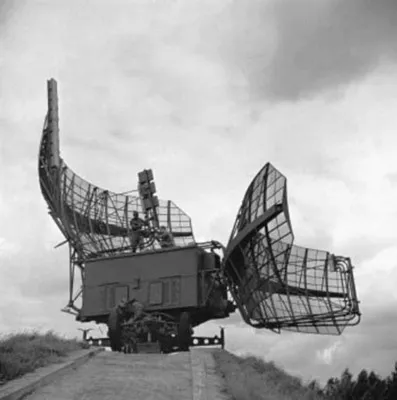
Soviet P-35 ‘Bar Lock’ long range acquisition radar. (DoD)
Together, SAMs and AAA formed a powerful ‘one-two’ punch for air defence. Add in a knock-out blow provided by fighter interceptors and a nation so equipped has an impressive system for keeping an adversary out of its skies.
The Iraqi air defences faced by the nearly 500,000 Allied ground, naval and air forces of the Coalition during Operation Desert Storm were thought to be some of the fiercest, most integrated of any nation in the world, much better even than those of the North Vietnamese.
At the heart of the Iraq integrated air defence system (IADS) was the French-designed and built KARI (Iraq spelled backward in French) Command/Control/Communications (C3) network. By providing a unified way of integrating all the inputs and centralised control of the reactions, KARI was a deadly threat to Coalition air power. Without destroying KARI and the component parts of the IADS, the Allies could not achieve air superiority.
Without air superiority, the ground forces necessary to drive Iraq from Kuwait were at much higher risk from the Iraqi Air Force. Without air superiority, General Norman Schwarzkopf, the overall military leader of the Coalition, did not have the ability to choose from all his options in dealing with Iraq’s large ground forces. Air superiority was thus the first key to success in winning the war. Killing the IADS, therefore, was job one for the Coalition’s air commanders.
In particular, the IADS of Iraq and its conquered territory of Kuwait had over 400 radar-guided surface-to-air missile batteries and nearly 7,000 shoulder-launched man-portable (MANPAD) IR SAMs. Add in the more than 6,000 AAA guns of various calibres and Iraqi skies were deadly.
Since Iraq had long been supplied and trained by the Soviet Union, it follows that her air defences used the Soviet model. The Iraqi strategic air defences used large EW radars such as the P-35/P-37 ‘Bar Lock’. These high powered, but low frequency and long pulse repetition frequency (PRF) radars were at fixed sites usually located at critical air bases or large cities.
The Bar Lock was also used by the Soviet-trained GCI (ground controlled intercept) controllers; technicians trained in deciphering the radar screen display and radioing height, speed, and heading instructions to the Iraqi fighter pilot. The pilot had to follow these instructions to the letter, since Soviet doctrine dictated very heavy reliance on ground controller instructions to obtain results versus the more free-ranging latitude used by most Western combat pilots.
Other EW radars were mobile but at the cost of detection range. Radars such as the Flat Face, Squat Eye, and Spoon Rest couldn’t see as far as a Bar Lock, but did provide more precise target location data. This data was then sent via electronic data link or relayed via voice over the telephone or radio directly to individual SAM or AAA batteries.
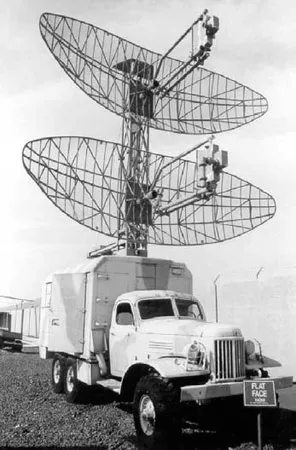
Soviet P-15 ‘Flat Face’ long range acquisition radar used most often by the SA-3 medium-range SAM system. (DoD)
The Flat Face radar consists of a trailer-mounted pair of elliptical antennas attached one above the other on a mast sticking up from the trailer. It typically supported SA-3, SA-6, SA-8, and SA-9 Soviet-built SAMs. It could also be used in conjunction with the French-built Roland SAM system. The Flat Face supported various calibres of AAA like the ZSU-23, a tank-like, four-barrelled, rapid fire 23-mm AAA vehicle as well.
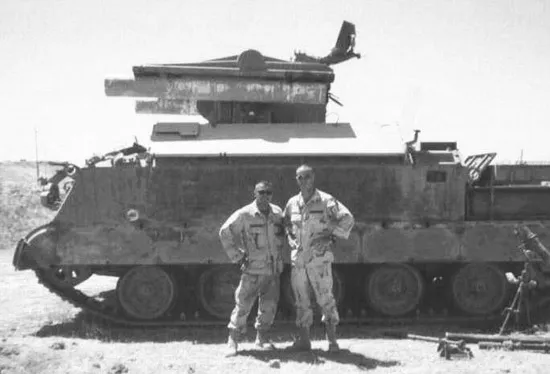
Roland short-range Franco-German manufactured mobile SAM system. Here a captured Iraqi unit is the backdrop for a couple of US Army troops. (DoD)
The Fan Song radar, known since its Vietnam days, primarily supported the venerable SA-2. Using two ‘trough’ antennas, one vertical on the side of the control van and the other horizontal under the front of the van, the radar had a respectable 150-mile range if the target was at very high altitude. Most targets, however, weren’t that high so a detection range of 40-50 miles was usually the norm. This was still a big enough picture to give the SA-2 with its 25-mile range a good look at the target prior to engaging.
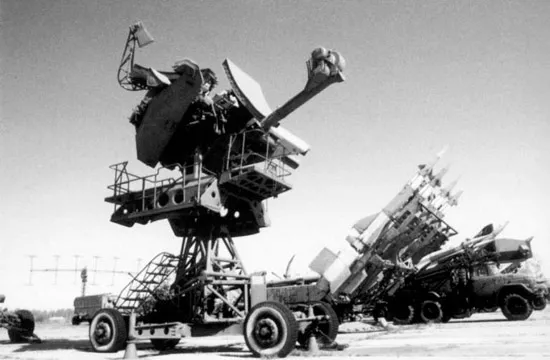
Soviet ‘Low Blow’ guidance radar with TV-guidance back up in front of a battery of SA-3 ‘Goa’ SAMs. (DoD)
While having a shorter range than the SA-2 or -3, the most deadly Iraqi SAMs were the newer generations of missiles like the SA-6 ‘Gainful’, and the Roland. In comparison with the SA-2, for example, the ‘Gainful’ can turn using up to 15 g. The older, larger SA-2 can pull around 4 g, thus a pilot evading an incoming SAM, if he times it right, can outturn the SA-2 because fighters can pull up to 9 g. A manned aircraft simply can’t do 15g.
The Iraqi’s SA-6 system actually consisted of several lightly armoured, tracked vehicles. One unit carried the acquisition and tracking radars and the three or four TELs (transporter erector launcher vehicles) held three missiles each. This self-contained SAM convoy can move quickly from one location to the next, making it a constant threat just by its possible presence. The highly mobile point defence SAMs like the SA-8 and the Roland offer similar capabilities and were also widely used by the Iraqis. The over 6,000 anti-aircraft artillery pieces ranged in size from automatic rifles that could cause trouble down on the deck up to 130-mm radar-directed cannons flinging steel up to 50,000 feet.
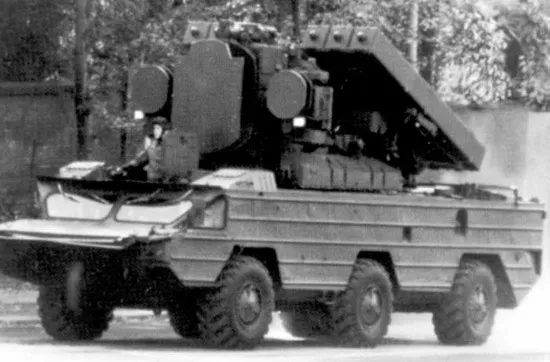
Wheeled, very mobile, SA-8 ‘Gecko’ short-range SAM built and supplied by the Soviets. (USAF)
Each of these radars contributed its piece of Iraq’s air picture over its country and the newly acquired ‘19th’ province of Kuwait to the Iraqi Air Force leadership. Each also had its own unique electronic signal pattern, dubbed a ‘signature’, that could be detected, countered and defeated by the Allies.
The final layer in the Iraqi IADS was their fighter aircraft. Mainly a mix of older and newer generation Soviet-built fighters, the Iraqis also used French and Chinese jets. They even carried some 1950s era British-built Hawker Hunters on their roster. All told, the Iraqi Air Force counted over 700 fighter and fighter-bombers at the start of the war in January 1991.
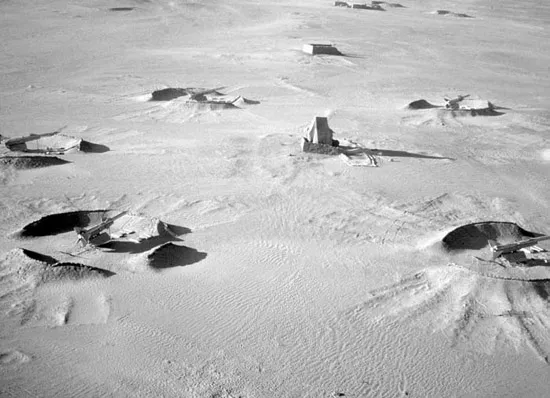
Typical SA-2 ‘Guideline’ SAM site in the desert. (DoD)
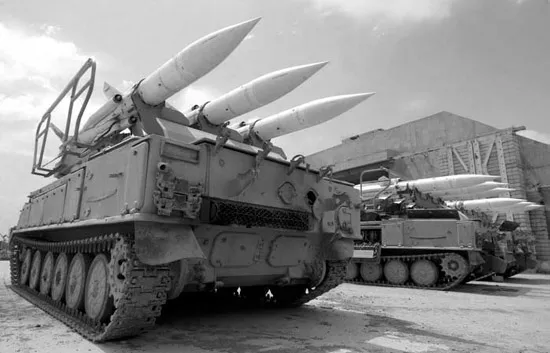
Soviet built and supplied SA-6 mobile SAM system. Each TEL carried three SA-6 ‘Gainful’ SAMs ready for launch plus a reload capability. (DoD pho...
Table of contents
- Cover
- Title
- Copyright
- Contents
- Dedication
- Acknowledgements
- Introduction
- Chapter 1
- Chapter 2
- Chapter 3
- Chapter 4
- Chapter 5
- Chapter 6
- Chapter 7
- Chapter 8
- Chapter 9
- Chapter 10
- Chapter 11
- Chapter 12
- Chapter 13
- Chapter 14
- Chapter 15
- Chapter 16
- Chapter 17
- Appendix-i
- Appendix-ii
- Appendix-iii
- Bibliography
- Index
Trusted by 375,005 students
Access to over 1.5 million titles for a fair monthly price.
Study more efficiently using our study tools.
Frequently asked questions
Yes, you can cancel anytime from the Subscription tab in your account settings on the Perlego website. Your subscription will stay active until the end of your current billing period. Learn how to cancel your subscription
No, books cannot be downloaded as external files, such as PDFs, for use outside of Perlego. However, you can download books within the Perlego app for offline reading on mobile or tablet. Learn how to download books offline
Perlego offers two plans: Essential and Complete
- Essential is ideal for learners and professionals who enjoy exploring a wide range of subjects. Access the Essential Library with 800,000+ trusted titles and best-sellers across business, personal growth, and the humanities. Includes unlimited reading time and Standard Read Aloud voice.
- Complete: Perfect for advanced learners and researchers needing full, unrestricted access. Unlock 1.5M+ books across hundreds of subjects, including academic and specialized titles. The Complete Plan also includes advanced features like Premium Read Aloud and Research Assistant.
We are an online textbook subscription service, where you can get access to an entire online library for less than the price of a single book per month. With over 1.5 million books across 990+ topics, we’ve got you covered! Learn about our mission
Look out for the read-aloud symbol on your next book to see if you can listen to it. The read-aloud tool reads text aloud for you, highlighting the text as it is being read. You can pause it, speed it up and slow it down. Learn more about Read Aloud
Yes! You can use the Perlego app on both iOS and Android devices to read anytime, anywhere — even offline. Perfect for commutes or when you’re on the go.
Please note we cannot support devices running on iOS 13 and Android 7 or earlier. Learn more about using the app
Please note we cannot support devices running on iOS 13 and Android 7 or earlier. Learn more about using the app
Yes, you can access Magnum! The Wild Weasels in Desert Storm by Brick Eisel,Jim 'Boomer' Schreiner in PDF and/or ePUB format, as well as other popular books in History & Middle Eastern History. We have over 1.5 million books available in our catalogue for you to explore.