- 400 pages
- English
- ePUB (mobile friendly)
- Available on iOS & Android
eBook - ePub
About this book
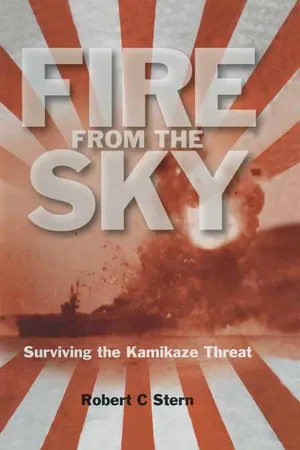
By late 1944 the war in the Pacific had turned decisively against the Japanese, and overwhelming Allied forces began to close in on the home islands. At this point Japan unveiled a terrifying new tactic: the suicide attack, or Kamikaze, named after the Divine Wind which had once before, in medieval times, saved Japan from invasion. Intentionally crashing bomb-laden aircraft into Allied warships, these piloted guided missiles at first seemed unstoppable, calling into question the naval strategy on which the whole war effort was based.This book looks at the origins of the campaign, at its strategic goals, the organization of the Japanese special attack forces, and the culture that made suicide not just acceptable, but honourable. Inevitably, much mythology has grown up around the subject, and the book attempts to sort the wheat from the chaff. One story that does stand up is the reported massive stock-piling of kamikaze aircraft for use against any Allied invasion of the home islands, if the atomic bombs had not forced Japans surrender.However, its principal focus is on the experience of those in the Allied fleets on the receiving end of this peculiarly alien and unnerving weapon how they learnt to endure and eventually counter a threat whose potential was over-estimated, by both sides. In this respect, it has a very modern resonance.
Information
Contents
| Acknowledgements | |
| Introduction | |
| 1 | Portents and Precursors (October 1942–June 1944) |
| 2 | The Origins of Organized Suicide Operations (August 1943–October 1944) |
| 3 | The Storm Unleashed – The Philippines (October–November 1944) |
| 4 | A Sustained Campaign of Terror – The Philippines (December 1944–January 1945) |
| 5 | The Kamikaze Magnet: HMAS Australia – The Philippines (October 1944–January 1945) |
| 6 | Kamikaze Tactics, Part 1 – The Philippines (October 1944–January 1945) |
| 7 | Turbulent Interlude – Iwo Jima & Ulithi (January 1945–March 1945) |
| 8 | Floating Chrysanthemums I – Okinawa (March–April 1945) |
| 9 | Floating Chrysanthemums II – Okinawa (May–June 1945) |
| 10 | Armageddon Avoided (July–August 1945) |
| 11 | Kamikaze Tactics, Part 2 – Okinawa (April–August 1945) |
| Postscript | |
| Appendices | |
| 1 | Japanese Aircraft Designations |
| 2 | Landing Craft Designations |
| 3 | Listing of Vessels Sunk or Damaged beyond Repair by Kamikazes |
| Notes | |
| Sources | |
| Index | |
Acknowledgements
IT GOES WITHOUT SAYING that no-one writes a book like this without assistance from a great many people. This work is no exception. Many people have helped in ways small and large whose contributions I failed to note. To them I offer my sincerest apologies and gratitude. Those whose help I made the effort to record are listed here:
- Dave McComb, who runs the Destroyer History Foundation and its indispensable website – www.destroyerhistory.org;
- Rick E Davis, who helped with photo identification and generally useful information;
- Richard Worth, who generously shared a number of documents, including the ORG reports, which helped immeasurably in the tactical analysis;
- Rich Tetrault, who runs the USS Lipan website (http://usslipan.com), for the kind permission to use Fred Kimball’s story of the loss of USS Barry (ex-APD 29) and LSM 59;
- Michael Mohl, for permission to use photographs found at the NavSource Naval History site (www.navsource.org), most of which are USN photographs, but some are from private sources; and
- Pete Wasmund and George E Stewart, for permission to use photographs and information from the VW-1 website (http://vwiassoc.tripod.com).
More anonymously, but no less importantly, I wish to thank the staffs at the US National Archives, College Park, MD and the British National Archives, Kew, Richmond, Surrey.
Photo Credits
Almost all the photographs used in this book were copied by the author from the several imagery sources at the US National Archives. Most are from the US Navy’s Second World War photography collections: Record Group (RG) 80, the Bureau of Aeronautics (BuAer) collection, and RG 19, the Bureau of Ships (BuShips) collection. Some were found appended to action reports found in the Modern Military Records section, also at the National Archives and Records Administration (NARA) facility in College Park, MD.
The other primary source is the Naval History & Heritage Command (NHHC – formerly the Naval Historical Center), the US Navy’s repository of all Second World War photography not at NARA.
The few photos that are not from NARA or NHHC are credited as appropriate. If a photo has no credit, it simply means I failed to record or have lost the record of the source of the photo. I apologize to any who are thus unacknowledged by my sometimes poor record-keeping.
Introduction
THIS IS A BOOK ABOUT what was in 1944 a new kind of war. One that, at least for those on the receiving end, had never been seen before. Men have been fighting each other in an organized fashion since before there was writing to record the event, but the Ancient Egyptians or Chinese would not have felt too out of place on a Napoleonic battlefield, despite the technological advances in the intervening years. Even a hundred years later, when the Allies and the Germans practiced wholesale slaughter on the Western Front, the ideologies that drove those men to war would have felt familiar. Despite the sheer butchery of the First World War, the issues being decided weren’t much different than those fought over thousands of years earlier. Emerging nationalism and widespread industrialization made the weapons deadlier and the emotions stronger, but the First World War ended like so many earlier wars, with exhaustion on both sides and the transfer of some land and money to the victors.
But something seismic changed in the years immediately following the Treaty of Versailles. The peace that was supposed to follow the ‘War to End All Wars’ failed catastrophically. Fiercely ultra-nationalist factions came to power in a number of countries, and similar ideologies gained strength in the liberal democracies of the West. Aided by new communications technologies and armed with ever more destructive weaponry, these regimes acted against enemies internal and external with unparalleled savagery. The most extreme examples of this rise of nationalism occurred in Germany and Japan. Certainly, the re-emergence of Germany as an aggressor state so soon after the end of the First World War surprised few. The emergence of an aggrieved, aggressive Japan as a world power was less expected.
Barely 60 years after being ‘opened’ by an American squadron under Matthew Perry, the Japanese had become a power in the western Pacific strong enough to merit the attention of American war planners. (The first War Plan Orange, anticipating a war in the Pacific against Japan, was created in 1919 but less formal planning had begun as early as 1897.) Having emerged victorious in wars against China and Russia, the Japanese signed on to the Allied cause in the First World War only to be shocked and angered at their shabby treatment at the Paris Peace Conference which produced the Treaty of Versailles. They responded to this perceived slight with renewed determination to become a major power in global politics. Inevitably this put them on a collision course with the established colonial powers in the Pacific: Great Britain, France, the Netherlands and especially the other power expanding its influence in the region, the United States.
Just as the Nazi state used racism to define its world view – touting the virtues of Aryan blood while demonizing Jews, Slavs, Gypsies and other ‘inferior races’ – the Japanese also saw the world in starkly racial terms. There were, however, important differences between Nazi racism and that of the Japanese. It is absolutely true that the Japanese, like the Germans, considered themselves a superior race. They looked down on other Asian peoples, considering the Koreans and Chinese to be inferior both physically and mentally. Their attitudes towards the West were more ambiguous. They recognized that Western technology paved the way to future power, but saw Europeans and Americans as spiritually weak. The persistence with which the Japanese and all Asians were looked down on by Western societies, particularly in the US, was a constant source of irritation.
There are many examples of discrimination against the Japanese in the US in the years leading up to the First World War. Just one example was the Alien Land Law of 1913 passed by the California State Legislature, which prohibited a...
Table of contents
- Cover
- Half Title
- Full Title
- Copyright Page
- Contents
Trusted by 375,005 students
Access to over 1.5 million titles for a fair monthly price.
Study more efficiently using our study tools.
Frequently asked questions
Yes, you can cancel anytime from the Subscription tab in your account settings on the Perlego website. Your subscription will stay active until the end of your current billing period. Learn how to cancel your subscription
No, books cannot be downloaded as external files, such as PDFs, for use outside of Perlego. However, you can download books within the Perlego app for offline reading on mobile or tablet. Learn how to download books offline
Perlego offers two plans: Essential and Complete
- Essential is ideal for learners and professionals who enjoy exploring a wide range of subjects. Access the Essential Library with 800,000+ trusted titles and best-sellers across business, personal growth, and the humanities. Includes unlimited reading time and Standard Read Aloud voice.
- Complete: Perfect for advanced learners and researchers needing full, unrestricted access. Unlock 1.5M+ books across hundreds of subjects, including academic and specialized titles. The Complete Plan also includes advanced features like Premium Read Aloud and Research Assistant.
We are an online textbook subscription service, where you can get access to an entire online library for less than the price of a single book per month. With over 1.5 million books across 990+ topics, we’ve got you covered! Learn about our mission
Look out for the read-aloud symbol on your next book to see if you can listen to it. The read-aloud tool reads text aloud for you, highlighting the text as it is being read. You can pause it, speed it up and slow it down. Learn more about Read Aloud
Yes! You can use the Perlego app on both iOS and Android devices to read anytime, anywhere — even offline. Perfect for commutes or when you’re on the go.
Please note we cannot support devices running on iOS 13 and Android 7 or earlier. Learn more about using the app
Please note we cannot support devices running on iOS 13 and Android 7 or earlier. Learn more about using the app
Yes, you can access Fire From the Sky by Robert C. Stem in PDF and/or ePUB format, as well as other popular books in History & World War II. We have over 1.5 million books available in our catalogue for you to explore.