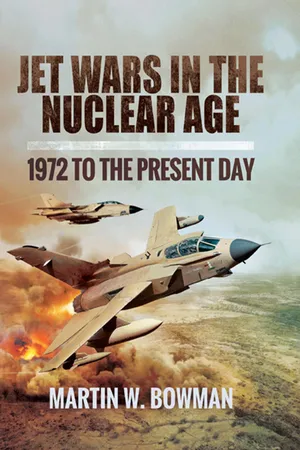
This book explores the era of the 1970s right up to the present day, illustrating howfighter-bombers and tactics have developed and evolved during this time. It covers all the most significant military conflicts that have characterised this era, including the Eleven Day War of Christmas 1972 in Vietnam and the Falklands War of 1982, when Harrier pilots engaged in aerial battles with Skyhawks and when Vulcans, supported by Victor tankers, flew 'Black Buck' raids on Argentine positions. It also explores the era of the Gulf War, which witnessed the Victor and the B-52 fighting alongside Buccaneers, Tornadoes and F-111s.Then there is the ongoing war against terror, culminating in the opening stages of 'Inherent Resolve' which has seen Tornadoes, F/A-18 Hornets, Soviet-built Su-24M2 and Su-30CM jet fighters, Su-25 SM armoured subsonic close air support/attack aircraft, Su-34 multi-role fighter/bombers and the Tupolev Tu-160 'Blackjack' heavy strategic bombers employed in the war against Islamic State in Iraq and Syria.The author's well-researched historical narrative sets a range of dramatic first-hand crew-member accounts solidly in context, creating a rounded and authentic sense of events as they played out during five dynamic decades of aviation history.
Trusted by 375,005 students
Access to over 1.5 million titles for a fair monthly price.
‘This is your chance to use military power effectively to win this war and if you don’t I’ll consider you personally responsible…I don’t want any more of this crap about the fact that [the air force] couldn’t hit this target or that one.’
President Richard Milhouse Nixon in a message to Admiral Thomas H. Moorer, Chairman of the Joint Chiefs of Staff to begin a ‘Linebacker II’ bombing campaign against Hànôi on Sunday 17 December 1972.
Forty-one year old Lieutenant Colonel Donald Louis Rissi, a B-52G pilot and aircraft commander in the 97th Bomb Wing at Andersen Air Force Base on Guam, could be forgiven if he felt frustrated. He and his TDY (temporary duty) crew had been scheduled to rotate back to Blytheville AFB, Arkansas for their one-month break, first on 4 December and then again on the 12th. Rissi was a former B-58 Hustler pilot and F-4 Phantom jet jockey who on 3 June 1955 had graduated from the Naval Academy with a commission as a second lieutenant in the US Air Force. He had then completed Undergraduate Pilot Training and in August 1956 was awarded his pilot wings at Reese AFB, Texas. He deployed to Southeast Asia in February 1971 and served with the 389th Tactical Fighter Squadron at Phù Cát until September that year when he became a Mission Launch Control Officer with 7th Air Force at Tân Sơn Nhứt. After completing B-52 Combat Crew Training in March 1972 his assignment to the 340th Bomb Squadron took place in June that year and deployment to Andersen AFB followed in October. Two months on the ‘Rock’ as the old volcanic mountaintop, 30 miles long and four to twelve miles wide was known, was more than enough for most men. December is the start of the dry season and this remote outpost 2,600 miles from Sàigòn is in Typhoon Alley. From early 1972 Andersen was the site of one of the most massive buildups of air power in history. The influx of bombers, crews and support personnel pushed Andersen’s military population past 15,000. Over 150 B-52s were positioned on the available ramp space on the five mile flight line. Combined with other SAC bombers stationed at U-Tapao Field, Thailand, about 50 percent of SAC’s total bomber force and 75 percent of all combat ready crews - equivalent to at least thirteen stateside bomber wings - were at the two bases. Billeting at Andersen was saturated and terms like ‘Tin City’ (un-air-conditioned) and ‘Tent City’ (of which there were three at Andersen with twelve men living in each tent amid dust, noise and tropical rains), became commonplace with improvised quarters set up in the open fields across from the flight line.
B-52Ds at Andersen AFBG on Guam. In December 1972 over 150 B-52s were positioned on the available ramp space on the five mile flight line.
On Friday, 15th December Rissi was notified that their replacement crew had become snowed in at Loring AFB, Maine and when they did arrive, they were minus two primary crewmembers and would need ‘over-the-shoulder’ training before they could transition to a combat-ready status. It meant that Rissi, a devoted husband, who loved to fish and enjoy the outdoors around Collinsville, Illinois, would not be Stateside for Christmas 1972 with wife Joan and their five children. It was especially maddening for he was in line to become the new squadron commander on his return home. A quick tour of the flight line on Saturday morning revealed all the B-52s were being refuelled and loaded with bombs. Bomb loaders had to put in exhausting twelve-hour shifts in the hot tropic sun struggling to get the B-52s fully bombed up. All Rissi and the other aircraft commanders could tell their crews was that they should order two lunches and to get lots of sleep.
An aura of invincibility had seemed to pervade B-52 operations although some questions had been raised in April 1972 during the so-called ‘special missions’ over the North. Then, on 22 November 1972 the first B-52 combat loss in Việtnam occurred. Just after dropping its bombs on enemy troops at Vinh, roughly 150 miles above the DMZ, two SAMs exploded beneath B-52D 55-0110, Call Sign ‘Olive 02’ commanded by 30-year old Captain Norbert J. ‘Oz’ Ostrozny of Lackawana, New York. 55-0110 was one of eighteen B-52s of the 307th Strategic Wing, whose crew were from the 96th Bomb Wing at Dyess AFB, Texas on rotation at U-Tapao. ‘Olive 02’ suffered numerous malfunctions of their ECM gear that prevented the EWO (electronic-warfare officer), Major Larry T. Stephens, 35, of Abilene, from ascertaining the exact position of the jamming transmitters. Secondly, high winds in the target area had blown the chaff corridor out of position and the entire cell was highlighted against the chaff. Just after bomb release at 35,000 feet Captain Philip A. ‘Tony’ Foley the 26-year old co-pilot, of Fair Haven, Vermont watched a SAM approach from 1 o’clock and disappear under the aircraft. Larry Stephens attempted to jam the Uplink/Downlink signals1 to the missile in the blind but it detonated under the belly. Enemy radar had provided accurate guidance despite electronic jamming by the victim, the other two B-52s in the cell and three EB-66s orbiting some distance away. Throughout the approach, when the countermeasures were most effective and Ostrozny received additional protection from a chaff corridor created by two ‘Iron Hand’ F-105Gs and four F-4s, the ‘Fan Song’ radar operator contented himself with passively tracking the jamming signal across his scope to determine azimuth (bearing) and elevation, using the normal operating altitude to establish the range and then verified the range by transmitting for a couple of seconds as he allowed ‘Olive 02’ to soar unchallenged to the release point. Then, as the B-52 turned sharply away after dropping its bombs, the wings formed an angle of roughly 45 degrees with the horizon and the strongest part of the jamming cone passed ineffectually beyond the SAM (Surface-to-Air Missile) site. At this instant, the ‘Fan Song’ transmitted just long enough to pinpoint its target before the missile battery launched the two SAMs that exploded beneath the B-52.
B-52Ds taxi out at Andersen AFB for another bombing mission.
Personnel at a North Vietnamese SAM missile battery. North Viêtnam began receiving Soviet SA-2 Dvina (SA-2F Guideline) missiles shortly after the start of Operation ‘Rolling Thunder’ in the spring of 1965. With Soviet help, the NVA built several well-camouflaged sites and also ringed them with anti-aircraft artillery (AAA), making them even more dangerous to attack. The SA-2 had a solid fuel booster rocket that launched and accelerated it and then dropped off after about six seconds. While in boost stage, the missile did not guide. During the second stage, the SA-2’s liquid-fuel rocket propelled it to the target.
‘Olive 02’ caught fire in the wings and rear fuselage; all aircraft power was lost and Ostrozny and ‘Tony’ Foley had to read their instruments with a flashlight. They nursed the damaged bomber for 100 miles with one of the two F-105G ‘Iron Hand’ defence suppression escort but about five miles from the Thai border the last of the engines wound down at 10,000 feet but Ostrozny judged that he had enough altitude to glide the rest of the way despite a fiercely burning aircraft with no electrical power or flight instruments. In the gun turret Staff Sergeant Ronald W. Sellers 28, of Waco, Texas could hear but could not transmit on his radio. His compartment began to get hot as the fire in the fuselage took hold and he could see the fire in the right outboard engine pod and wing becoming brighter and the wings were gradually being burned away. Then these and other engines started flaming out due to fuel starvation from the wing fires. Sellers noted that the wing fires had turned a bright blue and had burned away part of the top of one wing. Soon he could see and count the internal ribs of the wing over the number eight engine pod. Then the last engine quit. Oztrozny asked his navigator, Captain Robert L. Estes, 32, of Abilene, Texas who was wounded by fragments of the SAM in his leg, how many more miles it was to the Thai border. The answer: five miles. The crew was alerted for an imminent bale out. Now for all practical purposes, they were a gliding torch, trying to trade precious altitude for those last long miles to safety. The aircraft could explode at any minute. Since the engines had quit, all electrical power was lost except battery power to the bail-out lights and interphone. Oztrozny lost his flight instruments.
B-52D 55-0110 ‘Olive 02’ was one of eighteen B-52s of the 307th Strategic Wing, whose crew were from the 96th Bomb Wing at Dyess AFB, Texas on rotation at U-Tapao. Above: Captain Norbert J. ‘Oz’ Ostrozny commanding B-52 55-0110 Call Sign ‘Olive 02’ on 22 November 1972.
Sellers observed the tip tank area starting to bend and fold up over the outboard engine pod. As the navigator announced that they had crossed the Mekong River into Thailand the starboard wing tip broke away and the aircraft started an uncontrolled turn. Reacting immediately to the pilot’s bail out signal, all the crew successfully abandoned their aircraft. Fortunately, an HH-53 ‘Jolly Green’ from Nakhon Phanom was airborne and it managed to locate all six crew. ‘Olive 02’ crashed into jungle near Pla Pak/Mueang district border, fifteen miles south west of Nakhon Phanom. ‘Tony’ Foley suffered a fracture of his right ankle when he landed in the dark. Major Larry Stephens; Major Adam ‘Bud’ Rech, 35, also of Abilene, the radar navigator and Sellers were uninjured. The crew gave personal accounts of their experiences to meetings and fellow crewmembers. One of these was taped, permitting their story to be related to the entire bomber force. Ostrozny was awarded the Silver Star. Up until this time ten B-52s had been lost as result of combat operations in South East Asia but this was the first B-52 to be destroyed by hostile fire in more than seven years of war.
Richard M. Nixon, who on 7 November had won a massive presidential re-election victory, was determined to end the long drawn out war in Việtnam, even if it meant using them to bomb Hànôi, to destruction. As early as 1968 during a visit to Air Defence HQ, H
Chi Minh had predicted that the B-52s would come to Hànôi one day but Air Force plans to bomb Hànôi had always been pushed aside. On 30 November Nixon signalled his intentions to bomb Hànôi with B-52s, dismissing fears of losses. On 3 December the mayor of Hànôi began to evacuate civilians from the city. On 12 December the Paris peace talks reached an impasse. The North indicated that they might not even reach agreement on the release of American PoWs and on 13 December they walked out of the peace talks. President Nixon issued an ultimatum to Hànôi to return to the conference table within seventy-two hours ‘or else’ but Hànôi rejected his ultimatum. Nixon however, could turn to massive air power if he needed to. On Guam there were 150 B-52D and B-52G crews of the 72nd Strategic Wing (P) and another sixty B-52D crews at U-Tapao in Thailand. On 6 December Nixon had ordered the Joint Chiefs of Staff to begin planning for B-52 strikes against Hànôi ‘as close as can reasonably risked’ that would ‘create the most massive shock effect in a psychological context.’
On the afternoon of 14 December Nixon turned to massive air power to begin the ‘Linebacker II’ bombing campaign against Hànôi. Admiral Thomas Moorer designated responsibility for ‘Linebacker II’ operations to General John C. Meyer (usually called ‘J.C’), the chief of Strategic Air Command (SAC) at his Headquarters at Offutt AFB, Omaha, Nebraska. After approval by the JCS the plans were sent to Lieutenant General Gerald W. Johnson commanding Eighth Air Force at Andersen AFB and General John W. Vogt commanding 7th Air Force in Sàigòn. Meyer and Johnson had been among the highest scoring fighter pilots in England during WW2. B-52D/G attacks on Hànôi were to begin at about 1900 hours Hànôi time on 17 December but Nixon moved ‘Linebacker II’ back twenty-four hours to the night of 18/19 December because of fears of offending the Chinese who hosted a political visit by North Viêtnam on the 17th. In any event not enough KC-135A tankers were in position to refuel the planned sorties by B-52s from Guam. It is 2,650 statute miles to Hànôi from Andersen AFB but combat routing lengthened the one-way distance to 3,000 miles; a 16-hour round trip, across South Việtnam, up through Laos and then a dogleg right on a northwest-to-southeast heading into Hànôi. Because of cockpit seat positioning limitations the B-52D had poorer refuelling visibility compared to the B-52G or H and it was underpowered. Added to this was an increase in drag created by 24 external bombs which the D model carried on the underwing stub pylons. Therefore a B-52D pilot who was able to get his full offload of fuel despite the loss of an outboard engine and an outboard spoiler group was considered a ‘real pro’. 2
The morning of the 16th there was a meeting at 8th Air Force headquarters, involving the division commander, wing commanders and the 8th Air Force staff. During the meeting, details were provided of the targets, routes to be flown inbound and outbound and an in-depth description of radar aiming points for bomb release. There was considerable discussion on enemy defences, supporting forces and target area attacks...
Table of contents
Cover
Title Page
Copyright
Contents
Acknowledgements
Dedication
Prelude
Chapter One: The Eleven Day War
Chapter Two: A War That Nobody Won
Chapter Three: Raging Storms
Chapter Four: The Falklands Air War
Photo Gallery
Chapter Five: ‘Tanker Trash’, Tornadoes and The ‘Buccs’
Chapter Six: Buffs and The Gulf War 1990-1991
Chapter Seven: The War Against Terror
Chapter Eight: Inherent Resolve
Frequently asked questions
Yes, you can cancel anytime from the Subscription tab in your account settings on the Perlego website. Your subscription will stay active until the end of your current billing period. Learn how to cancel your subscription
No, books cannot be downloaded as external files, such as PDFs, for use outside of Perlego. However, you can download books within the Perlego app for offline reading on mobile or tablet. Learn how to download books offline
Perlego offers two plans: Essential and Complete
Essential is ideal for learners and professionals who enjoy exploring a wide range of subjects. Access the Essential Library with 800,000+ trusted titles and best-sellers across business, personal growth, and the humanities. Includes unlimited reading time and Standard Read Aloud voice.
Complete: Perfect for advanced learners and researchers needing full, unrestricted access. Unlock 1.5M+ books across hundreds of subjects, including academic and specialized titles. The Complete Plan also includes advanced features like Premium Read Aloud and Research Assistant.
Both plans are available with monthly, semester, or annual billing cycles.
We are an online textbook subscription service, where you can get access to an entire online library for less than the price of a single book per month. With over 1.5 million books across 990+ topics, we’ve got you covered! Learn about our mission
Look out for the read-aloud symbol on your next book to see if you can listen to it. The read-aloud tool reads text aloud for you, highlighting the text as it is being read. You can pause it, speed it up and slow it down. Learn more about Read Aloud
Yes! You can use the Perlego app on both iOS and Android devices to read anytime, anywhere — even offline. Perfect for commutes or when you’re on the go. Please note we cannot support devices running on iOS 13 and Android 7 or earlier. Learn more about using the app
Yes, you can access Jet Wars in the Nuclear Age by Martin W. Bowman in PDF and/or ePUB format, as well as other popular books in History & Military & Maritime History. We have over 1.5 million books available in our catalogue for you to explore.