![]()
Chapter 1
The Problems of Training
At 11.00 hours on Saturday 3 September 1939 many families in the UK were gathered around their wireless sets. They were listening to the gloomy voice of their Prime Minister, Neville Chamberlain, announcing that no reply had been received from Herr Hitler to his ultimatum delivered three days before and that ‘in consequence, this country is at war with Germany’.
The air raid sirens wailed immediately after he finished, in what was obviously a demonstration, followed by the ‘all clear’. Although not unexpected, this announcement must have been received with dismay by those with direct experience of the carnage of The Great War (as the First World War was known in those days). For some of the younger generation, however, it provided a welcome opportunity.
At this time, I was a few weeks beyond my eighteenth birthday, living with my parents and three brothers in a suburban house in Woodford Green, Essex. This was on the northern fringe of Epping Forest and only a short train ride to the City of London, where our father held a position in the Bank of England. We lived comfortably as a middle-class family. The secure position of our father had insulated us from inter-war unemployment and the Great Depression of the early 1930s. Moreover, all four boys had gained scholarships to schools which brought them up to Matriculation standard.
My employment was that of a junior clerk in Lloyds Bank, Fenchurch Street in London. In many respects this was an enviable occupation of the time, being secure, reasonably well paid and with good prospects. However, the work seemed so dreary and monotonous that I longed for something more adventurous. I had read copiously about the exploits of pilots in the Great War and studied books about the modern RAF. I had looked enviously at the fighter aircraft in the airfield of North Weald, near Epping, and had recently applied to join the RAF Volunteer Reserve (RAFVR), under the impression that this would be a part-time occupation – although no reply had been received.
It had been obvious for months that war was inevitable, despite the occasion in September 1938 when Chamberlain returned from a conference with Hitler in Munich, waving a piece of paper which he said assured us of ‘peace in our time’. Since then, German had invaded Czechoslovakia and now had invaded Poland. It was time for me to act.
As soon as the sirens sounded the all-clear I telephoned a former school-friend who lived nearby. We had already discussed our course of action and duly cycled about five miles to Romford, where we knew that a recruitment centre was open on Sundays. At the beginning of the war, the age of conscription was twenty years – although it was soon reduced to eighteen. Conscripted entrants could be drafted into any branch of the armed services but those who volunteered could apply for whatever branch they chose. Thus we signed forms for training as pilots in the RAFVR.
On the next morning, I reported my action to the sub-manager at Lloyds Bank. He seemed displeased, presumably thinking I should have asked his permission beforehand and that he might have to find a replacement at short notice, but this did not worry me for I was looking forward to a great adventure. I did not have to wait long, for to my delight I received an official letter on the next day, telling me to report to RAF Uxbridge in Middlesex for an examination.
On arrival, I was first given an intensive medical examination. This had been anticipated and I had previously purchased from HM Stationery Office a copy of Air Publication 130 entitled The Medical Examination for Fitness for Flying and had practised all the relevant exercises. For instance, I could hold my breath for 90 seconds and carry out the necessary number of press-ups on the floor. I was a somewhat skinny youth but quite strong for my size and weight, with plenty of stamina and good eyesight.
The staff could find nothing wrong with me and I was passed on for interview. My scholastic record had been somewhat patchy, with a mixture of distinctions, credits, passes and one failure (in Latin). However, while at Lloyds Bank I had passed some of the subjects in Part I of the Associated Institute of Bankers examinations, by studying in the evenings and at weekends. We could sit for these subjects piecemeal over several years. When all those in Parts 1 and 2 had been passed, our names would include the magic letters AIB, thus providing entry to managerial positions. This minor achievement seemed to interest the RAF interviewer, as well as my father’s position in the Bank of England. It is possible that they had an influence on my wartime RAFVR service, for I was frequently picked out for extra administrative duties.
After the interview I was sworn in at the lowest rank in the RAF, Aircraftman Second Class, being designated in the category of Aircrew (Under Training). Several of the other applicants were rejected for minor disabilities, such as colour blindness, and some were so dejected that they had tears in their eyes. Together with other successful entrants, I was sent to a hut for the night preparatory to ‘kitting out’. There was little to do except eat a rather unappetising meal and listen to bawdy RAF songs sung by airmen in nearby huts, memorising the words for future use.
On the following day, I received a series of injections and was then provided with kit which included an ancient uniform which buttoned up to the neck, instead of the modern version with lapels which was worn with a shirt and black tie. To my surprise, I was then told to go home and await further orders.
I expected my mother to be proud when she saw me in uniform but instead she looked shocked. It took me some time to realise that she must have been thinking of her two brothers, one of whom had lost a leg on the Western Front and the other who suffered permanently from what was known as ‘shell shock’ in those days, as well as my father’s elder brother who had been killed in the Second Battle of Ypres. Moreover, my elder brother had enlisted in the Territorial Army (TA) some months before and had already been called up. My two younger brothers, who were twins, were below military age but would become eligible in a couple of years.
Of course, I immediately notified Lloyds Bank of my RAF enlistment. The authorities were gratifyingly patriotic, for they continued to credit my bank account with my salary, less the small payment I received as an Aircraftman Second Class. I was duty-bound to notify them of any increase in my rank and pay, and did so meticulously when these events happened.
For fourteen long weeks I fretted at home, reading anything that concerned flying training but bewildered by the ‘Phoney War’ that persisted between the Anglo-French and German forces on the Western Front. Finally, I was ordered to report back to RAF Uxbridge on New Year’s Day 1940, and went off enthusiastically to war in my ancient uniform, carrying an Airman’s Diary for 1940 and a ‘Stop-a-Shot’ steel mirror in my left breast pocket, both of these articles having been given to me by my father, who was a veteran of the Great War.
At Uxbridge I joined a group of other recruits and found that we were all promoted to the rank of Leading Aircraftman, equivalent to Lance-Corporal in the British army. It was interesting to find that some of these recruits were not resident in the UK but had travelled from different parts of the Commonwealth and then volunteered. There was even one who lived in South America. We were all provided with modern uniforms, with a propeller on each sleeve to denote our new rank, and each given a white flash to be worn in the front of the forage cap, indicating a status of ‘u.t. pilot’, with the ‘u.t.’ meaning ‘under training’.
Thus equipped, thirty of us were sent by train to Cambridge, where parts of the some of the university’s colleges had been taken over by the RAF to form a scattered and make-shift Initial Training Wing (ITW), although not given that title. Instead, we became 11 Flight, C Squadron, Downing College, and were billeted three to each bedroom in the former students’ quarters in one of the blocks surrounding a quadrangle. The weather was freezing cold and no heating was provided, although there were fireplaces without fuel. We rapidly discovered that the best way to keep reasonably warm was to put sheets of newspapers between our bed blankets.
Our days were spent with early morning drill in the quadrangle, followed by intensive work in a lecture hall. The drill was conducted by a steely-eyed corporal who barked orders at us in the time-honoured service fashion, scathing about our efficiency and continually demanding smarter behaviour. We expected this process and did not resent it or even dislike the corporal. All of us had experienced the strict discipline which was common in the schools of those days. This was merely a somewhat different version and in any event we wanted to behave like smart servicemen.
Soon after our arrival we were given another series of injections during the afternoon. On this occasion the medical officer stuck the needles into our chests instead of our arms and the outcome was rather painful. We had to parade with full packs on the following morning and there was thick snow on the ground. The effect of the injections took hold on some recruits who felt dizzy and collapsed on the snow, while the others continued to march and step over their bodies. I was little affected, and the scene reminded me of a painting which hung in my grandmother’s drawing room, entitled ‘Napoleon’s Retreat from Moscow’. Our worthy corporal was forced to dismiss the Flight.
On other occasions we joined Flights from other colleges on route marches in lanes threading through the surrounding countryside. I enjoyed these occasions in the crisp winter air, although our efforts to sing bawdy RAF songs while marching were quickly silenced by the officer leading the parade. On one occasion we were ordered to wear our gas masks and double-march the last stretch back to our colleges, so that we all arrived red-faced and breathless. The purpose of this was not explained to us.
![]()
The wireless operator in a Lockheed Hudson signalling with an Aldis lamp to the crew of another aircraft. (Author’s collection)
![]()
The lectures were also similar to schooldays but covering subjects such as navigation, signals including Morse Code, aero engines, armoury including RAF machine-guns, meteorology, aircraft recognition and RAF organisation. Some trainees found the contents difficult but I was anxious to learn every subject and applied myself diligently, being helped to some extent by my previous studies at home. There were periodic tests, marked in a similar way to children’s school, and my results were rated as excellent.
The course was supposed to last for about eight weeks, after which we should have been posted elsewhere to Elementary Flying Training School (EFTS) and learnt how to fly, but nothing happened when the time arrived. Thus the drill and the lectures began all over again, to our frustration. Winter turned into Spring and the ‘Phoney War’ continued on the Western Front, although there was some activity in the air and major problems in the Atlantic Ocean with German capital ships and U-boats.
When we dared to query our situation, we were told that all EFTSs were full and that no places were available for us. Of course we knew that the RAF was split into Bomber Command, Fighter Command, Coastal Command and Training Command, plus a Maintenance Group. All had embarked on programmes of expansion, but we did not know that Training Command had planned primarily on a huge programme overseas in the Commonwealth. This had begun on 17 December 1939 when the Empire Air Training Scheme was agreed. It was centred mainly in Canada but other schools were set up in Australia and New Zealand.
![]()
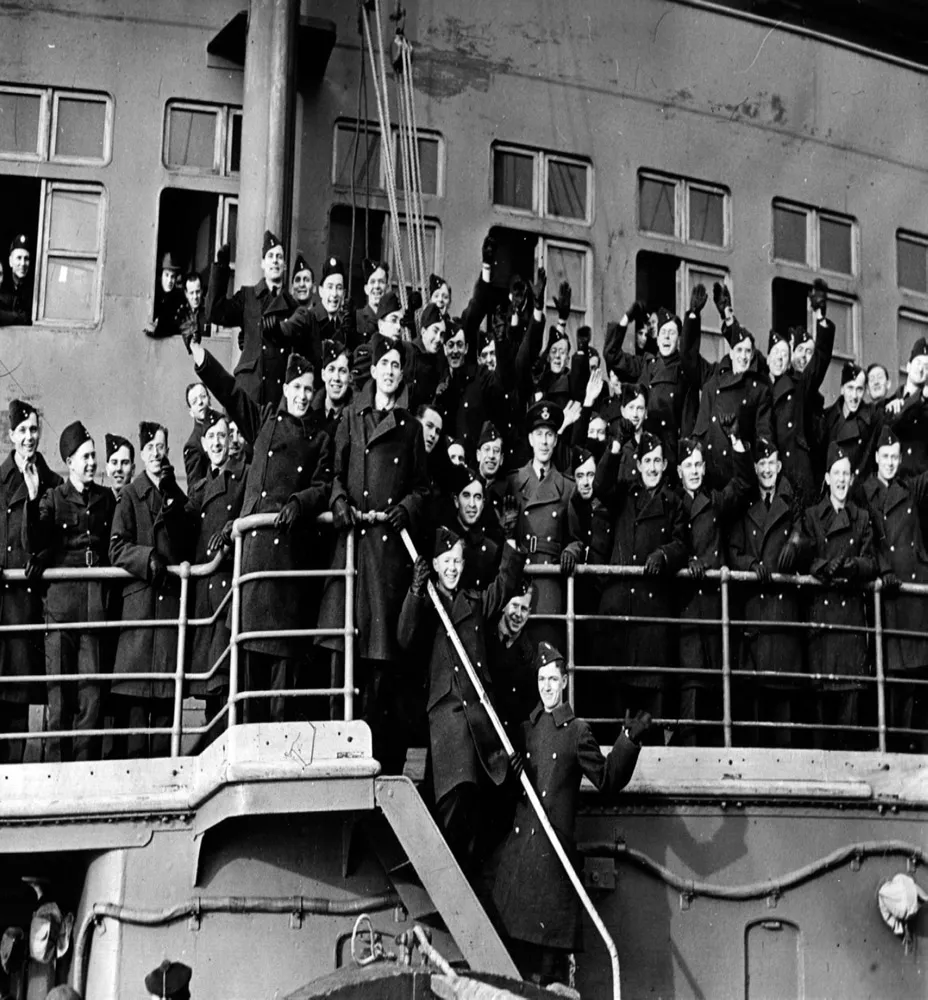
A large draft of aircrew volunteers leaving Britain for training in Canada in their various specialisms. (Author’s collection)
![]()
These training schools provided instructors from their own citizens but the UK was sending flying instructors as well as aircraft. Eventually there were twenty-five EFTSs, twenty-five Service Flying Training Schools (SFTSs), fourteen Air Observer Schools (AOSs), fourteen Bombing and Gunnery Schools (B&GSs) and two Navigation Schools. Apart from these, Southern Rhodesia had already set up its own Air Training Scheme, wit...