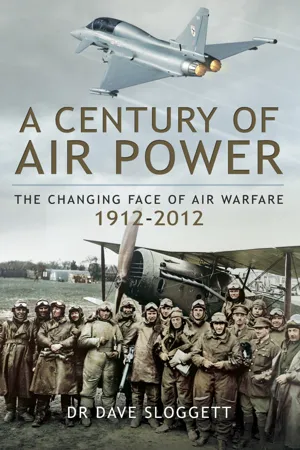
An extensive history of the first century of aerial warfare, covering the every major conflict including the two world wars.
No other technical development since the introduction of gunpowder has had as great an influence on warfare as the aircraft. From its early beginnings as simply a means of aerial reconnaissance to its utter supremacy on the battlefield, the aircraft has evolved into the most versatile and precise killing machine known to man.
In this wide-ranging and comprehensive study, David Sloggett, an internationally-respected defence analyst, investigates the changing role and increasing significance of air power over the course of the previous 100 years. This is accomplished by detailing every major conflict during that period including not only the two world wars and the recent conflicts in the Middle East but also the Korean War, the Cuban Missile Crisis, the Falklands War and Russian use of air power in Afghanistan. Air power's role in Malaya, Oman, Kenya and in Northern Ireland is also explained.
A Century of Air Power is the most important study of the use of military aircraft ever undertaken and as such provides valuable lessons for the future—not only for the commanders who have to apply these all-powerful weapons but also for the politicians who have to determine its use.
- 240 pages
- English
- ePUB (mobile friendly)
- Available on iOS & Android
eBook - ePub
About this book
Information
Chapter One
Introduction
Context
Today at the start of the twenty-first century people take aviation for granted. As we go about our daily lives the noise from an aircraft passes by without raising much interest, except of course when one flies low over a city. The collective psyche that developed after 11 September 2001 is not easily forgotten. On that day aircraft were turned into cruise missiles and the ideas of how air power could be projected entered a new phase. Leonardo da Vinci’s vision of flight had been taken to a new and deadly extreme.
Ask any layperson what the first century of air power means for them and some might pause for a moment to think. A few, suspecting a question which is more involved than it initially appears, may wonder what the term actually means. They may be unfamiliar with its military overtones, preferring to ignore its role in delivering death and destruction upon an adversary. For many of them the discussion will evoke memories of a recent holiday, an unfulfilled desire to have flown on Concorde before it was taken out of service, or the trials and tribulations of getting through airports. The aviation industry is able quite literally to motivate a wide variety of responses from the general public.
Others, however, will quickly get the idea that the term ‘air power’ refers to its use as part of the military instrument of power in the land, sea, air and space domains. For many of them the term will quickly conjure up in their minds some stereotypical images. These may include dogfights over the trenches in the First World War, Spitfires and Hurricanes going toe to toe with Luftwaffe bombers in the Battle of Britain, the Blitz and D-Day. For the wider public the idea of air power will often be seen through the magnifying lens of history.
Deeper questioning about the way in which air power has evolved might also trigger a wider realization about some of the essential features of air power. One of those that many people will be capable of grasping is the notion of air superiority. First achieved over the battlefields of Verdun in the First World War, it is now the sine qua non for those planning military campaigns.
A widely-held view is that those who control the air are able to impose their tempo and will upon a military campaign. This is a somewhat simple perspective. The characteristics of air power, such as speed and flexibility of response, allow it to be delivered quickly over what can be large distances. While this notion grew out of the Second World War, through the Korean War, it was during the Vietnam War that some of this thinking started to change. Simply trying to bomb the North Vietnamese to the negotiating table did not work for a variety of reasons.
Those who are proponents of air power point out the political constraints on its application. Those who are the ‘naysayers’ offer equally robust reasons for its failure to break the will of a population. Over Iraq and Afghanistan nearly 100 years on from its inception some limitations of air power in a counter-insurgency environment became apparent. In the Libyan campaign in 2011 against a very different backdrop air power yet again found an opportunity to show how effective it could be when used in the right circumstances.
Of course, to achieve air superiority it is also important to project military power into a theatre of war. In Afghanistan routine movements of aircraft and crews ensure that the air superiority that has been achieved over that country can be maintained. As NATO moves towards its military draw-down in 2014 the issue of how the Afghan National Security Forces (ANSF) are provided with air support is critical. In Iraq the rebuilding of the Iraqi Air Force is only just taking place. This has left a gap in which the insurgents have been able to regain a footprint in the country. These are only examples of many that exist today where countries are investing increasing sums in air power.
Of all the examples it is perhaps China’s rapid increase in its air force’s capabilities that is most notable. The flight of the second variant of its new stealth fighter in November 2012 was the cause of much debate in aviation circles. It appears that China is taking the opportunity of its rapid economic rise to invest heavily in its air force and naval capabilities. These have traditionally lagged behind the army and its strategic nuclear force. As China turns outwards it has to provide itself with the capability to project air power over greater ranges.
In the Philippines recent concerns over China’s intentions towards its claim over the South China Sea have forced the government to embark upon a re-equipment programme for the air force. Similar concerns have seen Vietnam, Singapore and Malaya updating their air forces. India, China’s long-standing adversary in the region, is also rapidly expanding its capabilities.
In terms of speed and distance over which air power can be projected, no other means of deploying the military instrument of power has come so far in such a short duration of time. In the first half of that century of air power, it saw its initial application in the First World War.
While historical records can sometimes hide the specific date on which an event occurred, it seems likely that the first actual use of air power to bomb a target in wartime was on 25 October 1914. Two months later the United Kingdom received its first bombing attack when two bombs were dropped on Admiralty Pier at Dover. This was followed up four days later when a seaplane dropped bombs on a residence near Dover Castle.
In the intervening years new ideas emerged about how best it could be applied to support ground forces, obliterate an enemy’s industrial capability or terrorize their population and political leadership into submission. In those early years the application of air power was primarily focused on its ability to deliver what today are referred to as kinetic effects: in short, the ability to destroy things during wartime.
Within years of the end of the Second World War the sound barrier was broken. In its second half-century the application of air power had to change. It could no longer be indiscriminate. Today precision is the watchword that governs the delivery of kinetic effect. This is coupled with the increasing emphasis on the projection of what now is called ‘smart power’. This is the ability to apply the military instrument of power in ways that avoid human suffering. In the past wars have tended to result in large areas being laid to waste and in need of being rebuilt. Today wars seek to avoid destroying essential areas of infrastructure. Military strikes against utilities such as water and electricity are not placed on target lists unless it is imperative.
The lexicon associated with air power has also quickly grown. Terms like non-lethal effects have emerged as technology has delivered new ways of having an effect upon an enemy. In twenty-first-century warfare the avoidance of civilian casualties is also an imperative. This is a very different world from that of the twentieth century and the doctrine of air power has had to evolve. Today air power not only is applied in its traditional kinetic sense but also to help those affected by natural or man-made disasters.
Arguably, while navies and armies have also had to adapt to this changing military environment, it is air power that has undergone the most dramatic levels of development. While the rate of change of how air power is applied has gone through accelerated times, that does not suggest that in the intervening years it somehow stagnated. Far from it: as far as air power is concerned, change is constant. It is why its three underlying characteristics of flexibility, adaptability and agility are so readily applied.
Those minded to be pedantic about these points might highlight the rapid pace of development of missiles which are used across the land, maritime and air domains and they would be right to mention the issue. However, the simple fact remains that as far as the delivery platforms are concerned, land and maritime forces simply cannot project power over the distances and at the speed of response that is possible using air power. It offers unique abilities to political and military leaders at a time when the international security landscape has never been so uncertain. In such difficult times the versatility, agility and adaptability of air power are essential elements of any developed country’s approach to defence and security.
One image that is easily recalled is of the flimsy bi-planes flying over the Western Front spotting enemy activity across the lines. Another is of the first attempts by the adversaries to contest the skies as they tried to shoot each other down. In just over a decade the aeroplane had moved from being a fantasy to reality. The dream of those who advocated how air power would play a critical role in military campaigns was quickly realized.
Early Beginnings
This was also the point at which air power was moving from the realm of the rich and famous and the dedicated enthusiast to its first hesitating steps as an operational capability. Those who flew in those early days were often driven by the sheer exhilaration of flying. They were the pioneers of military aviation.
Of all the achievements in that first decade the small but significant flight undertaken by Louis Blériot across the English Channel stands out. The flight itself was unremarkable. It lasted forty minutes and the average speed at which the aviator flew was 46 mph. The only interesting moment was when Blériot had overtaken the destroyer that was guiding him across to England and he nearly missed the English coastline. The shortest route was obviously the easiest but had he missed Dover and the weather deteriorated, his flight may have had an altogether different outcome. For some analysts, however, mindful of the implications of what they had just seen, it was a defining moment. It was now easy to see that the aircraft would not only be the plaything of the engineers, the rich and the famous. It would also become a weapon of war. The only question was when.
History shows that time would pass before it became accepted. Armies and navies were not about to stand aside and allow a new entrant into their domains without some resistance. Indeed, in a sign of the challenges to come, members of the cavalry complained bitterly that an aircraft, acting in a reconnaissance role on Salisbury Plain, was ‘frightening the horses’. Be that as it may, the momentum to apply aviation in conflict was now unstoppable.
While the first serious applications of air power were to come in the form of the Zeppelins, the rapid developments in aircraft structures saw machines developed that would ultimately be far more versatile than the airships. The Zeppelin’s impact on the military application of air power was very transitory. As airframes became increasingly robust, so important developments also occurred in engines. Aviators had quickly appreciated that the Holy Grail of flying was to find the right balance between weight and power. Robust structures often meant increased weight. That had an inevitable impact on the power requirements from the engines to get the aeroplanes into the air.
As with many early developments in aviation it was French ingenuity that pioneered early developments. Léon Levavasseur’s Antoinette engines first flew on his Gastambide-Mengin I aircraft in December 1907. This was the forerunner to the successful Antoinette monoplane. An aircraft similar to this was to win the first prize at the inaugural Daily Mail Round Britain Air Race in 1911 flown by another Frenchman, Lieutenant Jean Conneau.
Early indications of the use of aviation in a military role appear in several accounts. Deciding which represents the definitive point at which aviation took on this role is difficult but some trends do emerge. Air shows became the place where the skills required to employ aircraft in a military capacity were first showcased. The first major air show in the United States took place at Dominguez Field outside Los Angeles in January 1910. At this meeting it was the French aviator Louis Paulhan who grabbed the most attention. Aside from setting several new records such as a new altitude ceiling of 4,164ft and taking a single passenger on a journey of almost 110 miles, he also flew a United States army Lieutenant called Paul Beck on one of the first recorded examples of a bombing sortie.
At a follow-up air show at Harvard Aviation Field in Atlantic Massachusetts a British pilot named Claude Graham-White stole the show with his mock attack on a model of a warship using a bomb made of plaster of Paris. It was from these highly speculative beginnings that the credentials of air power as an element of the military instrument of power were to emerge. It was a capability that was quick to catch on.
Within three years as the war clouds gathered over Europe the newly-formed Royal Flying Corps and the Royal Navy Air Service were able to call upon 113 aircraft and six airships. The French Air Force had 176 aircraft. The Germans and Russians, however, had invested more heavily and had assembled an inventory of 282 and 228 aircraft respectively. Austria-Hungary, the place where the fires of the First World War would be lit, only had forty aircraft. With aviation technology still in its earliest stages, how that air power would be applied in wartime became a central issue. Its debut was not glorious.
Television documentaries and re-enactments have shown the problems experienced by the various air forces in the early days of the war. In what were the first primitive attempts to contest the airspace, pilots carried pistols and observers’ rifles. Their efforts to shoot at other planes could be thought of as almost comedic. The actual chances of hitting someone were slight. That was, however, not to remain a problem for very long.
The invention of metal deflectors that allowed bullets to pass through the propeller was to transform the ability of aircraft to contest the skies. The invention by the French aviation pioneer Roland Garros enabled him to shoot down five German planes in April 1915 in a period of sixteen days. For this achievement he became the first fighter ace of the war. The advantage that the Allies were to hold was, however, soon to be lost. When Garros was shot down over enemy lines a Dutchman called Anthony Fokker studied the design of the machine gun and the metal deflectors and quickly developed an equivalent system. When this was added to the advanced design and essential manoeuvrability of the aircraft he had devised, the Germans were quickly able to establish control of the skies over Europe. The ‘Fokker scourge’ had begun. Such was the dominance of the German Air Force at this moment that for many new recruits to the RFC their life expectancy was significantly reduced; a point parodied years later in the BBC television series Black Adder. While the origin of the term ‘twenty-minuters’ remains shrouded in mystery, the basic idea that new pilots had to learn fast to stay alive was true.
New Directions
Towards the end of the war as Germany unleashed its final desperate attempt to break the stalemate the aircraft moved from its reconnaissance and air-to-air duties into having a formal role as a bomber. The attacks on munitions dumps, enemy airfields and supply lines that were carried out by the RFC were crucial to defeating the German onslaught. The creation of the Royal Air Force in 1918 by David Lloyd George saw him send Handley Page 0/400 bombers into Germany. This was the time when the application of military aviation moved through its first tentative steps. It was to be the start of a long and sometimes challenging road. One year after the end of the First World War cutbacks in the capabilities of the RAF almost destroyed it.
Other images that would also surface would be those of the Battle of Britain. The connoisseurs might perhaps also recall the development of the Spitfire and its success in the Schneider Trophy races around the Solent off the Isle of Wight in 1931. The Schneider Trophy had originally been offered as a reward for the fastest seaplane by the French industrialist Jacques Schneider in 1912. The winners also received a cash prize of £1,000. This provides an important insight into the ways in which the initial pioneering efforts in aviation arose from non-governmental sources. The rather flimsy designs of the early aircraft did not generate a high degree of enthusiasm in military circles.
In 1913 a French airman called Maurice Prevost won the trophy flying at an average speed of 45.71 mph. A year later a Briton called Howard Pixton secured the trophy at nearly twice the speed (86.83 mph) of the year before. The First World War intervened and the races were resumed in 1919 when the honours were shared between Italian, British and American competitors with winning average speeds growing steadily year-on-year from 43.83 mph in 1920 to over 300 mph in 1931 when the race was held off Calshot Spit in the Solent. The race not only provided a catalyst for speed and engine design: it also fostered developments in flight control systems and aerodynamics that were to be pivotal to the forthcoming Battle of Britain.
The role of R.J. Mitchell as the designer of the S.6B prototype for the Spitfire is widely acknowledged. His design work was pivotal to the British successes in 1927, 1929 and 1931. However, at a time of economic depression his ability to attract funds to help him complete the development was not easy. The programme was saved by the vital financial contribution of £100,000 made by Lady Lucy Houston, the widow of a millionaire ship-owner, which rescued the development programme. It is sobering to think of what might have happened as the war clouds gathered over Europe had her philanthropy not seen the development of the S.6B variant. After overcoming some initial aerodynamic handling issues the aircraft went on to win the trophy on 12 September 1931. Flight Lieutenant J.N. Boothman achieved an average speed of 340.08 mph around the triangular 50km course.
This was a speed over the ground close to 6 miles a minute. Later that day one of the other pilots set a new speed record of 379.05 mph. A matter of two weeks later the same pilot, Flight Lieutenant G.H. Stainforth, went on to add nearly 30 mph to that figure when he flew at an average speed of 407.5 mph. The foundations for the crucial role that was to be played by the Spitfire in the Battle of Britain had been laid.
Applying Air Power
It was perhaps inevitable that with the advent of air power, key advocates of its capabilities would emerge. The names of Douhet, Trenchard and Mitchell are synonymous with developments in the application of air power. They were the air-power equivalents of Corbett and Mahan from the naval viewpoint. All three broadly subscribed to the view that as a result of the development of air power the way warfare was going to be conducted had been fundamentally changed. They were, however, quite different people. Trenchard was a patient man. Douhet was the complete opposite.
Arguably Douhet was the first of the air-power philosophers. Throughout his career he was a controversial figure, keen to buck trends in what he clearly regarded as staid thinking. He believed that by moving warfare into a third dimension those who exploited it correctly would ‘wield offensive power so great that it defies human imagination’. Given the development...
Table of contents
- Cover
- Title Page
- Copyright
- Contents
- Foreword
- Preface
- Acknowledgements
- Chapter 1 Introduction
- Chapter 2 Airborne Intelligence Sources
- Chapter 3 Air-to-Air Case Studies
- Chapter 4 Tactical and Strategic Heavy-Lifting
- Chapter 5 Maritime Air Power
- Chapter 6 Air Power and Strategic Effect
- Chapter 7 Air Power and Tactical Effect
- Chapter 8 Conclusions
- Bibliography
Trusted by 375,005 students
Access to over 1.5 million titles for a fair monthly price.
Study more efficiently using our study tools.
Frequently asked questions
Yes, you can cancel anytime from the Subscription tab in your account settings on the Perlego website. Your subscription will stay active until the end of your current billing period. Learn how to cancel your subscription
No, books cannot be downloaded as external files, such as PDFs, for use outside of Perlego. However, you can download books within the Perlego app for offline reading on mobile or tablet. Learn how to download books offline
Perlego offers two plans: Essential and Complete
- Essential is ideal for learners and professionals who enjoy exploring a wide range of subjects. Access the Essential Library with 800,000+ trusted titles and best-sellers across business, personal growth, and the humanities. Includes unlimited reading time and Standard Read Aloud voice.
- Complete: Perfect for advanced learners and researchers needing full, unrestricted access. Unlock 1.5M+ books across hundreds of subjects, including academic and specialized titles. The Complete Plan also includes advanced features like Premium Read Aloud and Research Assistant.
We are an online textbook subscription service, where you can get access to an entire online library for less than the price of a single book per month. With over 1.5 million books across 990+ topics, we’ve got you covered! Learn about our mission
Look out for the read-aloud symbol on your next book to see if you can listen to it. The read-aloud tool reads text aloud for you, highlighting the text as it is being read. You can pause it, speed it up and slow it down. Learn more about Read Aloud
Yes! You can use the Perlego app on both iOS and Android devices to read anytime, anywhere — even offline. Perfect for commutes or when you’re on the go.
Please note we cannot support devices running on iOS 13 and Android 7 or earlier. Learn more about using the app
Please note we cannot support devices running on iOS 13 and Android 7 or earlier. Learn more about using the app
Yes, you can access A Century of Air Power by Dave Sloggett in PDF and/or ePUB format, as well as other popular books in History & Military & Maritime History. We have over 1.5 million books available in our catalogue for you to explore.