- 240 pages
- English
- ePUB (mobile friendly)
- Available on iOS & Android
eBook - ePub
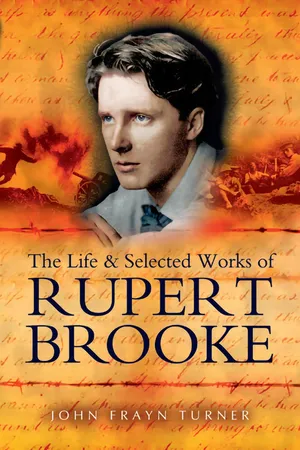
The Life and Selected Works of Rupert Brooke
About this book
Rupert Brooke's short life was filled to brimming with drama and romance. Today he is the best known of that extraordinary collection of British Poets of the Great War. Tragically his life was cut short but not before he produced arguably the finest poetry of the 20th Century, the best examples of which are in this book.
Information
Part One
The Life of Rupert Brooke
Chapter One
The Rugby Years
Rupert Brooke was born on 3 August 1887, the year of Queen Victoria’s Golden Jubilee. From his adolescence, though, he was vehemently anti-Victorian and detested the brand of imperialism bred by the nineteenth century. In fact, his whole being belonged to the twentieth century.
Brooke’s birthplace was 5 Hillmorton Road, within sight of Rugby School, where his father had started teaching several years earlier. Their home stood only one road away from the School House, which Rupert came to know so well later on.
His father, William Parker Brooke, wore a walrus moustache and a spotted bow tie under the wing collar of the period. Being the son of a canon, Mr Brooke’s vision remained cleanly conventional, although he was known to compose jocund verses in his rare lighter moments. Rupert’s mother, Mary Ruth Cotterill, possessed a certain amount of money, over which she exercised the control of a straight and stern mind.
Into this formal family of the respectable late-Victorian middle class Rupert came to consciousness. But Hillmorton Road never imprinted more than an early memory, for in 1892, when Rupert was five, Mr Brooke received promotion to housemaster of School Field in Barby Road. With it went the house, so the family moved the few hundred yards and settled into their new home. Rupert’s elder brother, Dick, was eleven by then, and Mrs Brooke had produced a third son, Alfred, when Rupert was three.
Almost as soon as they were installed at School Field, Rupert Brooke revealed his inherent unconventionality by wandering right away from the immediate world of the school and exploring everything in walking range. Once he was retrieved down by the Avon, another time roaming in the fields surrounding Rugby with his old bull terrier, mysteriously named Mister Pudsey Dawson.
But the full force of School Field with the environment of Rugby and its sprawling acres did not really reach him yet, for he was sent away to Hillbrow preparatory school. Just before he joined, Mrs Brooke led him into Rugby town to be photographed in his large, stiff Eton collar protruding over a velvet jacket. Completing the boy’s correct attire were knickerbockers and long stockings. Rupert, aged seven, stood with his hands on his hips, his hair combed straight towards the front without a parting. He did not like that garb; in particular, he hated his Eton collar with its stiff, restricting feel. But as yet he was too young to rebel openly against such senseless conventions.
By 1898, he had graduated to a dark coat and waistcoat, with lighter trousers. He wore a large tie over the inevitable larger-still collar. Each year he resented those collars more. Now, at eleven, his proud, perfect features were well formed, and his lips might sometimes be parted with the upper one sloping slightly towards the centre.
Sir Gilbert Scott, the architect of School Field, recalls him at this time as delightful and intelligent. To these rare qualities for a boy could be added independence, for in 1899 he supported a local meeting in favour of the Boers! His mother told him off for trying to bully his younger brother into similar support, but Rupert countered with agility that it was she who was bullying for attempting to inflict her views on him.
Rupert was becoming an acute observer of life, with an enquiring intellect. Already he had developed a love of freedom and the unconventional, which could be ascribed at least in part to a revolt against the respectability of his background. He could not be bothered with the religious pieties of the family, and now his hate of formal clothes exploded into a fetish for an open neck wherever possible, and running about barefooted in summer. Rupert had a mind of his own: sensitive, strong.
Trim took the place of Mister Pudsey Dawson, the century closed and Rupert moved on from Hillbrow to Rugby itself; back home to his father’s house and under the parental eyes. But his natural and growing enthusiasm and élan overcame any real resentment of the restrictions of Rugby. And all the while he gradually grew more conscious of his surroundings, his attitude towards them, his feelings for them; aware, if not yet articulate or able to express them clearly.
What was this school life, which would leave so indelible an impression on him? Rugby ranks as one of the first public schools, and was founded in 1567 by a man named Sheriff, who made his money in grocery. So it had existed since Elizabethan days, whose poets always attracted Rupert above all other periods. Many of the present buildings were far younger than this, though, the old cloistered quadrangle and the headmaster’s house then being barely a century old. The new Big School was built as lately as 1885, while an expensive quadrangle celebrating the tercentenary of the foundation was finished soon after the Brookes moved into School Field.
Rupert looked up at the tall three-storey house as he returned to it in July 1901 for the summer holidays. This would be home over the next five years, home and school interwoven through his adolescence. School Field, set in a corner of the peaceful playing fields, with its trio of dormer windows on the top floor almost cloaked in ivy. Even the chimneys seemed extra tall, too. It was all impressive, enduring, permanent, secure: the perfect place to grow up, to remember with joy. Although almost palatial from the outside, it lacked many amenities, having cold stone passages all over the ground floor, and a generally dark air about it. But Rupert loved every crevice and seemed to be glad of its safety for the time being. Especially he loved the garden, part formal, part wilder. The whole situation, looking on to the playing fields called Big Side, was ideal.
Over on the left there rose the sharp strange outlines of a monkey-puzzle tree; beneath it, the fragrance of flowers at their late-July zenith; but best of all he liked the long grass path that he made his own by constant use. He would wander up and down its length, reading as he went. Old pergolas threaded overhead. And round to the right of School Field, he could see the Island – the large grass mound supporting the famous clump of trees that gave summer shade to the spectators of school games. For Rugby, remember, thrived on cricket and also gave its name to the brand of football played with the hands as well as the feet. The game actually arose out of an incident in the autumn of 1823, on these very grounds, when one William Webb Ellis, while playing in the Close, caught the ball, but instead of retiring back and kicking it according to the rules of those times, had the extreme temerity to run with it clasped in his arms towards the opposing goal!
Rupert’s fourteenth birthday passed and so did that summer when he was suspended between his preparatory school days and the Rugby years starting in September. He relished every high-summer day and realized that here was a turning-point in his life. The next would come exactly five years later as he left Rugby, but for the moment he stood on its threshold. Not only the threshold of Rugby, but the whole Edwardian decade which coincided with the start of the Michaelmas term.
While still at Hillbrow, Rupert had scribbled secretive verses; now with Rugby as stimulus and setting, he turned more toward this world. But at the same time, he had to accustom himself to the teeming, lunging life of 600 boys. In the process, he began to lose a lot of the introversion apparent when younger. He lived a normal school existence, but as always, he never became swamped by tradition or convention for their own sake. He could be impressed at the sense of solidity around him in the shape of big buildings; but he insisted rightly on ridiculing the incongruous castellations and giant Gothic excrescences of much of this monumental architecture. The rest accepted it, or more likely, never noticed it: Rupert questioned and commented.
For the first year or two, few of the boys in School Field realized that anyone out of the ordinary was among them. Rupert was still inclined to be quiet some of the time, though he could mix well, too, and proved himself good at games almost at once.
Although he lived much as anyone else, gradually they became aware of little differences about him. Instead of joining a group going ‘down town’, he went only as far as the newly-opened Temple Library.
Then he would call: ‘Carry on and have a good time, you fellows, I’ve got to look at something over there’. He crossed the road with a wave, and vanished eagerly into the lofty single-storey structure to read the reviews of the latest books. Here he sat content, occasionally glancing up to the high, arched windows, and beyond to the trees on the Island. Books, and poetry in particular, were already in his essence.
H.F. Russell-Smith, one of the boys in the same house then, remembers him reading Walter Pater and other authors quite foreign to his companions. When he was not in the library, where even the tick of the clock in the corner echoed around the room, Rupert walked to and fro along his grass path, reciting the meter of a poem to the pounding of his step. Early in the century he discovered Oscar Wilde, Ernest Dowson and Swinburne. Rupert rhapsodized over Swinburne to his house friends who, on the whole, adopted an adamant indifference.
‘The trouble is that you’re all a lot of Philistines’ he complained cheerfully.
His hair began to grow longer than was usual, and he won a school scholarship. But books did not exclude games. In his second summer, 1903, he played cricket for the House XI at an age younger than anyone else in the team, and later helped School Field to become Cock House in both football and cricket.
As Rugby and Rupert came to terms, he began to develop an extraordinary vitality, which showed itself in a boundless enthusiasm and boisterous sense of fun. When he wrote to his friends, too, this sense of the absurd was revealed in a kind burlesque of masters or boys, or parodies of himself.
Rupert usually seemed to be hurrying somewhere, when he was not studying. He and Russell-Smith used to dash across from School Field so as not to be late for chapel. Then after the day’s work, another rush to Big Side prayers, when Rupert would sing the evening hymn at the top of his voice with a glorious disregard for tune.
One day when a sheep became entangled in one of the cricket nets, Rupert rushed on the Close to release the creature which was calling pitifully for help. But generally the boys saw him with a book, for while they were going for a walk or a bathe, he would be reading.
Rupert got through a great deal, but neither Rugby nor Cambridge persuaded him to pursue a steady scholastic course. He preferred to study what interested him most – seldom the conventional classics or the syllabus set! A little later, for instance, he wrote several chapters of an enormous romance, while he should have been busy with school work. So the Rugby scene was helping him to develop; but the things to spark his senses were the white moonlight strangely reflected on the glass roof of the observatory, or the huge elm beside the chapel, rather than the Greek epics.
By the time he was sixteen, Rupert was writing fluent adolescent verse, and in the spring of 1904 came his earliest recorded work, The Pyramids. This he composed for the annual prize poem for the school, and though it did not win, he received an additional award, as it was considered so nearly equal to the winning entry.
Imperfect and immature as it was, the poem promised much for the future, with lines like:
And heard the roll and clangour of the years bearing on men and their little hopes and fears.
And later:
Proud in the girdle of her Seven Hills,
Indomitable Rome.
Indomitable Rome.
Perhaps the most promising mark was that he tried to avoid the cliché and the merely pretty phrase. In his original manuscript, one line read:
child of the newborn France, the Corsican.
But when his mother had the poem privately printed in May 1904, he decided to change ‘newborn’ to ‘newgrown’. Mrs Brooke, although she never for a moment understood her son properly, apparently recognized or realized that he had some talent by arranging for the poem to be circulated to their friends.
Three of his five years at Rugby had fled in the flurry of daily school routine. In the Michaelmas term, he saw himself in print for the first time more or less publicly. A touring company performed As You Like It in the Town Hall early in the term and Rupert contributed an unsigned notice of the play to the school magazine The Meteor on 1 November. Throughout the ten years left of his life, Rupert maintained a growing interest in the poetic theatre, most of all, the Elizabethan poet-playwrights.
The earliest examples of Rupert’s poetry were contained in a second school publication, The Phoenix, which survived for only three numbers between 1904 and 1905. A prose offering entitled A child’s guide to Rugby School showed he was no respecter of persons or place, but whether this could have been connected with the early demise of The Phoenix is not known! One of its successors, The Vulture, however, was definitely forbidden by the school authorities.
He initialled his more serious poems that winter ‘E.R.T.’ – the last three letters of his Christian name – and one of these, The Return, appeared in the next number of The Phoenix. This is the poem beginnin...
Table of contents
- Front Cover
- Title Page
- Copyright Page
- Contents
- Alphabetical List of Selected Poems
- List of Plates
- Acknowledgements
- Introduction
- Part One – The Life of Rupert Brooke
- Part Two – Selected Poems
Trusted by 375,005 students
Access to over 1.5 million titles for a fair monthly price.
Study more efficiently using our study tools.
Frequently asked questions
Yes, you can cancel anytime from the Subscription tab in your account settings on the Perlego website. Your subscription will stay active until the end of your current billing period. Learn how to cancel your subscription
No, books cannot be downloaded as external files, such as PDFs, for use outside of Perlego. However, you can download books within the Perlego app for offline reading on mobile or tablet. Learn how to download books offline
Perlego offers two plans: Essential and Complete
- Essential is ideal for learners and professionals who enjoy exploring a wide range of subjects. Access the Essential Library with 800,000+ trusted titles and best-sellers across business, personal growth, and the humanities. Includes unlimited reading time and Standard Read Aloud voice.
- Complete: Perfect for advanced learners and researchers needing full, unrestricted access. Unlock 1.5M+ books across hundreds of subjects, including academic and specialized titles. The Complete Plan also includes advanced features like Premium Read Aloud and Research Assistant.
We are an online textbook subscription service, where you can get access to an entire online library for less than the price of a single book per month. With over 1.5 million books across 990+ topics, we’ve got you covered! Learn about our mission
Look out for the read-aloud symbol on your next book to see if you can listen to it. The read-aloud tool reads text aloud for you, highlighting the text as it is being read. You can pause it, speed it up and slow it down. Learn more about Read Aloud
Yes! You can use the Perlego app on both iOS and Android devices to read anytime, anywhere — even offline. Perfect for commutes or when you’re on the go.
Please note we cannot support devices running on iOS 13 and Android 7 or earlier. Learn more about using the app
Please note we cannot support devices running on iOS 13 and Android 7 or earlier. Learn more about using the app
Yes, you can access The Life and Selected Works of Rupert Brooke by John Frayn Turner in PDF and/or ePUB format, as well as other popular books in History & Historical Biographies. We have over 1.5 million books available in our catalogue for you to explore.