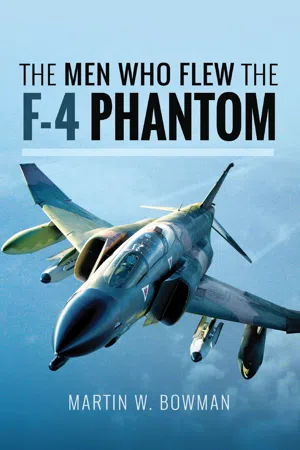
- 272 pages
- English
- ePUB (mobile friendly)
- Available on iOS & Android
eBook - ePub
The Men Who Flew the F-4 Phantom
About this book
The Phantom was developed for the US Navy as a long-range all-weather fighter and first flew in May 1958, before becoming operational in 1961. The US Air Force then realized that the Navy had an aircraft that was far better than any tactical aircraft in their inventory and ordered 543 F-4C variants. There then followed a spate of orders from around the world. In Britain, it was ordered for the Navy and Air Force, but was modified to take the Rolls-Royce Spey turbofan. One of the Royal Navy's Phantoms stole the record for the fastest Atlantic crossing, a record that stood until taken by the remarkable Blackbird. Phantoms have been used in combat in many conflicts throughout its long service history. It was one of America's most utilized aircraft during the long Vietnam War and has been flown in anger in the Middle East by a number of different air forces.This is the perfect book for the general reader, enthusiast or modeler wishing to find a succinct yet detailed introduction to the design of the aircraft that has made history. It features a multitude of stories as relayed by USAF and Israeli airmen who actually flew this remarkable aircraft in wars in SE Asia and the Middle East, detailing just what it was like to fly the F-4 in combat. Many of the dozen or so chapters include combat testimonies of the Phantom design and durability in SE Asia and in the wars fought between Israel and her surrounding Arab enemies throughout the 1970s and beyond.The book also features a wealth of technical data along with stirring images that supplement the text perfectly, enhancing its visual appeal.
Information
Chapter 1
The Gunfighters
Despite being designed as a specialized carrier-borne aircraft, the Phantom was to become the most widely used American supersonic fighter during the era of the Mach.2 missilelaunching fighter era. No less than 1,264 F-4s were delivered to the US Navy and 2,640 Phantoms to the USAF. Only the F-86 Sabre/FJ Fury exceeded the F-4 Phantom in numbers produced, but in terms of longevity, the North American design had a shorter career span than the Phantom. The F4H-1F (F-4A) Phantom entered service with the US Navy on 30 December 1960 with VF-121 ‘Pacemakers’ the Pacific Fleet RAG (Replacement Air Group) at NAS Miramar, California. On 30 March McDonnell received an order for one F-110A and a production contract for 310 F-4C aircraft soon followed. In April 1962 the Department of Defense (DoD) announced that versions of the Phantom were to become the standard fighter and tactical reconnaissance aircraft of TAC, United States Air Force in Europe (USAFE) and the Pacific Air Force (PACAF).
The Phantom men’s greatest claim to fame was in the Việtnam War 1965-1973 where their MiG victories, ground-attack, ECM suppression missions and attacks on bridges with conventional and later ‘smart’ bombs formed the major part of their war. By the end of 1965, there were eighteen squadrons of ‘fast movers’ in South East Asia including six tactical fighter squadrons equipped with the F-4C. The Republic of South Việtnam was created in July 1954 using the 17th Parallel to separate it from the Communist North. However, Hồ Chi Minh’s Việt Minh forces, led by General Võ Nguyên Giáp, planned to take over control of the South using a new Communist guerrilla force called the Việt Công (VC) or National Liberation Front (NLF). The VC campaign increased in intensity in 1957 and finally, in 1960, Premier Ngô Đình Diệm appealed to the United States for help. In 1961 ‘special advisers’ were sent in and later President Lyndon B. Johnson began the first moves, which would lead to total American involvement in Việtnam.
In the autumn of 1965, after having flown in the back seat of an F-100 in Việtnam, Winston Spencer Churchill, a journalist before becoming a Member of Parliament, who in the 1950s had covered conflict in Yemen and Borneo, had still not got his Phantom strike and thought he would try his luck once again. Born at Chequers on 10 October 1940, days before the victorious conclusion to the Battle of Britain which his grandfather hailed as the nation’s ‘finest hour’, he was the only child of Randolph Churchill’s wartime marriage to the young Pamela Digby. She would enjoy a near-scandalous romantic career and eventually, after outliving the much older Averell Harriman, became President Clinton’s ambassador in Paris. In the 1960s the Six Day War during which time young Churchill would meet numerous Israeli politicians, including Moshe Dayan;1 and publish a book recounting the war, got his attention, just as Việtnam had. The first US aircraft on a mission against targets in North Việtnam in August 1964 had encountered only a rudimentary air defence system which did not severely impede the attack. The NVNAF possessed no jet aircraft or surface-to-air missiles and had only a crude radar system. These deficiencies were soon corrected, however, when in 1965 they introduced MiG-15 and MiG-17 jet fighters and other defences. The MiG-17 was a generation behind the Phantom in age, but some Americans feared it more than the newer MiG-21. Pushed through the sky by two 17,900lb afterburning General Electric J79-GE-10 axial-flow turbojet engines, the Phantom weighed ten times as much as the nimble MiG-17.
The Phantoms at Đà Nẵng operated almost exclusively on what was termed ‘out-of-country’ missions, over North Việtnam. Because of the significant numbers of surface-to-air missiles, heavy anti-aircraft fire and the very great difficulties of recovering downed pilots from the north, journalists were forbidden to go on such missions. But to Churchill’s amazement, an in-country mission was set up, using an F-4C Phantom and two B-57s (the US designation for the British-built Canberra medium bomber). Having been kitted up as before with pressure suit, survival kit, parachute, dinghy, life-jacket and assorted gear, Churchill was briefed on the mission by Lieutenant Colonel Pasqualicchio - Call me ‘Pancho’ for short! - a dark, lean, distinguished-looking fellow with a well-trimmed moustache, who commanded the 480th Tactical Fighter Squadron.
‘I climbed into the rear seat of the Phantom’ he wrote, ‘where, before take-off, I was given a full hour’s briefing on the aircraft’s controls and systems. The aircraft was equipped with four Sparrow air-to-air missiles which could only be fired from the navigator-bombardier’s seat, which I was to occupy. Since we were so close to the North Việtnamese border and there was a danger that we might be engaged by MiGs, I was given a detailed briefing on how to bracket a target on the radar so as to achieve ‘lock-on’, as well as instructions for the arming and firing of the missiles. In addition to our defensive missiles, we carried on underwing pylons four pods, each containing sixteen rockets with high-explosive incendiary warheads, as well as an enormous cigar-shaped pod under the belly of the aircraft, known as ‘the pistol’ - a Gatling gun capable of firing 1,200 rounds in the space of twelve seconds. Though the Phantom could fly at Mach 2, or twice the speed of sound, the vast array of weaponry that we carried restricted our speed to Mach .82 or 600 mph. In the event that we were engaged by MiG-21s, we would instantly jettison all the ‘garbage’, as ‘Pancho’ described our external war-load, so as to recover the full speed and manoeuvrability of the aircraft for a dog-fight.
‘Once our weapons had been armed, we taxied for take-off behind some Marine Crusaders and South Việtnamese F-5s, in company with the two B-57s that were to come with us. On this occasion, I had a vivid demonstration of the way the taxi-rank concept for the deployment of air power was used by the Americans in Việtnam. No sooner were we airborne and climbing on track towards our destination than we were switched to a different target. Five minutes later we were reassigned to a third, even higher priority target. This turned out to be a point on the la Drang River, just three miles from the Cambodian border, where a US Special Forces unit found themselves engaged in a ‘fire-fight’ with a sizable force of Việt Công’ guerrillas on the far side of the river.
‘The Forward Air Controller met us over the target area and pinpointed where he wanted us to drop our munitions on the east side of the river. The two B-57s made a shallow dive into the target and we followed close behind. They seemed to make little impression on the dense jungle with their 750lb bombs but, as we reached about 2,000 feet, we fired one of our rocket pods, followed moments later by a second one - making a salvo of thirty-two rockets. We pulled 6.5 times the force of gravity as we came out of the dive and, as we made a steep left-hand turn, we could see the jungle in flames for 100 yards or more along the bank of the river. We came round for a second pass with our bombs and rockets. Finally, we made four or five run-ins with our Gatling gun, which growled fiercely as we let fly two or three bursts on each pass, each time making a quick bank to left and to right, as we climbed away, so as to avoid the enemy ground fire which had been reported by the FAC. As we set course back to Đà Nẵng we could see a pall of smoke rising from the smouldering jungle we left behind us.
A couple of days later, when I visited the Special Forces base at Pleiku in the central highlands of Việtnam, I discovered that we had, in fact, killed no one in the strike but that it had had the desired effect of persuading the Việt Công to break off the action and make a tactical withdrawal. Shortly before we were due to touch down at Đà Nẵng, Colonel ‘Pancho’, who had let me fly the plane all the way to and from the target area, exclaimed: ‘I don’t think I’ve shown you how this bird performs!’ We were at the time descending through 1,500 feet on final approach to the runway, when he thrust throttles abruptly forward and pulled back sharply on the stick, cocking the Phantom on its rear end, almost vertical to the ground. At the same instant the two after burners kicked in and, with an incredible surge of power, we shot up through the clouds into the brilliant sunshine above, making climbing barrel rolls as we went. Within seconds we were at 22,000 feet: two minutes later we were on the ground.
‘My two air combat missions and a subsequent two-hour flight low over the jungle canopy at no more than 80 or 100 mph with a Forward Air Controller in his ‘Bird-dog’ gave me a first-hand insight into the lives and attitudes of fighterbomber pilots in combat. Unlike troops on the ground, the pilot is, to a large degree, divorced from the realities and discomforts of war. Hurtling through the sky at hundreds of miles per hour with incredible power at his fingertips and the ability, at the touch of a button, to decide the fate of hundreds of his fellow mortals, he can easily come to feel like a god of Greek mythology, unleashing deadly thunderbolts from the sky. As one dive towards the target at nearly 600 mph, it is difficult to appreciate that the black ant-like creatures scrambling for cover below are in fact human beings - each someone’s son, husband, father or brother. Unless unlucky enough to be shot down by a missile or by ground fire - as indeed all too many were, especially over the North - one is back at base within an hour or two in a totally secure environment far removed from the squalor and hardship of the battlefield, sipping an ice-cold lager. It is a form of warfare which can readily lead to insensitivity and callousness.
‘As one who has on half a dozen occasions flown in fast military combat aircraft and felt totally exhilarated by the experience, I count it a salutary antidote that, three years later, while reporting the Nigerian civil war from Biafra, I found myself on the receiving end when a Russian-made Tupolev bomber of the Nigerian Air Force opened its bomb-bay almost directly over my head, dumping its weaponload just a quarter of a mile away on what turned out to be a clinic for nursing mothers and their babies. Under such circumstances, one is liable to get a more jaundiced - possibly truer - view of air power. It becomes easy to understand how simple people, who find themselves defenceless in the face of such awesome destructive power, have before now, when a plane has been brought down, literally torn the pilot limb from limb in expiation of their pent-up rage and hatred, ‘a fate that has undoubtedly befallen several Israeli pilots shot down over Arab lands’.
The political and physical restrictions on the basing of US aircraft in South Việtnam was to some extent solved by the permanent stationing of aircraft carriers in the South China Sea. In March 1965 the US 7th Fleet’s Task Force 77 had developed a pattern of positioning carriers at ‘Yankee Station’ in the South China Sea off Đà Nẵng from which to launch attacks against North Việtnam. On 20 May TF 77 established ‘Dixie Station’ 100 miles southeast of Cam Ranh Bay from where close air support missions could be mounted against South Việtnam. The carriers developed a system that normally kept each ship on line duty for a period of between 25 and 35 days after which the carrier would visit a port in the Philippines, Japan or Hong Kong for rest and replenishment of supplies. Each carrier would normally complete four spells of duty on the line before returning to its homeport for refitting and re-equipping. However, the period spent on line duty could vary considerably and some ships spent well over the average number of days on duty. The establishment of ‘Dixie Station’ required the assignment of a fifth carrier to the Western Pacific to maintain the constant presence of at least two carriers at ‘Yankee Station’ and one at ‘Dixie Station’. By the summer of 1966, there were enough aircraft based in South Việtnam to provide the required airpower and ‘Dixie Station’ was discontinued from 4 August.
When in 1964 two F-8 Crusaders were brought down during a reconnaissance mission over Laos, the USAF flew a retaliatory strike on 9 June against AAA sites. On 2 August North Việtnamese torpedo boats attacked the destroyer USS Maddox in international waters in the Gulf of Tonkin. At the time, thirteen of the 31 Navy deployable fighter squadrons were equipped with F-4Bs, one had a mix of F-4Bs and F-4Gs and one was converting from F-3Bs to F-4Bs. In addition, two RAG squadrons flew a mix of F-4As and F-4Bs. In Operation ‘Pierce-Arrow’ in the early afternoon of 5 August two F-4Bs, of VF-142 ‘Ghostriders’ and VF-143 ‘Pukin Dogs’on the USS Constellation (CVA-64) made the first Phantom combat sortie of the Việtnam War when they provided bomber escort for ten A-1H Skyraiders and eight Skyhawks in an attack on the gunboats and shore facilities near the coalmining town of Hon Gai northeast of Hànôi. Twelve more (five Skyhawks, four Skyraiders and three Phantoms) from the same carrier struck the Lộc Cháo base. On 10 August the US Congress passed what came to be known as the ‘Gulf of Tonkin Resolution’, committing America to direct, large-scale intervention in the conflict. The Navy began a campaign of limited bombing attacks against North Việtnam codenamed ‘Barrel Roll’ in December 1964 that continued into January 1965. Next to see action during the war in SE Asia War were F-4Bs of VF-92, VF-96 and VF-151, which flew combat air patrols during retaliatory strikes in February 1965 (‘Flaming Dart’) and early ‘Rolling Thunder’ raids in spring 1965.
Following the establishment of TF 77 aircraft carriers in the South China Sea in August 1964 it was six months before the US Navy was again in action although thirteen naval aircraft had been lost in accidents over Southeast Asian waters during this time. Air strikes against North Việtnam were part of President Lyndon B. Johnson’s 2 December plan but they were not immediately instigated. However, VC attacks on US facilities at Sàigòn on 24 December and Pleiku and Camp Holloway on 7 February caused Johnson to order the first air strike against North Việtnam since ‘Pierce-Arrow’ in August 1964. In retaliation, the order was given for a strike code-named ‘Flaming Dart I’, from carriers in the Gulf of Tonkin. On 7 February 1965 49 aircraft were launched from the decks of the Hancock and Coral Sea against Viêt Công installations at Đồng Hới, while the Ranger sent 34 aircraft to bomb Vit Thù lù and other targets were to be hit by VNAF A-1s. The raid was led by Commander Warren H. Sells, Commander of Hancock’s Air Wing 21. In the event, monsoon weather forced the 34 aircraft of Ranger’s strike force to abort their mission against Vit Thù lù but Đồng Hới’s barracks and port facilities were attacked by twenty aircraft from the Coral Sea and 29 from the Hancock. The strike was carried out at low-level under a 700 feet cloud base in rain and poor visibility. The mission did not appear to have the effect on the North Việtnamese that Washington had hoped for. On 10 February the Việt Công struck at an American camp at Quy Nhơn causing serious casualties. The immediate response to this was ‘Flaming Dart 2’, flown the following day when a total of 99 naval aircraft from the Coral Sea, Hancock and Ranger were sent against NVA barracks at Chánh Hóa near Đồng Hới. The target was attacked in poor visibility with low cloud and the Coral Sea suffered the loss of an A-4C and an F-8D Crusader and one pilot lost on this raid. Bomb damage assessments at Chánh Hóa showed that twenty-three of the seventy-six buildings in the camp were either damaged or destroyed during the raid.
In March 1965 Operation ‘Rolling Thunder’ was launched and the Navy’s first strike took place on the 18th when aircraft from the Coral Sea and Hancock bombed supply dumps at Phú Văn and Vĩnh Sơn. The US Navy’s second ‘Rolling Thunder’ mission, on 26 March resulted in the loss of three aircraft out of seventy dispatched. The ability of the North Việtnamese air defence system to monitor US raids was a concern even in the early days of the war and the targets for this mission were radar sites at Bạch Long Vi, Cap Mùi Rắn, Hà Tĩnh and Vĩnh Sơn. The battle against the North Việtnamese radar system continued on 31 March with further raids on the Vĩnh Sơn and Cap Mùi Rắn radar sites by sixty aircraft from the Hancock and Coral Sea.
The decision to interdict the North Việtnamese rail system south of the 20th parallel led immediately to the 3 April strike against the giant Long Biên or Hàm Rồng (‘Dragon’s Jaw’) road and rail bridge over the Sông Mã River, three miles north of Thành Hòa in North Việtnam’s bloody ‘Iron Triangle’ (Hảiphòng, Hànôi and Thành Hòa). The 540 feet long, 56 feet wide, Chinese-engineered cantilever bridge, which stood 50 feet above the river, would prove to be one of the single most challenging targets for American air power in Việtnam. In March the US Navy had attacked the Thành Hóa Bridge with AGM-62 Walleye television-guided glide bombs with a 250lb high-explosive warhead but failed to knock out the structure despite three direct hits. On 3 April a total of 35 A-4s, sixteen F-8s and four F-4s were launched from the Hancock and Coral Sea. The raids were the first occasion when the Việtnamese People’s Air Force employed its MiG-17 fighters. Thirty-two Bullpups and ten dozen 750lb bombs were aimed at the bridge but when the smoke cleared, observer aircraft found that the bridge still spanned the river. The Navy flew 97 sorties and dropped 215 tons of bombs on the charmed bridge from April to September 1967 with little to show for its effort. Almost 700 sorties were flown against the bridge at a cost of 104 crewmen shot down over an area of 75 square miles around the ‘Dragon’. On 27 April 1972 a flight of eight Air Force Phantoms, two carrying 2,000lb laser-guided bombs and two carrying Walleye IIs, attacked the Thành Hóa Bridge. Cloud cover prevented the LGBs from being used, but five of the Walleyes locked on, causing heavy damage to the bridge, even though failing to bring down a span. The spans were finally brought down three days into the ‘Linebacker’ campaign on 13 May 1972 by 3,000 and 2,000lb LGBs dropped by F-4Ds of the 8th TFW. Unfortunately, by then the Communists had built several other back-up routes around the bridge and the flow of supplies across the Sông Mã River was not seriously affected.
The first air combat victory was made on 9 April 1965 when two F-4Bs of VF-96 ‘Fighting Falcons’ were launched from the USS Ranger (CVA-61) to relieve two other aircraft flying a BARCAP (Barrier Combat Air Patrol) racetrack pattern in the northern Gulf of Tonkin. However, the first aircraft to launch lost its starboard engine as it was being catapulted from the carrier and the aircraft ditched into the sea but both Lieutenant Commander William E. Greer and Lieutenant (jg) R. Bruning ejected just as the aircraft impacted the water and were rescued. Lieutenant (jg) Terence Meredith Murphy and his RIO, Ensign Ronald James Fegan were then launched and took over as section leader with a replacement ...
Table of contents
- Cover
- Title
- Copyright
- Contents
- Preface: - Scott Campbell
- Chapter 1: The ‘Gunfighters’
- Chapter 2: Memories Of Ubon - Richard E. Hamilton
- Chapter 3: Operation ‘Bolo’
- Chapter 4: Tailhookers and MiGCAP
- Chapter 5: ‘Barrel Roll’ Backseater - Rayford ‘RK’ Brown
- Chapter 6: Blue Bandits - Commander John R. Cheshire
- Chapter 7: ‘Linebacker’
- Chapter 8: The MiG Killers
- Chapter 9: Keeping the Bear at Bay
- Chapter 10: The Sword of David
- Chapter 11: Phantoms Phorever
- Acknowledgements
- Plate section
Trusted by 375,005 students
Access to over 1.5 million titles for a fair monthly price.
Study more efficiently using our study tools.
Frequently asked questions
Yes, you can cancel anytime from the Subscription tab in your account settings on the Perlego website. Your subscription will stay active until the end of your current billing period. Learn how to cancel your subscription
No, books cannot be downloaded as external files, such as PDFs, for use outside of Perlego. However, you can download books within the Perlego app for offline reading on mobile or tablet. Learn how to download books offline
Perlego offers two plans: Essential and Complete
- Essential is ideal for learners and professionals who enjoy exploring a wide range of subjects. Access the Essential Library with 800,000+ trusted titles and best-sellers across business, personal growth, and the humanities. Includes unlimited reading time and Standard Read Aloud voice.
- Complete: Perfect for advanced learners and researchers needing full, unrestricted access. Unlock 1.5M+ books across hundreds of subjects, including academic and specialized titles. The Complete Plan also includes advanced features like Premium Read Aloud and Research Assistant.
We are an online textbook subscription service, where you can get access to an entire online library for less than the price of a single book per month. With over 1.5 million books across 990+ topics, we’ve got you covered! Learn about our mission
Look out for the read-aloud symbol on your next book to see if you can listen to it. The read-aloud tool reads text aloud for you, highlighting the text as it is being read. You can pause it, speed it up and slow it down. Learn more about Read Aloud
Yes! You can use the Perlego app on both iOS and Android devices to read anytime, anywhere — even offline. Perfect for commutes or when you’re on the go.
Please note we cannot support devices running on iOS 13 and Android 7 or earlier. Learn more about using the app
Please note we cannot support devices running on iOS 13 and Android 7 or earlier. Learn more about using the app
Yes, you can access The Men Who Flew the F-4 Phantom by Martin W. Bowman in PDF and/or ePUB format, as well as other popular books in History & Military Biographies. We have over 1.5 million books available in our catalogue for you to explore.