- 224 pages
- English
- ePUB (mobile friendly)
- Available on iOS & Android
eBook - ePub
On the Road to Mandalay
About this book
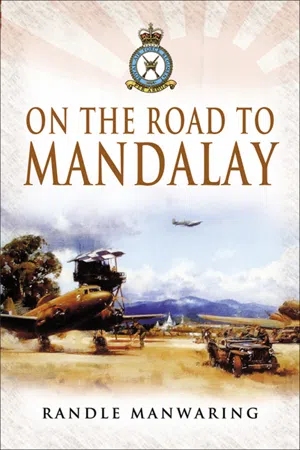
"The fascinating book features the life story of Dr Randle Manwaring,focusing particularly on his Regiment's fight to capture Burma towards the end of WW2As one of the founding Officers of the RAF Regiment, the author helped train and set up the Regiment from its inception in 1942.He saw active service with the Regiment in Burma, where the Regiment particularly distinguished itself but suffered heavy losses. Randle was present at the Japanese surrender in Rangoon and took the Swords from the Japanese Generals as they surrendered.The end of the War saw a return to a very different life requiring different skills. Guided by his strong Christian beliefs, Randle established a successful career in the City in Insurance Broking."
Information
Subtopic
Military BiographiesIndex
HistoryChapter 1
War Leading to War
I was born on 3 May 1912, two or three weeks after the world was shaken by the loss, near the coast of Newfoundland, of the luxury White Star liner Titanic. At her launch she was showered with eulogies but some thought that overconfidence encouraged the ancient Greek fear of provoking high heaven. She was so huge, they said, that the sea, far from endangering her, would hardly disturb the comfort of those on board and they would scarcely know, unless they wanted to, that they were all at sea. But an iceberg, drifting across her in the night, destroyed her with the loss of 1,635 lives. Lifeboats, instead of being a means of saving lives were thought to be an extra problem for these huge liners. How could they be easily launched from such a height? The Titanic was a ship of 46,800 tons but legislation covering lifeboats had previously only considered ships of up to 10,000. Therefore this unsinkable ship carried lifeboats for only half the passengers.
It might be argued that the arrogance of man at the beginning of the twentieth century was typified by the Titanic disaster. His way of life was only mildly disturbed by the disappointments of the Boer War and it waited another two years before that prophet of doom, Thomas Hardy, would mutter his sad predictions about the Breaking of Nations, which was imminent.
My father, one of the two official Assistant Librarians at the London Library, received a letter on the day of my birth from the Librarian, Sir Charles Hagberg Wright: ‘Dear Manwaring’, he wrote, ‘enclosed is a trifle to mark the happy event.’ (I’m not sure what it was.) My father suffered from a congenital heart complaint and was therefore excused military service in the Great War but, being also a naval historian, he was able to write naval propaganda under the general title of Foreign Impressions of the Fleet, subsequently published in book form in 1930, as The Flower of England’s Garland.
I started my school life at the age of five at King’s College, Wandsworth Common, in South London and my father passed on to me my first school report, which indicates that I had made a good beginning. There were only five pupils in my form but somehow I was placed first in all five subjects. A polymath in the making?
I have a few memories of the Great War, although I was only six when it ended. I recall seeing wounded men walking the streets in a medium blue uniform with a bright red tie and I picked up in my road the odd piece of shrapnel, which came from Zeppelin raids on London. This navigable form of balloon, taking to the air in 1908, was felt to have advantages over the aeroplane; behaving well against the wind, it carried fifteen passengers. Raids on London did not amount to much in those war years but for a boy to find a bomb splinter was an interesting experience and these raids were the first effective use of aerial bombardment. Although later one airship disaster followed another, the early use of Zeppelins was an outstanding success. In the six years of their flights before war commenced in 1914, they had carried 35,000 passengers, without mishap.
I remember the Armistice in November 1918 and was taken to Wandsworth Common to see the victory fireworks display. The ghastly horror of the First World War had hardly dawned on a nation overjoyed with the end of hostilities but it gradually became known that from the time the first pistol shot was fired in Sarajevo on 28 June 1914, killing the Archduke Ferdinand, until the guns fell silent in November 1918, over four years later, engulfing almost the whole of Europe and bringing in the USA from April 1917, the loss of life on both sides had been enormous.
In the battle of the Somme tanks were used for the first time and the Allies lost some 600,000, the Germans 650,000. Other later battles produced great carnage; in Passchendaele over 245,000 British losses. It could be said that the flower of youth was mown down in those dreadful years and historians, viewing life as a whole, might well agree that civilization, as it was previously known, would never be the same again.
Life in Edwardian times had been so settled – like an endless summer day, yet ferment was abroad even then. The slippery slope of international imperial rivalry had resulted in the destruction of a life beyond recall. In 1914 twilight was coming on; an evening chill was in the air – in Europe, at least, but perhaps not in the USA. War had done its worst and would continue to do so.
When the Armistice was being signed in 1918, an unknown ex lance corporal in the German Army was recovering in hospital from his war disability. In peacetime he was a house painter and his name was Adolf Hitler. Devastated to realize that his Fatherland was broken and the German army shattered, he arose to found a revolutionary party and used his tough, visionary oratory to mesmerize the young generation. His Teutonic pride rose to new levels of belief in the all-powerful state and the elimination of all other elements. The success of the Russian Revolution had not passed unnoticed and the huge reparations, which had been demanded of the Germans after the war, were being circumvented by making the Mark valueless. The Versailles Treaty, which arranged peace terms in 1919, was shunned by the Americans but it stripped a defeated enemy of lands, colonies and prestige. Here indeed were the seeds of another world war. We ought not to have been surprised but most of us were. There were limits to which you could subject a defeated nation and these had been breached. What might have been a better way of dealing with a beaten foe would always be open to conjecture.
In 1921, a seemingly insignificant event took place in my young life when I became a member of a Christian youth movement called Crusaders, which, in 2006, celebrates its centenary with a service at the Royal Albert Hall. Later in this book I will go into the details of how this involvement enabled me in the war years to manage life in tented camps and to become, as I believe, a reasonably able commander in the field but at this stage, after a lifetime of involvement in many different ways in the Crusader movement, I occupy an honorary position as one of its vice presidents. More anon.
In 1919, the National Socialist German Workers’ party came into being and was led by Adolf Hitler until his suicide in 1945. Almost concurrently, in Italy, the Blackshirts were established under Mussolini and again, as with Hitler, racial superiority was the keynote. Rallies were the life-blood of these almost fanatical uprisings, becoming anti-communist in essence.
Two years after assuming power over his Nazi party Hitler staged an abortive coup against the Bavarian government. It was known as the Munich putsch and the leader suffered imprisonment for his troubles but it gave him the opportunity to write a book that he called Mein Kampf (My Struggle). In this work Hitler blamed the Jews for Germany’s defeat in the First World War. Thus were the seeds being sown for the extermination of about six million Jews in Hitler’s holocaust of 1939-45. It represented approximately two-thirds of European Jewry and they were exterminated in ghastly concentration camps, such as Auschwitz. So much, say many historians, for the nature of European civilization of the twentieth century. How could such a cultivated nation as Germany descend to the depths of annihilation of a whole people? It all started with the end of the Weimar Republic in 1933, crushed under Hitler’s jackboot. If ever there was a reason for accepting the Christian doctrine of original sin, this was it.
My father began to make his mark in 1920 as a naval historian through the publication by the Navy Records Society, in two volumes, of the Life and Works of Sir Henry Mainwaring. This interesting gentleman was a privateer in Stuart times, a kind of successor to the more famous Tudor, Sir Francis Drake. Piracy, in those days, was a sort of school of seamanship but Sir Henry soon gravitated, in the early seventeenth century, to high command in the Navy and later was appointed Lieutenant of Dover Castle and Deputy Warden of the Cinque Ports.
These two volumes received outstandingly good reviews, notably from The Daily Telegraph, The Times Literary Supplement and The Observer. I do not suppose that, at the ages of nine or ten, I helped my father with his literary work but I certainly remember helping him with indexing when I was a young teenager. How I disliked the work, being keener on playing football or cricket on the Common. But I learned that the appearance of these two volumes carried for my father Fellowship of the Royal Historical Society. Many years later, on a visit to the home of Rudyard Kipling at Bateman’s, Burwash in Sussex, I surprised the curator in her library by asking if I could handle the two volumes written by my father which I had spotted on the shelves. She almost fell off her chair in amazement. On my own much smaller bookshelves I have one of Kipling’s books presented to my father.
My father would, I think, have described himself as an agnostic and in literati terms, he would loosely have identified himself with the giants of his age, George Bernard Shaw (1850-1950) and H. G. Wells (1866-1946), although these two men often disagreed over social and political matters. The whole intellectual climate of the first half of the twentieth century was overshadowed, initially by Charles Darwin (1809-1882) declaring the natural selection of all living things and then by the era of scientific rationalism headed up by Thomas Huxley (1825-1895) who coined the term agnosticism and violently challenged orthodox theology. As I, even as a very young teenager, was embracing the Christian faith, my father, although not showing active opposition, clearly did not approve of my commitment to what he saw as an outdated religion with, in my case, pietistic overtones of an anti-social nature, all fortunately discarded by me as the years went by. I had inherited an unpleasant sub-culture, which I would describe as life denying rather than life-affirming.
Meanwhile, in the wider world, the competitive status of empire and of impressive armaments continued, notably shown in a rivalry at sea with talk of the necessity for England to outbuild Germany in terms of fighting ships. Suspicion and the fear of war were in the air. The Balkans were, as ever, the cockpit of Europe and, long before the First World War, danger always lurked in that area. In due course, the inevitable resurgence of the German nation came about under the full hypnotic leadership of Hitler and the stage was being set for another cataclysmic conflict. All Europe would become engulfed yet again.
But my father continued his amazing literary output, for his work at the London Library, whilst allowing him to do a certain amount of research, meant that he would always be chasing, at the beck and call of members, volumes in different parts of the library and never getting home on a five and a half day week before about seven o‘clock. On his half day he would often be at the British Museum doing his research and all day on Sundays he would be using his typewriter. He never earned more than an annual pay of £300 from the library; his several books, whilst selling well for their type, only added a little to his income, so he often added to that by cataloguing private libraries in London on his half days.
In 1928 my father was appointed the General Editor of The Seafarers’ Library (Cassell) and he wrote the introduction and notes for the first volume. I think that about six volumes were published but at about the same time he achieved widespread recognition through the publication of a Bibliography of British Naval History (Routledge), which became a textbook at naval colleges. Also there was My Friend the Admiral (Routledge) and The Floating Republic (Bles), the latter also coming out as a Pelican paperback, telling the story of the naval mutiny at the Nore and Spithead in 1797. It was due to be made into a film at a later date but the project never got off the ground. The book was written jointly by Professor Bonamy Dobrée and my father, Dobrée occupying the Chair of English at Leeds University. Other interests of my father included serving on the committee for the preservation of the Victory in Portsmouth and on that of the Navy Records Society. I gained the impression that he was very popular with members of the London Library.
In the early 1920s I began to take public examinations, first the Cambridge Junior and then the Cambridge Senior and this study gave rise to one of the great interests of my life – poetry. My special interest became the poets of the First World War and An Anthology of Modern Verse (Methuen) contained what was, to my young mind, a significant and most attractive selection. Overlapping with this category of poets were what were known as the Georgians and placing some in alphabetical order I would mention Edmund Blunden, Rupert Brooke (the beau ideal), John Drinkwater, Wilfred Gibson, Robert Graves, Robert Nichols, Wilfred Owen, Siegfried Sassoon, J. C. Squire and Edward Thomas. Those killed or dying in the war, Brooke, Owen and Thomas, achieved a special lustre. It has only recently dawned on me that, in all probability, I may have inherited from my father, a large interest in the overtones and undertones of war. However, my fascination with what was then current poetry extended well beyond the Georgians and the War Poets, notably with regard to three poets who had connections with my father as members of the London Library. These were John Masefield, Poet Laureate from 1930, Sir Henry Newbolt who, my father heard, could well have been in that position had the Conservative government been in power when Robert Bridges died, Masefield being appointed his successor and, in particular, Walter de la Mare with whom, after an introduction to him by my father, I had an on and off relationship for about twenty years. Masefield also had a strong business affinity with my aunt in charge of the receiving desk at the library and almost always sent her some of his verses at Christmas. I visited de la Mare at his house in Taplow, Buckinghamshire for Saturday afternoon tea – an unforgettable and poetry-defining experience.
The scenario for the pre-war and post-world war years would not be complete without reference to the Chamberlains. Joseph (1836-1914) dominated British politics, with an imperialism second only to that displayed in Germany. The English people were securely dominant in India where Queen Victoria had long been Empress, they were established in Egypt and other parts of Africa. It was acknowledged that Britain had the best colonies, much better than the Germans or the Belgians who had the vastness of the Congo for what that was worth. So the rivalry simmered but Kipling warned against the imperialism, ‘Lord God of Hosts, be with us yet, lest we forget, lest we forget’. He was not jingoistic!
Late in the 1930s a policy of appeasement, led by Neville Chamberlain (1869-1940) was adopted towards the rising fascist powers. Italy’s conquest of Ethiopia in 1925 was greeted by a blind eye and Chamberlain did not want to know about the Spanish Civil War which began in 1936, as a kind of trial run for the fascist powers. Famously, the disarmament and appeasement advocated in Britain, was typified by Chamberlain and his frequent friendly visits to Hitler culminating in his 1939 message to his country, ‘Peace for our time’, but the invasion of Czechoslovakia earlier brought about serious doubts of western and British security.
Ten years earlier, a crippling economics crisis gripped the western world. Strangely, Germany’s economic plight partly enabled Hitler to achieve his rise to power in the 1930s and in Britain and the US fortunes were lost overnight. Before all t...
Table of contents
- Title Page
- Copyright Page
- Table of Contents
- List of poems
- Preface
- Chapter 1 - War Leading to War
- Chapter 2 - Training for Overseas
- Chapter 3 - Road to Rangoon
- Chapter4 - Shadows of War
- Chapter 5 - Peace and War in the City and Elsewhere
- Chapter 6 - As Time Went By
- Index
Trusted by 375,005 students
Access to over 1.5 million titles for a fair monthly price.
Study more efficiently using our study tools.
Frequently asked questions
Yes, you can cancel anytime from the Subscription tab in your account settings on the Perlego website. Your subscription will stay active until the end of your current billing period. Learn how to cancel your subscription
No, books cannot be downloaded as external files, such as PDFs, for use outside of Perlego. However, you can download books within the Perlego app for offline reading on mobile or tablet. Learn how to download books offline
Perlego offers two plans: Essential and Complete
- Essential is ideal for learners and professionals who enjoy exploring a wide range of subjects. Access the Essential Library with 800,000+ trusted titles and best-sellers across business, personal growth, and the humanities. Includes unlimited reading time and Standard Read Aloud voice.
- Complete: Perfect for advanced learners and researchers needing full, unrestricted access. Unlock 1.5M+ books across hundreds of subjects, including academic and specialized titles. The Complete Plan also includes advanced features like Premium Read Aloud and Research Assistant.
We are an online textbook subscription service, where you can get access to an entire online library for less than the price of a single book per month. With over 1.5 million books across 990+ topics, we’ve got you covered! Learn about our mission
Look out for the read-aloud symbol on your next book to see if you can listen to it. The read-aloud tool reads text aloud for you, highlighting the text as it is being read. You can pause it, speed it up and slow it down. Learn more about Read Aloud
Yes! You can use the Perlego app on both iOS and Android devices to read anytime, anywhere — even offline. Perfect for commutes or when you’re on the go.
Please note we cannot support devices running on iOS 13 and Android 7 or earlier. Learn more about using the app
Please note we cannot support devices running on iOS 13 and Android 7 or earlier. Learn more about using the app
Yes, you can access On the Road to Mandalay by Randle Manwaring in PDF and/or ePUB format, as well as other popular books in History & Military Biographies. We have over 1.5 million books available in our catalogue for you to explore.