- 358 pages
- English
- ePUB (mobile friendly)
- Available on iOS & Android
eBook - ePub
About this book
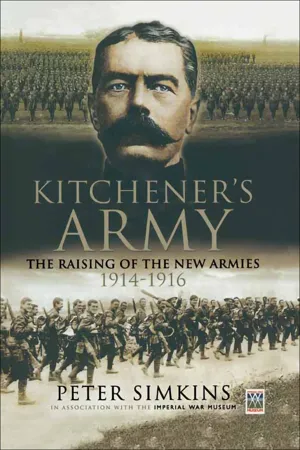
Numbering over five million men, Britain's army in the First World War was the biggest in the country's history. Remarkably, nearly half those men who served in it were volunteers. 2,466,719 men enlisted between August 1914 and December 1915, many in response to the appeals of the Field-Marshal Lord Kitchener. How did Britain succeed in creating a mass army, almost from scratch, in the middle of a major war ? What compelled so many men to volunteer ' and what happened to them once they had taken the King's shilling ? Peter Simkins describes how Kitchener's New Armies were raised and reviews the main political, economic and social effects of the recruiting campaign. He examines the experiences and impressions of the officers and men who made up the New Armies. As well as analysing their motives for enlisting, he explores how they were fed, housed, equipped and trained before they set off for active service abroad. Drawing upon a wide variety of sources, ranging from government papers to the diaries and letters of individual soldiers, he questions long-held assumptions about the 'rush to the colours' and the nature of patriotism in 1914. The book will be of interest not only to those studying social, political and economic history, but also to general readers who wish to know more about the story of Britain's citizen soldiers in the Great War.
Information
Contents
| Acknowledgements | |
| Abbreviations | |
| Illustrations | |
| Introduction | |
| Prologue | |
| Part I | The recruiting campaign |
| Chapter 1 | Kitchener and the call to arms |
| 2 | The recruiting boom: August–September 1914 |
| 3 | The Pals Battalions |
| 4 | Recruiting in decline, October 1914–May 1915 |
| 5 | The coming of conscription |
| Part II | Enlistment, equipment and training |
| 6 | Taking the King’s shilling: experiences of enlistment |
| 7 | Adjusting to life in the Army |
| 8 | Officers and NCOs |
| 9 | Training camps and billets |
| 10 | Uniforms and equipment |
| 11 | Arms and ammunition |
| 12 | Preparing for the Front |
| Conclusion | |
| Sources and bibliography | |
| General index | |
| Index of units |
Acknowledgements
It is impossible to thank adequately all those who have helped me in the preparation of this book. However, I must acknowledge the considerable debt of gratitude which I owe to the Trustees of the Imperial War Museum and to the two Directors under whom I have worked, Dr Noble Frankland and Dr Alan Borg, for giving me both the opportunity and the time to undertake the necessary research and to complete the manuscript. Robert Crawford, the Deputy Director and Head of the Research and Information Office, has also offered me valued support at every stage of the project.
Of my many colleagues in the Museum who have helped and encouraged me throughout, I wish to extend my special thanks to Roderick Suddaby and the staff of the Department of Documents, to Dr Gwyn Bayliss and the Department of Printed Books, to Jane Carmichael and the Department of Photographs and to Margaret Brooks and the Department of Sound Records. Others who have been of great assistance to me include Laurie Milner, Mark Seaman, Christopher Dowling, Michael Hibberd, Chris McCarthy, Jan Mihell, Michael Moody and David Penn. Outside the Museum, Dr Ian F. W. Beckett has taken a close interest in the project from the beginning and has done much to smooth the path towards publication. I am no less indebted to Dr M. J. Allison, Professor Brian Bond, Stephen Brooks, Malcolm Brown, Dr Patrick Callan, Dr Peter N. Farrar, Dr David French, Michael Houlihan, Clive Hughes, Dr Keith Jeffery, David L. Jones, John Keegan, Peter Liddle, Dr Patricia M. Morris, Gary Sheffield, Keith Simpson, Dr Edward M. Spiers and Dr J. M. Winter. All have given generously of their time and expertise. I am, of course, solely responsible for any errors of fact or interpretation that remain.
I am most grateful to the following for granting me access to manuscript collections of which they are the owners or custodians and, where requested, for permission to quote from documents whose copyright they control: Lord Bonham Carter; the Earl of Derby; the Viscount Esher; the Earl Haig; Mr M. A. F. Rawlinson; the Earl of Selborne; Mrs Joan Simon; the Trustees of the Imperial War Museum; the Trustees of the Beaverbrook Foundation; the Trustees of the British Library Board; the Master, Fellows and Scholars of Churchill College, Cambridge; the Trustees of the Liddell Hart Centre for Military Archives, King’s College, London; the Clerk of the Records and the House of Lords Record Office; the Trustees of the National Library of Scotland; the Trustees of the National Library of Wales; the National Library of Ireland; the Public Record Office; the Chelmsford and Essex Museum; the National Army Museum; the University of Birmingham Library; the Bodleian Library; the University of Newcastle upon Tyne Library; Nuffield College, Oxford; Bristol Central Library and Record Office; the Essex Record Office; Leeds City Library; Liverpool City Libraries; Manchester Central Library; Westminster City Libraries; and the Labour Party Archives, Transport House. Extracts from Crown copyright material held in the Public Record Office and elsewhere are reproduced by permission of the Controller of Her Majesty’s Stationery Office.
For permission to quote directly from documents deposited in the Imperial War Museum I must thank Miss Joan Ashley; Lieutenant-Colonel C. C. Aston; Mr A. M. Bickerton; Miss Daphne Bird; Mr D. M. A. Cain; Mr Charles Cameron; Colonel John Christie-Miller; Mr O. D. H. Clauson; Mr W. N. Collins; Mr Julian Colyer; Mr E. A. Crane; Mr A. W. Day; the Reverend Christopher Drummond; Mrs R. A. Du Cane; Mr J. N. Dykes; Miss Mary Fraser; Mrs Barbara Gamble; Mrs Fay Gjester; Mrs Edith Gordon; Mr David M. Griffiths, Mrs A. L. Hemming; Mr Brian Hunt; Mr Paul Jones; Mr Peter Kirkpatrick; Dr W. B. D. Maile; Mrs J. M. Ockleshaw; the Reverend Raymond Patston; Mrs R. J. Pearson; Mrs L. G. Perkins; Mr A. E. Perriman; Sir Richard Pilditch, Bt.; Captain R. C. Read; Miss Enid M. Roberts; Mrs Phyllis Robinson; Mrs E. Scullin; Mrs J. E. Sharp; Mrs C. Sheard; Mrs J. J. H. Swallow; Mr Leslie F. Taylor; Mr C. F. J. Thompson; Mrs S. M. Vischer; Mrs Margaret Williams; and Mr A. I. Winstanley.
My thanks are also due to the following individuals, publishers and literary agents for allowing me to quote from books whose copyright they hold: Basil Blackwell Ltd for Letters of Arthur George Heath (1917); Lady Bliss for As I Remember by Sir Arthur Bliss (Faber, 1970); Buchan and Enright Ltd for A Passionate Prodigality by Guy Chapman (Buchan and Enright, 1985; originally published by Ivor Nicholson and Watson, 1933); Constable and Co. Ltd for At Suvla Bay by John Hargrave (1916) and Experiences of a Dug-out by Major-General Sir C. E. Callwell (1920); Eyre and Spottiswoode Ltd for In London during the Great War by Michael MacDonagh (1935) and Make me a Soldier by Arthur Behrend (1961); Grafton Books Ltd for Disenchantment by C. E. Montague (Chatto and Windus, 1922); the Hamlyn Publishing Group Ltd for The World Crisis, 1911–1914 by Winston S. Churchill (Thornton Butterworth, 1923); Harrap Ltd for The Life of John Redmond by Denis Gwynn (1932); David Higham Associates Ltd. for My Political Life by L. S. Amery (Hutchinson, 1953–55), The Supreme Command, 1914–1918 by Lord Hankey (Allen and Unwin, 1961) and Lloyd George: A Diary by Frances Stevenson, edited by A. J. P. Taylor (Hutchinson, 1963); Hodder and Stoughton Ltd for An Autobiography by R. B. Haldane (1929); C. S. Kendall and the Lancashire Evening Post for H. Cartmell’s For Remembrance (Toulmin, 1919); William Kimber and Co. Ltd (Thorsons Publishing Group) for Schoolboy into War by H. E. L. Mellersh (1978), Johnny Get Your Gun by John F. Tucker (1978) and The Anger of the Guns by John Nettleton (1979); Macmillan Publishers Ltd. for Life of Lord Kitchener by Sir George Arthur (1920); Methuen and Co. Ltd for Great Britain and the War of 1914–1918 by Sir Llewellyn Woodward (1967); John Murray Ltd for The Weary Road by Charles Douie (1929) and Inside Asquith’s Cabinet, edited by Edward David (1977); the National Library of Wales and David Higham Associates Ltd for Lloyd George Family Letters, 1885–1936, edited by Kenneth O. Morgan (University of Wales Press, 1973); A. D. Peters and Co. Ltd for The Life of Lord Carson by Ian Colvin (Gollancz, 1934–36); Regimental Headquarters, The Royal Green Jackets for The Oxfordshire and Buckinghamshire Light Infantry Chronicle (1914–15); The Rifle Brigade Club for The History of the Rifle Brigade in the War of 1914–1918 by Reginald Berkeley (1927); Routledge and Kegan Paul Ltd for Enlistment or Conscription by A. M. B. Meakin (1915); Sidgwick and Jackson Ltd for The 23rd (Service) Battalion Royal Fusiliers (First Sportsmans) by F. W. Ward (1920); Arthur H. Stockwell Ltd. for Soldier’s Luck by Percy Croney (1965); Un win Hyman Ltd for Society at War, 1914–1916 by Caroline E. Playne (Allen and Unwin, 1931); A. P. Watt Ltd on behalf of the Executors of the Estate of Robert Graves for Good-bye to all That (Cape, 1929); Dennis Wheatley Ltd for Officer and Temporary Gentleman, 1914–1919 by Dennis Wheatley (Hutchinson, 1978); and H. F. and G. Witherby Ltd. for Roundabout by Viscount Buckmaster (1969). Every effort has been made to trace and acknowledge the holders of all copyright material, but some have proved elusive. I trust that anyone whose copyright I have unwittingly infringed will accept my sincere apologies.
Finally I must express my gratitude to Jean Lucas and Rosemary Sharman for their help with the typing; to ...
Table of contents
- Cover
- Half Title
- Full Title
- Copyright Page
- Contents
Trusted by 375,005 students
Access to over 1.5 million titles for a fair monthly price.
Study more efficiently using our study tools.
Frequently asked questions
Yes, you can cancel anytime from the Subscription tab in your account settings on the Perlego website. Your subscription will stay active until the end of your current billing period. Learn how to cancel your subscription
No, books cannot be downloaded as external files, such as PDFs, for use outside of Perlego. However, you can download books within the Perlego app for offline reading on mobile or tablet. Learn how to download books offline
Perlego offers two plans: Essential and Complete
- Essential is ideal for learners and professionals who enjoy exploring a wide range of subjects. Access the Essential Library with 800,000+ trusted titles and best-sellers across business, personal growth, and the humanities. Includes unlimited reading time and Standard Read Aloud voice.
- Complete: Perfect for advanced learners and researchers needing full, unrestricted access. Unlock 1.5M+ books across hundreds of subjects, including academic and specialized titles. The Complete Plan also includes advanced features like Premium Read Aloud and Research Assistant.
We are an online textbook subscription service, where you can get access to an entire online library for less than the price of a single book per month. With over 1.5 million books across 990+ topics, we’ve got you covered! Learn about our mission
Look out for the read-aloud symbol on your next book to see if you can listen to it. The read-aloud tool reads text aloud for you, highlighting the text as it is being read. You can pause it, speed it up and slow it down. Learn more about Read Aloud
Yes! You can use the Perlego app on both iOS and Android devices to read anytime, anywhere — even offline. Perfect for commutes or when you’re on the go.
Please note we cannot support devices running on iOS 13 and Android 7 or earlier. Learn more about using the app
Please note we cannot support devices running on iOS 13 and Android 7 or earlier. Learn more about using the app
Yes, you can access Kitchener's Army by Peter Simkins in PDF and/or ePUB format, as well as other popular books in History & British History. We have over 1.5 million books available in our catalogue for you to explore.