The only book written by the legendary "legless" ace, the double amputee World War II fighter pilot immortalized by the film
Reach for the Sky.
In
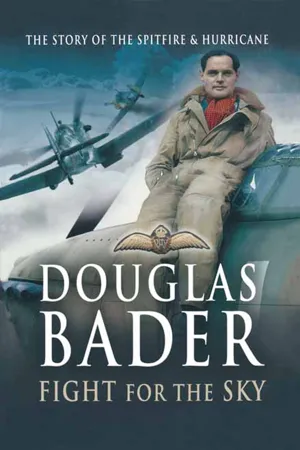
Fight for the Sky, Douglas Bader tells the inspiring story of the Battle of Britain from the viewpoint of "The Few." Using superb illustrations he traces the development of the Spitfire and Hurricane and describes the nail-biting actions of those who flew them against far superior numbers of enemy aircraft. As an added bonus, other well-known fighter aces including Johnnie Johnson, "Laddie" Lucas and Max Aikten contribute to Douglas's book, no doubt out of affection and respect. This a really important contribution to RAF history by one of the greatest—and certainly the most famous—pilot of the Second World War.
- 224 pages
- English
- ePUB (mobile friendly)
- Available on iOS & Android
eBook - ePub
About this book
Information
C O N T E N T S
| Prologue | |
| 1 | In Flight and in Action |
| 2 | Birth of the Hurricane |
| 3 | Birth of the Spitfire |
| 4 | The Battle of France |
| 5 | Fight for Survival |
| 6 | The Hurricanes of Malta |
| 7 | Balkan Blitzkrieg |
| 8 | Attack and Defence |
| 9 | Malta at Bay |
| 10 | Sea Hurricane |
| 11 | Mediterranean Offensive |
| 12 | D-Day and Beyond |
| 13 | The Battle for Asia |
| Epilogue |
Prologue
I was delighted when Lord Longford, Chairman of Sidgwick and Jackson, London, asked me to write the story of the Spitfire and Hurricane. My memories went straight back to June 1940. The Germans had by then conquered Poland, Norway, Denmark, Holland, Belgium, and France. The British people stood alone, separated from enemy-occupied Europe by twenty-one miles of blessed English Channel. Those immortal words which Shakespeare put into the mouth of the dying John of Gaunt – in Richard II:
‘This royal throne of kings, this sceptred isle …
This precious stone set in the silver sea,
Which serves it in the office of a wall,
Or as a moat defensive to a house …’
This precious stone set in the silver sea,
Which serves it in the office of a wall,
Or as a moat defensive to a house …’
comforted many of us when we reflected that the English Channel was indeed a moat which provided an insuperable tank obstacle which the Germans could not attempt to cross without first defeating the Royal Air Force – in particular the Spitfire and the Hurricane.
I recall as though yesterday a scene in the Mess at Kirton-in-Lindsay to which 222 Squadron (Spitfires) had returned in early June after Dunkirk. We were all standing around the ante-room at lunchtime listening to the B.B.C. news. The announcement came over the air that the French Government had capitulated. Tubby Mermagen, the Commanding Officer of 222 Squadron in which I was a Flight Commander, said: ‘Thank God, now we’re on our own.’ He expressed the feelings of us all.
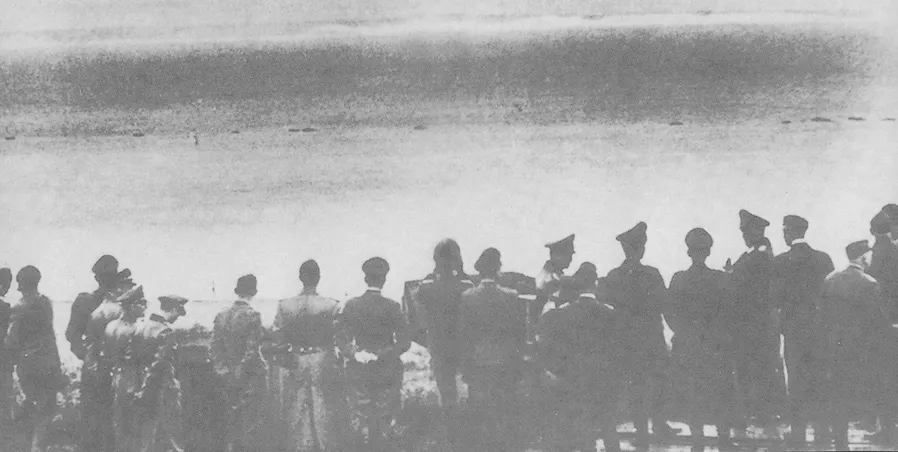
‘A moat … which the Germans could not attempt to cross without first defeating the Royal Air Force – in particular the Spitfire and the Hurricane’ (picture shows Goering and staff gazing across Channel in 1940).
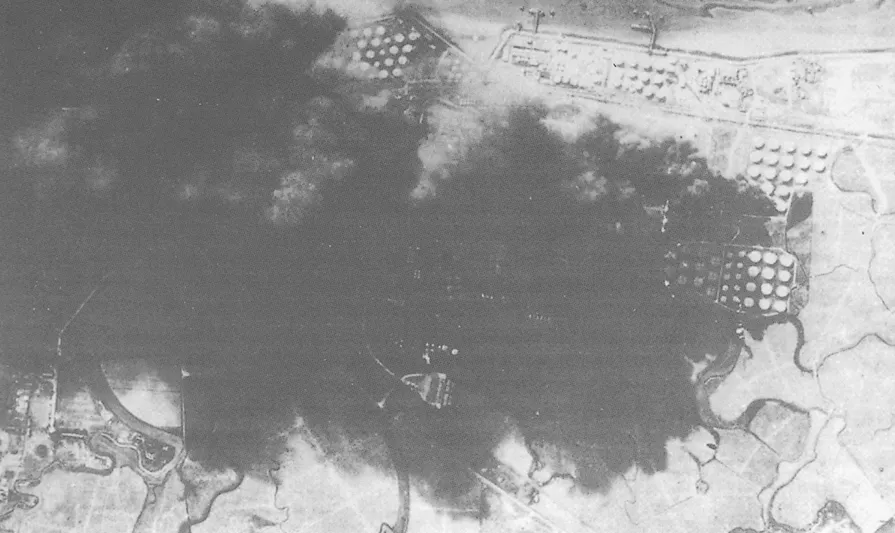
‘A plume of black smoke from the burning oil tanks at Shell Haven … stains the blue summer sky …’
Another memory that came back vividly was of the first time I led a squadron into battle – it was against a horde of German bombers, sixty to a hundred of them flying at 17,000 feet in perfect formation. We were in the ideal position, up-sun and above them.
There were nine of us Hurricanes. Suddenly, I was angry. ‘Who the hell do these Huns think they are, flying like this in their bloody bombers covered with iron crosses and swastikas over our country?’ We were flying in sections of three in line astern, exactly above the Germans.
I told the two sections behind that I would dive to attack the front of the enemy formation and they would follow immediately after my section had made contact. It worked perfectly. As we hit them, the leading German bombers and their twin-engined Messerschmitt fighter escorts banked away to right and left, which disrupted the ones behind them, so the entire formation was broken into separate units turning south and making for home, pursued and in some cases being shot down by Hurricanes. Later in the evening we heard to our great satisfaction that other British fighters had knocked down more of this formation as they went south. It was a satisfactory first outing.
I recall also one morning during a mêlée in the sky, sighting a German bomber which seemed a good target. I was closing from behind when some instinct made me look up to see a Spitfire above me diving near-vertically at the German. As I throttled back watching, the Spitfire hit the enemy exactly in the centre, where wings and fuselage meet. The bomber sort of folded up round the fighter and the whole lot caught fire and drifted apparently quite slowly downwards just like a screwed up ball of paper set alight and thrown from a cliff. Clearly the Spitfire pilot was diving to attack some other enemy and did not see the one he hit.
Indeed memories come flooding back … two Hurricanes converging to attack the same German bomber, each pilot concentrating on his target, oblivious of the sky around him. They touch and a wing breaks off to float away like an autumn leaf from a tree. One pilot bales out and lives to fight again tomorrow and all the rest of the days the battle lasted.
A German bomber diving and zooming all over the sky. A closer look reveals what appears to be a weight swinging some feet below the tail. It is one of the crew whose parachute got wrapped round the tail as he baled out. There is no one in the cockpit.
That same morning, in that same sky, another German attempts to leave his dying bomber. As far as the watching Hurricane pilot can see, his parachute pack gets caught half-way out and the man is held against the fuselage with the parachute inside and him outside. A brave companion frees him and both sail down to captivity.
A plume of black smoke from the burning oil-tanks at Shell Haven, on the Thames Estuary, stains the blue summer sky to a height of 10,000 feet. A large formation of Germans has been broken up by Spitfires and Hurricanes and the usual aftermath of personal combats is going on all over the place between 15,000 and 10,000 feet. I am lining up an enemy in my sights when I look in my mirror to see the yellow nose of an Me 109 lining me up in his. I turn away left just in time; but not quite. A stream of bullets arrives in the right hand side of the cockpit frightening me out of my wits, but causing no serious damage. I straighten up to see my 109 go past with a Hurricane on his tail. As I look, the Messerschmitt goes into a steepening dive emitting white smoke and flame. It disappears into the black smoke from Shell Haven. The German had not looked behind before he started shooting at me.
There were strange, unforgettable sights in the sky over southeast England in those far-off Battle of Britain days.
Winston Churchill’s historic remark about the Few made us proud, and we loved him for it. But the Battle was not won only by us in the sky. It was won by every man and woman in this country. We had the good job, we could fight back. They were on the ground building fighters to replace the ones we lost; when their factories were bombed they went on producing them under bridges and in the open. They did not stop. The ground crews of the Royal Air Force worked round the clock to keep our aeroplanes in trim. The Operations rooms were on watch night and day. The Ops Room at Detling received a direct hit with the near total loss of all the men and women inside.
The voluntary services, air-raid wardens, firemen, doctors, hospital workers, engineers, police, shopkeepers, dockers, the Observer Corps, the whole community sustained us fighter pilots with their courage.
We were their representatives in the air. Meanwhile our wonderful Merchant Navy, escorted by the Royal Navy, brought to all of us in our beleaguered island the necessities of life and the wherewithal to continue our struggle for survival. The East End of London with its docks received heavy attention from the Luftwaffe but the spirit of the Cockney was unbreakable.
I shall never forget a picture in the newspapers of a German bomber, minus its tail, diving into a tobacconist shop on the corner of Victoria Station. It was an incredible shot and showed the enemy aeroplane about 200 feet from the ground. A subsequent photograph depicted the shop in ruins with the grinning proprietor standing outside. In front of him on the pavement was a trestle table with some packets of cigarettes upon it together with a cardboard notice on which was pencilled ‘Business as usual’. That was the spirit which won the Battle of Britain. The pilot’s account of shooting down that particular enemy is in this book.
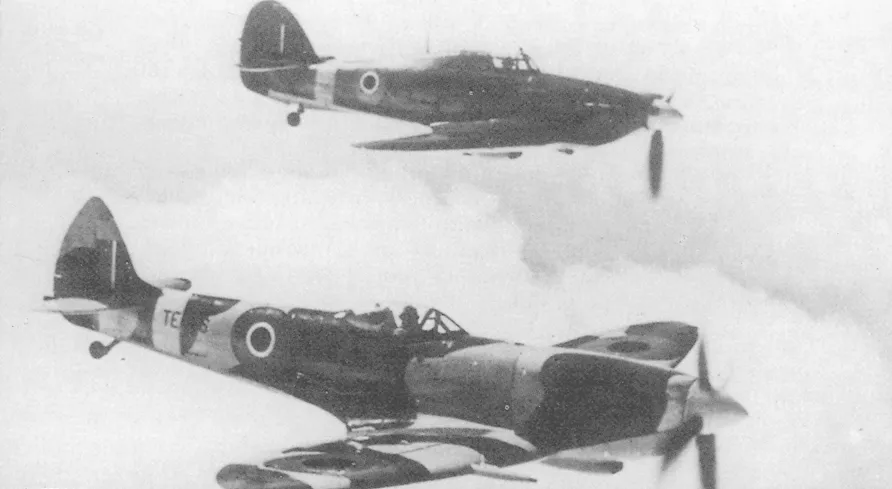
‘… two fighters, born of British genius, produced by British craftsmen, and, in the event, sustained by the whole British nation’.
I make no apology for saying all this in a book about the Spitfire and Hurricane. It is part of the story of these two matchless fighters, born of British genius, produced by British craftsmen and, in the event, sustained by the whole British nation.
Memories crowd the mind, but the one which dominates all others is that of the British people at bay, united and unconquerable, in our island kingdom.
This book is far more than a collection of my reminiscences and the story of the Battle of Britain. Combat reports of pilots support the narrative, while accounts of campaigns have been included from chaps who were there.
Above all, the story of the Spitfire and the Hurricane is the story of Britain’s war. They fought on every battle front, from the Arctic wastes of northern Russia to the tropical jungles of the Far East; from the green of Europe to the brown of Northern Africa.
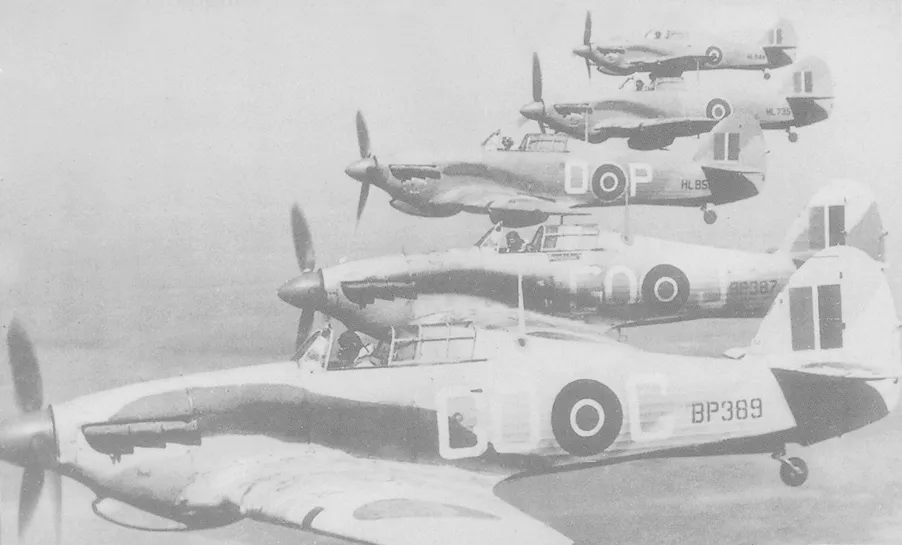
They flew high, they flew low; they were catapulted off ships (the Sea Hurricane); they flew off aircraft carriers (the Seafire); they were adapted to most military and many naval tasks. In the Western Desert campaign against the German Afrika Korps with its redoubtable leader, General Rommel, Spitfires were used to escort low-flying cannon Hurricanes which created havoc among the armoured vehicles and tanks of the enemy. In Europe, during the closing stages of the war, cannon-firing Spitfires and Hurricanes devastated retreating enemy columns on road and railway lines. They provided the R.A.F., Royal Navy, and Allied air forces with almost unlimited variations in armament and range. At various times both these remarkable fighters were adapted to carry bombs or rockets.
Except for one brief period in 1942, when the German Focke-Wulf 190 mastered the Spitfire Vb, this superlative fighter dominated the skies over Europe and North Africa. I have often wondered who t...
Table of contents
- Cover
- Half Title
- Full Title
- Copyright
- Contents
Trusted by 375,005 students
Access to over 1.5 million titles for a fair monthly price.
Study more efficiently using our study tools.
Frequently asked questions
Yes, you can cancel anytime from the Subscription tab in your account settings on the Perlego website. Your subscription will stay active until the end of your current billing period. Learn how to cancel your subscription
No, books cannot be downloaded as external files, such as PDFs, for use outside of Perlego. However, you can download books within the Perlego app for offline reading on mobile or tablet. Learn how to download books offline
Perlego offers two plans: Essential and Complete
- Essential is ideal for learners and professionals who enjoy exploring a wide range of subjects. Access the Essential Library with 800,000+ trusted titles and best-sellers across business, personal growth, and the humanities. Includes unlimited reading time and Standard Read Aloud voice.
- Complete: Perfect for advanced learners and researchers needing full, unrestricted access. Unlock 1.5M+ books across hundreds of subjects, including academic and specialized titles. The Complete Plan also includes advanced features like Premium Read Aloud and Research Assistant.
We are an online textbook subscription service, where you can get access to an entire online library for less than the price of a single book per month. With over 1.5 million books across 990+ topics, we’ve got you covered! Learn about our mission
Look out for the read-aloud symbol on your next book to see if you can listen to it. The read-aloud tool reads text aloud for you, highlighting the text as it is being read. You can pause it, speed it up and slow it down. Learn more about Read Aloud
Yes! You can use the Perlego app on both iOS and Android devices to read anytime, anywhere — even offline. Perfect for commutes or when you’re on the go.
Please note we cannot support devices running on iOS 13 and Android 7 or earlier. Learn more about using the app
Please note we cannot support devices running on iOS 13 and Android 7 or earlier. Learn more about using the app
Yes, you can access Fight for the Sky by Douglas Bader in PDF and/or ePUB format, as well as other popular books in History & Military & Maritime History. We have over 1.5 million books available in our catalogue for you to explore.