An innovative study of the Macedonian war machine's sarissa-wielding infantry under such leaders as Philip II and Alexander the Great.
The Hellenistic pike-phalanx was a true military innovation, transforming the face of warfare in the ancient world. For nearly 200 years, from the rise of the Macedonians as a military power in the mid-fourth century BC, to their defeat at the hands of the Romans at Pydna in 168BC, the pike-wielding heavy infantryman (the phalangite) formed the basis of nearly every Hellenistic army to deploy on battlefields stretching from Italy to India. And yet, despite this dominance, and the vast literature dedicated to detailing the history of the Hellenistic world, there remains fierce debate among modern scholars about how infantry combat in this age was actually conducted.
Christopher Matthews critically examines phalanx combat by using techniques such as physical re-creation, experimental archaeology, and ballistics testing, and then comparing the findings of this testing to the ancient literary, artistic and archaeological evidence, as well as modern theories. The result is the most comprehensive and up-to-date study of what heavy infantry combat was like in the age of Alexander the Great and his successors.
eBook - ePub
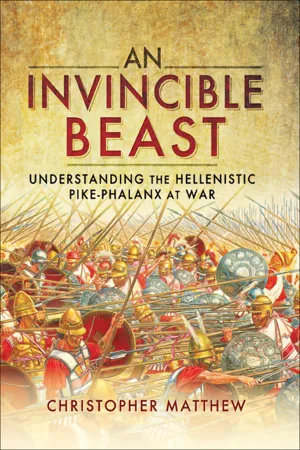
An Invincible Beast
Understanding the Hellenistic Pike Phalanx in Action
- 368 pages
- English
- ePUB (mobile friendly)
- Available on iOS & Android
eBook - ePub
About this book
Information
Topic
GeschichteChapter One
Who Invented the Pike Phalanx?
Any reappraisal of the warfare of the Hellenistic Age must begin with an examination of the main infantry combatant of the time – a heavy infantryman (the phalangite) who fought in a massed formation of ranks and files (the phalanx), and who was armed with a long pike known as the sarissa. An understanding of how the individual phalangite functioned on the battlefields of the ancient world, how he interacted with those around him while in formation, and how his actions dictated, and were dictated by, the actions of others, forms the foundation upon which every subsequent investigation into the broader aspects of the warfare of the Hellenistic Age must be based. Similarly, any enquiry into the roles and functions of the individual phalangite must begin with an examination of who created this new style of warfare and when this occurred.
The Hellenistic pike-phalanx was a true military innovation in every sense of the term: it literally changed the face of warfare in the ancient world. For almost 200 years, from the rise of Macedon as a military power in the mid-fourth century BC, to their defeat at the hands of the Romans at Pydna in 168BC, the pike-wielding phalangite formed the core of almost every Hellenistic army to deploy on battlefields stretching from Italy to India. And yet, despite the dominance of this form of fighting for nearly two centuries, and despite the vast amount of modern and ancient literature dedicated to detailing the history of the Hellenistic world, and the organization of the Hellenistic formations which shaped it, there remains great contention among scholars as to who actually created the pike-phalanx and when.
Prior to the rise of Macedon as a military power, the main offensive combatant in the ancient Greek world was the heavily-armoured hoplite. The fundamentals of hoplite warfare emerged at the end of the Greek Archaic Age (c.750BC) and remained relatively unchanged for the next 400 years. The Greek hoplite was geared for hand-to-hand combat. Armed with a spear approximately 2.5m in length (the doru), carrying a large round shield (the aspis) almost 1m in diameter, and wearing a bronze helmet and breastplate, the equipment of the Greek hoplite was designed to both withstand and engage in the rigours of close-contact fighting where an opponent was never more than 2m away. Deployed in a large phalanx formation, and engaging an enemy front-on, hoplite armies dominated the battlefields of the Greek world for centuries.
Against more lightly armoured opponents such as the Persians, Greek hoplites greatly outclassed enemies who were not prepared for the same close-contact style of fighting. Testaments to the effectiveness of the hoplite in combat can be seen in the accounts of the battles of Marathon (490BC), Thermopylae (480BC) and Plataea (479BC) where the Greeks were able to inflict considerable casualties among invading armies which greatly outnumbered them, while suffering comparatively small losses of their own.1 These successes made the Greek hoplite one of the most sought after mercenaries of the late fifth and early fourth centuries BC.
This dichotomy of war between the advantages of the hoplite compared to more lightly-armed troops only changed when Greeks fought against other Greeks. The battles of the long, bloody and costly Peloponnesian War (431-404BC) and its aftermath highlight how even-handed a hoplite versus hoplite engagement could be if both sides possessed strong enough morale to hold their ground.2 The conflicts of this time also demonstrated where the weaknesses in the hoplite phalanx lay. When engaged by skirmishers, who fought the hoplite from a distance, who were mobile enough to attack the vulnerable flanks of the hoplite phalanx, and were quick enough to be able to withdraw while the encumbered hoplite was unable to pursue, armies composed mainly of hoplites suffered significant losses.3 Thus, as the age of Classical Greece began to wane, the nature of warfare had fundamentally changed to a mode of fighting in which the effective use of troops armed in a variety of manners – from heavily armed hoplites, to skirmishers, to cavalry – was what now carried the day. An appreciation of tactics and generalship were now on the rise as a desired martial skill and many individuals who possessed these qualities and/or the innovative ability to come up with unconventional tactics – men such as Epaminondas and Pelopidas of Thebes, and able commanders such as Chabrias and Iphicrates of Athens – saw their stars, and those of their home states, well and truly shine.
However, following the end of the Peloponnesian War, many of the city-states of Greece were exhausted physically, politically and economically and very few states were able to hold sway over the others for any considerable period of time despite the ability of their military leaders. The ancient writer Justin surmises that, ‘the states of Greece, while each sought the sovereignty of the country for itself, lost it as a body’.4 In other words, the Greeks had fought themselves into a state of military impotence, where no one state was able to unite Greece under its hegemony, until a point was reached where the whole of Greece was in a position to be easily conquered by an outsider who had been spared the ravages of the previous decades of conflict. Into this vacuum marched the armies of the new emerging power in the Greek world – Macedon. Spared from much of the Peloponnesian War, Macedon was in a far better position than many of the Greek states to the south that it now sought to dominate.
Yet despite the internal weaknesses of many of the Greek city-states, the hoplite was still a formidable warrior on the field of battle. One of the tools which allowed Macedon to conquer Greece was the use of a style of fighting that had not yet been seen (for the most part) by many of the armies of the Greek city-states. This new style of fighting was the pike-phalanx. The employment of men armed with long pikes, rather than spears, allowed the Macedonians to fight the Greek hoplites in a conventional, hand-to-hand, manner. However, much like the skirmishers of the Peloponnesian War, the length of the sarissa allowed the Macedonians to engage the Greeks at a distance where the Greek hoplites were not able to respond in kind (see The Reach and Trajectory of Attacks made with the sarissa and [from page 167] The Anvil in Action [from page 375]).
The creation of the pike-phalanx, and particularly who created it, has been a topic of considerable scholarly debate for decades. Numerous theories have been forwarded, examining a variety of (albeit often ambiguous) ancient passages, and which offer a number of possible candidates for the creator of this new system of warfare. Adding to the scholarly controversy is the fact that the theories that have been forwarded cover a 170 year period of Macedonian history and four distinct rulers: Alexander I (495-450BC), Alexander II (370-368BC), Philip II (359-336BC), and Alexander III ‘The Great’ (336-323BC), with several others occasionally remembered. A critical examination of the ancient source material and the various modern hypotheses can now finally answer the question of ‘who invented the pike-phalanx?’
DID AN ALEXANDER INVENT THE PIKE PHALANX?
The writer Harpocration relates how the historian Anaximenes, a contemporary of Alexander the Great who wrote the Philippika, a history of both Philip II and Alexander’s reigns, mentions that the organization of the Macedonian military into distinct units was implemented by someone by the name of Alexander:
Anaximenes, in the first book of the Philippika, speaking about Alexander, states: Next, after he accustomed those of the highest honour to ride on horseback, he called them ‘Companions’ [hetairoi], and, after he had divided the majority of the infantry into companies [lochoi] and files [dekads] and other commands, he named them ‘Infantry Companions’ [pezhetairoi], so that each of the two classes, by participating in the royal companionship, might continue to be very loyal.5
Aelian states that the first thing that must be done with a new levy of troops is to arrange them into files and larger units – in other words, to accustom them from the very beginning to the military structure required to create an effective fighting force.6 This finds similarities with the passage of Anaximenes and shows that such practices were a clear part of a professional military institution under ‘Alexander’. Unfortunately, which Alexander is being alluded to is not clear as there are three possible rulers that this text may be referring to: Alexander I, Alexander II and Alexander III.
THE CASE FOR ALEXANDER I (king of Macedon 495-450BC)
The important element of Anaximenes’ passage for the understanding of the development of the pike-phalanx, is his reference to the creation of the ‘Foot Companions’ (pezhetairoi) under the mysterious Alexander. Demosthenes, writing in the 340s BC, states that the pezhetairoi had a ‘reputation for being remarkably well trained in military matters’ and formed a part of the armed forces of Philip II.7 Theopompus, a contemporary of Alexander the Great, states that the pezhetairoi had acted as the king’s bodyguard – a definition later recalled by the lexicographer Photius.8
Thus the written sources concerning the role of the pezhetairoi seem to conflict. For Anaximenes and Demosthenes, the pezhetairoi seem to be a part of the infantry phalanx, whereas for Theopompus and Photius they only seem to be the guard of the king. However, Theopompus uses the imperfect tense (i.e. the pezhetairoi had formed a bodyguard) which suggests that Theopompus was aware that the pezhetairoi had once acted as the bodyguard for the king but that, at the time he was writing, they no longer performed this function. Thus, even if the pezhetairoi had once performed the role of a bodyguard unit, by the time of Alexander the Great they must have functioned in some other capacity – most likely as a unit or units within the main infantry of the Macedonian army. This suggests that the sources may not conflict as much as they first appear.
The nature of these ancient passages has led to many differing modern interpretations of who the pezhetairoi were. Connolly, for example, refers to the whole pike-wielding infantry as the ‘Foot Companions’ – a view shared by some other scholars.9 Warry suggests that the term pezhetairoi could encompass not only the pikemen of the Macedonian army, but also the elite hypaspists as well.10 However, this conclusion seems unlikely as the pezhetairoi and the hypaspists are often treated separately by the ancient writers (see following). Heckel suggests that Philip gave the term pezhetairoi to an elite unit of infantry and that this term was later transferred, in the time of Alexander the Great, to mean the whole pike-infantry.11 Gabriel, on the other hand, states that Philip gave the name pezhetairoi to the whole pike-phalanx.12
Contrary to all of these suggestions, Erskine argues that, if the term pezhetairoi is to be applied to the whole pike-wielding infantry by the time of Alexander the Great, it is odd that the term appears only three times in the works of Arrian (see following) which, he suggests, indicates that it is a term for a select unit within the Macedonian infantry.13 Erskine then argues that the pezhetairoi under Philip were a bodyguard (as per Theopompus and Photius) while, under Alexander the Great, they were a unit of infantry (as per Anaximenes and Demosthenes) with the guard role being taken up by the hypaspists.14 Regardless of who the term pezhetairoi should be applied to, the evidence seems clear that, at least by the time of Alexander the Great, the ‘Foot Companions’ were operating on the battlefield as fully armed, pike-wielding, phalangites.
As noted by Erskine, in the writings of Arrian the pezhetairoi are specifically mentioned only three times. These passages all suggest that the pezhetairoi were part of the main body of pike-wielding infantry. For example, when the Macedonians deployed against the Pisidians in 334BC:
On the right of the attacking force, Alexander had the hypaspists under his personal command. Next to them were the pezhetairoi – forming the whole centre of the line and commanded by the various officers whose turn of duty happened to fall upon that day… In advance of the right wing he stationed the archers and Agrianes...
Table of contents
- Cover
- Title Page
- Copyright
- Contents
- Acknowledgements
- List of Illustrations
- List of Tables
- List of Plates
- Abbreviations
- Foreword
- Preface
- Chapter 1: Who Invented the Pike Phalanx?
- Chapter 2: The Sarissa
- Chapter 3: The Phalangite Panoply
- Chapter 4: Bearing the Phalangite Panoply
- Chapter 5: Phalangite Drill
- Chapter 6: The Reach and Trajectory of Attacks made with the Sarissa
- Chapter 7: The ‘Kill Shot’ of Phalangite Combat
- Chapter 8: Accuracy and Endurance when Fighting with the Sarissa
- Chapter 9: The Penetration Power of the Sarissa
- Chapter 10: The Use of the Butt-Spike in Phalangite Combat
- Chapter 11: The Phalanx
- Chapter 12: The Pike-Phalanx in Battle
- Chapter 13: The Anvil in Action
- Chapter 14: The Legacy of the Hellenistic Pike-Phalanx
- Notes
- Bibliography
Trusted by 375,005 students
Access to over 1.5 million titles for a fair monthly price.
Study more efficiently using our study tools.
Frequently asked questions
Yes, you can cancel anytime from the Subscription tab in your account settings on the Perlego website. Your subscription will stay active until the end of your current billing period. Learn how to cancel your subscription
No, books cannot be downloaded as external files, such as PDFs, for use outside of Perlego. However, you can download books within the Perlego app for offline reading on mobile or tablet. Learn how to download books offline
Perlego offers two plans: Essential and Complete
- Essential is ideal for learners and professionals who enjoy exploring a wide range of subjects. Access the Essential Library with 800,000+ trusted titles and best-sellers across business, personal growth, and the humanities. Includes unlimited reading time and Standard Read Aloud voice.
- Complete: Perfect for advanced learners and researchers needing full, unrestricted access. Unlock 1.5M+ books across hundreds of subjects, including academic and specialized titles. The Complete Plan also includes advanced features like Premium Read Aloud and Research Assistant.
We are an online textbook subscription service, where you can get access to an entire online library for less than the price of a single book per month. With over 1.5 million books across 990+ topics, we’ve got you covered! Learn about our mission
Look out for the read-aloud symbol on your next book to see if you can listen to it. The read-aloud tool reads text aloud for you, highlighting the text as it is being read. You can pause it, speed it up and slow it down. Learn more about Read Aloud
Yes! You can use the Perlego app on both iOS and Android devices to read anytime, anywhere — even offline. Perfect for commutes or when you’re on the go.
Please note we cannot support devices running on iOS 13 and Android 7 or earlier. Learn more about using the app
Please note we cannot support devices running on iOS 13 and Android 7 or earlier. Learn more about using the app
Yes, you can access An Invincible Beast by Christopher Matthew in PDF and/or ePUB format, as well as other popular books in Geschichte & Geschichte der griechischen Antike. We have over 1.5 million books available in our catalogue for you to explore.