- 140 pages
- English
- ePUB (mobile friendly)
- Available on iOS & Android
eBook - ePub
Animals in the Great War
About this book
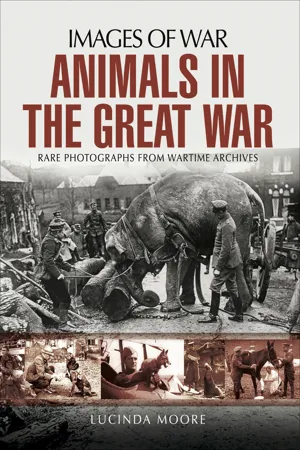
Tails from the Great War throws a spot light on the experience of creatures great and small during the First World War, vividly telling their stories through the incredible archival images of the Mary Evans Picture Library. The enduring public interest in Michael Morpurgos tale of the war horse reveals an enthusiasm for the animal perspective on war, but what of the untold stories of the war dog, the trench rat or even the ships pig? Through unrivaled access to rarely seen illustrated wartime magazines, books and postcards, discover the sea lions who were trained to detect submarines, and witness the carcass of the 61ft mine-destroying wonder whale. Meet the dog that brought a sailor back from the brink of death, and inspired a Hollywood legend. See how depictions of animals were powerfully manipulated by the propaganda machine on both sides, and how the presence of animals could bring much needed and even lifesaving companionship and cheer amid the carnage of war. As the centenary of the Great War is commemorated all over the world, take a timely journey via the lens of Mary Evans wartime images, and marvel at the often overlooked but significant contribution and experience of animals at war. By turns astonishing, heart-warming and occasionally downright bizarre, Tails from the Great War champions the little-known story of the bison, the chameleon, the canary et al in wartime.
Information
Chapter 1
Tails from the sea
As part of the theatre of war, the sea was a backdrop to a remarkable variety of animals, aquatic and otherwise. Through the visual material held in the Mary Evans Picture Library, the lesser known stories of these creatures who lived above and beneath the ocean waves can be told.
The depiction opposite by Italian artist Cyrus Cuneo in the children’s book Great Deeds of the Great War shows the rescue of the ship’s pets after the sinking of HMS King Edward VII in January 1916. The ship struck a drifting mine off the coast of Cape Wrath, Scotland, and was badly damaged in the explosion. Some crew members courageously risked their lives to round up the ship’s menagerie of pets as the vessel began to sink. Able Seaman Needham is pictured placing Norah the bulldog, the ship’s mascot, into a lifeboat that was already being lowered. Besides Norah, the ships’ two monkeys were rescued by Leading Seaman Wood; no mean feat, as they were reportedly in a state of considerable agitation after the explosion, and scampering about wildly. The ship’s parrot was not used to being manhandled, had to be set free, and was last seen heading in the direction of shore. The men hunted fruitlessly for the ship’s three cats as the vessel sank further into the water, though eventually two kittens were discovered. One had run into one of the ship’s guns, and could not be removed in time, but the other was caught by W.A. Wise, a member of the canteen staff, who thrust it into his jumper. With no time left to save his kit and his money, Wise put on a lifebelt and managed to swim free of the battleship before it sank. On being picked up by a boat, his first concern was for the kitten, which was none the worse off for its dip, and eventually accompanied Wise home to Ilford in Essex. The kitten was given the name ‘Teddy’, after the ship, though it never returned to sea after its adventures.
Norah was just one of many seadogs that served during the Great War. Peggy was the canine mascot of HMS Iron Duke, a dreadnought class battleship, and her presence was a considerable boost to morale for those on board, as these vignettes testify. Loaned by her owner for the duration of the war, Peggy soon became a favourite of the crew. Jumbo, another bulldog on board HMS Iron Duke, had been presented to Admiral Jellicoe by the actor Arthur Playfair, and was an inseparable companion of Peggy’s. Peter Shaw Barker in his 1933 book Animal War Heroes relates that Jumbo was very protective of Peggy when other dogs were about, and that ‘he once attacked an Airdale belonging to Admiral Burney and chased it into the stern sheets of a picket boat where a fierce fight ensued. They were only separated with the help of sailors with mops.’ In due course, Peggy and Jumbo had a litter of five bulldog pups together. Peggy’s sense of mischief was evident in her great enjoyment at carrying off any loose items left on deck, and stashing them away in her kennel. She was an enthusiastic participant in the ship’s football team, whether on deck or on shore, and was not above invading the pitch when egged-on by spectators who were dissatisfied by the team’s performance. In accordance with the agreed arrangement, Peggy returned to her owner in 1919 once the war was over. A portrait of Peggy was painted to sell in order to raise funds for St Bartholomew’s Hospital, a charitable cause she had personally supported before, when collecting at Harrods department store, accompanied by a nurse. In January 1920, it was decided that Peggy herself should be included in an auction sale to raise money for Barts, and so she became ‘Lot 21’, raising sixty guineas for the charity. The purchaser of Peggy generously presented her back to the delighted crew of HMS Iron Duke, by now based with the Mediterranean Fleet, who sent a destroyer to collect her; a privilege afforded to few dogs. Peggy spent the last two and half years of her life happily in the care of A. B Viney on board HMS Iron Duke, for which he received a certain sum for her keep. She would sleep alongside Viney, with him using her as a pillow. When Peggy died after a short illness in June 1923, she was given a sailor’s burial, and lowered over the side of the ship.
Old Bill, a wired-haired terrier, became the mascot of HMS Falmouth in rather unusual circumstances. In early August 1914, shortly after the outbreak of war, HMS Falmouth came across a fleet of five German fishing trawlers whilst on patrol in the North Sea. Acting on orders to take as prisoners any enemy crew, and to sink their vessels, four of the five ships were duly dispatched, with one old wooden boat left. After trying ineffectually to sink her with three rounds of shellfire, a boarding party attempted to blow her up using TNT. Though parts of the ship were thrown sky-high, the main body of the ship remained, and the decision was made to ram her, to prevent the derelict vessel being a hazard to shipping. After a few attempts, the ship was split clean in two, and to everyone’s surprise a terrier appeared on one of the still floating halves. Bruised and barking furiously, the dog was remarkably unscathed after the encounter, and a boat was immediately sent from HMS Falmouth to rescue him. The dog was wearing a chain collar and brass name plate, inscribed with his name ‘Fritz’, so in spite of being abandoned to his fate on the trawler, he must have originally had an owner who cared enough to give him his own engraved collar. Adopted as the mascot of HMS Falmouth, he was patriotically re-christened with ‘Old Bill’, no doubt in homage to the comic creation of the same name by Bruce Bairnsfather. Old Bill was on board the Falmouth for the sinking of the German cruiser Mainz, and was even wounded three times during the Battle of Jutland. The Falmouth was sunk in August 1916 by torpedoes, after a sustained attack from Zeppelins L11 and L31 and two U-boats. Old Bill was rescued along with the crew, and went to live at Plymouth Barracks, where he remained a popular pet, living to a ripe old age and eventually dying of natural causes.
As the experience of Old Bill relates, the sea sometimes presented unexpected opportunities for crews to add to their number of pets. When some unusual circumstances found the crew of HMS Glasgow in possession of a magnificent pig, it was enthusiastically adopted as the ship’s mascot. The pig originally hailed from SMS Dresden, a German light cruiser, where it had most likely been kept aboard as a source of fresh meat. Following a successful encounter for the British at the Battle of the Falkland Islands in December 1914, HMS Glasgow gave chase to the fleeing SMS Dresden. The Germans responded by scuttling the ship off the coast of Chile on 15 March 1915, leaving the unfortunate pig on board. Managing to swim clear of the sinking Dresden, the pig made for the nearby Royal Navy ships, and was rescued from the sea (after a considerable struggle) by a petty officer. The pig was dubbed ‘Tirpitz’, despite being female, after the German Admiral Alfred von Tirpitz, and jokingly awarded an Iron Cross for staying with the Dresden after the crew had abandoned ship. The pig became a favourite pet of the crew, as this affectionate photograph suggests. This wasn’t the end of the adventures of Tirpitz the pig, however. After a spell at the Royal Navy training facility on Whale Island in Portsmouth harbour, she was later auctioned to raise funds for the British Red Cross, fetching 400 guineas (approximately £20,000 in todays’ money). The details of her subsequent years are unknown, but we do know that in 1919, her then owner William Cavendish-Bentinck, 6th Duke of Portland, had her head stuffed, mounted and gifted to the Imperial War Museum in London. Her trotters were made into a carving knife and fork, and were used on the subsequent HMS Glasgow, before finding a home with Tirpitz’s head in the Imperial War Museum.
The illustrated periodical The Sphere ran a spread on maritime animal life in March 1917 entitled ‘Day by Day in the Royal Navy’, featuring by several photographs, including a cat sitting on top of a 12-inch gun on board an unspecified ship, and two little Sealyhams posing with a sailor on deck. In the accompanying article celebrating the Noah’s ark of mascots and companions at sea, The Sphere observed:
Every ship has its pet, sometimes cats, sometimes dogs, and sometimes a monkey or other animal acquired under some special circumstances, which gives the pet his place of peculiar privilege on board. Cats are great favourites because of the homely feeling they give to a ship. Their coolness under fire is often remarkable.
For some, cats on board brought not just companionship and homeliness, but good luck. The society publication The Tatler celebrated the successful British raid on the Belgian port of Bruges-Zeebrugge in April 1918 with the picture of Vice-Admiral Alfred Carpenter and Commander Osborne of HMS Vindictive holding the ship’s mascots, two black cats. The Tatler opined, ‘Never, we suppose, has a ship had as great a need of mascots plus brave men as “Vindictive” had when she went under heavy fire and lay alongside the Zeebrugge Mole…’ A month after this picture was published, HMS Vindictive was sunk on purpose as a ‘blockship’ after running aground at the Second Ostend Raid on 10 May 1918. What became of the cats is not known.
Ships’ mascots could hinder as well ...
Table of contents
- Cover
- Title
- Copyright
- Contents
- Introduction
- Chapter 1 - Tails from the sea
- Chapter 2 - The dogs of war
- Chapter 3 - Birds in battle
- Chapter 4 - All creatures great and small
- Chapter 5 - A political animal: Use as symbols and propaganda
- Chapter 6 - Four-footed fighters: Horses at war
- Chapter 7 - Mules and donkeys at the front
Trusted by 375,005 students
Access to over 1.5 million titles for a fair monthly price.
Study more efficiently using our study tools.
Frequently asked questions
Yes, you can cancel anytime from the Subscription tab in your account settings on the Perlego website. Your subscription will stay active until the end of your current billing period. Learn how to cancel your subscription
No, books cannot be downloaded as external files, such as PDFs, for use outside of Perlego. However, you can download books within the Perlego app for offline reading on mobile or tablet. Learn how to download books offline
Perlego offers two plans: Essential and Complete
- Essential is ideal for learners and professionals who enjoy exploring a wide range of subjects. Access the Essential Library with 800,000+ trusted titles and best-sellers across business, personal growth, and the humanities. Includes unlimited reading time and Standard Read Aloud voice.
- Complete: Perfect for advanced learners and researchers needing full, unrestricted access. Unlock 1.5M+ books across hundreds of subjects, including academic and specialized titles. The Complete Plan also includes advanced features like Premium Read Aloud and Research Assistant.
We are an online textbook subscription service, where you can get access to an entire online library for less than the price of a single book per month. With over 1.5 million books across 990+ topics, we’ve got you covered! Learn about our mission
Look out for the read-aloud symbol on your next book to see if you can listen to it. The read-aloud tool reads text aloud for you, highlighting the text as it is being read. You can pause it, speed it up and slow it down. Learn more about Read Aloud
Yes! You can use the Perlego app on both iOS and Android devices to read anytime, anywhere — even offline. Perfect for commutes or when you’re on the go.
Please note we cannot support devices running on iOS 13 and Android 7 or earlier. Learn more about using the app
Please note we cannot support devices running on iOS 13 and Android 7 or earlier. Learn more about using the app
Yes, you can access Animals in the Great War by Lucinda Moore in PDF and/or ePUB format, as well as other popular books in History & Military & Maritime History. We have over 1.5 million books available in our catalogue for you to explore.