- 320 pages
- English
- ePUB (mobile friendly)
- Available on iOS & Android
eBook - ePub
About this book
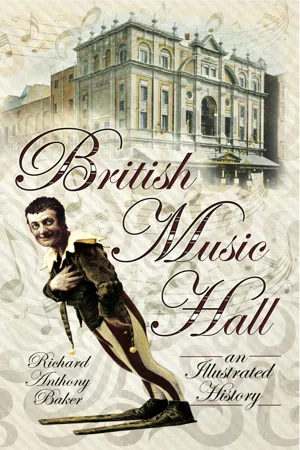
'The music hall ...had no place for reticence; it was downright, it shouted, it made noise, it enjoyed itself and made the people enjoy themselves as well.' W.J. MACQUEEN POPEMusic Hall lies at the root of all modern popular entertainment. With stars such as Marie Lloyd, Harry Lauder and Dan Leno, it reached its glorious, brassy height between 1890 and the First World War. In the first book on this subject for many years, Richard Anthony Baker whisks us off on a colourful and nostalgic tour of the rise and fall of British music hall.At the beginning of the nineteenth century people sang traditional songs in taverns for entertainment. This was so popular that rooms started to be added to inns for shows to be staged, and, before long, songs were being specially composed and purpose-built theatres were springing up everywhere. Britain's working class had, for the first time, its own form of public entertainment and its own breed of stars. The colour and vitality attracted serious writers and artists, as well as the future Edward VII, and music hall became simultaneously the haunt of the working classes and the avant-garde.Including stories of a clergyman who wrote music-hall sketches, a hall in Glasgow where luckless entertainers were pulled off stage by a long hooked pole, and Cockney dictionaries that helped Americans understand touring British performers, this book is a hugely engaging slice of social history, rich in humour, tragedy and bathos.As featured on BBC Radio Lincolnshire and in the Sunderland Echo.
Information
Subtopic
British HistoryChapter One
In the Beginning
Victorian Britain does not deserve its reputation for prudery. The idea that the nineteenth century middle class was so offended by nakedness that piano legs were covered up is a ludicrous legend. The truth, albeit concealed, was that pornography was rife, as was prostitution, especially child prostitution. More than 50,000 prostitutes operated in London in the middle of the century. As for the protection of children, the age of consent stood at twelve until 1871 and was then raised only to thirteen. In the first 50 years of Victoria’s reign, nearly a quarter of the prostitutes in York were aged 18 or under.
In addition, life expectancy in Victorian Britain was horrifically low. Between 1838 and 1854, men need not to have expected to live beyond the age of 40. For women, the figure was 42. Epidemics of cholera and typhoid killed thousands. More routinely, 7,000 people died of measles every year. No wonder. Public hygiene was disgusting. Human excrement and slaughter-house refuse was routinely pumped into the Thames, causing such a stench that Disraeli walked about the Palace of Westminster with a handkerchief clutched to his nose. Brighton flushed its sewage onto local beaches until 1874. Torquay was four years behind.
Food was deliberately adulterated. A report issued in 1863 indicated that one fifth of all meat came from diseased cattle.
Overcrowding helped disease spread fast and London was the most densely populated city in the world. The number of families living in one room was put at 150,000.
When education was made compulsory in 1870, the full extent of the debility of children became apparent. Vast numbers of them were found to be suffering from defective eyesight and hearing, awful dental problems and a widespread lack of personal cleanliness. Barely 30 years later, only two out of every five men volunteering for the Boer War were deemed fit for military service.
Work was both hard and hard to come by. A medical officer at the London Hospital reckoned that the worst paid and most industrious people he saw were seamstresses. They could work from 3am until 10pm and earn between only three shillings [15P] and four shillings [20P] a week. When the social researcher, Charles Booth, conducted his extensive survey of life in London at the end of the nineteenth century, he found that close to one-third of all Londoners were living on or close to the poverty line.
Life for the working classes, then, was wretched. Entertainment provided the only escape from grim reality.
In the early years of the nineteenth century, customers at inns staged their own entertainment. When tavern owners began employing professional entertainers, local unpaid amateurs continued to perform. These places were known as free-and-easies. Many future stars began their careers there, but, as early as the first year of Victoria’s reign, some saw only a pernicious influence:
The epidemic of vocal music has more particularly spread its contagious and devastating influence amongst the youth of the Metropolis, the London apprentice boys. These young gentlemen generally give vent to their passion and display their vocal abilities in the spacious room appropriated to that purpose of some tavern or public house and these meetings are most aptly denominated Free and Easies: free as air they are for the advancement of drunkenness and profligacy and easy enough of access to all classes of society with little regard to appearances or character1.
More even-handedly, the Scottish comedian, W.F. Frame, neatly summarised the role of the free-and-easy:
There was no charge of admission to a free-and-easy, at which refreshments were supplied at the usual rates. Anyone who was bold enough could make an appearance at such a concert, his friends doing the needful by handing his or her name to the chairman, who, like the pianist, was paid at the rate of 5s [25P] a night. The chairman2 was frequently a good vocalist himself and, if necessary, would sing a song.
A free-and-easy was a happy, go-as-you-please sort of entertainment and a capital preparatory school for budding amateurs3.
Another early and important influence was the song-and-supper room. In London, three predominated. An advertisement in The Era4 in 1851 described the Coal Hole, which stood in Fountain Court, just off the Strand, as “the oldest and most popular of the singing establishments”. It was home to [among others] John Rhodes, a bass singer and the Coal Hole’s landlord; J.A. Cave, the first singer to introduce the banjo into Britain; and Joe Wells, who, according to the writer, Edmund Yates, was “a dreadful old creature … who used to sing the most disgusting ditties.” From 1853, Renton Nicholson [1809–1861] staged mock trials run by his Judge and Jury Society at the Cyder Cellars and, from 1858, at the Coal Hole. The tavern lost its licence in 1862 and was later closed and demolished so that the Strand could be widened.
The second was Evans’ Supper Rooms at King Street in Covent Garden, probably the most important of the three. Filling the basement of a family hotel, the Grand, in the late eighteenth century, it was converted into its new role by W.C. [William Carpenter] Evans. Its heyday came after a former actor, John “Paddy” Green, became Chairman and Conductor of Music in 1842. He undertook further conversions two years later and succeeded Evans as proprietor the year after that. Evans’ most popular entertainer was the character singer, Sam Cowell. In fact, by 1851, he had become so popular that he grew lax about the times of his performances. One night, in response to cries of “Cowell” from the audience, Paddy Green told them:
Gentlemen, I have done my best to introduce many good and deserving singers to your notice, but you won’t have them. You insist on having Cowell and none but Cowell. You have pampered him to such an extent that he has got too big for his clothes and now presumes upon the position you have given him. Cowell comes when he likes, goes when he likes and does what he likes – and you encourage him. In fact, he is your God. But, by God, he shan’t be mine5.
Cowell arrived shortly afterwards and made his own speech, telling Green he was no longer a schoolboy and should not be treated like one, but he was taken aback when the audience started hissing him. He never appeared at Evans’ again.
The patrons of Evans’ included Dickens and Thackeray. On the menu were mutton chops, devilled kidneys and baked potatoes, served by the so-called Calculating Waiter, a man named Skinner, who became something of a character:
Standing guard at the exit, he used his powers to the full on nervous youths waiting in the queue to state what they had had for supper:
What have you had, sir? – Chop.
One chop, two and six. – Potatoes.
Potatoes, three and nine. Any bread? – No bread.
No bread, four and two. – One tankard of stout.
One tankard of stout, five and ten. Cheese? – No cheese.
No cheese, six and four. Sixpence for the waiter, sir. Thank you, seven and four – eight shillings.
Thank you, sir! Next, please6.
One chop, two and six. – Potatoes.
Potatoes, three and nine. Any bread? – No bread.
No bread, four and two. – One tankard of stout.
One tankard of stout, five and ten. Cheese? – No cheese.
No cheese, six and four. Sixpence for the waiter, sir. Thank you, seven and four – eight shillings.
Thank you, sir! Next, please6.
At one stage, diners were entertained by songs then considered risque [or, to quote the critic, Clement Scott, “songs of unadulterated indecency and filth”]. This ended when all such ribaldry was replaced by glees and madrigals sung by groups of young choirboys. In 1879, however, the saucy songs of the comedian, Arthur Roberts, caused Evans’ to lose its licence, only to have it reinstated the following year.
The Cyder Cellars [or Cider Cellars], which stood next to the stage door of the Adelphi Theatre in Covent Garden, was the third of the halls’ famous precursors. Dating from the late 1820s, they were opened by W.C. Evans, who acted as Chairman three times a week, Charles Sloman presiding on three other nights. Thackeray chronicled the Cyder Cellars’ regulars: country tradesmen and farmers, young apprentices, rakish medical students, university “bucks”; guardsmen and members of the House of Lords. Thackeray himself was a regular, going twice in October 1848 to hear W.G. Ross sing at two in the morning. As with Evans’ Supper Rooms, however, a marked change of entertainment policy was introduced in 1853. The Era reported that “instead of ribald songs, coarse allusions and a specious immorality, glees, madrigals and choruses form the staple attractions.” All the same, “Baron” Renton Nicholson’s dubious Judge and Jury trials continued here: in 1859, the Liverpool Daily Post described him as an “obscene and foul fellow, who … solaces decrepit debauchees and precipitates unthinking young men into ruin.” Nicholson was an extraordinary character. In and out of prison, he scraped a living at various times as a pawnbroker, a jeweller, a newspaper editor, a cigar shop owner and a wine merchant, but it was the mock trials he presented that earned him the notoriety he deserved. In seemingly endless sentences, Edmund Yates painted a vivid picture of them:
[The courts were] presided over by Nicholson himself as the Lord Chief Justice in full wig and gown, the case being argued out by persons dressed as, and, in some instances, giving also imitations of, leading barristers and the witnesses being actors of more or less versatility and mimetic ability. The whole affair was written and arranged by Nicholson, who deported himself on the bench with the most solemn gravity, the contrast between which and his invariable speech on taking his seat – “Usher! Get me a cigar and a little brandy and water” – was the signal for the first laugh. The entertainment was undoubtedly clever, but was so full of grossness and indecency, expressed and implied, as to render it wholly disgusting7.
It was an all-male affair. Women appearing in the trials were, in fact, men dressed up and, according to the writer, J. Ewing Ritchie, “everything was done that the most liquorish [drunken] imagination could suggest or that could pander most effectually to the lowest propensities of depraved humanity”:
I dare not even attempt to give a faint outline of the proceedings. After the defence came the summing-up, which men about town told you was a model of wit, but in which wit bore but a small proportion to the obscenity8.
The trials were often satirical send-ups of real contemporary cases, such as the murder in Washington in 1859 by a New York City Congressman, Daniel Sickles, of the American attorney for Columbia, Philip Barton Key, who had been having an affair with Sickles’ wife. The American public viewed the killing as a crime passionel and Sickles was acquitted. Even so, Nicholson’s treatment of the case seemed particularly tasteless:
The Lord Chief Baron Nicholson has the honour to announce the recent extraordinary trial at Washington as it would have been conducted, had the tragedy and the crime which led to it been committed in this country. The Judge particularly invites the presence of his American friends now in London and, to them and to his usual patrons, he promises a treat in the shape of forensic eloquence unrivalled in the history of proceedings in British law courts9.
Nicholson had friends in high places and his juries often included members of both Houses of Parliament. In contrast to the Liverpool newspaper, the Dictionary of National Biography, a very sober publication in Victorian times, found him worthy of inclusions: “The trials were humorous and gave occasion for much real eloquence, brilliant repartee, fluent satire and not unfrequently [sic] for indecent witticism.”
In spite of Nicholson’s notoriety, he was overshadowed by W.G. Ross, who built his reputation on one song, The Ballad of Sam Hall [c. 1840], which recounted the thoughts of a chimney sweep the night before his execution for murder:
My name it is Sam Hall.
I rob both great and small,
But they makes me pay for all.
Damn their eyes.
I rob both great and small,
But they makes me pay for all.
Damn their eyes.
With each succeeding chorus, the word ‘damn’ was replaced with a stronger expletive. The theatre writer, W.J. MacQueen-Pope, was greatly moved by it:
It was a piece of stark realism and Ross brought great dramatic art to his rendering of it. He entered and did not start to sing right away. He was restless, his eyes darting about him, but not seeing what they looked at … Ross gave a performance of high tragedy, excusing nothing of the squalor of the crime, making no attempt to whitewash the character, just expressing the scattered thoughts of the bestial criminal, who could already feel the noose round his neck, but who lacked the finer feelings to make any fervent appeal for sympathy or even to speculate on what went beyond. As a piece of characterisation of its kind, it is doubtful if it was ever excelled. Certainly it was never forgotten by any individuals who saw Ross do it10.
When Ross sang it at the Cyder Cellars, people were turned away at the doors every night. His picture, ...
Table of contents
- Front Cover
- Dedication
- Title Page
- Copyright Page
- Contents
- Acknowledgements
- Foreword By Roy Hudd O.B.E.
- Chapter 1 In the Beginning
- Chapter 2 First Generation
- Chapter 3 Pioneers
- Chapter 4 Troika
- Chapter 5 Dens of Antiquity
- Chapter 6 Our Foes in the North
- Chapter 7 Empire Building
- Chapter 8 Matchless Matcham
- Chapter 9 Mixing with Toffs
- Chapter 10 Across the Pond
- Chapter 11 Bondage and Muscles
- Chapter 12 More London Halls …
- Chapter 13 … and others across Britain
- Chapter 14 Wizard of Oz
- Chapter 15 Behind the Laughter
- Chapter 16 Sung Heroes
- Chapter 17 And More
- Chapter 18 Here’s to the Ladies who were …
- Chapter 19 Here’s to the Ladies Who Weren’t … and the men who were
- Chapter 20 Wal the Ripper?
- Chapter 21 The Quickness of the Hand
- Chapter 22 I Can See Your Lips Move
- Chapter 23 Burnt Cork
- Chapter 24 Your Own, Your Very Own …
- Chapter 25 Less Ten Per Cent
- Chapter 26 Midnight – and still no Dick
- Chapter 27 One-hit Wonders
- Chapter 28 Two’s Company
- Chapter 29 True Individuals
- Chapter 30 The Death of Music Hall (nearly)
- Final Curtain
- Bibliography
- Notes
Trusted by 375,005 students
Access to over 1.5 million titles for a fair monthly price.
Study more efficiently using our study tools.
Frequently asked questions
Yes, you can cancel anytime from the Subscription tab in your account settings on the Perlego website. Your subscription will stay active until the end of your current billing period. Learn how to cancel your subscription
No, books cannot be downloaded as external files, such as PDFs, for use outside of Perlego. However, you can download books within the Perlego app for offline reading on mobile or tablet. Learn how to download books offline
Perlego offers two plans: Essential and Complete
- Essential is ideal for learners and professionals who enjoy exploring a wide range of subjects. Access the Essential Library with 800,000+ trusted titles and best-sellers across business, personal growth, and the humanities. Includes unlimited reading time and Standard Read Aloud voice.
- Complete: Perfect for advanced learners and researchers needing full, unrestricted access. Unlock 1.5M+ books across hundreds of subjects, including academic and specialized titles. The Complete Plan also includes advanced features like Premium Read Aloud and Research Assistant.
We are an online textbook subscription service, where you can get access to an entire online library for less than the price of a single book per month. With over 1.5 million books across 990+ topics, we’ve got you covered! Learn about our mission
Look out for the read-aloud symbol on your next book to see if you can listen to it. The read-aloud tool reads text aloud for you, highlighting the text as it is being read. You can pause it, speed it up and slow it down. Learn more about Read Aloud
Yes! You can use the Perlego app on both iOS and Android devices to read anytime, anywhere — even offline. Perfect for commutes or when you’re on the go.
Please note we cannot support devices running on iOS 13 and Android 7 or earlier. Learn more about using the app
Please note we cannot support devices running on iOS 13 and Android 7 or earlier. Learn more about using the app
Yes, you can access British Music Hall by Richard Anthony Baker in PDF and/or ePUB format, as well as other popular books in Media & Performing Arts & British History. We have over 1.5 million books available in our catalogue for you to explore.