How pagan women blended magic and medicine—and why their medieval recipes may help cure modern-day illnesses.
In ninth-century England, Bishop lfheah the Bald is dabbling with magic. By collecting folk remedies from pagan women, he risks his reputation. Yet posterity has been kind, as from the pages of Bald's book a remedy has been found that cures the superbug MRSA where modern antibiotics have failed.
Within a few months of this discovery, a whole new area of medical research called Ancientbiotics has been created to discover further applications for these remedies. Yet, what will science make of the elves, hags and nightwalkers which also stalk the pages of Bald's book and its companion piece
Lacnunga, urging prescriptions of a very different, unsettling nature?
In these works, cures for the "moon mad" and hysteria are interspersed with directives to drink sheep's dung and jump across dead men's graves.
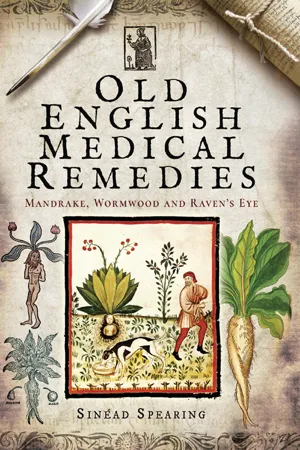
Old English Medical Remedies explores the herbal efficacy of these ancient remedies while evaluating the supernatural, magical elements, and suggests these provide a powerful psychological narrative revealing an approach to healthcare far more sophisticated than hitherto believed. All the while, the voices of the wise women who created and used these remedies are brought to life, after centuries of suppression by the Church, in this fascinating read.
- 192 pages
- English
- ePUB (mobile friendly)
- Available on iOS & Android
eBook - ePub
About this book
Information
Topic
HistoriaSubtopic
Historia británicaChapter 1
The Embarrassment of Bald
Bald had no notion of the controversy his work would inspire in recent times, and how the third volume of his medical treatise would be reviled by some of his modern church brethren as Satan’s work. Today, Bald’s medical codex has been predominantly viewed through a lens of religious duality, a contrast further supported by the action of transcription and translation. Yet is this dualistic evaluation fair, or is it a product of biased cultural response?
Bald collected and had Cild write down, a vast number of healing remedies and customs that existed in England during the Dark Ages, creating three volumes in total. Before Bald’s endeavour, the source of medical knowledge for the monasteries came exclusively from Arabic and Greco-Roman herbals, Pliny’s Naturalis Historia (77-79CE) and Galen’s Simplicibus (2CE) being two of the earliest and most notable. Such works were detailed with healing remedies, illustrations and folklore; however, the remedies of the Classical World were not always replicable, as England had its own native flora.
The third volume of Bald’s Leechbook indicates a desire in the late Anglo-Saxon period to accumulate healing knowledge from local traditions rather than relying solely upon imported texts. This trend is continued in works such as Lacnunga and the books of Saint Hildegard, which also catalogue remedies from local populations of Northern Europe, as the local people had their own unique folk-healing traditions that had never previously been transcribed.
The first volume of Bald’s work deals with external illness and his second with internal complaints, creating an organised glossary of medical treatments. The content of these two volumes has much in common with Mediterranean herbals. The third book is markedly different, however, representing remedies that did not conform to the first two volumes’ aims and further, presents cures that have a particularly different, supernatural character. The Lacnunga text is a similar affair, as it contains remedies which appear particularly obscure and magical to the modern reader.
The differences between Bald’s third book and his first two volumes are stark, with Malcom Cameron suggesting in his 1983 paper Bald’s Leechbook: its sources and their use in its compilation, that:
‘The third book is a collection of medical recipes, of lesser scholarly import, entirely separate from and unrelated to Bald’s Leechbook.’
Bald’s Leechbook was compiled in the ninth to tenth centuries in Winchester, probably in the Benedictine cathedral priory of St Peter, St Paul and St Swithun. It is predominantly written in Old English with some Old Irish and Latin as well as unidentified words. Scholars agree that Bald and Cild are unidentifiable. I suggest, however, that Bald is most likely to be Ælfheah the Bald, first English Bishop of Winchester (934-951). The date and location are perfect and although modern surname research finds the name Bald emerging from a small area of Scotland, the name Ecgbald was in existence in Anglo-Saxon England independently, with bald meaning sharp and strong.
It seems clear that with Ælfheah the Bald, the use of the word Bald is similar to that of a nickname. The use of nicknames was common in Anglo-Saxon England and for Ælfheah the Bald to be shortened to ‘Bald’ would be characteristic of the time. A previous Bishop of Winchester was named Ecgbald, and Ælfheah may also have assumed part of his name to provide continued legitimacy for his own position. Bald was obviously a powerful individual, as Cild asserts that Bald had ordered him to compile the codex, placing Bald in a position of authority.
Cild is an Anglo-Saxon word meaning child and was commonly used as a nickname to denote the favoured offspring of a noble family. Such children were often sent for their education to a monastery, many working as scribes in the scriptorium. Cild was likely an important charge with few being able to command authority over him. These noble children were normally charged to the Bishop.
The Diocese of Winchester is one of the oldest in England and covered territory from the South Coast to Southwark in London. Ælfheah the Bald studied in the court of King Athelstan and may have been a relation of St Dunstan, Abbot of Glastonbury who became Archbishop of Canterbury in 960. With such illustrious family ties, he may have wished to make his own, personal mark when becoming Bishop of Winchester and as a champion of Church reform and education, an English codex of healing remedies may well have formed part of his agenda.
The third book of Bald’s codex suffers from a number of transcriptional difficulties and linguistic uncertainties. Local oracular Irish, Cornish and pre-Old English dialects are evident within a number of remedies, and there are some words that defy translation even today. For example, the remedy, Wið þeofentum luben luben niga efið niga efið fel ceid fel ceid, delf fel cumer orcggaei ceufor dard giug farig pidig delou delupih, has never been adequately translated and seems garbled by scribes uncertain of the words they were using or hearing. The original import and experiential context therefore, have become lost to us. Cameron considers that Old Irish and other probably obsolete dialects were included in the manuscript due to an ancient tradition of travel and migration that saw youngsters seeking shelter and hospitality within foreign lands. So scribes, versed in Old English and Latin, may have been transcribing words and languages they had never before heard from a context of folk customs so alien that all we have today is a shadow of their actual import. Furthermore, the original translator of these works, Reverend T. Oswald Cockayne, believed that a large amount of early English words were simply never written down at all and have become lost.
When studying the texts, this linguistic confusion is increased by the problems of transcription and then translation. Cockayne accomplished the first translations into Modern English in the nineteenth century, his painstaking work culminating in the 1864 publication of Leechdoms, Wort-cunning and Starcraft of Early England. A number of scholars, including Anne Van Arsdall, argue that Cockayne’s work has resulted in a biased view of Anglo-Saxon texts, rendering them literary curiosities rather than offering anything meaningful to the historic record of medicine, Cockayne being guilty therefore of viewing these works as unsophisticated nonsense:
‘Cockayne’s emphasis on the magical, superstitious, and non-rational elements in … medieval medical works has contributed to a generally negative and close-minded perception of medieval medicine generally.’
(Arsdall, Medieval Herbal Remedies, 2010.)
Arsdall’s criticism echoes that of many modern researchers who eschew dualistic methodological inquiry into Anglo-Saxon medical manuscripts and argue for a more nuanced response. The dualistic methodology is twofold yet contingent; the lens of religious duality of Christian verses pagan, combined with a dualism of sophistication whereby the classically inspired remedies are seen as intelligent and the Old English remedies are by contrast illogical hokum.
I do not believe, however, that Cockayne identified Anglo-Saxon medicine as distinctly supernatural in contrast to that of Classical Medicine out of hand. His distinction between the two, which has indeed informed modern interpretation, evolved from the material itself. He identified, as did his contemporaries, that there was something qualitatively different between the herbariums and codices based upon or drawn from classical works, and the unique texts of Leechbook III and Lacnunga. I would suggest therefore that Cockayne was correct to speak of a uniquely Anglo-Saxon or Old English medical tradition, the origins of which are ancient. Cockayne’s scathing view of this ancient tradition, however, viewing Old English medicine as barbaric in contrast to the rational learned medicine of the Classical World, was greatly flawed. When speaking of Bald’s endeavour, Cockayne even goes so far as to say, ‘Bald … may have got some good out of it, he may have learned to think, have begun to discriminate …’
It is not coincidental that the Anglo-Saxon compilers of these two texts chose to document them separately from the classically inspired volumes. They identified, even then, that these particular remedies were something different and did not fit within familiar herbal codices. Further, the medical authorities found in Bald’s Leechbook are not the great figures of the Mediterranean such as Hippocrates; we find instead mention of Dun and Oxa, both described as being teachers of medicine, yet these names are Old English. It seems there was indeed an English native tradition of medicine and healing that has survived within the two texts, Leechbook III and Lacnunga. This is not to say that the Anglo-Saxons did not also draw on Classical Medicine, especially in the medieval period.
For such a distinction between English and Mediterranean practices to be identified by researchers and translators is not therefore an injustice to the study of Anglo-Saxon medicine that renders it nothing more than a curiosity but rather, it is a clue that reveals a unique Old English folk-healing tradition:
‘Although English vernacular medicine of the late ninth to twelfth centuries draws heavily upon the classical and sub-classical tradition, classical authorities are almost never cited. In fact, citations of any kind are very rare, and the majority of authorities cited in texts compiled before the Norman Conquest are themselves English. Only in the twelfth century are Galen and Hippocrates mentioned for the first time. This suggests a rather self-sufficient medical community in England, with limited historical awareness or contact with wider developments.’
(Debby Banham, Dun, Oxa and Pliny the Great Physician, 2011.)
Edward Pettit, writing in 2001 agrees with Banham that book three is, ‘now usually regarded as a separate work’. Yet this has always been true as Cockayne, the first to discover these manuscripts, felt the same, as did the compilers, and when considering the three volumes of Bald’s Leechbook, Sir Henry Wellcome, writing in 1912, said of Leechbook III, ‘what is termed the third part of this work evidently does not belong to it’.
Cockayne’s transcription and translation have fuelled the argument against dualistic research methods, yet as has been suggested here, he was simply drawing on the already distinctive properties of the material he was handling. His personal opinion regarding sophistication was adjunct to this process and it is helpful to now turn to his endeavour.
Cockayne was a Cambridge-educated ordained priest, yet his life was one of disappointment as his scholarly achievements were never recognised and after serving as a teacher at a London boys school for twenty-seven years, he was dismissed without further pay or pension due to teaching inappropriate material, such as the subject of Mary’s virginity, to his students. He committed suicide just a few years later. Cockayne’s achievement is undervalued today, as what he accomplished with his transcription and translation paved the way for future research.
Transcribing the Old English texts is an arduous task and many authors, even notable academics have preferred to use the transcriptions of others rather than study the original documents. This is understandable when you see the documents. Unfortunately, this method does at times result in inaccuracies, some of which have gone unnoticed to the point that fictions are at times presented as facts. For example, in Lacnunga there is a remedy to ward off attacks from dwarves, and here is the second part of the charm in Old English followed by Modern English:
‘Her com ingangan, in spiderwiht hæfde him his haman on handa cwæð þæt þu his hæncgest wære lege þe his teage on sweoran, ongunnan him of þæm lande liþan, sona swa hey of þæm lande coman þa ongunnon him þæt þa colian, þa com ingangan deores sweostar, þa geændode heo, ond aðas swor ðæt næfrte þis ðæm adlegan derian ne moste, ne þæm þe þis galdor begytan mihte oððe þe þis galdor ongalan cuþe.’
‘In came a noble spiderwiht with his mantle in his hand, proclaiming that you [the dwarf] were his stallion, he put his cord around your neck and he set forth to travel the land, loudly he began to circle the lands, he cast off a garment so the limbs grew cold, then entered his dear sister, and she had brought this about, and she swore an oath that this should never trouble us, nor those that obtain the power of this charm or those that recite this charm through knowledge.’
In the original document, the Old English script is difficult to decipher. The letters p, s, f and w are all very similar and there is scarce punctuation or use of capitalisation, along with scribal errors and parts that are difficult to read because of the age of the document. Also, certain letters and words used can be ambiguous with researchers arguing and disagreeing on the word before any translation has even been attempted. Spiderwiht (the fifth word of the remedy above) is a good example. Grattan and Singer, translating some of the remedies in 1952, transcribed it from the original as inwriðen with. Yet in the original document one can see that the word contains an odd-looking string of letters, a number of which all look like p. It is by analysing the surrounding letters that one can tell Grattan’s transcription is wrong. Grattan has also made an error reading the Old English letter ð as d. This is a pivotal mistake that obscured the real word from him and caused his further errors regarding the use of p when it is a w.
The whole remedy relies, however, on the accurate transcription of the word spiderwiht. A spiderwiht is a supernatural creature that battles the dwarf and cures the illness. If we believe Grattan’s translation of inwriðen with, then we would be talking about a sort of swaddling garment. Or Jason Fisher, who argues the word to be a scribe’s error and that perhaps the word was supposed to be spiwða, which means to vomit. This is where context is important and the supernatural element of Old English healing needs to be understood. Neither vomit nor a swaddling garment fit the wider context of the cure. Spiderwiht it is.
The first words of the remedy are often confused too. Cockayne made a transcription mistake rendering Wið dweorh (Against a dwarf) as Wið weorh. Yet many researchers talk today of there being an error in the manuscript. There is no error in the manuscript; the error was Cockayne’s. This all goes to demonstrate how important it is to go back to the original source and check for accuracy; this is why, where I analyse a remedy at some depth, I have wherever possible (although not exclusively) referred back to the original documents.
Grattan and Singer made a number of ambiguous transcriptions in the remedy against a dwarf, a further one being eores sweostar which can be seen in the original document to be deores sweostar (dear sister). Grattan believed that eores referred to the pagan earth goddess Eastre or Erce, which is an interesting speculation. Eastre’s festival with her symbols of the hare, rabbit and egg continue to be celebrated today in churches and schools across England as part of the Easter devotions. Yet the word is obviously deores, and Grattan it seems may have tried too hard to make the text fit a certain pagan point of view.
Next comes interpretation. We can see that the spider is not to be feared, and the words her and hæfde indicate nobility and status, so we have a respected creature here. The dwarf in the first page of the charm is symbolic of the illness afflicting the victim and the spider is brought in to bind (prevent) the dwarf from doing harm, and so the spider becomes the dominant party controlling the disease. The spider rides the dwarf out into the land where it becomes cooler, sympathetically symbolic of the fever leaving. While the spider is dealing with the fever, its sister comes into the scene to complete the rest of the remedy declaring that no one else will be troubled by the dwarf so long as they understand and can recite this healing cure. The amulet placed around the neck may indicate that a real spider was hung around the neck of the patient, a common Anglo-Saxon practice. The use of the word galdor indicates this remedy is to be sung or chanted bringing in a ritualistic element.
In Lacnunga we find clues as to the mode of collection of these curious remedies. Where most herbariums and medical codices were copies of classical works, one remedy in Lacnunga contains the words ‘This is my remedy’ and continues in a performative voice. Other remedies specific to Lacnunga and Leechbook III also use the first person, indicating that, unlike many medieval herbals, these English ones were being collected and dictated from the healers themselves. Medieval herbals are predominantly male oriented manuscripts with their authors using the word man rather than person or woman. Yet in these English texts, when we encounter the performative voice, it is often female,...
Table of contents
- Cover
- Dedication
- Title
- Copyright
- Content
- Acknowledgements
- Introduction
- Chapter 1. The Embarrassment of Bald
- Chapter 2. Where Strange Creatures Lurk
- Chapter 3. The Day the Elves Died
- Chapter 4. Raven’s Eye
- Chapter 5. Mandrake
- Chapter 6. A Sudden Stitch and The Nine Herbs Charm
- Chapter 7. Herbal Remedies
- Chapter 8. Dead Men’s Graves
- Chapter 9. Devils, Elves and Nightwalkers
- Chapter 10. Hags et al.
- Chapter 11. ‘Cunning-Women’
- Appendix 1: The Nine Herbs Charm in Old English
- Appendix 2: The Cure for MRSA
- Bibliography
- Plate section
Trusted by 375,005 students
Access to over 1.5 million titles for a fair monthly price.
Study more efficiently using our study tools.
Frequently asked questions
Yes, you can cancel anytime from the Subscription tab in your account settings on the Perlego website. Your subscription will stay active until the end of your current billing period. Learn how to cancel your subscription
No, books cannot be downloaded as external files, such as PDFs, for use outside of Perlego. However, you can download books within the Perlego app for offline reading on mobile or tablet. Learn how to download books offline
Perlego offers two plans: Essential and Complete
- Essential is ideal for learners and professionals who enjoy exploring a wide range of subjects. Access the Essential Library with 800,000+ trusted titles and best-sellers across business, personal growth, and the humanities. Includes unlimited reading time and Standard Read Aloud voice.
- Complete: Perfect for advanced learners and researchers needing full, unrestricted access. Unlock 1.5M+ books across hundreds of subjects, including academic and specialized titles. The Complete Plan also includes advanced features like Premium Read Aloud and Research Assistant.
We are an online textbook subscription service, where you can get access to an entire online library for less than the price of a single book per month. With over 1.5 million books across 990+ topics, we’ve got you covered! Learn about our mission
Look out for the read-aloud symbol on your next book to see if you can listen to it. The read-aloud tool reads text aloud for you, highlighting the text as it is being read. You can pause it, speed it up and slow it down. Learn more about Read Aloud
Yes! You can use the Perlego app on both iOS and Android devices to read anytime, anywhere — even offline. Perfect for commutes or when you’re on the go.
Please note we cannot support devices running on iOS 13 and Android 7 or earlier. Learn more about using the app
Please note we cannot support devices running on iOS 13 and Android 7 or earlier. Learn more about using the app
Yes, you can access Old English Medical Remedies by Sinéad Spearing in PDF and/or ePUB format, as well as other popular books in Historia & Historia británica. We have over 1.5 million books available in our catalogue for you to explore.