"A photographic record of Operation Barbarossa . . . The conditions endured by the invaders, the defenders and civilians caught up in the conflict."—Stuart Asquith, author of Military Modelling
German Army on the Eastern Front: The
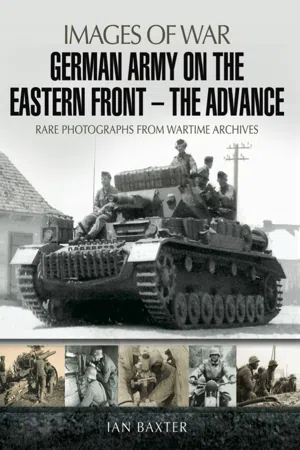
Advance is a highly illustrated record of the extraordinary feat of arms that saw the Nazi armies drive deep into the vast terrain of the Soviet Union, to the gates of Stalingrad and Moscow. It traces the campaign from these hopeful beginnings until, on the brink of victory, the defenders and the winter contrived to slow and then halt the advance. It vividly conveys the appalling conditions endured by the invaders. By early 1943 the German advance finally petered out, leaving some 1.5 million dead from the battle of Stalingrad alone. The long and costly retreat was about to begin.
"This is a book of photographs, featuring some hitherto unseen images of the German Army on the Eastern Front in WWII . . . The pictures and accompanying text have been well researched by the author and in my view this is an ideal book for those interested in that theatre of war in WWII. The pictures alone tell the story."—The Armourer
"The rare photographs will be of great interest to professionals and enthusiasts, but this is also a very good starting point for the novice and represents very good value for money . . . This book provides a strong impression of the happy months before the weaknesses led into an increasing string of defeats as the Allied forces began to advance on German homeland."—FIRE Project
- 160 pages
- English
- ePUB (mobile friendly)
- Available on iOS & Android
eBook - ePub
German Army on the Eastern Front—The Advance
About this book
Information
Chapter One
Advance to the East
For the invasion of Russia, code-named ‘Barbarossa’, the German Army assembled some 3 million men, divided into a total of 105 infantry divisions and 32 Panzer divisions. There were 3,332 tanks, over 7,000 artillery pieces, 60,000 motor vehicles and 625,000 horses. This massive force was distributed into three German Army groups:
- Heeresgruppe Nord – commanded by Generalfeldmarschall Wilhelm Ritter von Leeb, which provided the main spearhead for the advance on Leningrad and assembled in East Prussia on the Lithuanian frontier.
- Heeresgruppe Mitte – commanded by Generalfeldmarschall Fedor von Bock, which assembled on the 1939 Polish/Russian Frontier, both north and south of Warsaw. Bock’s force consisted of forty-two Infantry Divisions of the 4th and 9th Armies, and Panzergruppen II and III. This army contained the largest number of German infantry and Panzer divisions in all three army groups.
- Army Group Süd – commanded by Generalfeldmarschall Gerd von Rundstedt, which was deployed down the longest stretch of border with Russia.
The front, reaching from central Poland to the Black Sea, was held by one Panzergruppe, three German and two Rumanian armies, plus a Hungarian motorized corps, under German command.
During the early morning of 22 June 1941, the German Army finally unleashed the maelstrom that was ‘Barbarossa’. Both the Infantry and Panzer Divisions wasted no time and soon sliced through the bewildered Russian forces on every front. The ferocity and effectiveness of both the Infantry and Panzer Divisions were so great that groups of up to fifteen Russia divisions were trapped at a time and slowly and systematically annihilated in a hurricane of fire.
In the North, Leeb’s rapid two-pronged offensive along the Baltic opened up at first light on the morning of 22 June 1941. His force, consisting of 16th and 18th Armies, smashed through the Soviet defences. Russian soldiers stood helpless in its path, too shocked to take action. Over the next weeks to come, German troops of Heeresgruppe Nord continued to chew through enemy positions heading through Lithuania, Latvia and Estonia, straight towards their objective – Leningrad. Fortunately for Leeb, the earth was baked under the blistering summer heat and his army was able to advance rapidly through the Baltic states.
By 10 July, Leeb’s units broke south of Pskov and rolled towards Luga. At the rate they were advancing, they would need no more than nine or ten days to reach the outskirts of Leningrad. But following their surge of success, the Wehrmacht were losing momentum. Not only were their supply lines being overstretched, but enemy resistance began to stiffen on the road to Leningrad. In a desperate attempt to blunt the German advance and prevent them from reaching the imperial city, brigades of Russian marines, naval units, and more than 80,000 men from the Baltic Fleet were hastily sent into action against Leeb’s forces. These Russian soldiers were now the sole barrier between Leningrad and the Germans. Although the advance was hampered by these Russian forces, by the end of August 1941, Leeb’s Panzers were finally within sight of Leningrad. The terrified civilians left inside the city walls were now going to endure one of the most brutal sieges in twentieth-century history.
As the summer of 1941 passed and the Germans drew closer to the city gates, Leningraders were given the grim orders to defend their city to the death. Although Leeb’s forces had arrived within shelling distance of Leningrad, the advance had not gone as planned. Already units had been badly disrupted and were mired on the Leningrad Front by stiffening resistance.
By 17 September, the Moscow Front could wait no longer for victory in the north. The shift of the main weight, the powerful 41.Panzerkorps which Leeb required to sledge-hammer his way to the outskirts of Leningrad, was taken out of line and ordered to the Moscow Front. Without the 41.Panzerkorps the whole dynamics of Heeresgruppe Nord had altered. There would now be no attack on Leningrad. Instead, Hitler ordered that the city would be encircled and the inhabitants defending inside would be starved to death. During October and November 1941, some ten German divisions were tied down around the city. For the next year German troops of Heeresgruppe Nord fought a series of bloody battles to hold their positions around Leningrad. Although they had managed to blunt Russian penetrations through their lines with the sacrifice of thousands of men killed and wounded, the battle had in fact absorbed all the available resources of the 18.Army and elements of the 11.Army, which had resulted in the planned assault on Leningrad being abandoned.
While Leeb’s forces smashed their way through Soviet lines during the first promising days of ‘Barbarossa’, the strongest army group, Army Group Centre, made a series of heavy penetrating drives through the Russian heartlands, bulldozing through the marshy ground to the main Russian defences. Within days of its first attacks across the frontier both the Infantry and Panzer Divisions had pulverized bewildered Russian formations, which led to a string of victories along its entire front.
The ultimate objective of Heeresgruppe Mitte was to spearhead as rapidly as possible eastwards to the city of Smolensk, which commanded the road to the Russian capital, Moscow. Facing this impressive array of German might along the River Dnieper and Dvina were groups of heavily defended fortifications called the Stalin Line. The defenders were the Russian 13th Army of the western front, and the 20th Army, 21st Army and the 22nd Army of the Supreme Command (STAVKA) Reserve. In the region around the strategic city of Vitebsk the 19th Army was ordered to hold it at all costs, while the 16th Army was hastily moved in front of Smolensk. It was the threat in the north from 3rd Panzer Army and 39th Panzerkorps that seriously worried the Red Army. However, in spite of this concern, Stalin had called for a Great Patriotic War against the Nazi invader, and every soldier was determined to do his duty and hold its lines to grim death. As Heeresgruppe Mitte continued a general push towards Smolensk in early July 1941, the Russians began a more determined defence. Many bridges were blown up and, for the first time, the Red Army units began laying mines to slow down the Germans. To make matters worse for both the Infantry and Panzer Divisions heavy rain, typical for July in central Russia, suddenly began turning the roads into streaming rivers of mud, and advancing German units found themselves either slowing down to a painful snail’s pace or totally immobile for hours at a time.
The German delays gave the Soviets time to organize for a massive armoured counter-blow.
On 6 July, the Russians finally launched their attack in front of Smolensk with the Soviet 20th Army’s 7th and 5th Mechanized Corps attacking advancing German troops and armour with 700 tanks. What followed was the battle of Smolensk with Red Army infantry bitterly contesting every part of ground along the Dnieper River.
To meet the Russian force was Guderian’s Panzergruppe, which was advancing steadily eastwards, along three separate axes. The most northerly of these ran from the Dnieper crossings below Orsha, along the line Dubrovno-Lyady-Krasny-Smolensk. This was under the 57th Korps, with the 29th Motorized Division leading the 17th and 18th Panzer Divisions. In the centre the 56th Korps advanced from Mogilev with the 10th Panzer Division, SS-Das Reich, and Guard Battalion of Gross Deutschland. To the south, up the winding valley of Oster, came the 24th Korps, with the 10th Motorized Division, the 3rd and 4th Panzer Divisions, and the cavalry division, all of which were converging toward Smolensk. For the Red Army the Battle of Smolensk would take place in several phases, divided into distinct operations to halt the German offensive and the armoured pincers.
In spite of relatively strong Russian defensive positions, by the second week of July the 3rd Panzergruppe’s 20th Panzer Division established a bridgehead on the east bank of the River Dvina and threatened Vitebsk. To the south, away from the main crossings, the 2nd Panzergruppe launched surprise attacks, forcing the River Dnieper. The Soviet 13th Army was pushed back, losing five divisions. As both German Panzer Armies drove east, three Soviet Armies, the 20th, 19th and 16th faced the prospect of encirclement around Smolensk.
Meanwhile, south of Smolensk, Guderian’s 2nd Panzergruppe bulldozed its way through Soviet lines. What followed was intense fighting. Armour and troops from the 29th Motorized Infantry Division in a series of successive attacks blasted their way through towards the city. Soviet soldiers either fought to the death or saved themselves by escaping the impending slaughter by withdrawing to anothe...
Table of contents
- Front Cover
- Title Page
- Copyright Page
- Contents
- About the Author
- Chapter One: Advance to the East
- Chapter Two: Army Group South, 1942
- Chapter Three: Winter and Spring Campaign, 1943
- Appendix I: Assessment of the German Soldier, 1941–1943
- Appendix II: German Infantry
- Appendix III: 6th Army Order of Battle, 19 November 1942
- Appendix IV: Rank Equivalents
Trusted by 375,005 students
Access to over 1.5 million titles for a fair monthly price.
Study more efficiently using our study tools.
Frequently asked questions
Yes, you can cancel anytime from the Subscription tab in your account settings on the Perlego website. Your subscription will stay active until the end of your current billing period. Learn how to cancel your subscription
No, books cannot be downloaded as external files, such as PDFs, for use outside of Perlego. However, you can download books within the Perlego app for offline reading on mobile or tablet. Learn how to download books offline
Perlego offers two plans: Essential and Complete
- Essential is ideal for learners and professionals who enjoy exploring a wide range of subjects. Access the Essential Library with 800,000+ trusted titles and best-sellers across business, personal growth, and the humanities. Includes unlimited reading time and Standard Read Aloud voice.
- Complete: Perfect for advanced learners and researchers needing full, unrestricted access. Unlock 1.5M+ books across hundreds of subjects, including academic and specialized titles. The Complete Plan also includes advanced features like Premium Read Aloud and Research Assistant.
We are an online textbook subscription service, where you can get access to an entire online library for less than the price of a single book per month. With over 1.5 million books across 990+ topics, we’ve got you covered! Learn about our mission
Look out for the read-aloud symbol on your next book to see if you can listen to it. The read-aloud tool reads text aloud for you, highlighting the text as it is being read. You can pause it, speed it up and slow it down. Learn more about Read Aloud
Yes! You can use the Perlego app on both iOS and Android devices to read anytime, anywhere — even offline. Perfect for commutes or when you’re on the go.
Please note we cannot support devices running on iOS 13 and Android 7 or earlier. Learn more about using the app
Please note we cannot support devices running on iOS 13 and Android 7 or earlier. Learn more about using the app
Yes, you can access German Army on the Eastern Front—The Advance by Ian Baxter in PDF and/or ePUB format, as well as other popular books in History & German History. We have over 1.5 million books available in our catalogue for you to explore.