With vivid firsthand accounts, this WWII history examines the RAF Coastal Command's operations at sea against U-boats and the German Navy.
In
Deep Sea Hunters, historian Martin Bowman delves into the Royal Air Force Coastal Command's dynamic role in countering German naval power during the Second World War. Beginning with the disastrous Norwegian Campaign, he covers the numerous attacks on the bustling German submarine base at Lorient, the attack on Brest, as well as many other pivotal and dramatic events of the conflict at sea.
The hunt or U-boats is relayed in full and gripping detail, with first-hand accounts from U-boat attackers—as well as German submariners—punctuating Bowman's dramatic prose. This two-sided history is sure to appeal to all enthusiasts interested in gaining a balanced insight into Second World War naval history.
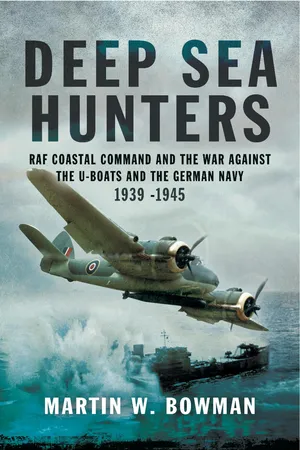
eBook - ePub
Deep Sea Hunters
RAF Coastal Command and the War Against the U-Boats and the German Navy 1939–1945
- 224 pages
- English
- ePUB (mobile friendly)
- Available on iOS & Android
eBook - ePub
Deep Sea Hunters
RAF Coastal Command and the War Against the U-Boats and the German Navy 1939–1945
About this book
Information
Print ISBN
9781783831968
Subtopic
Military & Maritime HistoryChapter 1
Norwegian Campaign
On 8th April 1940 at 2 o’clock in the afternoon, a Sunderland flying boat sighted a battleship of the ‘Scharnhorst’ class accompanied by two cruisers of the ‘Leipzig’ class and two destroyers. They were a hundred and thirty miles from the Alsboen Light off the West coast of Norway. The ships saw the Sunderland almost at the same moment and opened anti-aircraft fire which was both heavy and accurate. The Sunderland was hit almost at once; two of its tanks were holed and the hull gradually filled with petrol. When it landed at its base it had lost 300 gallons. That same day German destroyers had been seen at various times in the neighbourhood of the Horns Reef, steaming on a Northerly course. The German attack on Norway had begun.
Throughout the next day aircraft of Coastal Command were very busy reconnoitring the new area of battle. Before midday a London flying boat had reported the presence of a German cruiser of the ‘Koln’ class in Bergen. This intelligence was confirmed later by a Blenheim and a Wellington. A Sunderland reported one ‘Hipper’ class cruiser in Trondheim Fjord and Wellingtons enemy warships and possibly transports at Kristiansand (South). The cruiser at Bergen was attacked that afternoon by Wellingtons, which dropped thirty armour-piercing 500-lb bombs from between 4,000 and 6,000 feet. They were met by heavy fire, but thought that they had scored one direct hit on her stern. On the next day a Hudson reported that after a further attack by naval Skuas from the aircraft carrier HMS Furious the cruiser had sunk.
On 12th April a Wellington, put at the service of Coastal by Bomber Command, flew from an aerodrome in Northern Scotland over a thousand miles’ of sea to the North of Norway. When it entered Narvik Fjord ‘huge rocks towered up on either side of us,’ reports the wireless operator. ‘Snow drifted down so that we could see only a few yards ahead. The gusts were terrific, bouncing and throwing us about ... By then we reckoned we were within about ten miles of Narvik, but we could not continue. Visibility was almost nil ... We went about and picked our way down the fjord again ... like a boat hugging the shore. Suddenly we saw once more the open sea. ‘They soon saw something else, a Ju 88 crossing their bows. ‘We began to circle each other, two heavy bombers waiting to pounce.’ Then the inevitable curtain of snow fell and they lost each other: Near Narvik the compass showed errors of between twenty and thirty degrees, but the Wellington set course for base and landed safely after a flight of fourteen and a half hours. When the Wimpy entered Narvik Fjord ‘huge rocks towered up on either side of us,’ reported the wireless operator. ‘Snow drifted down so that we could see only a few yards’ ahead. The gusts were terrific, bouncing and throwing us about.... By then we reckoned we were within about ten miles of Narvik, but we could not continue. Visibility was almost nil.... We went about and picked our way down the fjord again. like a boat hugging the shore. Suddenly we saw once more the open sea.’ They soon saw something else, a Ju 88 crossing their bows. ‘We began to circle each other, two heavy bombers waiting to pounce.’ Then the inevitable curtain of snow fell and they lost each other: Near Narvik the compass showed errors of between twenty and thirty degrees, but the Wellington set course for base and landed safely after a flight of fourteen and a half hours. On the next day the Royal Navy entered the fjord and sank seven German destroyers. By 14th April the German Air Force was in occupation of all the aerodromes in Norway and Denmark ...’
Coastal Command: The Fight for Norway Air (Air Ministry 1942.)
The great consolidation of the Empire Air Force began almost concurrently with the fall of France in May 1940. In this, the Atlantic Delivery Service was a major factor. The service was inaugurated on the night of 10 November 1940 when seven Hudson aircraft, crewed by men from Britain, Australia, South Africa, Norway, Canada and the United States made the first flight under the leadership of Captain D. C. T. Bennett, who later became Air Officer Commanding RAF Pathfinder Force. Headquarters for the Atlantic Delivery Service were set up at Montreal and with the help of the Canadian Pacific Railway Company the service was built up. Pilots and radio operators were at first obtained from British Overseas Airways as a nucleus. Later, service navigators trained under the Joint Air Training Plan became available. 7
In Coastal Command, Hudsons were just coming into squadrons at the outbreak of war and eventually they completely superseded the shorter range Avro Anson. Hudsons gave excellent service for a number of years on anti-submarine and general reconnaissance duties from bases all round the British coastline and they also served in a maritime role with the RAF in West Africa, the Mediterranean area, the West Indies, in Iceland and in the Far East. They were the first American aircraft to be delivered by air to Britain and the first aircraft in Coastal Command to carry airborne lifeboats for air-sea rescue duties. Hudsons were hard at work over the North Sea from the first day of the war, their main task being to keep a watch for German surface raiders attempting to escape into the Atlantic between Scotland and Norway. A Hudson on 224 Squadron can claim to be the first RAF aircraft operating from the United Kingdom to shoot down an enemy aircraft, on 8 October 1939, when the Hudson succeeded in destroying a Dornier Do 18 flying-boat during a patrol over Jutland.
224 Squadron began operations before war was declared. During the Munich crisis all the Coastal Squadrons were sent to their war stations. 224 Squadron was already at Leuchars, from which they were to patrol the North Sea in venerable Ansons, which could not reach the Norwegian coast and be able to return. All the German fleet had to do was to cling to the coast and slip out to the Atlantic without being seen, As the threat of war increased the Squadron was equipped with Lockheed Hudsons, Two weeks before the war truly began, 224 sent out its first sortie, disguised as an exercise but actually to report the movements of the German naval units off the coast of Norway, while the Home Fleet was moving from Portsmouth to Scapa Flow.
Wing Commander Terry McComb, CO of 224 Squadron recalled, ‘Going to Norway was a big thrill in those days. I know it must seem funny now, but we had all wanted to look at the Norwegian coastline because it had been impossible in our old Ansons, The first member of the Squadron to see it was quite a hero for a few hours. During the exercise the weather was bloody awful and the Squadron suffered its first war casualty; Dingle Bell, the Squadron adjutant, who crashed into a Norwegian cliff.’ The aircraft were poorly armed and gun turrets had not arrived. Although they had no gun turrets, 224 aircraft waded into the enemy with two fixed front guns. ‘It was not long before we had our first kill. Three Hudsons led by the Flight Commander of ‘C’ Flight did it. The leader was ‘Dog-shooter’ Womersley, who always wore drain pipe trousers, a shooting jacket and bow tie.’
The Squadron also took part in photographic reconnaissance. It began with nervous little attempts to photograph the enemy country on the other side of the Channel. A detached flight of 224 Squadron was kept at Thornaby at the beginning of the war to photograph and report on the movements of naval units in the Heligoland Bight. McComb said that photographic reconnaissance was ‘a very dirty job’ in those days, but that as a result of those flights, information was brought back, making it possible for the Wellingtons and Hampdens to attack enemy ships in force. In those early days the aircraft of 224 Squadron flew battle flights to intercept and shoot down enemy aircraft, they bombed aerodromes in Norway, searched for enemy ships and photographed enemy harbours and attacked shipping. That cumbersome word, specialization, has conquered all these uncertain arrangements and 224 now do little but hunt and kill U-boats at night. 8
On 31 January 1940 fourteen Hudsons became the first aircraft in Coastal Command to be fitted with ASV radar which enabled the location of U-boats at night or in poor visibility. In February 1940 a Hudson on 220 Squadron directed naval forces to the hideout of the German prison ship Altmark (an auxiliary of the Graf Spee) in Norway. Many British prisoners of war were set free as a result. A Flight Commander on 224 Squadron gave a talk on the BBC about a raid on Norway. ‘When I was last in London I was actually taken for a Scotsman, but, as you may guess, my home is in Canada - Vancouver, British Columbia. In some ways, Scotland is quite like home - pine trees, mountains and plenty of snow in the winter.
‘We’ve been pretty busy in the last few weeks with our American-built Hudson aircraft. It’s a mixed type of work that falls to the Coastal Command. We spend most of our time over the North Sea doing reconnaissance work, looking for U-boats and escorting convoys. These are comparatively peaceable occupations, although you may run into German aircraft doing the same job from the other side. But sometimes you get an operation which breaks the monotony. We had a bit of excitement the other day when orders came through for us to attack some shipping in a Norwegian harbour. Our leader was our Wing Commander [Terry McComb] and we had a talk in his office before starting, discussing the method of attack and then we got ready for the flight. Soon after we left we ran into mist, fog and rain and had to fly blind for about half an hour. There was a possibility that the bad weather might spoil the fun, but nearer to the Norwegian coast, it cleared.
In the half light the scores of little islands were a greyish-brown colour, with the sea a darker shade. The wide fjord showed up almost black ahead. We flew into it, keeping level with the tops of the surrounding mountains. We kept on until we had a big, snow-covered mountain between us and the harbour. We skipped over the top of this mountain and flew down the other side so close to the snow that we almost seemed to be tobogganing down it. In a few minutes we were below the snow level, skimming the rocks and the tops of the pines. The wing commander was leading, with five of us streaming along behind. That was just about the moment that the guns opened up on us. Batteries on the mountain-side behind started firing down from above and anti-aircraft posts on each flank and in from let us have all they’d got. Streams of tracer shells coming at us made a criss-cross pattern all round and there were bursts of black smoke ahead where the heavy stuff was exploding. It was really a fireworks display and, actually, it looked very nice - if you were in a position to appreciate it.
‘Another few seconds and we were down over the harbour. Machine gunners were shooting from the windows of the hotels on the waterfront. One of our rear gunners sprayed the buildings with bullets as we passed - and the windows emptied like magic. The guns on either side were firing so low that they were probably hitting each other as we went between them. They didn’t touch us and, as a matter of fact, none of our six aircraft was so much as scratched. The ships we were after were lying at anchor-some against the quays and some moored in the harbour. We dropped our bombs on and around them and shot off towards the sea. As we looked back, we could see the smoke and flames caused by the explosions. We had an even more spectacular party over the same harbour, later, when we paid a return visit and blew up an ammunition dump. I arrived by myself, a little early for the appointment and decided to start the ball rolling. It was very early dawn and I could just pick out the little huts on the end of the quay which we knew contained ammunition. (I’d seen photographs of them before leaving, taken by another aircraft of the squadron.) ‘Two of my bombs and possibly more, scored direct hits on the dumps. We were about 2,500 feet up, but even there the force of the explosion lifted the aircraft as if it were riding a wave.
‘We went right over the hill and did a right turn and circled back round the harbour to see what damage we had done. Growing from the remains of the ammunition dump was a huge mushroom of black smoke, going up to 2,000 feet. Its base was a fiery red mass and higher up it was pierced through and through by flames and pieces of burning debris flying through the air. Other aircraft which arrived later saw the fire still burning. We all returned from that trip safely.
‘Another job was the occasion when we bombed a group of enemy warships. To give honour where it is due, I must raise my hat to the German naval gunners. We were flying at 15,000 feet, but they kept planting their heavy ack-ack so close to us that we could see the flash of the bursts before the smoke appeared (the burst has to be VERY close for you to see more than just the smoke). We could feel the aircraft vibrating from the explosions. It was continually jerking, as though it had been kicked by a giant. All six of our aircraft were hit by bits of high explosive shell, but we all got back to our base-and I might mention as a tribute to the maintenance staff that the six were all flying again the next day.
‘On one of our raids in the north of Norway, we used the Midnight Sun to light us to our objective, which was an aerodrome. We dropped numbers of high explosive and incendiary bombs on that occasion and left several fires behind us. Perhaps our most successful attack on an enemy aerodrome was when we dropped ninety bombs in less than a minute. This particular aerodrome had hardly been used and was tucked into the side of a hill. With infinite trouble, the Germans had built new wooden runways which looked as smooth as a skating rink when we arrived, but were burning merrily after our bombing. We counted forty fires when we left, some of them in the woods where the aircraft were probably hidden and others in the huts around the side of the aerodrome.’
After the collapse of France two squadrons of Hudsons moved to Northern Ireland to strengthen the anti-U-boat force and some of these aircraft took part in the hunting of the Bismarck in April 1941. 269 Squadron operated over the Western Approaches from Iceland. 9
On 30 January 1940 a Sunderland on 228 Squadron laid claim to the first U-boat kill for Coastal Command. Flight Lieutenant E. J. Brooks was flying Sunderland N9025/Y when he attacked U-55 in the North Sea after the enemy submarine had been depth-charged to the surface by the sloop HMS Fowey. The destroyer HMS Whitshed and the French destroyer Valmy escorting Convoy OA.80G arrived on the scene and as the warships opened fire the U-boat crew scuttled their boat and were all rescued except the commander, 31-year old Kapitänleutnant Werner Heidel. 10 From June 1940 Sunderlands on 228 Squadron operated against Italian shipping in the Mediterranean and in November one of these boats flying from Malta carried out a reconnaissance of Taranto prior to the celebrated Fleet Air Arm attack on the night of 11 November by Swordfish aircraft on the Italian Fleet. Preliminary reconnaissance of Taranto harbour showed that the Italians had six battleships at anchor, as well as several cruisers and destroyers. 11
In April 1940 meanwhile, Sunderland crews in Britain were tasked to monitor German naval activity off Norway and reconnoitre the coast to obtain intelligence for possible future operations. On 1 April 204 Squadron were at Sullom Voe, 201 Squadron at Pembroke Dock and 10 Squadron RAAF at Mount Batten. One writer noted that ‘the Australians seemed to be at home beside this ancient water from which Drake left to circumnavigate the world, nearly 400 years earlier. They were housed in two hangars where T. E. Lawrence worked as Aircraftman Shaw from 1929 to 1933. The Australians are not history worshippers and sometimes they treat the past as if it were a cigarette end. But the ghosts of Drake and Lawrence are treated amiably here.’12
Three days’ later 204 Squadron flew its first operation from Sullom Voe when Flight Lieutenant Frankie Phillips in N9046 took off at 1125 for a convoy escort. Phillips located the convoy in the estimated position. At 1550 while the aircraft was twenty miles away from the convoy on the starboard bow, two Ju 88s were sighted low on the water approaching from the direction of the Norwegian coast. The Sunderland and the enemy aircraft were 50-100 feet above the sea. The Ju 88s circled around the Sunderland for two minutes and then carried out a beam attack on the starboard side at a range of 800 yards, the two aircraft flying past successively on a course parallel to the flying-boat. A desultory engagement took place without any apparent damage to either aircraft. Both turrets and the starboard amidship gunner fired short bursts. The subsequent appearance of four more Ju 88 aircraft led to the belief that the enemy was employing this tactic to draw fire. After three minutes’ fighting the two aircraft began to climb turning away from our aircraft and after a three-minute pause, four more Ju 88s appeared from the same direction and immediately delivered a line astern attack on the tail of the Sunderland. The rear gunner, Corporal Little, held his fire till the leading Ju 88 was at 100 yards range. He then opened fire and shot down the leading attacker, which banked steeply and dived into the sea. The second Ju 88 was also hit and was afterwards known to have force-landed. During this attack the first two Ju 88s to arrive were attempting to bomb the Sunderland from a height of 1,500 feet. The bombs however were easily avoided by the fire control officer in the observation dome, directing the pilot away from them. The bombs could be seen falling as soon as they were released and the nearest one burst at least 100 yards from the Sunderland. As soon as the attack of the four aircraft had been broken up by our gunfire, the five remaining Ju 88s immediately made off and the Sunderland made for home, having suffered the following damage: bullets in port inner, starboard middle and starboard inner fuel tanks causing loss of 500 gallons during return flight; bullet holes in hull, fin, instrument panel; trimming gear and fuel jettison systems made unserviceable; one bomb rack damaged; the fire control officer and navigator both sustained face cuts from splinters. Two fuel tanks were hit and the control wires and certain instruments were shot through. Phillips was awarded a DFC and Corporal William Little received the award of the DFM.
Also on 4 April a reconnaissance flight over the Elbe estuary discovered German naval vessels and sixty merchant ships in the Schillig Roads moving northward in formations of five ships. The naval vessels were attacked by six Blenheims without visible result. A patrol sent to the same place on the next day had to be recalled on account of weather; but its leader got through and flying just below clouds, which were down to 200 feet, found the Roads almost empty. On Saturday 6 April a photographic reconnaissance showed that several units of the German Fleet, including the 26,000-ton battle cruisers Scharnhorst and the Gneisenau, were in the harbours of North-Western Germany. It was, however, on the night of 6/7 April that the signs of an impending great event became unmistakable. British bombers engaged in the dropping of leaflets reported that a wide stream of motor transport, headlights blazing, was flowing along the autobahn from Hamburg to Lübeck, while at Eckernforde, near Kiel, there was great activity among shipping under the glare of brilliant arc lamps. The Germans made no pretence of concealment. When all is on the hazard they rarely do, believing that speed is more important than secrecy.
Although it was not until 9 April 1940 that German ships of war were seen in Norwegian harbours, they had sailed on the 7th. On 7 April bomber crews were brought to a state of readiness when it was realised that German ships sighted heading for Norway and Denmark the day before were part ...
Table of contents
- Front Cover
- Title Page
- Copyright Page
- Contents
- Acknowledgements
- Introduction
- Chapter 1 Norwegian Campaign
- Chapter 2 Wimpys Over The Waves
- Chapter 3 Bombers Against the German Navy
- Chapter 4 One-Way Ocean ‘Bruce Sanders’
- Chapter 5 Queen of the Boats
- Footnotes
Trusted by 375,005 students
Access to over 1.5 million titles for a fair monthly price.
Study more efficiently using our study tools.
Frequently asked questions
Yes, you can cancel anytime from the Subscription tab in your account settings on the Perlego website. Your subscription will stay active until the end of your current billing period. Learn how to cancel your subscription
No, books cannot be downloaded as external files, such as PDFs, for use outside of Perlego. However, you can download books within the Perlego app for offline reading on mobile or tablet. Learn how to download books offline
Perlego offers two plans: Essential and Complete
- Essential is ideal for learners and professionals who enjoy exploring a wide range of subjects. Access the Essential Library with 800,000+ trusted titles and best-sellers across business, personal growth, and the humanities. Includes unlimited reading time and Standard Read Aloud voice.
- Complete: Perfect for advanced learners and researchers needing full, unrestricted access. Unlock 1.5M+ books across hundreds of subjects, including academic and specialized titles. The Complete Plan also includes advanced features like Premium Read Aloud and Research Assistant.
We are an online textbook subscription service, where you can get access to an entire online library for less than the price of a single book per month. With over 1.5 million books across 990+ topics, we’ve got you covered! Learn about our mission
Look out for the read-aloud symbol on your next book to see if you can listen to it. The read-aloud tool reads text aloud for you, highlighting the text as it is being read. You can pause it, speed it up and slow it down. Learn more about Read Aloud
Yes! You can use the Perlego app on both iOS and Android devices to read anytime, anywhere — even offline. Perfect for commutes or when you’re on the go.
Please note we cannot support devices running on iOS 13 and Android 7 or earlier. Learn more about using the app
Please note we cannot support devices running on iOS 13 and Android 7 or earlier. Learn more about using the app
Yes, you can access Deep Sea Hunters by Martin W. Bowman in PDF and/or ePUB format. We have over 1.5 million books available in our catalogue for you to explore.