- 528 pages
- English
- ePUB (mobile friendly)
- Available on iOS & Android
eBook - ePub
About this book
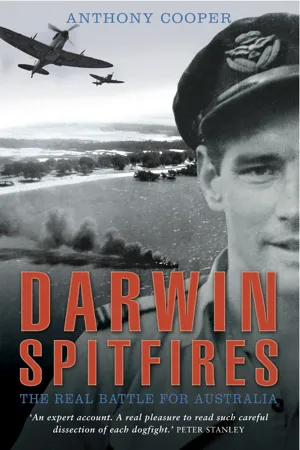
The Japanese air raids on Darwin on 19 February 1942 are well-known to most Australians, although not perhaps to the rest of the world. What happened afterwards, however, remains unknown to many. This publication attempts to illuminate this little-known period of war history, charting the exploits, losses and successes of the RAF's No 1 Fighter Wing and the contribution they made to the allied war effort. The stalwart Spitfire is celebrated in a narrative that is sure to appeal widely.For almost two years the airspace over North West Australia was routinely penetrated by Japanese raids, tallying about 70 in total. The 1942-43 air raids on Darwin constituted the only sustained and intensive direct assault on Australian mainland territory in the whole of World War II - and the whole history of post- 1788 Australia - yet, surprisingly, most Australians have no idea that it ever happened. And the rest of the world are yet more so in the dark.Telling the story of the RAF'S No 1 Fighter Wing, composed of both Australian and British Spitfire pilots, Darwin Spitfires explores the little known 1943 season of air combat over the top end, recovering important aspects of Australian history. It brings to the attention of the world the heroic exploits of the skilled pilots who did so much to protect Australia and support the Allied effort. This important publication attempts to celebrate and commemorate the spirit of solidarity that characterized the experiences of No 1 Fighter Wing.As featured in Aeroplane Monthly
Information
Topic
StoriaSubtopic
Storia militare e marittima
1
Playing catch-up
The great raid on Darwin on 19 February 1942 needs little introduction, having assumed almost legendary status in popular Australian history. This dramatic day, when the war came so suddenly and violently to the Australian continent, understandably triggered a healthy output of historical narratives. By the 1960s, detailed accounts had been provided in the official histories of all three of Australia’s services, as well as in Douglas Lockwood’s definitive full-length account. Since then, this story has been regularly revived in the form of popular histories, memoirs, biographies, and even a movie: it is clear that the story of the 19 February raid has been well told, as it deserves to be. From the perspective of this book’s account of the ongoing 1943 bombing campaign, that titanic first raid is noteworthy for two aspects: the massive force used by the Japanese, and the nonexistent state of the air defence.
The missing RAAF fighter force
The vast Japanese air armada on 19 February had been effectively unopposed, due to the failure of successive Australian governments to build up a defensive system in the north or to create a fighter force within the RAAF. There was not a single fighter aircraft in Australia, and this did not change between the outbreak of the war against Germany in September 1939 and the outbreak of the Pacific War in December 1941, despite clear awareness in Canberra of the very high likelihood of hostilities with Japan. Thus the home-based RAAF went through the early part of the war with no fighters, no current fighter pilots and little ongoing tradition or expertise in fighter operations.
This was because successive Australian governments had gambled that Britain’s Singapore base would provide strategic protection to Australia. By this logic, if the ‘Singapore Strategy’ worked as advertised, there would be no need to establish a defensive fighter force on the Australian continent. If there were no fighters, there would be no need for the network of bases, radar stations and logistical systems required to support successful fighter action. According to this script, sheltered behind its Singapore shield, the home-based RAAF would merely need to patrol the sea approaches and mount air strikes against any of the small-scale seaborne forays that might temporarily slip through the defence shield further north.
In 1941, despite the steady escalation of Japan’s war threats, Britain’s Air Ministry was still able to make the rather patronising assertion that Australian demands for fighters were based on psychological grounds only, lacking real military justification. Working from this foundation, the RAAF’s Chief of Air Staff, Air Chief Marshal Sir Charles Burnett (a British officer seconded from the RAF), had meanwhile been able to gut the home-based air force of its potential combat capability, instead turning it into a huge training machine to churn out aircrew for the RAF’s expensive war against Hitler’s Germany, as part of the Empire Air Training Scheme (EATS). The effect of this generous allocation of manpower and resources to the European war can be demonstrated by some simple statistics: the RAAF’s entire home-based front-line strength at the outbreak of the Pacific War (ignoring the non-combat-worthy Wirraways) numbered a mere 53 Hudsons and 12 Catalinas – this for a service that in 1941 alone had trained 1367 pilots and sent almost 3000 trained aircrew to the United Kingdom.
Thus 1942 dawned without any credible means for Australia to defend itself against air attack, anywhere. Although the RAAF’s failure to provide any air defence at all on 19 February was highly discreditable, it is likely that the outcome would have been little different had it actually possessed a fighter force at Darwin. It is most likely that any counterfactual Darwin-based RAAF fighters would have been accorded the same rough treatment as the Japanese handed out to the fighter garrisons at Pearl Harbor, Clark Air Base, Wake Island, Singapore, Sumatra, Ceylon and Midway. The only fighter types available in 1941 were Buffaloes or Hurricanes, and both largely failed in air combat against the Japanese. Against the great raid of 19 February, a weak force of RAAF fighters at Darwin would have merely provided more scoring opportunities for the rampant Zeros.
Air defence at last – the USAAF to the rescue
There were no further raids in February 1942, but March saw the start of an air campaign of harassment and reconnaissance against Darwin, with alternating fighter sweeps and unescorted bomber raids. Although Darwin and its airfields were attacked without hindrance, these raiding forces of fewer than ten aircraft were unlikely to have much effect.
In conjunction with this sharp downgrading of the Japanese raids, Darwin’s situation improved further with the arrival of the 9th Pursuit Squadron (9th PS) of the United States Army Air Forces (USAAF) in late March. This American P-40 unit was the vanguard of its parent unit, the 49th Pursuit Group (49th PG), which was also under orders to move north. From the moment the 9th PS flew into the battered RAAF base, Darwin finally had some measure of air defence; the days of easy victories for the Japanese were coming to an end.
The Japanese responded to the American challenge by increasing the size of their raiding forces, and on 25 April for the first time since 19 February they committed an entire bomber group – after the arrival in Timor of the main body of the Takao Bomber Air Group upon the running-down of the successful Philippines campaign. After good successes earlier in April, the 49th PG found itself in a hard campaign in which the experienced Japanese, in their higher performing aircraft, held the upper hand. The loss rate of the Japanese bombers dropped from the alarming figure of 13 per cent, in the period up to the Anzac Day raid, to only 1 per cent in the six raids that followed.
Over the entire five months of this defensive campaign, the US pilots claimed 66 Japanese aircraft shot down. However, fighter pilots in the early part of World War II often overclaimed by a ratio of about three to one, and the 49th was no different. By a collation of accounts which have accessed Japanese records, it seems that, in total, the admitted Japanese loss was about 21 aircraft (13 bombers, seven fighters and one photoreconnaissance aircraft). If these figures are accepted, and placed against the 19 P-40s that were lost in air combat, it would seem that the Americans sustained a kill-to-loss ratio of slightly more than 1:1 – a typical enough performance in defensive fighter combat using first-generation fighters in the early war period.
Even if they had not done as brilliantly as they had thought, the US pilots had done well, for they had imposed some attrition upon the Japanese, and perhaps more importantly they had completely defeated the enemy’s intention to destroy the Darwin fighter force. According to Imperial Navy airpower doctrine, its land-based bomber groups were to deliver smashing blows against any Allied bases that threatened the Japanese defensive perimeter. In this context, perhaps the greatest service provided by the Darwin fighter force had been to neuter the Imperial Navy’s bomber weapon. The bombers needed to drop their bombs from 10000 feet in order to achieve the desired bombing accuracy and therefore destructive effect, yet the defence at Darwin had forced the bombers up to 25 000 feet and even higher. Japanese bomber commanders were thus caught in a catch-22: low bombing heights were needed to destroy targets, but this made the bombers too vulnerable to fighter attack. It was in this prosaic manner that the Allied fighter weapon had prevailed: it had not been decisive in ‘winning the battle’ for air supremacy over the Timor Sea front, but in ruining the effectiveness of Japanese bombing the fighters had provided the preconditions for the build-up of the Darwin base area into a major network of airfields, ready for the day when MacArthur’s air command would permit the deployment there of an expanded and offensively configured air force.
Indeed, the 49th PG had not been committed to the defence of Darwin as an act of American charity, as deserving as the RAAF might have been. Rather, the American forces that arrived in Australia during 1942 were placed in the service of the post-Pearl Harbor US strategic agenda, which pragmatically exploited the location of Australia to turn it into a useful base from which to launch the intended American counter-offensive. From the US perspective, defending Australia was not the main concern, but the American commanders nonetheless recognised that a Japanese lodgment on the northern coast of Australia would suck in US resources and render insecure their intended Australian rear base area. In those early days of US forces in Australia, Darwin was seen as one of the two critical battle fronts, the other being Port Moresby. In early 1942, General Douglas MacArthur, the newly appointed theatre commander, had only three US fighter groups in theatre, so the deployment of one-third of this force to Darwin had signified his clear understanding that Darwin needed to be secured as the hinge for his intended right hook up through New Guinea to Rabaul.
The creation of a ground-based air defence system
In parallel with this early 1942 build-up of the Allied fighter force in the Top End, the Australians and Americans were frenetically active in laying out a substantial supporting ground network. RAAF and USAAF maintenance and logistics units arrived to back up the front-line squadrons, while engineering units improved and extended roads and airfields. An intensive program of airfield construction and site dispersal went on throughout 1942, preceding the 19 February raid and continuing in an unbroken program of civil engineering. Heavy earthmoving machinery was brought in to the Northern Territory by a broad coalition of Allied organisations, such as RAAF airfield construction squadrons, the US Army’s 808th Engineering Battalion, and last but not least, road crews provided by the Main Roads Departments of the Australian state governments, operating under the umbrella of the Curtin government’s Allied Works Council under the direction of Queensland ALP power-broker EG ‘Red Ted’ Theodore. These diverse teams of construction workers used their tip-trucks, bulldozers and graders to carve new roads and airfields out of the bush to support the Allied fightback.
Importantly, each airfield was given a ring of taxiways leading away from the airstrip into the tree cover, thus providing a network of camouflaged aircraft dispersals. This meant that by the time the Japanese raids intensified from April 1942 onwards, they had lost the ability to hit the Allied aircraft on the ground. The air force in the Top End had thus made itself virtually air raid proof, and would henceforth operate without any significant hindrance to its airfield operations. By April, the Japanese had lost the battle of the bulldozers, and this would lose them the air battle – and indeed the war.
All this activity was going on right through the supposed panic that ostensibly gripped the Australian leaders in early 1942; indeed, at the high point of the period that was associated with the purported defeatism of the ‘Brisbane line’ strategy. This scurrilous interpretation was popularised by the ALP politician Eddie Ward as a political attack against the previous conservative government, and then self-interestedly propagated by General Douglas MacArthur. In effect, it amounted to an allegation that Australia’s political and military leaders had unpatriotically judged the northern half of the continent to be undefendable, and so had withdrawn forces from the north. The reality on the ground in the north was very different, refuting the myth.
A command organisation to direct the air forces in the Northern Territory already existed before the outbreak of the Pacific War – Northwestern Area (NWA) RAAF HQ. After the great raid, officers and men were posted in to flesh out the capabilities of this organisation, and so an effective command apparatus was put in place to coordinate both the air defence and the offensive air campaign. The most impressive aspect of this new command and control capability was the progressive creation of an RAAF air defence radar network across the north-west coastline. The ability to detect and track raids was the prerequisite for effective air defence, so it was fortunate that the RAAF had belatedly made a start on this prior to the 19 February raid.
Having earlier dismissed the need for air defence radar – wedded as the service was to its ‘no fighters required’ doctrine – the RAAF was saved from its own intellectual complacency by a coalition of civilian scientists at the University of Sydney and in the Council for Scientific and Industrial Research (CSIR), combined within the newly established Radio Physics Laboratory (RPL). Piggybacking onto the army’s earlier gun-ranging radar project, the RAAF was unwillingly cajoled into supporting the design and testing of air defence radar. As a result, even before the great raid on 19 February 1942, and even before the RAAF had any fighters to operate, No. 31 Radar Station already existed at Dripstone Caves, along the coast to the north of Darwin, set up under the personal guidance of Wing Commander Albert Pither, Director of Radar at RAAF HQ in Melbourne. Although the CSIR-designed Air Warning (AW) radar set was not erected in time to be operational on that day, it was made to work effectively by April.
Considering Australia’s remoteness from the established centres of radar expertise in the United Kingdom and United States and the country’s undeveloped industrial base, this was no small achievement by the country’s universities and industry. To place the Australian achievement in perspective, as late as July 1942 the air defence of the west coast of the United States was still primarily based upon the visual observation of raiders: the future commander of MacArthur’s 5th Air Force, General George Kenney, recorded that there were only six radar sets along that vast coastline. Moreover, once 31 Station’s Australian-designed AW radar was ‘de-bugged’, it consistently achieved greater detection ranges than 105 Station’s US-technology MAWD radar.
Further stations were added through 1942. The addition of 38 Station at Cape Fourcroy on Bathurst Island extended radar coverage an extra 120 kilometres out to sea and provided an unobstructed radar arc covering the Japanese approach route from the north-west. Additional stations included No. 105 at Point Charles and No. 307 on Perron Island, both of which extended the coverage along the coast to the west of Darwin, thickening the surveillance of likely Japanese approach paths from Timor. The RAAF supplemented its ‘high-tech’ radar network with ‘low-tech’ coastwatchers – small parties of radio-equipped observers were deployed to vantage points on the northern coast of the Cox Peninsula and on the north-west coast of Bathurst Island.
The RAAF takes over the air defence of Darwin
In August 1942, MacArthur transferred the 49th Fighter Group to New Guinea in order to add its strength to the Allied fightback in his South West Pacific Area (SWPA) command. The division of labour between the RAAF and USAAF within MacArthur’s command was simple: the Australians would use their second-rate aircraft to look after menial defensive tasks like shipping patrols and rear area air defence, while the Americans would concentrate their better-equipped units upon the decisive battles in New Guinea. The RAAF was thus relegated to the status of a ‘second eleven’. By now, however, the RAAF was not as bereft of fighter units as it had been at the start of the year. The beginnings of a home-based Australian fighter force had been made in March 1942, with the birth of No. 75 Squadron, destined for hard service in defence of Port Moresby and Milne Bay. From then on, the RAAF fighter force expanded progressively, beneficiary of the supply stream of new P-40 aircraft that were being shipped across the Pacific. This meant that the redeployment of the 49th FG could now be covered by two RAAF Kittyhawk fighter squadrons.
Although the first of these Australian units arrived in the Northern Territory as early as July 1942, the RAAF Kittyhawk pilots were fated to miss out on the action, for their arrival in the North was concurrent with the withdrawal of the Japanese units from the Darwin front, transferred to Rabaul for operations over Guadalcanal. As a result, the RAAF’s 77 and 76 Squadrons found themselves defending Darwin against an enemy that now confined its offensive operations to night raids only.
In any case, these two Australian Kittyhawk squadrons had a caretaker role only, for high-level political negotiations between the Australian and British governments had meanwhile secured agreement for a wing of Spitfires to be transferred from Britain for Australia’s defence. Stung by the failure to defend against the 19 February raid and by the collapse of the Singapore ‘fortress’ in that same disastrous month, the Australian government had sought a countervailing act of imperial collaboration to reassure the Australian public that its defences had now been placed on a proper footing. Accordingly, when Australia’s Minister for External Affairs, Dr Herbert ‘Doc’ Evatt, went to London for intergovernmental talks in May 1942, he secured British agreement for the dispatch of three Spitfire squadrons to Australia. RAF Fighter Command was thus politically obliged to donate three of its 60-odd Spitfire squadrons to Australia, at a time when the urgent demands of Malta and North Africa were also starting to siphon Spit...
Table of contents
- Cover
- Title Page
- Copyright
- Contents
- Acknowledgments
- Introduction
- Chapter 1: Playing catch-up
- Chapter 2: The raid on Coomalie Creek
- Chapter 3: ‘A sharp reverse’
- Chapter 4: Failure of the big wing
- Chapter 5: Dogfights over Millingimbi
- Chapter 6: Success at last
- Chapter 7: The army raid
- Chapter 8: A missed opportunity
- Chapter 9: The first Fenton raid
- Chapter 10: The second Fenton raid
- Chapter 11: The defeat of Japanese reconnaissance
- Chapter 12: The accounting of battle
- References
- Bibliography
Trusted by 375,005 students
Access to over 1.5 million titles for a fair monthly price.
Study more efficiently using our study tools.
Frequently asked questions
Yes, you can cancel anytime from the Subscription tab in your account settings on the Perlego website. Your subscription will stay active until the end of your current billing period. Learn how to cancel your subscription
No, books cannot be downloaded as external files, such as PDFs, for use outside of Perlego. However, you can download books within the Perlego app for offline reading on mobile or tablet. Learn how to download books offline
Perlego offers two plans: Essential and Complete
- Essential is ideal for learners and professionals who enjoy exploring a wide range of subjects. Access the Essential Library with 800,000+ trusted titles and best-sellers across business, personal growth, and the humanities. Includes unlimited reading time and Standard Read Aloud voice.
- Complete: Perfect for advanced learners and researchers needing full, unrestricted access. Unlock 1.5M+ books across hundreds of subjects, including academic and specialized titles. The Complete Plan also includes advanced features like Premium Read Aloud and Research Assistant.
We are an online textbook subscription service, where you can get access to an entire online library for less than the price of a single book per month. With over 1.5 million books across 990+ topics, we’ve got you covered! Learn about our mission
Look out for the read-aloud symbol on your next book to see if you can listen to it. The read-aloud tool reads text aloud for you, highlighting the text as it is being read. You can pause it, speed it up and slow it down. Learn more about Read Aloud
Yes! You can use the Perlego app on both iOS and Android devices to read anytime, anywhere — even offline. Perfect for commutes or when you’re on the go.
Please note we cannot support devices running on iOS 13 and Android 7 or earlier. Learn more about using the app
Please note we cannot support devices running on iOS 13 and Android 7 or earlier. Learn more about using the app
Yes, you can access Darwin Spitfires by Anthony Cooper in PDF and/or ePUB format, as well as other popular books in Storia & Storia militare e marittima. We have over 1.5 million books available in our catalogue for you to explore.