- 224 pages
- English
- ePUB (mobile friendly)
- Available on iOS & Android
eBook - ePub
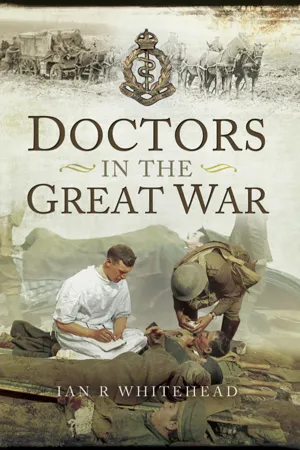
Doctors in the Great War
About this book
Doctors played a bigger role in the First World War than in any other previous conflict. This reflected not only the War's unprecedented scale but a growing recognition of the need for proper medical cover. The RAMC had to be expanded to meet the needs of Britain's citizen army. As a result by 1918 some 13,000 doctors were on active service over half the nation's doctors.Strangely, historians have largely neglected the work of doctors during the War. Doctors in the Great War brings to light the thoughts and motivations of doctors who served in 1914-1918, by drawing on a wealth of personal experience documentation, as well as official military sources and the medical press. The author examines the impact of the War upon the medical profession and the Army. He looks at the contribution of medical students, and the extent to which new professional opportunities became available to women doctors.An insight into the breadth of responsibilities undertaken by Medical Officers is given through analysis of the work of various medical units on the Western Front, demonstrating the important role played by doctors in the maintenance of the Army's physical and mental well-being. The differences between civilian and military medicine are discussed with a consideration of the arrangements for the training of doctors, and an assessment of the difficulties faced by doctors in adapting to military priorities and dealing with new challenges such as gas poisoning, infected wounds and shell shock.Doctors in the Great War will undoubtedly appeal to general readers, students and specialists in the history of war and society, as well as to those with an interest in the medical profession.As featured in the Derby Telegraph, Dover Express and Kent & Sussex Courier
Information
Chapter 1
Doctors and the Army, 1854–1914: The Struggle for Recognition
The creation of the RAMC in 1898 marked a significant victory for the BMA in its fight to establish an efficient Army Medical Service, and to secure proper military status for army doctors. This chapter sets out to examine, briefly, the events that led to the formation of the RAMC, and its development thereafter, with a view to establishing the position of the medical service on the eve of the First World War.
It was the dismal performance of the medical arrangements during the Crimean War that had first awakened the BMA’s1 interest in army medical reform. The Army went to war in 1854 without a unified medical service, its personnel being divided horizontally. Each regiment had a surgeon, with an assistant, ranking respectively as Surgeon-Captain and Surgeon-Lieutenant. But there was also the Army Medical Department, the staff of which comprised a Director-General, four Inspectors-General, eleven Deputy-Inspectors and 163 officer-surgeons, distributed in garrisons worldwide.2 The general readiness of the medical services for war left much to be desired. During the long interval of peace between the final victory over Napoleon’s forces in 1815 and the outbreak of war in 1854, cuts in military expenditure had severely weakened the medical service. With the abolition of the Royal Wagon Train,3 what little provision for ambulance transport that had existed was lost; whilst many of the lessons learnt regarding the treatment of wounds in battle were forgotten. Moreover, there had been no progress towards the establishment of a single body to administer the army hospitals; control was still divided between the Army Medical Department and the Purveyor’s Department.4
However, the central weakness of the service was the lack of authority and low status accorded to the Regimental Medical Officers. They had no direct control over the regimental troops and were without a support staff to collect the wounded and carry out orderly and nursing duties. An attempt was made to meet this latter deficiency through the formation of the Hospital Conveyance Corps, but, untrained, it proved a very ineffective solution.5 In any case, the Medical Officers had no authority over the Conveyance Corps, and so their position was no better than under the existing arrangements whereby the regiments detailed men for nursing and orderly duty.6
The lack of authority conferred on Medical Officers was an expression of the prejudice against them which was widespread in military circles. They were not regarded as fellow officers, but merely as ‘camp followers’; some regiments did not allow the Medical Officers to dine with the other officers in the mess, whilst the Medical Officer, no matter how long he had served was always subordinate to the most junior subaltern. In addition to social ostracism, the medical man also faced discrimination with regard to pay and the distribution of honours.
The doctor’s pay was not on a par with that of other officers, and there were also expenses, related to his duties, that he had to meet out of his own pocket.7 Meanwhile, despite the acts of gallantry performed by Medical Officers in the Crimea, military honours had largely been refused them,8 although three surgeons did receive the Victoria Cross (VC).9
The lowly status of the Medical Officer was damaging in two respects. On the one hand, his lack of authority added to the inefficiency of the medical arrangements hampered any attempts he might make to improve the lot of the sick and wounded. On the other hand, it undermined morale within the service, and further discouraged young medical men from joining a service which was considered by the profession at large to have been passed over by the improvements in medical knowledge and practice.10
The inevitable result of this combination of administrative inefficiency and the impotence of the Medical Officers was a high incidence of disease during the Crimean campaign, and an organization incapable of responding to the task before it. Utter confusion was the result.11 W.H. Russell, The Times correspondent in the Crimea, described the mismanagement of the medical services which could not even supply enough beds for the sick.12 Provision of the most basic medicines and medical stores was also dangerously inadequate.13 But most damning of all was the fact that had proper provision for sanitation been made, much of the disease that was destroying the British Army could easily have been avoided.
The Sanitary Commission, despatched to the Crimea in 1855, documented the sanitary defects of the Barrack Hospital, Scutari. The water supply was found to be contaminated; there were no covers for privies, and no means of flushing them. A sea of filth and wards filled with poisonous gases were the results of an overloaded sewage system. The Commissioners took in hand the cleaning up of the hospital, with positive results as regards the incidence of disease,14 but the knowledge that so much disease could easily have been avoided fuelled growing public concern15 regarding the performance of the military medical service.
Not for the last time, attempts were made to blame the Medical Officers themselves for the inadequacies of the AMS; accusations of army doctors neglecting their duty were carried in many of the daily newspapers. An enquiry held at Raglan’s16 headquarters, in the Crimea, seemed to authenticate such press claims.17 The Association Medical Journal18 sprang to the defence of the military doctors, blaming the hidebound Army Medical Department for the fact that little opportunity had been afforded Medical Officers to gain hospital experience during peacetime. It criticized the Army’s reluctance to augment the ranks of the AMS with more experienced civil practitioners. Moreover, it was quite clear from Russell’s reports that the devotion to duty of the Medical Officers was not in question; the problem was that there were too few of them to cope with the heavy load of work.19
Continued pressure from the BMA, and Florence Nightingale’s crusading efforts on the issue of army sanitary reform, led to the appointment in 1857 of a Royal Commission, headed by Sidney Herbert. Its report a year later made several recommendations which were intended to ensure that the importance of sanitary science was recognized. It stressed the need for Medical Officers to be armed with sufficient knowledge and authority to enable them to take measures against preventable diseases, and so avoid a recurrence of the large-scale and unnecessary losses that had blighted the Army’s performance during the Crimean campaign.20
Its recommendations on improving the status of Medical Officers were embodied in the Warrant of 1858 which granted them increased pay and equality of rank with the regimental officers. Although the position of the military doctor was still not perfect,21 the Warrant was nevertheless looked upon as a significant step upwards for the military branch of the medical profession.
Other important advances resulting from the Report were the foundation of the new military hospital at Netley and the establishment of an Army Medical School.22 At last, opportunities for improving scientific knowledge were being provided. The medical school both allowed for the education and specialist training of Medical Officers, and became a centre for research into military medicine and hygiene; many important discoveries in the field of tropical medicine were to follow.23
There was also the formation of the Army Hospital Corps (AHC), with the intention of providing high-quality personnel to carry out stretcher-bearer, orderly and nursing duties in the regimental, garrison and general hospitals.24 And for the first time they were to be on a level status with the rest of the Army.25
Despite these improvements, however, the medical profession continued to take a disparaging view of army service, and recruitment continued to slide. Part of the reason lay in the fact that regimental officers, resenting the parity of status now enjoyed by Medical Officers, successfully neutralized the effects of the new warrant; a policy of slights and black-balling undermined the status of Medical Officers.26 The War Office ignored the effects of depriving the Medical Officer of the necessary ‘weight of a gentleman amongst gentlemen’27 on his ability to carry out such essential functions as the maintenance of high standards of hygiene. Indeed, the War Office displayed a dangerously complacent attitude towards ensuring that careful sanitary provision could be made by Medical Officers, whilst hostile voices in Parliament were questioning the importance which Herbert’s reforms had accorded to sanitation.28 There was also hostility to the AHC because of the free access it would be allowed to regimental preserves, and this resulted in a whittling down of its powers.29
But, above all, the changes...
Table of contents
- Cover
- Title Page
- Copyright
- Contents
- Acknowledgements
- List of abbreviations
- List of appendices
- Introduction
- Chapter 1: Doctors and the Army, 1854–1914: The Struggle for Recognition
- Chapter 2: The Medical Volunteers: The Recruitment of Medical Officers, 1914–1916
- Chapter 3: Medical Practitioners and Compulsory Service, 1916–1918
- Chapter 4: Medical Students and Military Service
- Chapter 5: Medical Women and War Service
- Chapter 6: RAMC Administration on the Western Front
- Chapter 7: Doctors and Military Medicine: The Training of Medical Officers
- Chapter 8: The Way of the Wounded: The Medical Officer’s Work from Front to Base
- Chapter 9: The Fight against Disease
- Conclusion
- Appendices
- Bibliography
Trusted by 375,005 students
Access to over 1.5 million titles for a fair monthly price.
Study more efficiently using our study tools.
Frequently asked questions
Yes, you can cancel anytime from the Subscription tab in your account settings on the Perlego website. Your subscription will stay active until the end of your current billing period. Learn how to cancel your subscription
No, books cannot be downloaded as external files, such as PDFs, for use outside of Perlego. However, you can download books within the Perlego app for offline reading on mobile or tablet. Learn how to download books offline
Perlego offers two plans: Essential and Complete
- Essential is ideal for learners and professionals who enjoy exploring a wide range of subjects. Access the Essential Library with 800,000+ trusted titles and best-sellers across business, personal growth, and the humanities. Includes unlimited reading time and Standard Read Aloud voice.
- Complete: Perfect for advanced learners and researchers needing full, unrestricted access. Unlock 1.5M+ books across hundreds of subjects, including academic and specialized titles. The Complete Plan also includes advanced features like Premium Read Aloud and Research Assistant.
We are an online textbook subscription service, where you can get access to an entire online library for less than the price of a single book per month. With over 1.5 million books across 990+ topics, we’ve got you covered! Learn about our mission
Look out for the read-aloud symbol on your next book to see if you can listen to it. The read-aloud tool reads text aloud for you, highlighting the text as it is being read. You can pause it, speed it up and slow it down. Learn more about Read Aloud
Yes! You can use the Perlego app on both iOS and Android devices to read anytime, anywhere — even offline. Perfect for commutes or when you’re on the go.
Please note we cannot support devices running on iOS 13 and Android 7 or earlier. Learn more about using the app
Please note we cannot support devices running on iOS 13 and Android 7 or earlier. Learn more about using the app
Yes, you can access Doctors in the Great War by Ian R. Whitehead in PDF and/or ePUB format, as well as other popular books in History & Military Biographies. We have over 1.5 million books available in our catalogue for you to explore.