- 224 pages
- English
- ePUB (mobile friendly)
- Available on iOS & Android
eBook - ePub
About this book
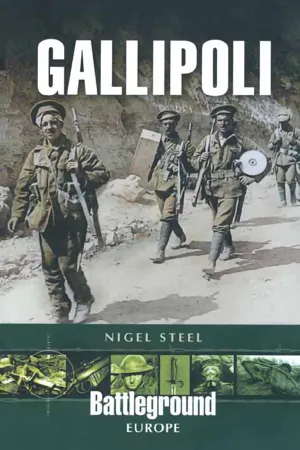
Gallipoli tells of the disastrous campaign at Gallipoli in 1915 when the allies failed to knock Turkey out of the war. With then and now photographs the book provides detailed historical descriptions of the area and the events, all of which will appeal to the armchair historian and the intrepid visitor to the sites. It will prove an indispensable companion.
Information
CONTENTS
Introduction by Series Editor
Acknowledgements
Author’s Introduction
Chapter 1 The Landings, 25 April
Chapter 2 Helles
S Beach
V Beach
Sedd el Bahr
The Helles Memorial
W Beach
X Beach
Chapter 3 The Northern Limits
The Helles Plain
The Krithia Road
Gully Ravine
The West Krithia Road
Chapter 4 Anzac Cove, April to August
Anzac Cove to Plugge’s Plateau
Russell’s Top to Baby 700
Pope’s Hill to Steele’s Post
Monash Gully to Lone Pine
Chapter 5 The August Offensive
Chapter 6 The Assault On Sari Bair
Baby 700 to Chunuk Bair
Reserve Gully to the Aghyl Dere
Chapter 7 The Landing At Sulva Bay
Lala Baba to Ghazi Baba
The Kiretch Tepe Sirt to Yilghin Burnu
Chapter 8 Hill 60
Afterword
References
Bibliography
Index
INTRODUCTION BY
SERIES EDITOR
It has been a long time coming, but it is a real pleasure to be able to write an introduction to this book, a completely revised and updated version of Nigel Steel’s earlier book. The Battlefields of Gallipoli – Then and Now. It is anticipated that this will be the first of a number of guides on that ill-fated expedition’s battlefield; it sets the scene for the heroism and stoic endurance that stretched through the spring, summer, autumn and early days of winter 1915.
The writing shows a profound knowledge of the campaign, of the battles and of the ground today, accompanied with a love of the landscape and a considerable empathy with those who were there. Alas, it is soon coming to the time when there will be no veterans of the campaign alive; books like this are all the more important as they attempt to explain what happened on the ground. And it is best if those who were there are allowed to speak for themselves, and Nigel Steel here makes good use of the various oral and documentary records that survive. History can become a plaything of societies and propagandists, so that we have come to a situation in which most people think this was an Australian campaign. Most certainly it was vitally important to that nation’s development and it helped to bring it out onto the world stage. But this has overshadowed the contribution of others, notably the Newfoundlanders, the New Zealanders and the British (and, indeed, the Irish) – and, perhaps, above all, the French.

Turkish prisoners of war being led down from the line by British troops in Gully Ravine. (Q15337)
Nigel Steel’s route through Gallipoli is in many ways a highly personal one – his descriptions of what can be seen come quite definitely from his heart. The narrative of events is cogent and well explained, put carefully into the context of the ground and of that most redoubtable and tenacious of foes, the Turk. By the time that the reader has finished the book – even if he or she has not been to this sad but beautiful place – the impact of the tragedy of Gallipoli will be that much clearer. I do not think that a military historian can be asked to achieve more.
Nigel Cave,
Ely Place, London
ACKNOWLEDGEMENTS
Since The Battlefields of Gallipoli – Then and Now was first published by Leo Cooper in 1990 I have been helped by a great many people and I am concerned that I have forgotten to include some of them here. I hope they will forgive me. As my debt to those who assisted me in the years between 1985 and 1990 remains undiminished, I felt it best to incorporate these new names into my original list and so with these additions it is reproduced again here.
Beginning with the formal acknowledgements, most of the contemporary material has been taken from the archive collections held in the Imperial War Museum. Principally the old photographs in this book have been taken from the Photograph Archive and much of the unpublished written material from the Department of Documents and I am grateful to the Keepers of those Departments, the Assistant Director, Collections and to the Trustees of the Museum for their help and permission to reproduce them here. The negative numbers of each IWM photograph is included after the appropriate caption. I would also like to thank the copyright holders of the collections of private papers listed in the bibliography for their permission to include quotations in the text. In addition, I consulted the Papers of General Sir Ian Hamilton at the Liddell Hart Centre for Military Archives, King’s College London and I am grateful to the Trustees of the Liddell Hart Centre for allowing me access to the papers and for their permission to include quotations in the book. I would also like to thank Sir Ian’s literary executors. Finally I am grateful to the following for allowing me to use material I have recorded with them: the late Joe Guthrie; the late Lieutenant Colonel M E Hancock; the late Ivor Powell; and the late William Wright. I would also like to thank the Keeper of the Sound Archive for her permission to use extracts from the IWM interviews with Colonel Hancock and Major G B Horridge. All books from which quotations have been taken are listed in the bibliography at the end and I would like to acknowledge the permission of their publishers to include extracts from them here. The maps drawn for the book have all been based on official maps printed at the time of the campaign or as part of the Official Histories published after the end of the war and I am grateful to HMSO for permission to reproduce adapted versions of these maps.
On a more personal note, I would like to thank again the three Gallipoli veterans to whom the book is dedicated: Malcolm Hancock, Ivor Powell and William Wright, and also the following who have helped at various times during the writing of this book: the President and Fellows of Corpus Christi College, Oxford; also from Oxford University the boards of the English and History Faculties; my grandfather, parents and wife’s parents; all of my colleagues with whom I have worked in the Department of Documents over the past ten years but particularly Rod, Phil, Simon, Stephen, Penny, Tony, Dave, Wendy, and in various other departments at the IWM: Greg Smith, Richard Bayford, Colin Bruce, Mike Hibberd, Paul Cornish, Neil Young, Bryn Hammond, Rosaleen King, Judy Newland, the ever obedient Peter Hart and my para-colleague Malcolm Brown; Professor Sir Michael Howard; Dr Mike Weaver; Dr Rhodri Williams; David Richardson, Volkan Susluoglu and Philip Noakes of the CWGC; Dr Mete Tunçoku; Tolga Ornek, Kemal Gokakin, Oktay Gokakin, all the members of their film crew, Ekrem Boz and Izzet Yilderim without all of whose help and kindness in April 1998 the revisions would not have been possible; Stewart Gamble; Leo Cooper, Tom Hartman, Charles Hewitt, and Roni Wilkinson; Tom Bader; Harry Musselwhite who, probably without realizing it, set me off on the path to Gallipoli; David Evans; our two good friends who roamed with us over the Peninsula in July, 1987, Bob and Jacqui Ridge-Stearn; and my wife Marion. I consider myself fortunate indeed as, without her companionship, critical judgement and unstinting support, I would never have done any of this, and it was for her that I began it in order to discover how and why her great-uncle, Corporal Harry Allen, was killed above Gully Ravine on 28 June, 1915.
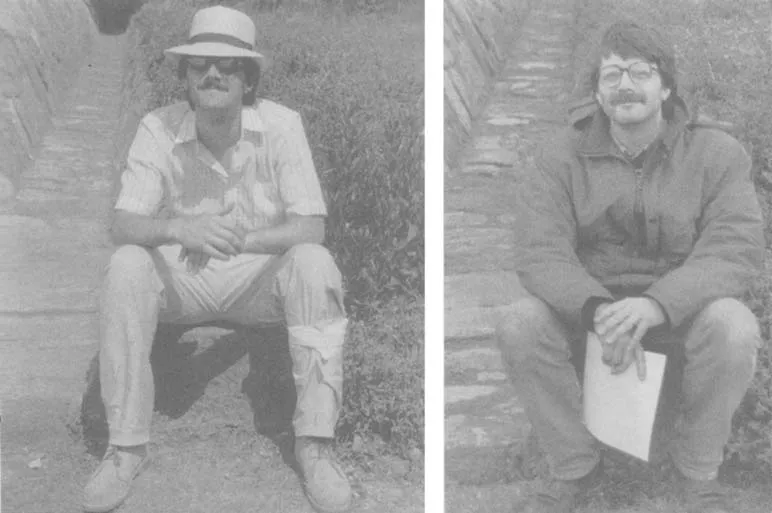
The author – then and now! (1988/1998)
INTRODUCTION
For seventy years after the end of the fierce fighting that took place there, Gallipoli remained an exquisitely beautiful place. Enveloped by an air of tragic loneliness, the battlefields seemed overwhelmingly sad. Writing in 1956 Alan Moorehead, the first modern historian of the campaign, observed that,
The cemeteries at Gallipoli are unlike those of any other battlefield in Europe…. In winter moss and grass cover the ground, and in summer a thick carpet of pine needles deadens the footfall. There is no sound except for the wind in the trees and the calls of the migrating birds who have found these places the safest sanctuary on the peninsula…. Often for months at a time nothing of any consequence happens, lizards scuttle about the tombstones in the sunshine and time goes by in an endless dream.1
Yet beneath this pervasive aura of pathos the striking magnificence of the countryside continued to shine through like sunshine piercing a cloud after a summer storm. Communication was difficult and security tight. The Dardanelles, both its shorelines and the whole of the surrounding area, remained firmly within the grip of the Turkish military authorities. There were few visitors and little to disturb the tranquil isolation of the landscape.
Beginning in around 1985 things began to change. New metalled roads started to appear. At first they linked the villages that were spread across the south-western half of the peninsula. But gradually the network was extended further into the hinterland, reaching out to formerly inaccessible points that no-one had been able to visit regularly since 1915. Houses were also built, particularly across the open bowl above V Beach at Cape Helles and the attractive strip of coastline running south from Suvla Bay. Retrospective memorials, bigger and m...
Table of contents
- Cover
- Half Title
- Title Page
- Copyright
- Contents
Trusted by 375,005 students
Access to over 1.5 million titles for a fair monthly price.
Study more efficiently using our study tools.
Frequently asked questions
Yes, you can cancel anytime from the Subscription tab in your account settings on the Perlego website. Your subscription will stay active until the end of your current billing period. Learn how to cancel your subscription
No, books cannot be downloaded as external files, such as PDFs, for use outside of Perlego. However, you can download books within the Perlego app for offline reading on mobile or tablet. Learn how to download books offline
Perlego offers two plans: Essential and Complete
- Essential is ideal for learners and professionals who enjoy exploring a wide range of subjects. Access the Essential Library with 800,000+ trusted titles and best-sellers across business, personal growth, and the humanities. Includes unlimited reading time and Standard Read Aloud voice.
- Complete: Perfect for advanced learners and researchers needing full, unrestricted access. Unlock 1.5M+ books across hundreds of subjects, including academic and specialized titles. The Complete Plan also includes advanced features like Premium Read Aloud and Research Assistant.
We are an online textbook subscription service, where you can get access to an entire online library for less than the price of a single book per month. With over 1.5 million books across 990+ topics, we’ve got you covered! Learn about our mission
Look out for the read-aloud symbol on your next book to see if you can listen to it. The read-aloud tool reads text aloud for you, highlighting the text as it is being read. You can pause it, speed it up and slow it down. Learn more about Read Aloud
Yes! You can use the Perlego app on both iOS and Android devices to read anytime, anywhere — even offline. Perfect for commutes or when you’re on the go.
Please note we cannot support devices running on iOS 13 and Android 7 or earlier. Learn more about using the app
Please note we cannot support devices running on iOS 13 and Android 7 or earlier. Learn more about using the app
Yes, you can access Gallipoli by Nigel Steel in PDF and/or ePUB format, as well as other popular books in History & Middle Eastern History. We have over 1.5 million books available in our catalogue for you to explore.