- 216 pages
- English
- ePUB (mobile friendly)
- Available on iOS & Android
eBook - ePub
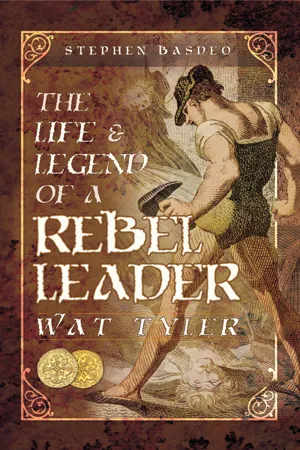
The Life & Legend of a Rebel Leader: Wat Tyler
About this book
In 1381, England was on the brink - the poor suffered the effects of war, the Black Death, and Poll Tax. At this time the brave Wat Tyler arose to lead the commoners, forming an army who set off to London to meet with King Richard II and present him with a list of grievances and demands for redress. Tyler was treacherously struck down by the Lord Mayor. His head hacked from his shoulders, pierced on a spike, and made a spectacle on London Bridge. Yet he lived on through the succeeding centuries as a radical figure, the hero of English Reformers, Revolutionaries, and Chartists.The Life and Legend of a Rebel Leader: Wat Tyler examines the eponymous hero's literary afterlives. Unlike other medieval heroes such as King Arthur or King Alfred, whose post medieval manifestations were supposed to inspire pride in the English past, if Wat Tyler's name was invoked by the people, the authorities had something to fear.
Information
CHAPTER ONE
The Great Revolt
A great and unexpected calamity not experienced by previous ages.
Thomas Walsingham
They rose and came towards London, to the number of sixty thousand; and they had a captain called Walter Tyler, and with him in company was Jack Straw and John Ball; these three were chief sovereign captains, but the head of all was Walter Tyler; he was indeed a tiler of houses, a man ungracious to his betters.
Jean Froissart
Most of what historians know about the Great Revolt of 1381 comes from chronicles written by men such as Thomas Walsingham, Jean Froissart, Henry Knighton, and an anonymously written source entitled Anonimalle Chronicle. None of them are overly sympathetic towards the rebels. The revolt is described by Walsingham as ‘a great and unexpected calamity not experienced by previous ages’.1 There had of course been rebellions in England before this date. In the immediate aftermath of the Norman Conquest in 1066, for instance, there had been groups of people particularly in the north of England who had risen up in order to overthrow the Norman oppressors. The so-called Peasants’ Revolt, however, was different. It was not the discontented murmurings of disorganised peasants. They had leaders, they were well-organised and armed. Indeed, it was not simply a peasants’ revolt so much as a people’s revolt. The rebels were drawn from a range of social classes.
Although Walsingham says that it was ‘a great and unexpected calamity’, the seeds of the rebellion were being sown earlier in the century. One of the long-term factors contributing to the outbreak of the Great Revolt was disease. The Black Death had ravaged Europe between 1348 and 1353. It was a nasty disease with a mortality rate of fifty per cent, in which the victim suffered swellings, known as buboes, on the neck, thighs, groins, and in the armpits, along with high fevers, until the poor patient died after a week. A more severe variant of the plague, known as pneumonic plague, attacked the lungs, with ninety per cent of patients dying within three days. Contemporaries believed that the plague was a punishment from God. Other people assumed that it was caused by bad air. Modern historians and scientists have surmised that it was a form of Yersinia pestis, carried on ships from the Orient. In total, the Black Death is assumed to have killed approximately sixty per cent of the European population during the fourteenth century.
While undoubtedly horrific for its victims, one of the consequences of the high mortality rate was that people from lower down the social scale became aware of their own importance. Some free labourers could now demand higher wages from the lords. Additionally, English society in the fourteenth century was a feudal society. Other labourers, known as villeins, or serfs, were tied to the soil and obliged to work for the nobles essentially for free. They saw the benefits that the free labourers were enjoying and desired to share in the emerging economic and social blessings that free men were enjoying. Consequently, some of the serfs began to demand a wage for the work that they carried out for their lords as well. The government was well aware of the situation as regards to wages and sought to control them. At the height of the plague, Parliament under Edward III (1312-77) passed the Statute of Labourers in 1351 which obliged all labourers to work only for the same amounts that they could command before the pestilence struck. The Act was enforced successfully in some areas, and undoubtedly contributed to discontent among the lower orders, which would eventually spill out into open revolt. As R.B. Dobson notes, ‘it can be no coincidence that the risings [of 1381] tended to be most violent in those counties where it is known the labour laws were strictly enforced.’2 The Black Death did not cause the Great Revolt, but it did bring to the fore certain grievances which, combined with other factors, made for an explosive combination.3
Another factor which contributed to the revolt, and one which led to the imposition of the hated poll tax, was the high cost of England’s military adventures abroad. This was the period of the Hundred Years War (1337-1453). While the war would witness some decisive and, if war can ever be described in such terms, ‘glorious’ English victories in the fifteenth century, during the 1370s and 1380s the war was going badly for England. In 1372, for example, the naval Battle of La Rochelle resulted in a French victory, which effectively brought English naval supremacy to an end.4 Indeed, the entire war at this point is described by one historian as having been ‘ill-managed and expensive’.5 It was so expensive that Parliament in 1377 authorised the first poll tax of four pence per head. At this point, Edward III was still on the throne. He had been a brave and strong king in his youth, and a competent war leader, but by the 1370s old age and infirmity had set in. His son, Edward, the Black Prince, was due to succeed him but he died in 1376. The King’s only remaining heir was his young grandson, Richard. In 1377, Edward died and the throne passed to the 10-year-old Richard who was crowned on 16 July 1377. In light of his youth, Parliament decided that a regency should be established. However, they made sure to exclude Richard’s uncle, John of Gaunt (1340-99), from having any official role in advising the King. Gaunt was disliked by a large section of both the elites and the people at large. He was the richest man in England and often flaunted his wealth, and had he wanted to, he certainly had the military backing behind him to seize the throne for himself. Yet he did not, which must give pause for thought before we take the words of Walsingham at face value, who declares in his writings that Gaunt was a man who was motivated by ‘unbridled malice and greed’.6 Despite having no official role in the government he still had a lot of influence, and both the people and many members of the elites laid the blame for the nation’s military woes and financial ills at his feet. Indeed, it was Gaunt who was one of the main instigators of the poll tax of 1377. While Walsingham’s comments regarding Gaunt at this point seem quite bitter (his views towards Gaunt did change somewhat over the course of time), Antonia Gransden remarks that ‘there is no reason to suppose that this part of his chronicle is not a fairly accurate reflection of the views of many of his contemporaries.’7 Indeed, when the common people did revolt in 1381, some of them declared that ‘they would be faithful to King Richard and the Commons and that they would accept no King who was called John.’8
The original poll tax levied could not meet the needs of the state, and Parliament granted a fresh poll tax in 1379. Although the first two taxes did not elicit any forcible resistance, there was, understandably, considerable and growing discontent among the populace against this measure. Interestingly, one man, a poet named John Gower (c.1330-1408), around the time of the first poll tax in 1377, predicted that the people might rise up due to the growing unhappiness which he observed in the country. In his lengthy poem, Mirour de l’omme, Gower warns the ruling classes to be on their guard because if the commoners do rise up, ‘they will not be stopped, by either reason or discipline.’9 The commons’ disaffection was no doubt fuelled in some areas of the country by the lay preacher, John Balle (c.1329-81) (hereafter named John Ball for consistency, as this is the way that it is spelt in later works that are cited in this book). Unlike the lazy priest, Sloth, seen in William Langland’s The Vision of Piers Plowman (c.1377), John Ball was a man whose ideology followed ‘in the long tradition of Christian social radicalism which goes back to St. Ambrose of Milan, if not before’.10 He gave a radical voice to the dire economic and social situation of the commons, highlighting the difference between the ‘haves’ and ‘have-nots’ of medieval society.11 More importantly, John Ball preached equality and common ownership of property. This was revolutionary stuff, especially in a society which, for the most part, believed that people fitted into divinely-ordained estates. There has been some speculation by historians in the past that John Ball was an associate of John Wycliffe (c.1320-84) and his followers the Lollards. Designated as ‘The Morning Star of the Reformation’ by some nineteenth-century historians, Wycliffe was an early religious reformer who rejected many standard Church practices, such as the sale of indulgences and the practice of private confession. At this time, furthermore, the Church forbade the translation of the Bible into any tongue but Latin, even though the scriptures themselves were originally written in Aramaic and Greek. But Wycliffe believed that all people should be able to read the word of God. Thus he set about translating the Bible into English.12 This injunction, however, did not preclude preachers from translating the Bible into the vernacular when reading aloud to their congregations. The only source which connects John Ball and John Wycliffe is a confession, supposedly written by Ball shortly before his death, but which scholars today agree is of dubious authenticity.13
John Ball appears to have been a constant irritation to the authorities in southern England. King Edward had withdrawn his protection from John Ball in 1364 for ‘not prosecuting any business but wanders from country to country preaching articles of faith contrary to the faith of the church to the peril of his soul and the souls of others, especially of laymen’.14 It was during this period, as Hilton points out, that Ball was first arrested and imprisoned for spreading his radical message.15 He was soon set at liberty again, however, and Walsingham records that he continued preaching for around twenty years. In April 1381, the Archbishop of Canterbury, Simon Sudbury (1317-81), had decided that enough was enough, and he had Ball arrested and thrown into Maidstone gaol.
Costly military expeditions in France were still eating into the nation’s finances. For example, while the graduated tax of 1379 earned £22,000 for the government, the cost of an ill-fated campaign in Breton had cost the government £50,000.16 The then-Chancellor, Lord Richard Scropes (c.1327-1403), was replaced with Sudbury. It was Sudbury who proposed a fresh poll tax of three groats per head in 1380, which was granted by Parliament in November. Three groats was equal to twelve pennies, or a shilling. This new tax, therefore like the others, disproportionately hit the pockets of the poor. Richard Scropes’ salary was six hundred pounds per year, and the tax would have meant nothing to him.17 In contrast, the average wage for an unskilled labouring man around the year 1380 was three pence per day.18 The work of collecting the tax started in December, but the government was aware that there was a great deal of tax evasion being committed. Consequently, in March 1381, new measures were put in place to deal with t...
Table of contents
- Cover
- Dedication
- Title
- Copyright
- Contents
- List of Illustrations
- Preface
- Chapter One: The Great Revolt
- Chapter Two: The Early Modern Period
- Chapter Three: The Eighteenth Century
- Chapter Four: Romanticism and Revolution
- Chapter Five: Radicalism and Chartism
- Chapter Six: The Nineteenth-Century Historical Novel
- Chapter Seven: ‘Let’s Finish the Job!’
- Appendix: Wat Tyler Poems, Songs, and Ballads
- Bibliography
- Plate section
Trusted by 375,005 students
Access to over 1.5 million titles for a fair monthly price.
Study more efficiently using our study tools.
Frequently asked questions
Yes, you can cancel anytime from the Subscription tab in your account settings on the Perlego website. Your subscription will stay active until the end of your current billing period. Learn how to cancel your subscription
No, books cannot be downloaded as external files, such as PDFs, for use outside of Perlego. However, you can download books within the Perlego app for offline reading on mobile or tablet. Learn how to download books offline
Perlego offers two plans: Essential and Complete
- Essential is ideal for learners and professionals who enjoy exploring a wide range of subjects. Access the Essential Library with 800,000+ trusted titles and best-sellers across business, personal growth, and the humanities. Includes unlimited reading time and Standard Read Aloud voice.
- Complete: Perfect for advanced learners and researchers needing full, unrestricted access. Unlock 1.5M+ books across hundreds of subjects, including academic and specialized titles. The Complete Plan also includes advanced features like Premium Read Aloud and Research Assistant.
We are an online textbook subscription service, where you can get access to an entire online library for less than the price of a single book per month. With over 1.5 million books across 990+ topics, we’ve got you covered! Learn about our mission
Look out for the read-aloud symbol on your next book to see if you can listen to it. The read-aloud tool reads text aloud for you, highlighting the text as it is being read. You can pause it, speed it up and slow it down. Learn more about Read Aloud
Yes! You can use the Perlego app on both iOS and Android devices to read anytime, anywhere — even offline. Perfect for commutes or when you’re on the go.
Please note we cannot support devices running on iOS 13 and Android 7 or earlier. Learn more about using the app
Please note we cannot support devices running on iOS 13 and Android 7 or earlier. Learn more about using the app
Yes, you can access The Life & Legend of a Rebel Leader: Wat Tyler by Stephen Basdeo in PDF and/or ePUB format, as well as other popular books in History & Military Biographies. We have over 1.5 million books available in our catalogue for you to explore.