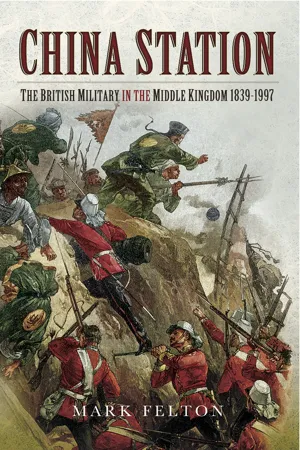
A revelatory history of how Britain's military shaped China's culture and politics for more than a century.
Historian Mark Felton demonstrates that the British military has been at the forefront of many of the great changes that have swept China over the last two centuries, citing the various wars, military adventures and rebellions that regularly punctuated Sino/British relationships since the First Opium War 1839-1842. This classic example of Imperial intervention saw the establishment of Hong Kong and Shanghai as key trading centers. The Second Opium War and the Taiping and Boxer Rebellions saw the advancement of British influence despite determined but unsuccessful efforts by the Chinese to loosen the grip of Western domination.
The Royal Navy might have ensured that, by gunboat diplomacy, trading rights and new posts were established and great fortunes made. But in the 1940s the British grossly underestimated Japanese military might and intentions with disastrous results. After the Second World War the British returned to find that the Americans had supplanted them. The Communist victory in the Civil War sealed British and Western fates and, while Hong Kong remained under British control until 1997, the end of British rule was almost inevitable. But the handover was a masterly piece of pragmatic capitalism and the former Colony remains an economic powerhouse with strong British influence.
- 224 pages
- English
- ePUB (mobile friendly)
- Available on iOS & Android
eBook - ePub
About this book
Information
Chapter 1
Foreign Mud
If you will not surrender, we shall be obliged to use warlike measures for obtaining possession.
Commodore Sir James Bremer,
Chusan Islands, China, 1840
Chusan Islands, China, 1840
The first shots in Britain’s most infamous conflict, the First Opium War, were not fired by a British warship at the Chinese but somewhat ironically by the Royal Navy warship at a British merchant vessel. On 27 October 1839 a British merchant ship named Royal Saxon attempted to run a Royal Navy blockade into what was then Britain’s biggest trading post in China, Canton, located nearly a hundred miles up the Pearl River in the south of the country. HMS Volage, a fully rigged frigate, fired a warning shot across Royal Saxon’s bows, a shot that was to bring out a large Chinese fleet under orders to protect the British merchantman. That this confused situation even occurred had its roots in a pernicious drug that the British were then in the process of foisting upon the Chinese literally by the ton. The British government, in a move of breathtaking immorality, launched the nation into a war against China to protect ruthless drug traffickers and in so doing ushered in over a hundred years of British military activity in China and dragged China unwillingly from feudalism into the modern world.
The Opium Wars are generally agreed by historians to have been one of the less proud chapters in the history of Britain’s ascent to world hegemony. For the first and only time in history one nation used narcotics to dominate another, and for good reason today the Opium Wars are remembered in China as a national humiliation. Although morally difficult to justify, Britain’s success in the First Opium War would eventually lead to China becoming a modern power in her own right, and it can be argued that China’s prosperity today has its roots in its forcible opening to the world economic system in the 1840s, forced by the sort of gunboat diplomacy that the British used so successfully to usher in the first globalisation of trade and finance.
Although Britain’s relationship with China had always been firmly rooted in trade and profit, it actually began quite differently. China, a vast underdeveloped empire and the oldest nation-state on earth with its teeming hundreds of millions, and self-satisfied contempt for all things ‘foreign’, was about to collide with a grasping, heavily-armed and belligerent nation of free-trading buccaneers busily adding ports and territories to its ever expanding empire with a determination unmatched even by the Romans.
The first ship from the British Isles had visited the south China coast in 1635. They were relative latecomers, for the Portuguese had already established a small colony at Macau a century before. Soon there were British traders in small communities at Zhoushan and Xiamen, but the most important trading town was Canton (now Guangzhou) at the mouth of the mighty Pearl River. A city of over a million souls, it was ringed, as was the Chinese style, by a massive town wall to protect it from the depredations of pirates and was at the time one of the largest cities in the world.
Between 1700 and 1842 Canton dominated the China trade, and it was the British who quickly became the masters of that trade. The British and other foreigners traded in China with the permission of the seldom seen divine emperor in Peking (now Beijing), under Chinese laws and at the behest of Chinese officials known collectively as mandarins. The ruling Qing dynasty, themselves foreigners from Manchuria who had seized power from the elegant Ming Dynasty in 1644, held an ambivalent attitude towards overseas trade and a Confucian disdain for merchants and traders. Chinese officials believed that trade incited unrest and disorder in the empire, caused piracy and compromised the nation’s defences. In the case of the British they were to be proved right on all of these scores. The Chinese were not particularly interested in foreign manufactures and technologies, seeing no practical use for them, and they erected high tariffs and created rigid laws governing such imports, also inadvertently fostering widespread corruption among junior officials and provincial governors.
The Chinese trading system with foreigners had operated for centuries on an elaborate system of tribute. The Chinese emperor was ‘The Son of Heaven’, mandated ruler of the entire Earth, so all foreign rulers were expected to present tribute to him and acknowledge his superiority. Western nations were happy to play along, as the emperor’s gifts, in order to demonstrate his munificence, were superior to the tribute given, and the emperor bestowed titles upon foreign emissaries and permitted them to trade. Trade for the foreigners was always lucrative but by the early nineteenth century European traders demanded more access to Chinese markets as their trade and wealth grew. At this juncture the emperor tried to turn back the clock, with disastrous results. The history of China in the mid- to late-nineteenth century is of successive leaders trying vainly to close the door to the foreigners, but finding that their former guests were not averse to kicking in the door to get what they wanted.
The Honourable East India Company, ‘John Company’, carried out British Far East trade under royal charter. It was a vast firm with a huge private army and navy that had conquered and administered great swathes of India. There was low demand among the Chinese for European goods but huge demand in Europe for Chinese tea, silk and porcelain. The problem for the Europeans was the Chinese demand to be paid in hard currency – and the only currency that they accepted was silver. The figures were astounding. For example, from the mid-sixteenth to the mid-nineteenth centuries the Chinese received 28 million kilograms of silver from Europe and America. The British especially did not like this arrangement because since the mid-eighteenth century they had used the gold standard, and in order to obtain the required silver they were forced to purchase it from other European nations and Mexico, thereby incurring fees that lowered their profits.
The East India Company first imported small quantities of the Indian narcotic opium, derisively called ‘foreign mud’ by the Chinese, following the annexation of Bengal by Robert Clive in 1757. The Company needed a product that they could trade with the Chinese in return for tea. Initially they tried European clothes, but the Chinese preferred homespun silk. Then, despite moral objections raised at the time, the British chose to fix the trade imbalance by means of Indian opium. Widespread addiction among all classes of Chinese soon reversed the flow of silver back into British coffers.
The Chinese government banned the importation of opium when they realised the damage the drug was inflicting on their society and perhaps, more importantly, on their silver reserves. The East India Company circumvented the ban by establishing an elaborate trading system using both legal and illegal markets in China. British merchants would buy tea on credit at Canton. They would then buy opium at auction in Calcutta. The chests of opium would be sent on British merchant ships to the China coast, smuggled inland by local Chinese merchants, and the debts would be settled.
Then as now, the profits from drug smuggling were enormous, and the trade boomed. In 1730, the British sold 15 tons of opium in China, by 1773 this figure was up to 75 tons, by the 1820s it had reached 900 tons annually. At the same time the British government attempted to persuade the emperor to ease the ban on opium imports in return for certain concessions. In 1793 Earl Macartney was granted an audience with the Qianlong Emperor in the yellow-roofed Forbidden City, but he was soon politely shown the door. In 1799 and 1810 the emperor issued imperial edicts forbidding opium importation or smoking. But because of endemic corruption, the emperor was unable to effectively govern his southern provinces and between 1821 and 1837 there was a five-fold increase in opium sales in China, vastly increasing British traders’ power over the region and its population.
The turning point came in 1834 when free trade reform in Britain ended the East India Company’s monopoly in the Far East, ushering in hundreds of piratical and independent operators and freebooters. The Americans also began importing cheaper lower quality Turkish opium into China.
In 1839 the 56-year-old Daoguang Emperor, who had reigned for nineteen years, appointed a Manchu nobleman named Lin Zexu as Governor of Canton with orders to stop the opium trade. Commissioner Lin banned the sale of opium, ordered all opium stocks to be surrendered and destroyed, and required foreign traders to sign a ‘no opium bond’ before they could moor their ships in the city. Any foreigner found with opium in his holds was to be put to death. Lin also closed the sea channel into Canton up a myriad of tributaries and creeks off the Pearl River, in effect holding the city’s British traders hostage.
The man who was responsible for opening up China to foreign trade, at the point of a gun, was 37-year-old Royal Navy Captain Charles Elliot, British Superintendent of Trade. Elliot had joined the navy in 1815 and had served in the East and West Indies and West Africa before being sent to Canton in 1833. Importantly, he was firmly and vocally against the opium trade, though he followed his orders to the letter. Elliot held a meeting with the angry British traders. He managed to persuade them to hand over their opium stocks to Lin, in return for the British government promising to compensate them for their losses. However, the government had no intention of honouring this agreement because it rightly feared a backlash from the British public if it became known that Her Majesty’s Government was protecting drug traffickers. The delighted Chinese commenced burning 20,000 chests of opium (each packed with 55kg of the drug) on 3 June 1839. There was so much ‘foreign mud’ that it took over twenty days to destroy. Lin wrote a ‘memorial’ to Queen Victoria, asking her to stop the opium trade, but this letter never reached Buckingham Palace and was conveniently ignored by the hawkish Foreign Secretary, Viscount Palmerston. The atmosphere all along the Chinese coast was tense during the summer of 1839.
The spark that opened general hostilities between Britain and China was an incident that occurred in the small fishing village of Tsim Sha Tsui (part of today’s Kowloon, Hong Kong) in July 1839. At the end of June the skipper of the British tea clipper Carnatic had been arrested by the Chinese coast guard in Kowloon. On 7 July a large group of British and American sailors, many off the Carnatic, had gone ashore in Kowloon and discovered a supply of locally produced rice wine. Sufficiently liquored up, the mob of sailors had started a small riot in Tsim Sha Tsui, vandalised a local temple and murdered a Chinese man.
At the time, China lacked a jury trial system or evidentiary process. Britons were horrified at the mediaeval punishments that were dispensed by Chinese magistrates. The British government and Commissioner Elliot demanded that British subjects be granted ‘extraterritoriality’ for crimes committed in China, meaning that Britons would be tried by their own consular authorities and not subjected to local justice. Commissioner Lin demanded that the sailors suspected of murder be handed over, but Elliot refused. Instead, a British court in Canton tried them, found them guilty and transported them back to Britain, where they were promptly released.
On the issue of the ‘no opium bond’ that the Chinese demanded all foreign skippers sign, Elliot refused to agree and instead ordered that the British withdraw from Canton and cease trading with the Chinese. In order to enforce this order Elliot ordered two Royal Navy sloops, HMS Volage and Hyacinth, to lie off the Bocca Tigris, a narrow channel that runs between islands in the Pearl River Delta, to prevent British ships reaching Canton. The Chinese called the channel the Humen or ‘Tiger Gate’ and it was well named for the Chinese had fitted the islands with ‘claws’ – multiple forts well supplied with cannon.
Not all of the British were drug smugglers. Some ship owners refused to allow their vessels to carry opium for religious or moral reasons, and they saw no reason why their own profits should be damaged by Elliot’s drastic measures to protect the drug traffickers. These owners and captains even agreed to sign the ‘no opium bond’ that the Chinese authorities demanded.
On 3 November 1839 the Royal Saxon, whose Quaker owners refused to take part in the opium trade, attempted to enter the Bocca Tigris and make her way upriver to Canton. Elliot ordered Captain Henry Smith aboard the Volage to stop the ship. The Volage fired a shot across the Royal Saxon’s bows. Shortly afterwards a small fleet of Chinese war junks and other craft emerged from the mouth of the river under the command of 58-year-old Admiral Guan Tianpei, who was later admiringly described by the British as ‘an altogether fine specimen of a gallant soldier’.1 The Chinese naval commander moved out to protect the Royal Saxon from further illegal interference from the Royal Navy, triggering a full-scale naval battle between Britain and the Celestial Empire.
The Volage and Hyacinth, the latter a 106-foot long 18-gun Favourite-class sloop constructed in 1829, that had previously surveyed the northeast coast of Australia, went line ahead in battle formation and opened tremendous broadsides from starboard on the Chinese vessels. Gun ports stood open as British cannons mouthed great iron balls at the Chinese ships, or loosed off grapeshot that peppered the junks’ sails and crew. The British ships were well armed and manoeuverable and they completely outclassed and outgunned Admiral Guan’s junks.
The Chinese were facing the world’s most technologically advanced and best disciplined navy, its ships officered by men who had fought under Admiral Nelson at Trafalgar or in a myriad other battles and landings from the West Indies to the Mediterranean, from the cold North Sea to the Cape of Good Hope. The Royal Navy bestrode the globe like a massive octopus; its men-of-war, frigates and gunboats protecting the sea-lanes for free trade, inserting military forces like projectiles onto hostile shores when required, and also mapping and exploring from Australia to the Arctic. Chinese naval warfare had scarcely evolved since the fifteenth century. It was the equivalent today of an F-15 supersonic jetfighter going head-to-head with a Sopwith Camel.
Within minutes one Chinese fire raft had sunk and a war junk blew up in a great cloud of fire and black smoke after a British shell tore into its magazine. It was a complete turkey shoot and a shocking display of British naval might. The action took place off Chuenpee Island, which was heavily defended by dug-in Chinese artillery and infantry in small forts and gun emplacements.
After an initial pass with all guns blazing, the two British warships came about and made a second pass firing port broadsides. Massive clouds of gunsmoke obscured the carnage as each deafening broadside did its grim work. Another huge junk blew up, three more sank, their hulls torn to pieces by solid shot, and several others were badly damaged and on fire. What was left of the Chinese fleet wisely retired upriver except for Admiral Guan’s flagship, which bravely remained stationary and continued firing. Realising that the small Chinese guns were ineffective, Captain Elliot ordered Captain Smith to cease firing and Guan’s damaged vessel retreated to safety. There was no honour in continuing to hit an opponent when he was already on the canvas, and the Royal Navy was nothing if not honourable.
HMS Volage had suffered some slight damage to her sails and rigging and the Hyacinth’s mizzenmast had been holed by a Chinese cannon ball. One British sailor was wounded, while fifteen Chinese had been killed and four of their war junks sunk.
The Royal Saxon, the original catalyst of this ugly little battle, brazenly continued on her way to Canton while Elliot withdrew his ships to the nearby Portuguese colony of Macau as he knew that the Chinese would send fire boats down the river. This was the only real threat to the British wooden sailing vessels, tied as they were to the vagaries of wind and tide.
The first round of the First Opium War had decisively gone to Britain. China had revealed itself to be militarily obsolete and fundamentally weak – what some were already calling the ‘sick man of Asia’. Such an easy victory only encouraged the British to press the Chinese further with the eventual goal of securing ports for their exclusive use. The seventeen battles that followed were as one-sided as those of the first. The British would manage to defeat the massive Chinese Empire for the loss of just seventy-four men. Chinese casualties were to be conservatively estimated in the tens of thousands and the ramifications of defeat were to be long and deep.
Foreign Secretary Lord Palmerston began hostilities to obtain compensation for the opium smugglers whose stocks had been burned by Commissioner Lin in Canton the year before. Opinion in Britain was deeply divided concerning the morality of such a war. The future prime minister William Gladstone denounced the war in the House of Commons as ‘unjust and iniquitous’, adding that Palmerston was too willing ‘to protect an infamous centralised traffic’. There was also outrage in the British and American press, but regardless of public opinion the government was determined to press ahead with its punitive campaign against China and protect the drug trade. For it saw that as well as keeping the traders happy, land could be added to the growing empire. Niall Ferguson notes in Empire that ‘whenever the British were behaving despotically, there was almost always a liberal critique of that behaviour from within Br...
Table of contents
- Cover
- Title Page
- Copyright
- Dedication
- Contents
- Acknowledgements
- Introduction
- Chapter 1: Foreign Mud
- Chapter 2: Harrying the Coast
- Chapter 3: The Arrow War
- Chapter 4: ‘Destroy the Foreigners’
- Chapter 5: Slaughter in Shangri-La
- Chapter 6: Showing the Flag
- Chapter 7: Christmas in Hell
- Chapter 8: Cloak and Dagger
- Chapter 9: ‘Am Under Heavy Fire’
- Chapter 10: The Immortal Memory
- Appendix 1: Order of Battle – Anglo-Tibet War 1903–04
- Appendix 2: Order of Battle – Shanghai Volunteer Corps 21 November 1941
- Appendix 3: China Command 1900–1997 British Garrisons, Hong Kong
- Appendix 4: Order of Battle – Hong Kong Volunteer Defence Corps, 8 December 1941
- Notes
- Bibliography
Trusted by 375,005 students
Access to over 1.5 million titles for a fair monthly price.
Study more efficiently using our study tools.
Frequently asked questions
Yes, you can cancel anytime from the Subscription tab in your account settings on the Perlego website. Your subscription will stay active until the end of your current billing period. Learn how to cancel your subscription
No, books cannot be downloaded as external files, such as PDFs, for use outside of Perlego. However, you can download books within the Perlego app for offline reading on mobile or tablet. Learn how to download books offline
We are an online textbook subscription service, where you can get access to an entire online library for less than the price of a single book per month. With over 1.5 million books across 990+ topics, we’ve got you covered! Learn about our mission
Look out for the read-aloud symbol on your next book to see if you can listen to it. The read-aloud tool reads text aloud for you, highlighting the text as it is being read. You can pause it, speed it up and slow it down. Learn more about Read Aloud
Yes! You can use the Perlego app on both iOS and Android devices to read anytime, anywhere — even offline. Perfect for commutes or when you’re on the go.
Please note we cannot support devices running on iOS 13 and Android 7 or earlier. Learn more about using the app
Please note we cannot support devices running on iOS 13 and Android 7 or earlier. Learn more about using the app
Yes, you can access China Station by Mark Felton in PDF and/or ePUB format, as well as other popular books in History & 19th Century History. We have over 1.5 million books available in our catalogue for you to explore.