A compelling biography of Constantine I's heir: "Excellent analyses of a number of battles and sieges . . . a good read for anyone interested in the late Empire." —
The NYMAS Review
The reign of Constantius II has been overshadowed by that of his titanic father, Constantine the Great, and his cousin and successor, the pagan Julian. But as Peter Crawford shows, Constantius deserves to be remembered as a very capable ruler in dangerous, tumultuous times.
When Constantine I died in 337, twenty-year-old Constantius and his two brothers, Constans and Constantine II, all received the title of Augustus to reign as equal co-emperors. In 340, however, Constantine II was killed in a fraternal civil war with Constans. The two remaining brothers shared the Empire for the next ten years, with Constantius ruling Egypt and the Asian provinces, constantly threatened by the Sassanid Persian Empire. Constans in turn was killed by the usurper Magnentius in 350. Constantius refused to accept this fait accompli, made war on Magnentius, and defeated him at the battles of Mursa Major and Mons Seleucus, leading Magnentius to commit suicide. Constantius was now sole ruler of the Empire—but it was an empire beset by external enemies.
This historical biography recounts Constantius' life and his successful campaigns against the Germanic Alamanni along the Rhine and the Quadi and Sarmatians across the Danube, as well as his efforts against the Persians in the East, which had more mixed results—and reveals how he defended the Empire until his dying day.
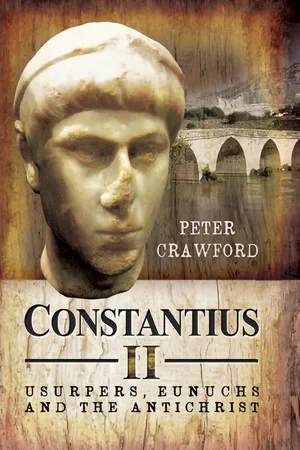
- 384 pages
- English
- ePUB (mobile friendly)
- Available on iOS & Android
eBook - ePub
About this book
Information
Chapter I
Crisis and Renewal: The Third Century and the Tetrarchy
Be harmonious, enrich the soldiers, and scorn all other men
– Cassius Dio LXXVII.15.2 on Septimius Severus’ advice to his sons
The Third Century Crises
The third century CE had not been the Roman Empire’s best. Indeed, the fact that any mention of it is accompanied by the epithet “crisis” suggests that it had been one of its worst. The origins of this crisis were in the last decade of the second century as the Roman world erupted into a four-way civil war on the murders of the emperors Commodus and Pertinax in 193. The commanders of the legions in Syria, Britain and on the Danube vied for control with each other and the Praetorian Guard, which was backing Didius Julianus, the highest bidder in an auctioning of the imperial throne. Through some clever manipulation of his opponents and the benefit of being closest to the centre of the Empire, the Danubian general, Septimius Severus emerged victorious and established a dynasty that was to last for forty years.
However, in achieving this stability, Severus set a disastrous political and military precedent. He made no attempt to hide that his power derived from the army, casting aside the illusion that the emperor ruled by popular consent – the first amongst equals. This might not have been a problem had his successors continued to lead the army in person as they had done for much of the second century;1 however, with Severus’ death, his son Caracalla shrank away from his military duties, although he made sure to buy the loyalty of the soldiers with a 50 per cent pay increase.2 This hands off and increasingly debauched approach to imperial government was copied and even expanded upon by Elagabalus while Alexander Severus lived in the shadow of his mother and advisors, allowing the army to grow accustomed to their new found status as imperial power brokers. Such rule by proxy undermined imperial authority and emboldened military commanders and when Alexander showed a willingness to buy off enemies and let his mother talk him out of leading the army in person, it sparked mutiny.
The subsequent murder of Alexander at Moguntiacum, modern Mainz in Germany, in 235 brought the Severan dynasty to an end and inaugurated an almost complete military meltdown as every commander of any modicum of success felt the need to claim the imperial title. The increasing feebleness of the central government to project power and stability saw various territories slip out of the imperial orbit. At one stage during the 260s, with the secessionist movements of the Gallic and Palmyrene Empires in the west and east respectively and the frontiers crumbling under the weight of barbarian invasion, the Roman Empire was reduced to just Italy, North Africa and parts of the Balkans.
In the period of fifty years between 235 and 285, twenty-one men were recognised as Augustus of the Roman world3 and that figure does not take into account the innumerable attempted usurpers and breakaway rulers. Of those twenty-one, only one – Claudius II – would be afforded a natural death, probably of smallpox, at Sirmium in 270.4 Every other emperor either died in battle or was murdered by his own men, while Valerian died as a prisoner of the Persian king. The only other possible exception was the emperor Carus, who after defeating the Persians and capturing their capital at Ctesiphon died in the summer of 283 after his tent was struck by lightning; however, it could be that that ‘lightning bolt’ was wielded by angry troops, Aper (the Praetorian commander), or Diocles (the commander of the imperial bodyguard). Other explanations are also recorded such as disease or a battle wound, while the lack of immediate opposition to the accession of his son Numerian might suggest a more natural death.5
However, the importance of Carus’ demise lies less in its suspicious manner and more in the overall circumstances surrounding it. That he had died in Persian territory demonstrates that by the early 280s, the Roman state was enjoying something of a resurgence of fortune. Even at the height of the military and political merry-go-round of the mid-third century, the Roman army remained capable of defeating separatists, usurpers, barbarians and the Persians, allowing skilled men such as Aurelian and Probus to restore the integrity of the Empire. Yet, despite the military successes that such emperors were able to achieve, there was still one set of hurdles that none of these men had proven capable overcoming – the fickleness of the soldiery and the bad faith of ambitious subordinates, which had seen numerous worthy emperors cut down in their prime, their reigns measured in months, weeks and even days rather than years or decades.
Such intrigue had not yet been swept away by the time that Numerian succeeded his father and another episode played out on the journey home from Ctesiphon in 284. At some stage, Numerian contracted an eye infection and had to be carried in a litter. When the column reached Nicomedia in late November, alerted by an awful smell, it was discovered that Numerian had been dead for quite some time. The exact cause of death, infection or murder, is not known for certain but Diocles jumped at the opportunity and before the congregation of the army accused Aper of having killed the emperor. Without being given the chance to defend himself, Aper was disposed of, perhaps even executed by Diocles himself before that very military assembly, which now hailed Diocles as emperor, from then on to be known as Diocletian.
Contemporaries will have been forgiven for thinking that this was just going to be another episode in the anarchy that had dogged the Empire for half a century. However, Diocletian was to confound expectations by not only reigning for twenty years but also bringing about a period of military and political stability and reform. That is not to say that his accession was a smooth transition; far from it. Indeed, there was good reason to think that Diocletian would not last long on the throne for while Carus and Numerian were both dead, Carus’ eldest son, Carinus, was still alive and in control of the western provinces. In July 285, the armies of the two emperors met on the banks of the Margus River, the modern Morava near Belgrade. Having the larger army, Carinus gained the upper hand and may even have won the battle; however, it seems that his unpopularity amongst his own officers came back to haunt him. He is accused of mistreating the Senate and seducing the wives of his supporters and just when it seemed he might ascend to supreme power, Carinus was killed by his own men, leaving Diocletian to assume the mantle of sole Augustus.
The New Model Empire and its Army
And yet within days of his ultimate victory at the Margus, Diocletian was to relinquish that title of sole emperor by elevating one of his senior officers, Maximian, to the position of Caesar, with a promotion to Augustus following on 2 April 286. Several reasons for this have been suggested. Despite his charisma and leadership, Diocletian realised that the Roman Empire was too big a job for one man. There were numerous threats along the frontier that were not going to wait for him to defeat them one at a time. He may also have thought that Margus had proven that he himself was at best a mediocre general and that he needed a more skilled man by his side. Diocletian may also have been wary that he as yet had no male heir and so turned to a trusted friend to secure the succession. Diocletian and Maximian both took religious names as part of their imperial title, the former Iovius and the latter Herculius. This not only helped solidify the esteem with which the Augusti were held, it also highlighted that Diocletian remained the dominant partner as the godly Jupiter while Maximian was to be Hercules, the task-completing demigod.6
And Maximian did complete a lot of tasks. While Diocletian campaigned against the Sarmatians along the Lower Danube, politicked with the Persian king and reorganised parts of the Roman east, Maximian campaigned throughout Gaul against bagaudae rebels, along the Rhine against Germanic tribes and in the English Channel against pirates. While not always plain sailing, these operations were successful until he found that his admiral, Carausius, was skimming imperial spoils. Maximian ordered his arrest prompting Carausius to abscond with the Roman fleet and set himself up as Augustus in Britain. Distracted by barbarian raids and neutered by the loss of his fleet, Maximian could do little to undermine the leader of the new Imperium Britanniarum.
By 293, the list of barbarian tribes defeated by the Augusti was extensive – Saxons, Franks, Alamanni, Frisii, Chamavi, Burgundians, Heruli, Chaibones, Sarmatians – but even then the troubles showed little sign of abating. The Rhine and Danube remained troublesome, Carausius still ruled Britain and now Egypt, Africa and the Arab tribes were becoming restless. This led Diocletian to view two emperors as insufficient to manage the military needs of the Empire so he extended the imperial college into what would become known as the Tetrarchy – Rule of Four – by promoting two more Illyrian officers, Galerius and Constantius, to the rank of Caesar, the former to serve under Diocletian in the east and the latter to serve under Maximian in the west. While not immediate, success was forthcoming. Constantius ejected Carausius from the continent and then defeated his successor, Allectus, in 296, reincorporating Britain before again defeating the Franks, while Maximian focused on the Saharan nomads harassing Africa. Over the next decade, Diocletian and Galerius took turns in campaigning along the Danube against the Sarmatians and the Carpi and creating a strong defensive line called the Ripa Sarmatica. They also took turns in suppressing revolt in Egypt, with Diocletian defeating the usurper, Domitianus, and his regime by 298.
The biggest war of the Tetrarchs, however, was with the old enemy, Persia. Wishing to follow in the footsteps of his father, Shapur I, the Persian king, Narseh struck west in around 295, meeting with great success, conquering Armenia and then defeating Galerius near Carrhae in 296. Such was the extent of the defeat that Diocletian forced Galerius to walk alongside the imperial carriage in humiliation. However, within two years, the humbled Caesar made amends. Gathering a large force from the eastern half of the empire, Galerius marched into Mesopotamia in early 298. Narseh retreated into Armenia, preventing Galerius from moving on Ctesiphon by threatening his supply lines; although when Galerius instead turned north, Narseh was trapped on unfavourable ground amongst unfriendly locals with nowhere to run. In two successive battles, the second at Satala, Galerius crushed the Persian army and seized the king’s camp, treasury, harem and wife. The victorious Caesar then advanced south, defeating whatever meagre forces Narseh could scramble together, retaking Nisibis and sacking Ctesiphon before 298 was out. The subsequent Peace of Nisibis confirmed the Roman annexation of northern Mesopotamia, including major cities such as Nisibis itself and Singara, and the extension of Roman influence into Armenia, Iberia and even across the Tigris into Corduene and Zabdicene.7
While the determination and martial prowess of Gallienus, Aurelian, Probus and now the Tetrarchs had saved and reunited the Empire, the financial, structural and military problems had yet to be addressed. Therefore, Diocletian set out on a wide range of reforms in order to recast the Roman Empire.8 He checked the power of governors and tightened local government through a “policy of giving officers carefully defined, more manageable areas of responsibility, and of avoiding wide discretionary powers”.9 This was achieved through a process of subdivision, stratification and separation. The number of provinces was doubled by the division of existing ones, with each of these smaller provinces having a civilian and military governor. These provinces were then grouped together into one of twelve dioceses under the command of a vicarius, while a group of dioceses made up a prefecture run by one of the four Praetorian Prefects, who served at the imperial residences at Trier, Milan, Sirmium and Nicomedia. As each governor now oversaw a smaller area and four prefectural capitals allowed closer imperial supervision, local administration was made more effective, tax collecting made more efficient and the chances of large scale military revolt were seemingly diminished.10
Diocletian also recast the frontiers with a mixture of aggression, rationalisation and deterrence. The aforementioned campaigns deterred opposition in Europe, Africa and Asia, but Diocletian was not above utilizing strategic withdrawals. No attempts were made to reconquer Dacia or the Agri Decumates abandoned in the 270s, while the Egyptian frontier was withdrawn to the first cataract of the Nile.11 To strengthen what he did retain, Diocletian embarked on an extensive building programme, placing strategic roads and fortresses all around ...
Table of contents
- Cover
- Title Page
- Copyright
- Contents
- Acknowledgements
- List of Plates
- List of Illustrations and Tactical Diagrams
- List of Emperors and Usurpers in the Fourth Century
- Constantinian-Tetrarchic Stemmata
- Introduction
- Chapter I: Crisis and Renewal : The Third Century and the Tetrarchy
- Chapter II: Preparation for the Purple: Constantius’ Upbringing and Accession
- Chapter III: The Sins of the Father: Constantius’ War with Shapur II
- Chapter IV: Fraternal Civil War and the Usurpation of Magnentius
- Chapter V: Drunk with Power: The Rise and Fall of Constantius Gallus
- Chapter VI: “This Turbulent Priest”: Constantius, Athanasius and Religious Politics
- Chapter VII: From Student to Soldier: The Rise of Julian
- Chapter VIII: Adversus Barbaros: Constantius and Julian Across the Rivers
- Chapter IX: The Return of the King of Kings
- Chapter X: The Usurpation of Julian: Ungrateful Brat or Left No Choice?
- Chapter XI: War Within and Without: Constantius’ Final Year
- Epilogue: Constantius II, A Good Emperor Lacking a Publicist?
- Appendix I: Consuls During the Life of Constantius II
- Appendix II: The Laws of Constantius II
- Footnotes
- Bibliography
Trusted by 375,005 students
Access to over 1.5 million titles for a fair monthly price.
Study more efficiently using our study tools.
Frequently asked questions
Yes, you can cancel anytime from the Subscription tab in your account settings on the Perlego website. Your subscription will stay active until the end of your current billing period. Learn how to cancel your subscription
No, books cannot be downloaded as external files, such as PDFs, for use outside of Perlego. However, you can download books within the Perlego app for offline reading on mobile or tablet. Learn how to download books offline
Perlego offers two plans: Essential and Complete
- Essential is ideal for learners and professionals who enjoy exploring a wide range of subjects. Access the Essential Library with 800,000+ trusted titles and best-sellers across business, personal growth, and the humanities. Includes unlimited reading time and Standard Read Aloud voice.
- Complete: Perfect for advanced learners and researchers needing full, unrestricted access. Unlock 1.5M+ books across hundreds of subjects, including academic and specialized titles. The Complete Plan also includes advanced features like Premium Read Aloud and Research Assistant.
We are an online textbook subscription service, where you can get access to an entire online library for less than the price of a single book per month. With over 1.5 million books across 990+ topics, we’ve got you covered! Learn about our mission
Look out for the read-aloud symbol on your next book to see if you can listen to it. The read-aloud tool reads text aloud for you, highlighting the text as it is being read. You can pause it, speed it up and slow it down. Learn more about Read Aloud
Yes! You can use the Perlego app on both iOS and Android devices to read anytime, anywhere — even offline. Perfect for commutes or when you’re on the go.
Please note we cannot support devices running on iOS 13 and Android 7 or earlier. Learn more about using the app
Please note we cannot support devices running on iOS 13 and Android 7 or earlier. Learn more about using the app
Yes, you can access Constantius II by Peter Crawford in PDF and/or ePUB format, as well as other popular books in History & Military Biographies. We have over 1.5 million books available in our catalogue for you to explore.