eBook - ePub
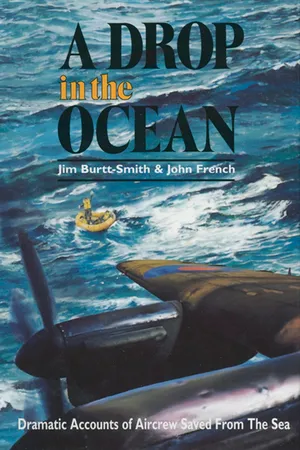
A Drop in the Ocean
Dramatic Accounts of Aircrew Saved From the Sea
- 176 pages
- English
- ePUB (mobile friendly)
- Available on iOS & Android
eBook - ePub
About this book
In the summer of 1942 a Wellington bomber, operating with 115 Squadron from Marham in Norfolk was forced to ditch in the North Sea returning from a raid on Hamburg. Two members of the crew, who were picked up by the Luftwaffe, have written this book. '
Trusted by 375,005 students
Access to over 1.5 million titles for a fair monthly price.
Study more efficiently using our study tools.
Information
CONTENTS
| 1. | The Charles Harrison Story: A Wet Whitley |
| 2. | The Charles Harrison Story: First Dip for a Halifax |
| 3. | Paddling in the Channel: ‘Tiffies’ to the Rescue |
| 4. | Paddling in the Channel: Bert Fitchett’s Version |
| 5. | A Yank Meets his Saviours |
| 6. | … And the Engines Fell Out |
| 7. | All in Vain |
| 8. | Such Language! |
| 9. | Sink that Lancaster |
| 10. | In a Rubber Ring |
| 11. | Flight Engineer/Organist |
| 12. | From Montreal into the Med. |
| 13. | Where Shall We Go Next? |
| 14. | Don’t Go Out That Way |
| 15. | Jobs for the Grimsby Boys |
| 16. | The Lease-Lend Launch |
| 17. | What Gremlin? |
| 18. | Home is a High-Speed Launch |
| 19. | Gardening was no Picnic |
| 20. | Here’s your Trousers, George |
| 21. | Can’t Drown, Can’t Burn |
| 22. | When the Bladder was Useful |
| 23. | Two Lancs. too Close |
| 24. | Lucky Old Stan |
| 25. | The Girl who did a Bleriot |
| 26. | ‘Sheilas!’ – And Then There Were None |
| 27. | Getting aboard the MTB was the Worst |
| 28. | Another Rescue by Fritz |
| 29. | A Kiwi Robinson Crusoe |
| 30. | Back Wet from Nürnberg |
| 31. | Even a Walrus can’t Swim |
| 32. | It was Nice Floating Down |
| 33. | Pass the Port |
| 34. | Chit-Chat in the Caribbean |
| 35. | Floating Kiwis |
| 36. | A Nasty Little Buoy |
| 37. | Birth of the Rescue Craft |
| 38. | Mind those Mines |
| 39. | Compassion |
| 40. | Here Comes the Navy! |
| 41. | No Substitute for a Honeymoon |
| 42. | What Else Can Happen? |
| Appendix 1: Reunion of Rescued and Rescuers | |
| Appendix 2: The Goldfish Club | |
| Index |
THE CHARLES HARRISON STORY:
A Wet Whitley
Charles Harrison’s first encounter with the sea was on 12 June, 1941, when he flew in a Whitley Mark 5 with 10 Squadron from Leeming in Yorkshire. The target was Schwerte in the Ruhr. Charles was filling in as tail gunner with a crew whose normal gunner was ill. Here is his story.
‘Just after passing over the Dutch coast we ran into some light, sporadic flak, which was close. Several minutes later I saw a mass of sparks fly past my turret from the starboard engine. There followed some conversation on the intercom between the crew about the state of the engine. It was decided that we should drop our bombs in the sea and turn back: in the meantime, the starboard engine was feathered.
‘Shortly afterwards the pilot called me and said he was having difficulty in maintaining height. He asked me to leave the turret, go into the fuselage and get rid of all the loose and heavy stuff I could find.
‘After disconnecting my intercom lead I opened the fuselage door to jettison some incendiary bombs and flares, and I remember saying to myself, “Hell, that sea looks close!” I threw out all I could find when I felt a tugging on my arm. It was the wireless operator, who shouted, “Go back to the turret – the skipper wants you.” I returned to the turret and plugged in the intercom. The pilot told me he could no longer maintain height and there was a “possibility” that we would have to land in the sea. He asked me to go back to the fuselage and prepare the dinghy for launching.
‘In the Whitley the dinghy was opposite the fuselage door and secured to the starboard side wall by “bungee” cords. Once again I opened my turret door, disconnected the i/c and went to grab the two handles to hoist myself out of the turret.
‘In the next seconds I was aware of an impact on the back of my head, a flash of light and stars behind my eyes. When I regained my senses I was lying in water in the fuselage. Everything was dark and quiet. On operations I always carried a torch stowed in my flying boot and I shone the torch into the darkness. I then saw that I was down the fuselage by the door, having been thrown backwards from the turret. In the process I had cleared the spar which supported the tail wheel and lay across the fuselage, about two feet high, from one side to the other.
‘My next thoughts were “The door – and the dinghy”. I freed the dinghy and opened the fuselage door to throw it out, retaining hold of the lanyard in order to inflate it when it hit the sea.
‘Then the wireless operator appeared. He had come out of the top hatch and crawled along the fuselage to the outside of the door. As I threw out the dinghy and pulled the lanyard he put his hand underneath to help it out, but his action turned the dinghy pack over and it inflated upside down. Before anything could be done the rest of the crew were in it. I had to swim for it and was last man in. It was about two in the morning, pitch dark, and we paddled hard to get away from the Whitley, which disappeared beneath the waves in less than two minutes. The navigator had injured himself in the impact; my neck and head ached, but I think I escaped serious injury due to my flying helmet and my para-suit. There had been no warning from the pilot and the crash into the water had been quite sudden. There was a heavy swell. We discussed the possibility of getting out and trying to right the dinghy when daylight came, but the navigator, apart from his injury, could not swim. So we agreed to manage with the upturned dinghy, although this meant no accessibility to all the aids normally carried in the dinghy.
‘We heard our own planes returning home from the raid and also some enemy planes returning from Britain. There was great satisfaction when dawn broke and, as the wireless operator had sent out an SOS before we ditched, we hoped for an early rescue.
‘After a time what appeared to be a launch was sighted in the distance, but it was not heading towards us and eventually disappeared over the horizon. Then came the sound of an aircraft and we saw a German plane flying quite low. It was a seaplane and the pilot was clearly visible. We began waving to him. He waved back, but we assumed he had been searching for German aircraft. As he circled low above us, he fired two Very lights and then flew off in the direction in which we had seen the launch. Minutes later more Very lights lit the sky. The German pilot reappeared, circled us and fired two more Very lights before disappearing. We settled down and tried to accept the fact that we were about to be picked up by the enemy.
‘Not long after, we spotted two planes diving and circling as though engaged in a dog fight. They seemed to be Hurricanes or Spitfires. One of them suddenly dived and flew right over the dinghy. It was a Spitfire and the pilot was waving to us. His colleague had gone, presumably to fetch help. As the fighter continued to circle overhead, the boat we had seen earlier was now approaching fast. We recognised it as an A.S.R. launch – an oceangoing type with four gun turrets fore and aft.
‘All of us, and the dinghy, were pulled aboard and taken below to a comfortable cabin with beds. The skipper told us that they had been searching for us when a German plane approached and fired signal flares. The crew immediately radioed Great Yarmouth for a fighter escort, fully expecting to be attacked. All turrets in the launch were manned. They certainly did not realize that the enemy pilot was merely trying to attract the launch to our position. It was, however, one of the escort fighters which eventually sighted the dinghy and brought the rescue launch to our position, just as they were about to return to port. We had been in the dinghy for eight-and-a-half hours.
‘After we had each swallowed a large glass of Naval rum no one seemed to be able to remember anything more until the launch tied up at the A.S.R. station in Great Yarmouth. The rest of that day and the following night were spent in a Seamen’s Hospital, but we were kept awake by the sound of bombs dropping in and around Great Yarmouth. Next morning our Commanding Officer sent his vehicle to take us back to Leeming. Meanwhile the Yarmouth ASR had kitted us out in basic Naval uniform in place of our own sodden clothing.
‘There was a strange welcome as we stopped at traffic lights in Yarmouth: members of the local population were swearing and hissing at us in the belief that we were captured German airmen from the previous night’s raid. There was some surprise when the navigator lowered the window and told them, in very colourful English, who we really were.
‘I was the only member of that crew who survived the war.’
Crew of Whitley:P.O. Littlewood (pilot); Sgt Poupard (second pilot); P.O. Stevens-Fox (navigator); Sgt Wilkinson (wireless operator); Sgt Harrison (air gunner).
THE CHARLES HARRISON STORY:
First Dip For A Halifax
Ten months later, 10 Squadron at Leeming had been converted to Halifax bombers. The target on the night of 14/15 April, 1942, was Dortmund, but to Charles Harrison there was something strangely ominous about the operation even before his Halifax Mark 2 was airborne. They were to carry two 4,000 pound bombs – the first time for a Halifax – and since the bomb doors had not been modified they could not be properly closed and would create a drag on the aircraft. Moreover, they were given the longest possible route to the target in order to attack Dortmund from an easterly direction. Finally, the excess weight being carried demanded that the two outer wing petrol tanks be left empty. No encouragement here for a bomber crew setting off for the heart of enemy territory.
Let Charles Harrison continue the story.
‘The flight outward was quiet and uneventful and we were unaffected by flak or searchlights. Some time before reaching the target, however, I heard the flight engineer tell the skipper that we had already used just over half of our petrol. Heavy cloud was building up and after our attack on Dortmund it got worse. Our final turning point was a lake south of the Ruhr Valley. From there our track took us back the way we had come. After sighting the lake and changing course we flew on dead reckoning through the heavy cloud.
‘All went well until the point at which we should have crossed the coast, but it was still impossible to see the ground. The skipper remarked about the fuel running low and I was asked by the navigator to get a radio fix. Our normal M/F stations, dotted along the east coast, could not pinpoint us for a fix, but gave us a line bearing. This indicated that we were a long way south of our intended position. I succeeded in getting a fix from three other M/F stations on the south coast. They placed us over the Channel Islands. The skipper estimated he had no more than ten or twenty minutes’ fuel left and told me to begin transmitting an SOS. At that point the rear gunner sighted two islands through a break in the cloud. “And they’re firing at us!”
‘This clearly verified the fix and we immediately set course for the nearest English coast. We flew on, reducing height, with the Flight Engineer draining the tanks and, when necessary, cutting an engine. Suddenly there were searchlights ahead. We were approaching the coast.
‘The pilot then gave the warning to ditch. At that point I decided we would not be caught out, as on the previous ditching, with no means of signalling. Accordingly I filled a parachute bag with cartridges, signal flares and a Very pistol...
Table of contents
- Cover
- Half Title
- Full Title
- Copyright Page
- Contents
Frequently asked questions
Yes, you can cancel anytime from the Subscription tab in your account settings on the Perlego website. Your subscription will stay active until the end of your current billing period. Learn how to cancel your subscription
No, books cannot be downloaded as external files, such as PDFs, for use outside of Perlego. However, you can download books within the Perlego app for offline reading on mobile or tablet. Learn how to download books offline
Perlego offers two plans: Essential and Complete
- Essential is ideal for learners and professionals who enjoy exploring a wide range of subjects. Access the Essential Library with 800,000+ trusted titles and best-sellers across business, personal growth, and the humanities. Includes unlimited reading time and Standard Read Aloud voice.
- Complete: Perfect for advanced learners and researchers needing full, unrestricted access. Unlock 1.5M+ books across hundreds of subjects, including academic and specialized titles. The Complete Plan also includes advanced features like Premium Read Aloud and Research Assistant.
We are an online textbook subscription service, where you can get access to an entire online library for less than the price of a single book per month. With over 1.5 million books across 990+ topics, we’ve got you covered! Learn about our mission
Look out for the read-aloud symbol on your next book to see if you can listen to it. The read-aloud tool reads text aloud for you, highlighting the text as it is being read. You can pause it, speed it up and slow it down. Learn more about Read Aloud
Yes! You can use the Perlego app on both iOS and Android devices to read anytime, anywhere — even offline. Perfect for commutes or when you’re on the go.
Please note we cannot support devices running on iOS 13 and Android 7 or earlier. Learn more about using the app
Please note we cannot support devices running on iOS 13 and Android 7 or earlier. Learn more about using the app
Yes, you can access A Drop in the Ocean by John French,Jim Burtt-Smith in PDF and/or ePUB format, as well as other popular books in History & Military & Maritime History. We have over 1.5 million books available in our catalogue for you to explore.