This revealing history explores Britain's use of concentration camps from the Boer War to WWII and the Troubles in Northern Ireland.
The term concentration camp will forever be associated with the horrors of Nazi Germany. But the British were the true driving force behind the development of these notorious facilities. During the Boer War, British concentration camps caused the deaths of tens of thousands of children from starvation and disease. In the years after World War II, hundreds of thousands of enslaved agricultural workers were held in a national network of camps.
Not only did the British government run its own camps, they allowed other countries to set up similar facilities within the United Kingdom. During and after the Second World War, the Polish government-in-exile maintained a number of camps in Scotland where Jews, communists and homosexuals were imprisoned and sometimes killed.
This book tells the terrible story of Britain's involvement in the use of concentration camps, which did not finally end until the last political prisoners being held behind barbed wire in the United Kingdom were released in 1975. From England to Cyprus, Scotland to Malaya, Kenya to Northern Ireland,
British Concentration Camps: A Brief History from 1900 to 1975 details some of the most shocking and least known events in British history.
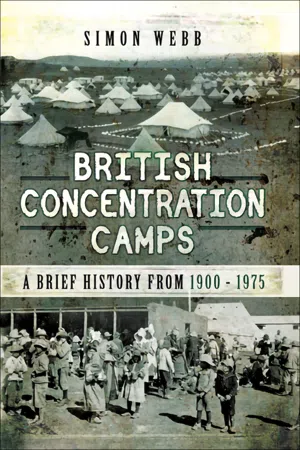
- 192 pages
- English
- ePUB (mobile friendly)
- Available on iOS & Android
eBook - ePub
About this book
Information
Chapter One
1896
A Prussian General’s Idea: The Origin and Nature of Concentration Camps
A Prussian General’s Idea: The Origin and Nature of Concentration Camps
The British may have pioneered the concept of concentration camps but it was a German who actually invented the concentration camp. Valeriano Weyler y Nicolau, born in 1838, was the son of a Prussian. His father was a career soldier who had moved to Spain and Valeriano decided to follow in his footsteps; becoming a lieutenant in the Spanish army by the age of twenty. His was a glittering military career. He fought in the Ten-Years War (1868-78), and was later appointed Captain-General of the Canary Islands. It was an earlier incident in his life though, when as a young man he had been sent to Washington as the military attache at the Spanish embassy, that gave Valeriano Wyler the idea for which he was to attain fame or, perhaps more accurately, notoriety.
During the American Civil War, while he was attached to the embassy in Washington, young Weyler heard about the tactics employed by General William Sherman, as he swept through the southern states using what would later become known as a ‘scorched earth’ policy. Not only was Sherman an exponent of brutal warfare, burning entire towns to terrify the enemy into submission, he also waged a campaign which some thought amounted to genocide against the Indians. Using as his slogan, ‘The only good Indian is a dead one’, Sherman harried the Indians mercilessly; seeing that they were penned up in camps where they died from starvation and illness. Sherman’s activities, both against the Confederacy and the Indians, made a great and lasting impression upon the young soldier who went on to govern several Spanish colonies.
At the age of 58, General Weyler as he was by then, was sent to Cuba to suppress, by any means he chose, the rebellion which was threatening to drive the Spanish from the island nation. When he arrived in Cuba as the newly appointed governor of the colony, Weyler found that the rebels were practically at the gates of Havana, the capital. He realised that only an altogether new and radical policy would be able to save the country for Spain.
The expression ‘concentration camps’ might only date from the end of the nineteenth and beginning of the twentieth centuries, but the concept itself is an ancient one. In 1997, an archaeologist working at Hadrian’s Wall even suggested that evidence had been found of the world’s earliest concentration camp, which had been set up in Britain! The foundations of many round huts were found near a Roman fort and the idea was mooted that this had been some sort of camp under the control of the Roman army and holding British hostages.
More recently, camps such as Andersonville in Georgia, a prisoner of war camp during the American Civil War, have produced conditions as shocking as any seen in the twentieth century. Of the 45,000 Union prisoners sent to Andersonville, no fewer than 13,000 died of starvation and disease. The commandant of the camp was hanged after the war. Most of the previous camps that were established before the Cuban War, places like Andersonville, were specifically for prisoners who had been fighting against an army or working to overthrow a regime. What was novel about the camps set up by General Weyler was that they were, from the very beginning, intended to house civilian non-combatants; primarily women and children who had no part in any fighting.
The main problem faced by the Spanish army in Cuba was that the guerrillas fighting them were all but indistinguishable from the ordinary Cuban peasants who were working the land. These men could ambush a Spanish column and then slip back to their homes later and resume their normal life; which meant that the enemy had no need to worry about supplies and so on. They just went home at the end of the action, to wives who had a hot meal ready and waiting for them. It was clear that unusual action would be needed and unconventional tactics would have to be devised to combat this new type of belligerent.
The idea that General Weyler came up with was to clear the countryside of its inhabitants and force the entire population into villages and towns. These would then be fortified and defended against the rebels. Anybody found in the countryside would be automatically viewed as an insurgent and liable to be shot down without warning. The fertile fields themselves would be untended and the peasants confined to the towns left to provide for themselves as best they were able.
On 21 October 1896, General Weyler announced:
All the inhabitants of the country now outside the line of fortifications of the towns, shall within the period of eight days concentrate themselves in the town so occupied by the troops.
The homes that the peasants left behind were frequently destroyed and their farms ravaged so that they could not provide food for the rebels. The temporary camps set up within the towns were only ever intended to be a stopgap measure. No real provision was made for those within them. As the months passed, conditions grew increasingly desperate.
To get some idea of the conditions of these ‘reconcentrados’, as the Spanish called those whom they had concentrated in this way, we cannot do better than examine the evidence of an eyewitness. United States Senator Redfield Proctor, from Vermont, visited Cuba to see for himself what was happening in the country. On 17 March 1898, he gave a speech in the US Senate, describing what he had found during his stay:
It is not peace, nor is it war. It is desolation and distress, misery and starvation. Every town and village is surrounded by a trocha (trench) a sort of rifle pit, but constructed on a plan new to me, the dirt being thrown up on the inside and a barbed wire fence on the outer side of the trench. These trochas have at every corner, and at frequent intervals along the sides, what are there called forts, but which are really small block-houses, many of them more like a large sentry box, loop-holed for musketry, and with a guard of from two to ten soldiers in each. The purpose of these trochas is to keep reconcentrados in as well as to keep the insurgents out.
From all the surrounding country the people have been driven into these fortified towns and held there to subsist as they can. They are virtually prison yards and not unlike one in general appearance, except that the walls are not so-high and strong, but they suffice, where every point is in range of a soldier’s rifle, to keep in the poor reconcentrado women and children.
With no crops to harvest in the towns and no livestock, the situation for the hundreds of thousands of smallholders and peasants who were thus confined in this way was dire indeed.
What Weyler called his, ‘Reconstruction Plan’ may have been a military success, but it soon became a humanitarian disaster. Well over a quarter of a million people died of hunger or disease as a direct consequence of Weyler’s actions in setting up his camps for ‘reconcentrados’. One figure for the total number of dead is 321,934.
World reaction to the campaign led by General Weyler was wholly unfavourable; except of course in Spain itself. There, Weyler was regarded by Conservatives as a saviour of the nation. What could not be denied was that faced with a new kind of warfare, the general had come up with a novel tactic; one which would become enormously widespread in the new century which was about to dawn. Scorched earth policies, the destruction of homes and herding of civilians into captivity behind barbed wire fences might have been a novelty at the end of the nineteenth century, but it was to be anything but out of-the-ordinary by the time that the twentieth century ended. Indeed, the concentration camp, as used by Nazi Germany, Soviet Russia, communist China and Britain bids fair to be regarded as something of a leit motif for the entire century. From the time of General Weyler onwards, civilians were frequently regarded as legitimate targets during times of war. Rather than, as was previously the case, being seen as largely an irrelevance, non-combatants were now viewed as pawns to be used and abused as circumstances dictated.
One nation above all others though, looked with interest at the exploits of General Weyler and his unorthodox methods for subduing an elusive enemy. It was this nation which was to adopt the idea of concentration camps from the first year of the twentieth century, and continue to use them, more or less continuously, right through to the middle of the 1970s. Only a few years after the Cuban War, the British found themselves facing a precisely similar situation of their own in southern Africa. It was perhaps inevitable that they would seek to adopt similar means to the Spanish when they came to tackle a guerrilla war of their own; one which almost defeated the mightiest empire the world had ever seen.
Chapter Two
1900-1902
Lord Kitchener’s Genocide: ‘Methods of Barbarism’ in the Boer War
Lord Kitchener’s Genocide: ‘Methods of Barbarism’ in the Boer War
The word ‘genocide’ was unknown in 1900. It was Raphael Lemkin, a Polish lawyer, who coined the expression in 1943, feeling that the murderous activities of the Nazis in Eastern Europe were so extraordinary that existing words were simply not adequate to describe what had been going on in Poland and Russia during the early years of the Second World War. The word may be relatively new, but the concept of systematically exterminating an entire nation or race is at least as old as recorded history. The Bible, for example, tells us in the Book of Joshua that when the Children of Israel entered the land of Canaan, they were commanded by God to kill all the existing inhabitants of the country. Every man, woman and child living in Jericho, the first city conquered by the Hebrews, was put to the sword and the city burned to the ground. Only one family escaped this holocaust.
The decimation or destruction of a people or tribe in this way may sometimes be accomplished by cold-blooded murder, but the same end can be obtained by producing living conditions which lead to starvation and death from disease. This happened of course in the nineteenth century, with the native Americans living under the jurisdiction of the United States. In 1945, the civilised world was shocked to see the conditions in German concentration camps such as Belsen, whose inmates had died in their tens of thousands from malnutrition and epidemics of illnesses such as typhoid. This too was genocide and was officially recognised as such in 1948, when the United Nations defined genocide as, ‘any of the following acts committed with the intent to destroy, in whole or in part, a national, ethnic, racial or religious group, as such’. The UN Convention on Genocide then went on to specify, apart from outright killing, ‘Deliberately inflicting on the group conditions of life calculated to bring about its physical destruction in whole or part’.
Before we examine in detail the network of concentration camps set up by the British in the opening years of the twentieth century in, it has since been claimed, an effort to destroy a national group in this way, perhaps we should look at Plates 2 and 3. Belsen was mentioned above and at first glance, these images could very well have originated from events at that most infamous of concentration camps. In fact, both are from 1901; some forty-two years before Belsen opened its gates. The first is a French cartoon, designed to draw attention to the horrors of the British concentration camps in South Africa. The second is of a child from Bloemfontein Concentration Camp; one of the worst of the camps. Seven-year-old Lizzie van Zuyl and her family were deliberately starved by the British soldiers controlling the concentration camp in which they were detained. Lizzie was on the point of dying of malnutrition, when she contracted typhoid and died on 9 May 1901. Her fate was precisely the same as Anne Frank and many others who died in Belsen almost half a century later.
Before looking in detail at the concentration camps organised by the British in the opening years of the last century, it will first be necessary to set the scene by asking ourselves what the British were doing in southern Africa in the late nineteenth and early twentieth centuries. Most people in Britain have heard of the Boer War; few have any clear idea what it was all about.
The first European colony in South Africa was established by the Dutch East India Company in 1652. By the late eighteenth century, this outpost on the southern tip of Africa was looking very attractive to the British, who wished to guard their trade routes to India. Before the construction of the Suez Canal, ships bound to and from India had to sail south through the Atlantic, rounding what was known as the Cape of Good Hope, before heading north to Asia. The Napoleonic Wars provided the perfect opportunity to gain a foothold there and the first British troops landed in what became the Cape Colony in 1806. Eight years later, the territory was formally ceded to Britain.
Many of the Dutch farmers and merchants living at the Cape did not wish to become part of a British colonial possession and so, over the course of time, made their way north; setting up two independent republics. These were the Orange Free State and the South African Republic; more commonly known as the Transvaal. The Dutch living in these new states were called by the British ‘Boers’, which means ‘farmers’. They preferred to call themselves ‘Burghers’ or citizens.
As the nineteenth century drew on, there were various developments which made amicable relations between the Dutch republics and the British Cape Colony all but impossible. One notable event was the discovery of gold in the Transvaal. Such treasure was very attractive to the British and in 1880, there was an attempt to annex the Transvaal. This became known as the First Boer War. By 1899, another problem had arisen, which was that the Transvaal was arming itself heavily and had also enlisted the help and advice of German military experts. When the British finally went to war on various pretexts, such as the rights of foreigners living and working within the two Boer republics, most people assumed that there would be a brief struggle, before the tiny nations were decisively crushed by the might of the greatest empire the world had ever known.
The Second Boer War began in October 1899 and, to begin with at least, the Boers managed to carry the war into British territory, causing the army to retreat to various garrison towns such as Mafeking and Ladysmith; which the Boer forces then besieged. All of this was a terrible shock for the British public, who were accustomed to their army beating any opponent. It must be recalled that most of the British army’s actions in the late nineteenth century had been against poorly equipped natives, who were no match for well-armed colonial troops. Facing foes who had up-to-date rifles and 155 mm artillery at their disposal was a novel and not altogether pleasing experience for the British army in Africa.
It took four or five months for Britain to transport enough troops and equipment to South Africa to turn the tide of the war in her favour. Field Marshal Lord Roberts was appointed Commander in Chief and adopted an aggressive policy which paid off in a short time. On 13 March 1900, British forces entered Bloemfontein, the capital of the Orange Free State, and by the middle of May, Mafeking had been relieved. On 28 May, the Orange Free State was annexed and a week later, the British captured Pretoria; the capital of the Transvaal. The Boer armies had been comprehensively defeated in the field and by all the usual rules of warfare, the war could be considered to have ended in a decisive victory for Britain. On 29 November 1900, Field Marshal Roberts believed the war to be over and left the country, handing over to his second in command: Lord Kitchener.
The fiercely independent Boers however, were playing by an entirely different set of rules to the British. Having seen their capital cities fall to a foreign invader and their armies swept aside on the field, the Boers decided that the war would need to be prosecuted by other means. The method which they adopted was to launch a ferocious guerrilla war, a series of hit and run attacks on the armed forces occupying their countries.
Central to all guerrilla wars, and crucial to their success, is the attitude of the civilian population. Mao Tse Tung, whose own guerrilla campaign captured for him the most populous nation on earth, said that ‘The guerrilla must move among the people as a fish swims in the sea.’ In other words, the goodwill of the people is vital to the guerrilla. In the case of the Boer republics, the armed forces of the Transvaal and Orange Free State certainly enjoyed the almost unanimous support of the Dutch settlers. Since most of the men were fighting the British, this meant that the great majority of the civilian population were women and children; the families of the men at war. This presented the Lord Kitchener and his army with a great problem.
In fact, the families of the Boer fighters posed several, closely interwoven problems for the British, all of which were ultimately to be solved in one way. To begin with, it was known that the women and children living in the farmhouses dotted about the land were in the main wholeheartedly in favour of what their men folk were doing. This meant that they observed the movements of British troops and passed on this information to the men in the field. They also fed the soldiers from the produce of their farms. The British, realising that they were, as they saw it, being constantly betrayed to their enemies, began to exact harsh reprisals for any attacks. The actual enemy being so elusive, these reprisals were made against the women and children whose husbands and fathers were at war. As early as January 1900, before Field Marshal Roberts arrived in South Africa, farmhouses were being burned down by the British forces and those living in them rendered homeless.
Once Roberts had taken charge of the campaign against the Boers, he instituted a systematic policy of the destruction of homes. This included not only individual houses, but also entire towns. From March to June 1900, for instance, Roberts authorised the burning of farms from which snipers had been firing on British troops. Attacks on ...
Table of contents
- Cover
- Dedication
- Title Page
- Copyright
- Contents
- List of Plates
- Introduction
- Chapter 1: 1896: A Prussian General’s Idea: The Origin and Nature of Concentration Camps
- Chapter 2: 1900-1902: Lord Kitchener’s Genocide: ‘Methods of Barbarism’ in the Boer War
- Chapter 3: 1914-1918: England, Scotland and Wales: Three Different Kinds of Concentration Camp of the First World War
- Chapter 4: 1929-1938: ‘Work Sets you Free’: The British Labour Camps of the Inter-War Years
- Chapter 5: 1940-1946: They must have known! The Polish Concentration Camps in Britain
- Photo Gallery
- Chapter 6: 1945-1948: Crimes Against Humanity: Slave Labour Camps in Post-War Britain
- Chapter 7: 1945-1949: Locking up Holocaust Survivors: The Concentration Camps in Cyprus
- Chapter 8: 1948-1960: Calling a Spade a Manual Digging Implement: The Malayan Emergency
- Chapter 9: 1952-1960: The Mau Mau Rising: A Million People in Concentration Camps
- Chapter 10: 1971-1975: Operation Demetrious and the Five Techniques: The Detention and Torture of Political Prisoners in Northern Ireland
- Endword
- Bibliography
Trusted by 375,005 students
Access to over 1.5 million titles for a fair monthly price.
Study more efficiently using our study tools.
Frequently asked questions
Yes, you can cancel anytime from the Subscription tab in your account settings on the Perlego website. Your subscription will stay active until the end of your current billing period. Learn how to cancel your subscription
No, books cannot be downloaded as external files, such as PDFs, for use outside of Perlego. However, you can download books within the Perlego app for offline reading on mobile or tablet. Learn how to download books offline
Perlego offers two plans: Essential and Complete
- Essential is ideal for learners and professionals who enjoy exploring a wide range of subjects. Access the Essential Library with 800,000+ trusted titles and best-sellers across business, personal growth, and the humanities. Includes unlimited reading time and Standard Read Aloud voice.
- Complete: Perfect for advanced learners and researchers needing full, unrestricted access. Unlock 1.5M+ books across hundreds of subjects, including academic and specialized titles. The Complete Plan also includes advanced features like Premium Read Aloud and Research Assistant.
We are an online textbook subscription service, where you can get access to an entire online library for less than the price of a single book per month. With over 1.5 million books across 990+ topics, we’ve got you covered! Learn about our mission
Look out for the read-aloud symbol on your next book to see if you can listen to it. The read-aloud tool reads text aloud for you, highlighting the text as it is being read. You can pause it, speed it up and slow it down. Learn more about Read Aloud
Yes! You can use the Perlego app on both iOS and Android devices to read anytime, anywhere — even offline. Perfect for commutes or when you’re on the go.
Please note we cannot support devices running on iOS 13 and Android 7 or earlier. Learn more about using the app
Please note we cannot support devices running on iOS 13 and Android 7 or earlier. Learn more about using the app
Yes, you can access British Concentration Camps by Simon Webb in PDF and/or ePUB format, as well as other popular books in History & Military & Maritime History. We have over 1.5 million books available in our catalogue for you to explore.