- 224 pages
- English
- ePUB (mobile friendly)
- Available on iOS & Android
eBook - ePub
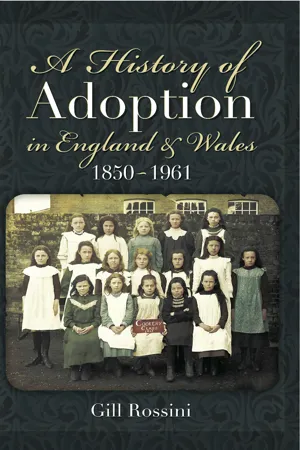
A History of Adoption in England and Wales 1850- 1961
About this book
Adoption is one of the most emotive and complex subjects in social and family history. Gill Rossini's social history of adoption between 1850 and 1961 uncovers the perspectives of all those concerned in adoption: children, birth relatives, adoptive families, and all the agencies and organisations involved. Rossini charts the transformation of the adoption process from a chaotic informal arrangement to a legal procedure. Set against the backdrop of the moral, cultural, and legal climate of the times, the contemporary voices of those who played a part in an adoption give real insights into this often turbulent period in their lives. Discover how shocking stories of baby farmers and unwanted orphans fuelled the campaign for change, and hear previously untold stories.For those who wish to conduct their own research into an adoption, Rossini has compiled a comprehensive guide to resources.
Information
CHAPTER 1
Introduction and Background
Adoption is one of the most emotive subjects in social history, and in family history in particular. Express an interest in adoption – especially those in past generations – and the majority of family historians have an adoption story to tell you about from their own genealogies.
Adoption is only one event in a person’s life, and yet it can resonate not only throughout that person’s life, but right through a family history too. One of the reasons it is such a compelling subject is perhaps its inherent and sometimes frustrating mystery. England and Wales were late in legislating for formal adoptions compared to other countries. Before that point there was a vast confusion of makeshift solutions to the perennial problem of the unwanted child or baby, especially those born out of wedlock.
The shame of being an unmarried mother, or of having a single mother in the family, led to a bewildering number of ways for dealing with these ‘misfits’, many of which involved the family closing ranks, dealing with the matter secretly, and never talking about it again. However, families being what they are, eventually someone usually breaks ranks and an ill-chosen, disingenuous or malicious remark could blow the cover of a secret that has been kept close for generations. All family historians love intrigue of this kind, but the problems of solving the adoption mysteries in a family tree can seem insurmountable. Even after 1926 – the year adoptions were legally formalised in England and Wales – the official secrecy around an adoption deters most enquirers who are not the adoptee themselves from tackling the research.
What Exactly is Adoption?
In order to explore this topic, a definition of adoption must be arrived at, but this is not as simple as it first appears. In the twenty-first century, we tend to think of adoption in a narrow sense, as the taking into one’s family through a legal procedure, the child of another person or family. It is a very small definition for an event of life-changing and highly emotional significance. The definition can be widened. For example, it could be said that whenever a person or an organisation is in loco parentis for any length of time, they are in an adoptive situation, or at the very least, are foster parents. This would then widen the definition to include the carers of evacuee children in World War Two, as well as the poor relief authorities caring for children in the nineteenth century and early twentieth century.
If one accepts organisations as adopters, children’s homes and orphanages must then be added. The definition of adoption would also apply to family members who informally took on a relative’s child, although they would be unlikely to see this as adoption, more as helping out the parent concerned out of familial loyalty. In 1937, the Horsbrugh Committee Report (see Chapter 4) described adoption as follows:
The essence of an adoption, whether legalised or de facto, seems to us to lie in the creation of an artificial family relationship analogous to that of parent and child … which is accepted by all parties as permanent. The child is absorbed into the family of the adopter and is treated as if it were their own natural child.
There is a word of warning to be borne in mind with regard to this statement, for not all natural children are treated with love, nurtured, and guided as they should be. Adoption does not always have a happy ending because the lives of children are variable whatever their beginnings, and it includes the whole spectrum of stories, just like those from any other walk of life.
Why Adopt?
What were/are the reasons for adoption? For decades, adoption has largely been seen from just a few perspectives. Today, it is a major option for couples who for whatever reason – infertility or previous illness, for example – are not able to have biological children of their own. It is seen as a form of altruism or humanistic action, to take in as your own the unwanted children of another person – often those with disabilities or perhaps those from another country altogether. Such adopters may feel they are ‘rescuing’ children from this group.
Some people have mixed families, with biological children, stepchildren and adopted children together; others may have taken on the children of a deceased, homeless or less abled relative. Over a hundred years ago, or even less, other reasons for adoption can be added to the list, although that is not to say that they are not considered as reasons by some people today. For example, adoption was used to create heirs for property, and to stop a family line dying out, particularly important for a family affluent enough to have substantial financial or property interests.
Altruism also had a place in the past in that some people would take on a child from an orphanage or children’s home in order to give her/him a family. It was also a loose term for the disposal of an illegitimate baby or small child to a baby farmer (see Chapter 2), the ‘industry’ that gave adoption such a bad name in the nineteenth century and which sadly persisted into the twentieth century, although of course some unwanted babies must have been sold to what turned out to be doting and excellent parents. In the past, adopted children could be taken on to look after their parents in old age, or to work for the family, which led to some distressing cases of cruelty, even after the 1926 Adoption of Children Act. Older children were particularly vulnerable to this form of abuse.
Adoption has for millennia been seen as a solution to housing an unwanted, abandoned (a ‘foundling’) or orphaned child. Victorians must have taken comfort from passages and stories which highlight adoption in the Hebrew and Christian Bibles – in the Book of Esther, the child Esther is orphaned when her parents die, and she is adopted and raised by her older cousin Mordecai. Esther is an adoption success story, as she goes on to become the consort of King Xerxes. Moses as a baby is also an adoptee – found alone in the reeds at the edge of a river, he becomes the beloved adopted child of the Pharoah’s daughter and of course as an adult, after many tribulations, he becomes the saviour of the Jewish people.
These and various other allusions to the concept of adoption reinforce the notion of adoption as a morally and culturally legitimate act. There are Classical allusions to adoption too – in the law of Ancient Rome, the paterfamilias or male head of the household had the right to give up a child for adoption by another family. Usually, it was the oldest boy who had a good health record and some education; in fact, girls could not be adopted and women could not adopt a child in their own right. Classically educated men in the nineteenth and twentieth centuries would have been well aware of this completely open Roman system, which was entirely pragmatic and seen as a normal thing to do.
A Word About Illegitimacy
It is virtually impossible to write about the history of adoption without addressing the topic of illegitimacy because the vast majority of babies and children who were adopted were born outside of a marriage – either the mother was not married at all, being single or a widow, or the mother was married, but her husband was not the father of the child. Only a small proportion of children who were ‘candidates’ for adoption were available because of the death of a married parent. Consequently, considerable attention is paid to the situation of the illegitimate child in this study, and their birth families.
How Easy is Adoption to Research?
Bearing in mind that adoptions of all kinds in the period covered by this book – both informal and legal – are restricted by secrecy, or just plain issues of confidentiality, it is hardly surprising that many people think that researching the history of adoption is well nigh impossible. However, given that the definition of adoption needs to be viewed in a broad sense for much of the period covered, we can readily gain a picture of what was happening to many adopted, abandoned or unwanted children and their carers, even though the adoption files may be closed. Many children and their mothers were, in a sense, ‘hidden in plain sight’, in that everyone in the community knew they were there but chose to ignore them or treat them with veiled hostility.
The huge growth in family history has uncovered many stories of informal adoptions via census returns and the discovery of family papers, and as time goes by, more papers uncovering the history of orphanages, adoption societies and children’s charities have been released for the perusal of historians. Historians are also fortunate that the period covered by this book saw a huge upsurge, not only in literacy but in popular publications such as provincial newspapers, women’s magazines and fiction – photographs abound too, and there was great activity within social action groups such as children’s charities. Other records may include court records, census returns, oral history sources, police records, trade directories and legal papers such as private agreements.
The secret is to approach the story of these families, children and the agencies who tried to help them, with a broad sweep. To look too closely at the plain facts of the story of the drive towards legislation is to miss the human aspects of the tale, and to lose touch with the people who were the subjects of all this attention. These people can be split into three groups: the children themselves; their birth mothers and other birth family; and the agencies, individuals or families who took the children into their institutions, homes and families.
These are the building blocks of the story of adoption. Attention is also given to the wider context in which this story is set – unless one understands how the nature of family was seen as at a given time, it will be more difficult to appreciate how adoption fits in to the whole. The final section of the book offers some practical advice and comprehensive lists for researching the subject at various different times from 1850 to 1961.
What Was Happening Before 1850?
To be born out of wedlock was a huge stigma. William Blackstone’s Laws of England, written in the middle of the eighteenth century, refers to a bastard or ‘spurious’ child as ‘Filius populi’ – child of the people: ‘The rights [of the bastard child] are very few, being only such as he can acquire; for he can inherit nothing, being looked upon as the son of nobody, and sometimes called filius nullius [son of no one], sometimes filius populi [son of the people]. Yet he may gain a surname by reputation, though he has none by inheritance.’ Therefore, in general terms, a filius populi, if he/she belonged to the people in a loose sense, could not have ancestors and looking forward, could not inherit from anyone either, as they had no true place in a legitimate family. The child had no status, and no connections.
Furthermore, filius populi was the product of bad blood, and as such, would be nothing but trouble. Coming from a mother of low morals (the father of the child was rarely labelled in this way), it was assumed that the child would be morally unsound, and worse still, would be a burden on the authorities, in particular the Poor Relief system. It was very much a case of the sins of the female parent being visited upon the child. This mindset was to continue more or less unchanged well into the latter half of the twentieth century.
The following poem, by Helen Leigh, the wife of a Cheshire curate, was written in 1788:
‘The Natural Child’
Let not the title of my verse offend,
Nor let the pride contract her rigid brow;
That helpless Innocence demands a friend,
Virtue herself will cheerfully allow:
And should my pencil prove too weak to paint,
The ills attendant on the babe ere born;
Whose parents swerved from virtue’s mild restraint,
Forgive the attempt, nor treat the Muse with scorn.
Yon rural farm, where Mirth was wont to dwell,
Of Melancholy, now appears the seat;
Solemn and silent as the hermit’s cell —
Say what, my muse, has caused a change so great?
This hapless morn, an infant first saw light,
Whose innocence a better fate might claim,
Than to be shunned as hateful to the sight,
And banished soon as it receives a name.
No joy attends its entrance into life,
No smile upon its mother’s face appears,
She cannot smile, alas! she is no wife;
But vents the sorrow of her heart in tears.
No father flies to clasp it to his breast,
And bless the power that gave it to his arms;
To see his form, in miniature expressed,
Or trace, with ecstasy, its mother’s charms.
Unhappy babe! thy father is thy foe!
Oft shall he wish thee numbered with the dead;
His crime entails on thee a load of woe,
And sorrow heaps on thy devoted head.
Torn from its breast, by shame or pride,
No matter which — to hireling hands assigned;
A parent’s tenderness, when thus denied,
Can it be thought its nurse is over-kind?
Too many, like this infant may we see,
Exposed, abandoned, helpless and forlorn;
Till death, misfortune’s friend, has set them free,
From a rude world, which gave them nought but scorn.
Too many mothers — horrid to relate!
Soon as their infants breathe the vital air,
Deaf to their plaintive cries, their helpless state,
Led on by shame, and driven by despair,
Fell murderers to become — Here cease, my pen,
And leave these wretched victims of despair;
But oh! what punishments await the men,
Who in such depths of misery plunge the fair.
Mrs Lei...
Table of contents
- Cover
- Dedication
- Title Page
- Copyright
- Contents
- Acknowledgements
- A Note Regarding Confidentiality
- A Note Regarding Terminology
- A List of Illustrations
- Chapter 1: Introduction and Background
- Chapter 2: “Our Innocence is all a Sham”: Fallen Women, Displaced Children and Public Sensibilities, 1850-1918
- Chapter 3: The Push for Legal Adoption, 1918-1926
- Chapter 4: From Perfect Families to Disrupted Lives: 1926-1945
- Chapter 5: For the Welfare of All Concerned? 1945-1961
- Chapter 6: Researching Adoption
- Appendix: Adoption Procedure: Taken from the booklet, A Baby is Adopted, by Margaret Kornitzer and published by The Children’s Society, 1950
- Further Reading
- Glossary
Trusted by 375,005 students
Access to over 1.5 million titles for a fair monthly price.
Study more efficiently using our study tools.
Frequently asked questions
Yes, you can cancel anytime from the Subscription tab in your account settings on the Perlego website. Your subscription will stay active until the end of your current billing period. Learn how to cancel your subscription
No, books cannot be downloaded as external files, such as PDFs, for use outside of Perlego. However, you can download books within the Perlego app for offline reading on mobile or tablet. Learn how to download books offline
Perlego offers two plans: Essential and Complete
- Essential is ideal for learners and professionals who enjoy exploring a wide range of subjects. Access the Essential Library with 800,000+ trusted titles and best-sellers across business, personal growth, and the humanities. Includes unlimited reading time and Standard Read Aloud voice.
- Complete: Perfect for advanced learners and researchers needing full, unrestricted access. Unlock 1.5M+ books across hundreds of subjects, including academic and specialized titles. The Complete Plan also includes advanced features like Premium Read Aloud and Research Assistant.
We are an online textbook subscription service, where you can get access to an entire online library for less than the price of a single book per month. With over 1.5 million books across 990+ topics, we’ve got you covered! Learn about our mission
Look out for the read-aloud symbol on your next book to see if you can listen to it. The read-aloud tool reads text aloud for you, highlighting the text as it is being read. You can pause it, speed it up and slow it down. Learn more about Read Aloud
Yes! You can use the Perlego app on both iOS and Android devices to read anytime, anywhere — even offline. Perfect for commutes or when you’re on the go.
Please note we cannot support devices running on iOS 13 and Android 7 or earlier. Learn more about using the app
Please note we cannot support devices running on iOS 13 and Android 7 or earlier. Learn more about using the app
Yes, you can access A History of Adoption in England and Wales 1850- 1961 by Gill Rossini in PDF and/or ePUB format, as well as other popular books in History & British History. We have over 1.5 million books available in our catalogue for you to explore.