This WWII pictorial history illustrates a horrifying episode of destruction in Nazi-occupied France.
In June of 1944, the Second SS Panzer Division
Das Reich was stationed in Southern France until it was called north to help stop the Allied advance. On its way toward Normandy,
Das Reich destroyed the French village of Oradour-sur-Glane and massacred its population. The brutal event ranks as one of the most notorious atrocities of the Second World War. While the scars left behind will never fully heal, many believe they should remain as a lesson to future generations.
Though a new village was built nearby, President Charles de Gaulle ordered the ruins of Oradour to be preserved as a memorial to the victims. This fully illustrated volume recounts the history and legacy Oradour's destruction, complete with photographs of the ruins throughout

- 176 pages
- English
- ePUB (mobile friendly)
- Available on iOS & Android
eBook - ePub
About this book
Information
CHAPTER 1
The Ruins
The name Oradour-sur-Glane means nothing to most people living outside France, even if it is linked with an appalling massacre. I have even met French people who admit ignorance of it. Most concise histories of the Second World War include Lidice and the reason for its extermination. But Oradour is strangely overlooked, perhaps because the motive is still controversial.
I first read about the massacre in a French magazine and was amazed that I had not heard of it before. I was shocked by the details of the slaughter of so many people and, when I read that the ruins had been preserved, being an investigative journalist, I felt that I had to go there, to try to find out what really happened.
It was the start of a long period of research. According to the map, I had to head for Poitiers and take the Route Nationale 147 to Limoges. Travelling towards Limoges, I saw many signposts bearing names which meant nothing to me. I was beginning to think I had missed the turn and would soon arrive in Limoges.
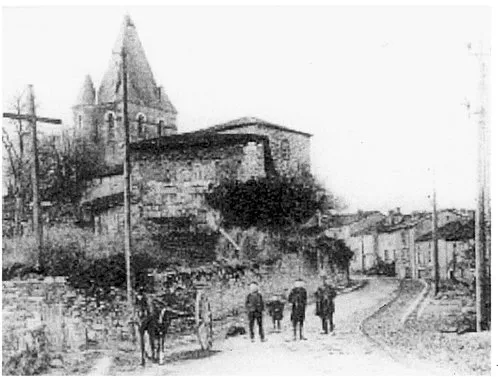
Entrance to the village shortly after the installation of the tramway (note the size of the tree behind the four figures).
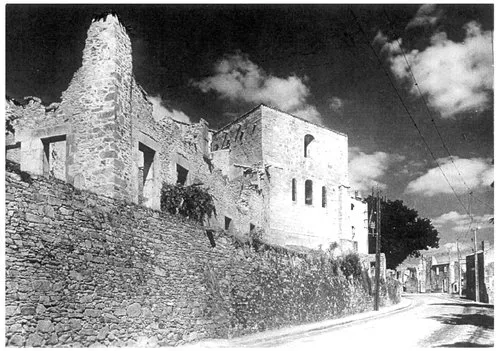
A view of the church at the main entrance to the ruins.
Then, suddenly, there it was, ORADOUR-SUR-GLANE, with nothing to indicate that it was vastly, terribly different from the other villages.
Reality presented two immediate surprises: the warm colour of the ruins, intensified by the evening sun, and the proximity of the church to the main entrance. I had visualised it at the far end. The new village, off to the left, was a cluster of modern, buildings dominated by a large church with a tall, square-cut tower. To anyone who doesn’t know the full terrible story the ruins may seem little more than a curiosity. They are enclosed in a low wall and have three gated entrances that are locked at night.
At each entrance there is a sign which reads simply: SOUVIENS-TOI. REMEMBER. Another sign says visitors should be correctly attired, conduct themselves with decorum, and not go into the houses. Dogs are excluded.
Entrance is free.
The first group of buildings, on the right flanking a pleasant green with trees, bears the notice SILENCE. The roofless church, which once had a steeple, dominates the main entrance. It was the scene of the worst act of the tragedy: the slaughter of hundreds of women and children whose screams were heard for miles around. One can see the window, identified by a tablet, through which Madame Rouffanche, the sole survivor, escaped. The grille which once covered it is still bent outwards, marking the passage of her body. There is a large tablet near the main entrance which tells what happened in the church. It has been fixed to the wall near a crucifix which, claims the inscription, was unscathed.
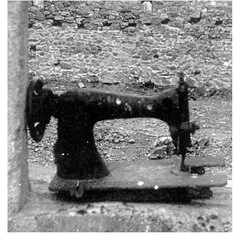
The remains of a sewing machine.
The main street, the Rue Emile Desourteaux, is still bordered on the right, as one ascends between the ruined houses, by the tramlines which linked Oradour with Limoges. The roofless tram station where the line branches into two tracks is about midway up the street.
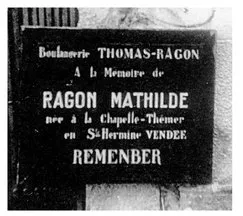
Plaque outside the bakery of Thomas Ragon. Note the misspelling.
As one walks through the ruins a feeling of desolation is augmented by one of a sudden extinction of life, as at Pompeii. The whole population, apart from a few who miraculously got away after the arrival of the SS, died during the afternoon. They were taken from their homes in that picturesque place – even in ruins it is far more attractive than the new village – just after lunch on 10 June, 1944 and herded like cattle to their deaths.
In the ruined kitchens are the remains of saucepans, frying pans, coffee grinders and other utensils, abandoned just as lunch had finished, or even while the meal was being prepared for those who worked late on the land. Garages contain the rusty wrecks of cars. Fire-buckled bicycles hang from nails an walls. No one had a chance to use them to escape. Some houses contain rusty sewing machines, a few of which seem to have been purposely placed on window sills to display the industry of their dead owners. It was a busy little rural community. Unfortunately in these days of widespread vandalism, souvenir hunting and the cynicism of some young people towards the ruins it is likely that over the years some of these things have disappeared. It should not be difficult to gain access after dark.
The Champ de Foire, the village green where the people were assembled by the SS, is on the right of the main street going up. It must have been a delightful place before the war with its varied architecture, trees and covered communal well. Now it is bordered by the empty shells of houses, one of which bears a plaque telling of the assembly.
On the grass are the rusty, wheeless remains of the car which belonged to the village doctor who arrived back from his rounds just as the round-up had been completed. He joined the others. Across the green lie the memorial grounds. A wide, hedged lawn leads to a bench-like arrangement of stones on the roof of a crypt. The crypt contains stone tablets bearing the names and ages of all the victims. In side chambers are display cabinets set in stone holding personal possessions found among the charred human remains: wedding rings and other jewellery, watches, pocket knives, a cigarette case pierced by a bullet, a denture and other such items. Most have been distorted by fire.
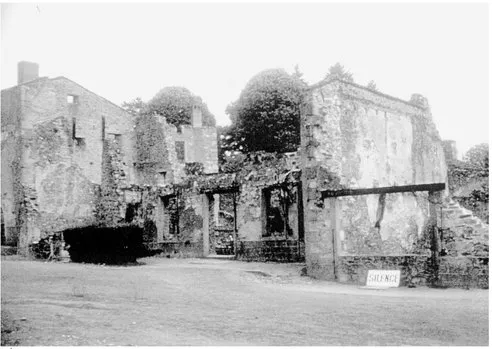
A notice inside the main entrance. Silence is difficult to observe in a party.
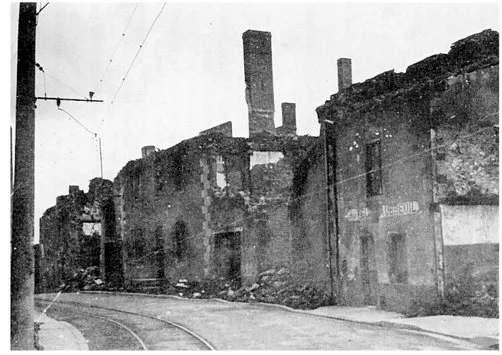
The Hotel Beaubreuil (nearest ruin) in the main street.
Beyond lies the cemetery, dominated by a column which marks the communal grave of 642 people. The stone platform bears two glass-topped coffins in which is displayed a collection of blue-grey human bone fragments. The most pitiful sight is, of course, the family tombs bearing inset photographs of the dead. Whole families are pictured with inscriptions after their names indicating that they were ‘killed’ ‘massacred’ or ‘burned’ by the ‘Nazis’ or ‘Germans’ on 10 June 1944. Some of them bear plastic or porcelain flowers. Some are garish and blatant in their silent expression of grief. The more discreet – such as a plain stone with a single picture of a pretty girl embedded in it and an insciption giving only her name and dates of birth and death – are the most impressive.
People walk quietly about the cemetery peering at the inscriptions. Children read them aloud without understanding their full implications. Some pose against headstones to be photographed.
Six tablets in various parts of the village identify the b...
Table of contents
- Title Page
- Copyright Page
- Table of Contents
- Acknowledgements
- Bibliography
- PREFACE
- PROLOGUE
- CHAPTER 1 - The Ruins
- CHAPTER 2 - The Massacre
- CHAPTER THREE - The Dreadful Toll
- CHAPTER FOUR - The Guilty
- CHAPTER FIVE - Atrocities
- CHAPTER SIX - Resistance
- CHAPTER SEVEN - A Fatal Encounter
- CHAPTER EIGHT - The Motive
- CHAPTER NINE - ‘Justice’
- CHAPTER TEN - The Only Officer
- CONCLUSIONS
- APPENDIX - The Dead
- LIST OF BODIES OF PEOPLE WHO COULD BE IDENTIFIED
- LIST OF PEOPLE PRESUMED DEAD BUT WHOSE REMAINS COULD NOT BE IDENTIFIED
- INDEX
Trusted by 375,005 students
Access to over 1.5 million titles for a fair monthly price.
Study more efficiently using our study tools.
Frequently asked questions
Yes, you can cancel anytime from the Subscription tab in your account settings on the Perlego website. Your subscription will stay active until the end of your current billing period. Learn how to cancel your subscription
No, books cannot be downloaded as external files, such as PDFs, for use outside of Perlego. However, you can download books within the Perlego app for offline reading on mobile or tablet. Learn how to download books offline
Perlego offers two plans: Essential and Complete
- Essential is ideal for learners and professionals who enjoy exploring a wide range of subjects. Access the Essential Library with 800,000+ trusted titles and best-sellers across business, personal growth, and the humanities. Includes unlimited reading time and Standard Read Aloud voice.
- Complete: Perfect for advanced learners and researchers needing full, unrestricted access. Unlock 1.5M+ books across hundreds of subjects, including academic and specialized titles. The Complete Plan also includes advanced features like Premium Read Aloud and Research Assistant.
We are an online textbook subscription service, where you can get access to an entire online library for less than the price of a single book per month. With over 1.5 million books across 990+ topics, we’ve got you covered! Learn about our mission
Look out for the read-aloud symbol on your next book to see if you can listen to it. The read-aloud tool reads text aloud for you, highlighting the text as it is being read. You can pause it, speed it up and slow it down. Learn more about Read Aloud
Yes! You can use the Perlego app on both iOS and Android devices to read anytime, anywhere — even offline. Perfect for commutes or when you’re on the go.
Please note we cannot support devices running on iOS 13 and Android 7 or earlier. Learn more about using the app
Please note we cannot support devices running on iOS 13 and Android 7 or earlier. Learn more about using the app
Yes, you can access Oradour by Philip Beck in PDF and/or ePUB format, as well as other popular books in History & French History. We have over 1.5 million books available in our catalogue for you to explore.