- 296 pages
- English
- ePUB (mobile friendly)
- Available on iOS & Android
eBook - ePub
About this book
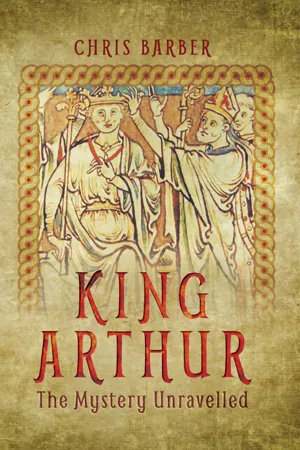
This book is the culmination of over thirty years of work and research by the author, who is a King Arthur specialist and bestseller.The book brings new information to light by examining through a jigsaw of connections throughout Dark Age Britain, especially Wales and Cornwall, as King Arthur is revealed to have been a hereditary King of the ancient land of the Silures in South Wales. In this way, Chris Barber has set out to reveal the true identity of King Arthur, whose identity has been obscured by the mists of time and the imaginative embellishments of romantic writers through the ages. After sorting fact from fiction, he not only identifies the Celtic prince who gave rise to the legend of Arthur, but reveals his family background, 6th century inscribed stones bearing his name and those of his contemporaries; locations of his courts, battle sites such as Badon Llongborth and Camlann; the identity of his enemies, the ancient Isle of Avalon and his final resting place.
Information
CHAPTER 1
Who was King Arthur?
It was the early bards who first mentioned a man named Arthur in their epic war poems which were composed in Rheged, an area of Britain now known as Cumberland. These verses celebrated the military prowess of a man named Arthur and it would seem that in the beginning he was more famous in the north than he was in the south. This has led some historians to locate his story in the border region of Scotland, while on the other hand there are others who firmly believe that his realm was in the West Country. However, the object of this book is to provide proof that the truth of the matter can only be found in Wales.
I will endeavour to explain why so much confusion has arisen and to locate Arthur in his correct place, but first of all it is necessary to sort out the identity of the various Arthurs who have been suggested as the basis for the King Arthur of legend and history.
Arthur of Dalriada
It was in the seventh-century Latin manuscript relating to the Life of St Columbanus (543–615) that the name of Artur (Arthur) was first mentioned.1 It was written by Adomnan, a successor of St Columba, at the monastery of Iona.2 This Artur (born c.570) was the son of Aedan mac Gabrain, King of Dalriada (now Argyll and Kintyre), the area on the north-west coast of Scotland, colonised by the Irish Gaels.3
Artur died fighting the Picts at the Battle of the Miathi, which was fought near the River Forth in Manau Guotodin in about 590–6.4 Miathi appears to be the Irish form of the tribal name Maeatae, described by the Roman writer Dio Cassius as a tribe hostile to Rome, living next to the Antonine Wall.
While Artur mac Aedan is the earliest verifiable personage with the name ‘Arthur’, he is much too late to be the historical King Arthur.5 To identify this Artur of Dalriada with the Arthur of legend is to disregard the evidence contained in Nennius’s Historia Brittonum and the Welsh Annals, and to deny him his most famous victory at the Battle of Badon, fought in c.516. Aedan was well known to the British and he has never been represented in the Arthurian legend.6
Arthurian place names were once common in Strathclyde, a good example being Ben Arthur, near Loch Long, which may be named after Artur mac Aedan.
The Arthur Mentioned by Aneurin
The bard Aneurin in his epic poem Y Gododdin, written in about 595, describes the feats of a certain British hero, called Gwawrddur, by saying that his valour was remarkable, ‘although he was no Arthur’.7 This statement suggests that everyone at that time would have known who Arthur was. Roman names had by then gone out of use in Britain and the Latin name Arturius or Arthurius became shortened to Arthur through changes in speech.
The Votadini were a tribe living in the Edinburgh area and they were fighting the Angles of Deira. The Arthur referred to in this poem was most likely Artur, the son of Aedan mac Gabrain of Dalriada.
Although presumed to be written in the sixth century by the bard Aneurin, the poem may in fact date from the tenth century, or perhaps the ninth, but no earlier. Too much weight has been attached to one line: ‘gochore brein du ar uur/caer ceni bei ef arthur’ – ‘fed black ravens on the rampart of a fort, although he was no Arthur’. This line only appears in one of two versions of the text which casts doubt on its being part of the presumed original sixth-century poem.
There were at least three men named Artur living in south-western Scotland at the time that Y Gododdin was compiled. These were Artur mac Aedan, Artur mac Conaing (probably named after his uncle Artur mac Aedan) and Artur mac Bicoir, who slew Morgan mac Fiachna of Ulster in 620/625.
Artorius the Roman Soldier
In 1925 the suggestion was made that the story of Arthur is based on Lucius Artorius Castus, praefectus castrum of the Sixth Legion. This Roman soldier lived in the second century (c.140–200) and served the Empire in the Middle East, Romania, Italy, Britain and Yugoslavia. He was stationed in Britain and served as praefectus (or prefect) of the VI Victrix Legion, which he led from York in AD 184 to suppress a rebellion in Armorica (Brittany).
There are two monuments near Split in old Yugoslavia which commemorate Lucius Artorius Castus, and one of the inscriptions tells us that he attained the rank of dux in the Roman army. It is relevant that while in Britain, Artorius, just like the Arthur of legend, commanded a band of cavalry, for this could explain why Nennius, writing in the eighth century, using a ‘heap of material’, referred to Arthur as a dux bellorum (battle-leader).
Arthur of Dyfed
A reasonably historical Arthur (c.570–615) once resided in Dyfed (southwest Wales). Of Irish descent, he was Artur mac Petuir (Arthur son of Pedr) and his great-grandfather was Vortiporius (c.470–c.545), whose memorial stone can be seen in Carmarthen Museum.8
Lineage of the Kings of Dyfed
Eochaid Allmuir (‘from Overseas’)
Corath
Aed Brosc
Triphunus Farchog (‘the Knight’)
Aircol Lawhir (Agricola ‘the Long-handed’)
Gwerthefyr (Vortiporix)
Cyngar
Pedr
Arthur
Noe (Nowy)
The Latin Name of Arthur
During the Roman occupation of Britain the name Artorius was quite common, and in post-Roman times it continued to be used. In the latter part of the sixth century there were at least four or five people called Artorius who lived in the Celtic areas of the British Isles.
It is important to emphasise that no Latin sources refer to Arthur as Artorius, but instead the Latinised Welsh version of the name is used, i.e., Arthurus, Arturus or Arturius. If Arthur’s name had come from Artorius we would expect to find the Latin form of the name used in Latin texts such as the Annales Cambriae or the Historia Brittonum, but in both works the name appears as Arthur.
The Historia Brittonum (attributed to Nennius) refers to Arthur as Arturus and this name can be found in the earliest of the surviving manuscripts dating from the tenth or eleventh centuries. In the ancient Book of Llandaff the name Athruis appears and is most likely derived from Arturus.
The normal ending for an individual’s name in Latin is us and such an ending was often added by the Britons to non-Latin names to give them a Latin appearance (hence Arthurus). In the earliest Latin of Nennius and the Welsh Annals the form Arturus is found.
Legend of St Goeznovius (1019) Arturo
Lifric of Llancarfan (c.1073) Arthurus/Arthurius
Vita Carantoci (c.1100) Arthur
Vita Illtuti (c.1100) Arthurii
William of Malmesbury (c.1125) Arturis
Henry of Huntingdon (c.1129) Arthurus/Arturus
Geoffrey of Monmouth (c.1136) Arturus
Caradoc of Llancarfan (c.1150) Arthuro
Giraldus Cambrensis (c.1191) Arthuri
Ralph of Coggleshall (c.1200) Arturi
Seventh–Ninth-Century Arthurs
An entry in the Annals of Tigernach for 620–5 records that ‘Mongon mac Fiachna Lwgan was struck with a stone by Artuir son of Bicoir the Briton and died’.
Athrwys ap Fferfael was the descendant of Athrwys ap Meurig and he ruled Gwent in the time of King Offa of Mercia, who came to power in 757.
Arthgen, King of Ceredigion, is noted in the Welsh Annals as having died in 807. He was the son of Seissil and grandson of Clitauc.
Arthgal or Artgal, one of the last British kings of Strathclyde, died in 872.
Arthur the Soldier
The ninth-century manuscript attributed to Nennius tells us that Arthur was a miles, a soldier, and he states that many men were more nobly born. He also tells us that Arthur fought ‘Cum regibus Brittonium sed ipse dux erat bellorum’ – ‘with the Kings of the Britons, although he was the leader in battle’.
This has resulted in doubt being cast upon Arthur being an actual king and some writers have downgraded him to the role of mere battle-leader. This statement has been much debated and needs careful consideration, for while Nennius states that Arthur led the other kings in battle, he does not definitely say that he was not a king himself. It suggests that by fighting with the British kings he was of equal status. Perhaps, just like William the Conqueror, Arthur was a dux (duke) who became a king.
The words dux bellorum may have been intended as a descriptive term meaning ‘Commander in Battle’. It implies that Arthur held a military title similar to the Comes Britaniae (Count of Britain) or Dux Britaniarum (Duke of the Britons) which were appointed in Britain during the latter years of the Roman administration.9
As a dux bellorum Arthur was something apart and distinctive, and the formal title quite literally means ‘leader of wars’ in the tradition of the Count of Britain. He was the leader of the British resistance against all invaders whose role was to protect Britannia and this he did alongside the rulers of petty kingdoms, he himself being the generalissimo of the Romano-Britons. In this capacity, he commanded a formidable cavalry force, the mobility of which enabled it to move rapidly from one area of Britain to another, opposing external invaders wherever the need was greatest.
It is likely that the medieval romances of Arthur’s knights of the Round Table represent a genuine folk memory of a mounted war band led by Arthur. The Romans had certainly made use of cavalry and two units served in Britain during the fourth century. It would appear that Arthur established a similar mobile force a century later. The best description we have of a sixth-century war-band riding to battle is contained in Aneurin’s epic poem Y Gododdin.
Arthur the Emperor
In a poem called ‘Geraint son of Erbin’, contained in the Black Book of Carmarthen, Arthur is described as ‘Arthur amherawdyr’ – Arthur the Emperor. The Welsh have borrowed the Latin title imperator, ‘emperor’, and made it into ‘amherawdyr’ and it was probably used in its original meaning – that of Commander-in-Chief. This may be explained by the fact that when the Roman imperator no longer had any interest in Britain, the title was given to the highest officer in the island, namely the Comes Britanniae and in this way arose the title ‘yr Amherawdyr Arthur’ – the ‘Emperor Arthur’.
This officer had a roving commission to defend the province wherever his presence might be required. The other military captains were the Dux Britanniarum, who had charge of the forces in the north, especially on Hadrian’s Wall, and the Comes Litoris Saxonici, who was entrusted with the defences of the island’s south-eastern coast.
The successors of both of these captains seem to have been called ‘gweldigs’ (rulers), so Arthur’s suggested position as Comes Britanniae would be in a sense superior to theirs, which fits in with his being called emperor (imperator) and not gwledig.
How the Name Changed from Artur to Arthur
In the sixth century the name was written as Artur or in Latin Arturus or Arturius. The name Artur was Latinised to Arturius and the ‘h’ was added by medieval writers and Artur thus became Arthur. The spelling of Arthur with ‘h’ did not develop until the twelfth century.
Artur – Arturius – Arthurius – Arthur
A good comparison is the Latin name Antoninus – Antony – Anthony. Latin names were also sometimes abbreviated, such as Marcus to Marc. Thus Arthurius may have been shortened to Arthur. It is significant that Latin writers refer to Arthur as Arturus or Arturis but never Artorius.
The Celtic Origin of the Name Arthur
It is necessary to understand that the name Arthur is derived from a number of similar sources which through the passing centuries became very confused. In the Welsh language ‘Arth Fawr’ means the ‘Great Bear’ and in ancient times this was the name given to the polar god who symbolised all the forces that came to us from the region of the seven main stars of the constellation called Ursa Major, which is Latin for Great Bear. The word Arctus comes from the two celestial constellations which are commonly called Ursa Major and Minor and Arcturus is a star near the tail of the Great Bear. Accordingly, Arcturus seems a more likely Latin root for Arthur than Artorius for it dates back to pre-Roman times and it is derived from the early Celtic form Artorix, meaning ‘Bear King’.
Arthur was undoubtedly known as ‘the Bear’ and it is relevant that Celtic personal names and nicknames that referred to animals were popular during the fifth–sixth century period: Bran (crow), March (horse), Morvran (sea crow), etc. Gildas in his De Excidio et Conquesta Britann...
Table of contents
- Cover
- Dedication
- Title Page
- Copyright
- Contents
- Acknowledgements
- Preface
- Chapter 1: Who was King Arthur?
- Chapter 2: Geoffrey of Monmouth
- Chapter 3: Arthur’s Illustrious Ancestors
- Chapter 4: Arthur’s Immediate Family
- Chapter 5: Red Herrings at Tintagel, Camelford and Glastonbury
- Chapter 6: Arthurian Connections in the West Country
- Chapter 7: Arthur’s Conception and Birth
- Chapter 8: The Importance of Erging
- Chapter 9: Educated at Llanilltud Fawr
- Chapter 10: The Crowning of Arthur
- Chapter 11: Merlin, the Round Table and Excalibur
- Photo Gallery
- Chapter 12: The Courts of King Arthur
- Chapter 13: Enemies of the Britons
- Chapter 14: Looking for Llongborth
- Chapter 15: Arthur’s Twelve Battles
- Chapter 16: The Battle of Badon
- Chapter 17: Arthur’s Gallic Campaign
- Chapter 18: The Battle of Camlann
- Chapter 19: The Island of Avalon
- Chapter 20: A New World in Armorica
- Chapter 21: Henry VII, ‘Son of Prophecy’
- Appendix I: Chronology
- Appendix II: The Positive Identification of King Arthur
- Notes
- Select Bibliography
Trusted by 375,005 students
Access to over 1.5 million titles for a fair monthly price.
Study more efficiently using our study tools.
Frequently asked questions
Yes, you can cancel anytime from the Subscription tab in your account settings on the Perlego website. Your subscription will stay active until the end of your current billing period. Learn how to cancel your subscription
No, books cannot be downloaded as external files, such as PDFs, for use outside of Perlego. However, you can download books within the Perlego app for offline reading on mobile or tablet. Learn how to download books offline
Perlego offers two plans: Essential and Complete
- Essential is ideal for learners and professionals who enjoy exploring a wide range of subjects. Access the Essential Library with 800,000+ trusted titles and best-sellers across business, personal growth, and the humanities. Includes unlimited reading time and Standard Read Aloud voice.
- Complete: Perfect for advanced learners and researchers needing full, unrestricted access. Unlock 1.5M+ books across hundreds of subjects, including academic and specialized titles. The Complete Plan also includes advanced features like Premium Read Aloud and Research Assistant.
We are an online textbook subscription service, where you can get access to an entire online library for less than the price of a single book per month. With over 1.5 million books across 990+ topics, we’ve got you covered! Learn about our mission
Look out for the read-aloud symbol on your next book to see if you can listen to it. The read-aloud tool reads text aloud for you, highlighting the text as it is being read. You can pause it, speed it up and slow it down. Learn more about Read Aloud
Yes! You can use the Perlego app on both iOS and Android devices to read anytime, anywhere — even offline. Perfect for commutes or when you’re on the go.
Please note we cannot support devices running on iOS 13 and Android 7 or earlier. Learn more about using the app
Please note we cannot support devices running on iOS 13 and Android 7 or earlier. Learn more about using the app
Yes, you can access King Arthur by Chris Barber in PDF and/or ePUB format, as well as other popular books in History & Military Biographies. We have over 1.5 million books available in our catalogue for you to explore.