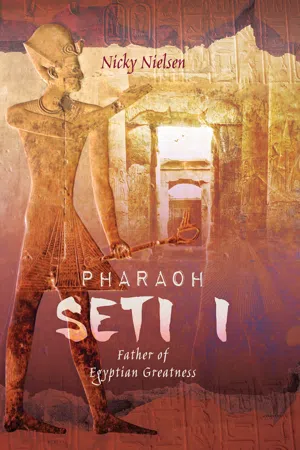
This authoritative biography examines the life and times of the transformative Egyptian ruler and father of Ramesses the Great.
Pharaoh Seti I ruled Egypt for only eleven years, from 1290 to 1279 BC, but his reign marked a revival of Egyptian military and economic power, as well as advances in cultural and religious life. Born the son of a military officer in northern Egypt, Seti grew up far from the halls of power in Memphis and Thebes. But when Horemheb, the last king of the 18th Dynasty, died without an heir, Seti's father was named king. He ruled for only two years before dying of old age, leaving Seti in charge of an ailing superpower.
Seti set about rebuilding Egypt after a century of dynastic struggles and religious unrest. He reasserted Egypt's might with a series of campaigns across the Levant, Libya and Nubia. He dispatched expeditions to mine for copper, gold, and quarry for stone in the deserts, laying the foundations for one of the most ambitious building projects of any Egyptian Pharaoh. His actions allowed his son, Ramesses the Great to rule in relative peace and stability for sixty-nine years, building on the legacy of his father.
- 216 pages
- English
- ePUB (mobile friendly)
- Available on iOS & Android
eBook - ePub
About this book
Information
Chapter 1
Setting the Stage1
A visitor to Cairo’s fabled Tahrir Square cannot fail to notice the bulk of The Museum of Egyptian Antiquities. Within its bright red walls, this neoclassical masterpiece has housed the world’s largest collection of ancient Egyptian artefacts since 1902. While it was built by the French architect Marcel Dourgnon (1858–1911), the museum was originally the brainchild of his compatriot, François Auguste Ferdinand Mariette (1821–1881).2 Mariette worked as an archaeologist in Egypt for most of his life, and rose to become Director of Antiquities in Cairo, spurning academic positions in Europe with the words: ‘I would die or go mad if I did not return to Egypt immediately!’ As he grew older, he became convinced that the customary division of finds after an excavation – European and American excavators would collect some of the better antiquities for their own museums back home – was deeply problematic. Attempting to protect Egypt’s heritage, Mariette founded The Museum of Egyptian Antiquities in a former magazine in the Bulaq neighbourhood of Cairo in 1858, aiming to create a permanent home for the excavated antiquities and limit the number that were making their way out of Egypt to museums or private collectors. Due to flooding and other damage, the growing collection of museum pieces was moved, first to a former royal palace near the Giza Pyramids and then, in the early years of the twentieth century, to its current purpose-built home in Tahrir Square.
As you make your way through the bustle of the square towards the museum, accompanied by the blaring of car horns, you first arrive in the peculiarly peaceful sculpture garden which fronts the museum entrance. Some of the largest pieces of temple relief, sarcophagi and statues ever taken from Egypt’s soil can be found here. Here too is the ostentatious sarcophagus which contains the remains of Mariette himself – a final reward for his service to the antiquities housed all around him.
One of the most visited exhibits accommodated within the museum’s high-ceilinged, echoing halls is the Royal Mummy Room. Inside this dimly lit space lie some of the greatest kings and queens of ancient Egypt, most of them astoundingly well-preserved thanks to the embalmer’s art. Here rests the body of Ramesses the Great, with tufts of auburn hair still curled at his temples, and his toe- and fingernails still clearly visible. Next to him, the mutilated corpse of the Second Intermediate Period Theban King Seqenenre-Tao, who met his death in battle, the injuries from an axe blow to his skull and several stab wounds still horrifically discernible.
Among the most well-preserved mummies in this august company is that of a middle-aged man with a prominent hooked nose, who lies with closed eyes, a slight smile playing around his lips. He appears – despite his shrunken form – to be sleeping peacefully. This is the body of King Seti I, the second ruler of the 19th Dynasty, the father of Ramesses the Great, and the de facto founder of the Ramesside Period. Born as a noble, but not a royal, Seti was not intended for kingship. But kingship was thrust upon him through an unusual combination of circumstances. As one of the Great Kings of the Late Bronze Age Near East, Seti used his time on the Horus Throne of the Living to reinvigorate Egypt’s foreign policy, society and religious life after years of uncertain royal succession and internal strife. It was Seti’s son, Ramesses II, whom history remembers as ‘the Great’, but it was Seti’s reign which gave him the opportunities to earn his moniker.
* * *
Two great tributaries rise in Africa, one in the Great Lakes region and the other in Lake Tana in Ethiopia. These two waterways, the White and the Blue Nile, merge near the modern city of Khartoum in the Sudan before flowing north towards the Mediterranean. At times the river glides serenely past tilled fields, hemmed in by flat-topped foothills of sandstone or limestone, and at others the edge of desert plateaus constrict it on both sides, rendering the land barren and hostile. It forces its way through five granite cataracts before emerging onto the most abundantly fertile regions of its passage; the Nile Valley of Upper Egypt and the Delta of Lower Egypt. As a result of the differences in history and environment, the land which pharaoh ruled was always considered a union of these two lands, Upper and Lower Egypt. Before the construction of the Aswan High Dam, the river reached these lands heavily laden with silt, which it would deposit during its annual inundation. It was around this yearly occurrence, more than any solar events, that the ancient Egyptians constructed their calendar and measured their time.
The ancient Egyptian year was, unlike the Gregorian year, divided into three seasons: Akhet (Season of Inundation), Peret (Season of Growth) and Shemu (Season of Harvest). Each of the three seasons was in turn subdivided into four months, usually counted as 1st, 2nd, 3rd and 4th, each being thirty days long, giving an annual total of 360 days. The five additional days, known as epagomenal days, were added to compensate for the difference between the days listed in the civil calendar and the astronomical year. Each of the twelve months was divided into three weeks, each being ten days in length. Unlike many current calendars, the ancient Egyptian did not count the passing years by ascribing to each a number starting from a significant point in time, like the birth of Jesus Christ in the Gregorian calendar or the emigration of the Prophet Muhammad from Mecca to Medina in the Hijri. Instead, they counted the regnal years of the ruling pharaoh and began again when a new pharaoh rose to power. A full date would therefore be provided in the following manner, this particular example being from the fictional Story of Sinuhe which is set during the reign of Amenemhat I:

Regnal Year 30, Month 3 of Akhet (Inundation), Day 7
The date given then is the seventh day in the third of four months of the first season of the thirtieth regnal year of Amenemhat I. In modern terms, this date would fall in early August 1956 BC.
If a modern traveller could have followed the flow of the river in the time of Seti’s ascension, they would have passed by small villages; in the Nile Valley set close to the banks of the river, and in the Delta built on small hillocks to prevent flooding during the inundation.3 The farmers would have been working the soil of their fields with wooden hoes, sowing emmer wheat and barley by hand and leading flocks of animals – cattle, goats and sheep – across the mud to trample the grain into the ground. The wealth of Egypt was in its fertile earth; a gift – as the Classical author Herodotus of Halicarnassus noted – of the Nile. In every village, bakers spent their time huddled around small domed ovens, making bread by slapping a flat circle of dough on their red-hot clay interior, and catching the finished flatbread before it fell into the flames. This method of baking was in many ways comparable to the baking of tandoori naan across much of the Near East, India and China today. Larger loaves of bread were baked in ceramic moulds, and for special feasts and celebrations, bread was baked in the shape of animals and sweetened with figs and dates, or flavoured with spices such as coarsely crushed coriander seeds. Beer was brewed nearby, for it utilized the same basic raw ingredient cereals although bread was mostly made from emmer wheat and beer from barley. Ancient Egyptian beer had little in common with modern ales and stouts; rather it was brewed from cooked grain and malt, fermented in the sun, and equivalent in taste to modern wort.
Fishing boats made from bound reeds would have crowded the river, catching catfish and Nile perch with lines and nets, and hunting hippopotami with large bone harpoons, a dangerous task considering the temperament of these monstrous aquatic mammals. The slow rhythm of the bucolic scene would be interspersed with activity surrounding the major settlements: Elephantine lying on the doorstep to Nubia; Thebes, the town of Amun and the burial site of the New Kingdom pharaohs; Memphis, the city of the white walls, the traditional capital of Egypt since the Early Dynastic Period. The landing areas and harbours would have been bustling with workers carrying amphora of wine and olive oil, ingots of copper, planks of cedar wood traded from Byblos on the Canaanite coast, foreign captives and all manner of mammals, birds and fish, some preserved by drying or brining, others walking unknowingly to the slaughterhouses in the courtyards of villas and palaces.4
The focal point of these cities were the temple districts, large stone structures standing out in a sea of mud-brick houses, their undulating temenos walls signifying the divine waters of creation and the inner shrines with golden idols of the local god closed to all but pharaoh himself and the High Priest appointed in his absence. Sculptors and artists worked in the temples, carving statues and relief from blocks of limestone, sandstone, granite, diorite and alabaster birthed from the rock face in quarries across the eastern desert and along Egypt’s southern border. Expeditions sent out by the temples and by royal decree would return with gold from mines in Wadi Hammamat and Wadi Allaqi cast into crude rings for ease of transportation, and turquoise from the mines at Serabit el-Khadim in south-western Sinai.
Much of the metal and precious stones was transformed into images of the gods or jewellery worn by the royal family and their entourage. Some would undoubtedly be traded by the merchants working for the temple institutions, along with the surplus produce of temple lands. Royal scribes, commanders of the army, priests and all manner of officials would have thronged the palaces built near the temple districts, or else taken their ease within the shady tranquillity of their own villas, managing their private fortunes as well as working on the myriad tasks required for the central administration to function. A description of such an elite mansion from Papyrus British Museum 9994 dating to the 20th Dynasty gives a clear impression of their wealth and splendour:
‘Raia has built a beautiful mansion […] It is constructed like a work of eternity. It is planted with trees on all sides. A channel was dug in front of it […] One is gay at its door and drunk in its halls. Handsome doorposts of limestone carved and chiselled. Beautiful doors, freshly carved. Walls inlaid with lapis lazuli. Its barns are supplied with grain, are bursting with abundance. Fowl yard and aviary are filled with geese; byres filled with cattle.’5
At the head of this throng of courtiers and wealthy nobles stood the viziers, one for Upper and one for Lower Egypt based in Thebes and Memphis. In theory, pharaoh ruled supreme over all these people, from the viziers and troop commanders in the cities to the farmers and bakers in their villages.
* * *
The Pharaonic civilization dominated Egypt from the Early Dynastic Period (c. 3000 BC) until the defeat of Cleopatra and Mark Antony at the hands of the later Emperor Augustus in 30 BC. Egyptologists sub-divide this extensive period of time firstly into ‘kingdoms’ (Old Kingdom, Middle Kingdom and New Kingdom), interspersed with periods of either unrest or significant decentralization and weakening of royal power known as ‘intermediate periods’ (First Intermediate Period, Second Intermediate Period and Third Intermediate Period). The most basic division (aside from the reign of individual kings) is the division of Pharaonic history into thirty-two ‘dynasties’, denoting specific ruling houses or families, often hailing from a specific geographical region. The 19th Dynasty for instance, was founded by Ramesses I, a non-royal military officer who most likely came from the north-eastern Delta region. This division of Egyptian history into dynasties is not a chronological tool invented by modern scholars. Rather, it dates back to the enigmatic historian Manetho.6
Living during the reign of the early Ptolemaic rulers who had risen to power in Egypt during the third century BC following Alexander the Great’s conquest of the country in 332 BC, Manetho was an Egyptian priest from the Delta city of Sebennytos. He was a native Egyptian, but wrote several important works on Egyptian history in Greek, most likely on the orders of the new Greek-speaking Ptolemaic rulers who wanted to know the history of the country they now controlled. Manetho obliged and, using written sources held in Egyptian temples which have since been lost to history, he composed the Aegyptiaca, a comprehensive overview of the reigns of many Egyptian pharaohs.
Manetho began his recitation of royal reigns with the divine rulers of Egypt, and claimed that during the first 13,900 years of Egyptian history, the country was ruled by various gods, followed by five millennia of rule by demi-gods and finally an additional five millennia where the country was ruled by the Spirits of the Dead. After this (somewhat unlikely) list, Manetho discusses the human rulers of the country, whom he sub-divided into ‘dynasties’ using the Greek term δυναστεία. Manetho’s dynastic division is still broadly maintained in common usage to this day, although several alterations and additions have been made, notably the introduction of Dynasty 0, a dynasty comprised of very early rulers of Egypt whom Manetho does not mention but whose existence has been verified predominantly by archaeological excavation of their tombs.
While Manetho’s broad chronological divisions have been retained in modern Egyptology, there are significant problems with the historicity of his work and its transmission. The most serious of these issues is the fact that no intact copy of the Aegyptiaca has survived. Instead, references and quotations from this work have been preserved only in the writings of later authors, such as the Jewish historian Josephus (AD 37–100), the Roman author Sextus Julius Africanos (AD 160–240) and the Byzantine historian George Syncellus (eighth century AD). These authors biased Manetho’s writings by their own interpretations and the selections they made among his work.
This long gap between the supposed composition of the work in the third century BC and the first mention of its existence more than 300 years later by Josephus also raise significant doubts about the historicity of Manetho himself, and suggests that while he may have composed some type of historical text, the actual authors of the Aegyptiaca post-date him. This theory is also supported by the existence of at least three clearly different versions of the text quoted by various later authors.
In compiling his original manuscript, Manetho (or other authors whose names have not survived) undoubtedly used existing records in the form of king lists.7 Such compilations of Egyptian rulers had been in existence at least since the Early Dynastic Period.8 During the 5th Dynasty, a more comprehensive king list – known as the Palermo Stone – was carved which, apart from listing kings of Egypt from the 1st to the 5th Dynasty, also included reference to notable events during the reigns of individual kings, such as the raids against Nubia by the 3rd Dynasty King Snefru as well as extensive records of the height of the annual Nile inundation, along with tax records and details of religious activity and building projects. The term ‘Palermo Stone’ is only partially truthful, as the original stela upon which this information was inscribed is in fact broken into seven fragments, only the largest of which is housed in the Regional Archaeological Museum Antonio Salinas in the Sicilian city of Palermo. Smaller pieces are kept in Cairo and the Petrie Museum of Archaeology in London. The original location of the stone is unknown, although it may have originated from the Memphite area, from where it was most likely uncovered during elicit excavations in the 1850s and sold to the Sicilian lawyer Ferdinand Guidano, who donated it to the museum.
No comprehensive king list has yet been discovered from the Middle Kingdom, although the Mit Rahina inscription dated to the reign of Amenemhat II preserves similar lists of military activity, tributes paid to the Egyptian state as well as rewards given to soldiers and courtiers, albeit only during the reign of Amenemhat II himself. Only with the advent of the 18th and 19th Dynasties are more extensive king lists preserved in the historical record. The first of these is the Karnak King List9 carved in the Festival Hall of Thutmosis III at the Karnak Temple during the reign of this monarch and currently held in the Louvre Museum in Paris (E. 13481). By comparison to the Palermo Stone and also later king lists, it presents a heavily edited or abbreviated version of Egyptian history listing only sixty-one rulers from Snefru of the 4th Dynasty to Thutmosis III himself. It leaves out most of the rulers of the 13th Dynasty, along with several rulers of the New Kingdom, including Thutmosis III’s own stepmother, Hatshepsut, who ruled as pharaoh before he came of age. By comparison, through archaeological exploration, and from the king lists of the 19th Dynasty, modern Egyptologists count as many as 200 ru...
Table of contents
- Cover
- Dedication
- Title
- Copyright
- Contents
- Maps
- Foreword
- Acknowledgements
- Chronology of Ancient Egyptian History
- Author’s Note
- Chapter 1 Setting the Stage
- Chapter 2 The Family Business
- Chapter 3 Smiting Foreign Lands
- Chapter 4 Houses of Life and Eternity
- Chapter 5 The Supporting Cast
- Chapter 6 An Eternal Resting Place
- Chapter 7 Rediscovering a Ruler
- Postscript: Who was Seti?
- Abbreviations
- Notes
- Selected Sources
- Plate section
Trusted by 375,005 students
Access to over 1.5 million titles for a fair monthly price.
Study more efficiently using our study tools.
Frequently asked questions
Yes, you can cancel anytime from the Subscription tab in your account settings on the Perlego website. Your subscription will stay active until the end of your current billing period. Learn how to cancel your subscription
No, books cannot be downloaded as external files, such as PDFs, for use outside of Perlego. However, you can download books within the Perlego app for offline reading on mobile or tablet. Learn how to download books offline
Perlego offers two plans: Essential and Complete
- Essential is ideal for learners and professionals who enjoy exploring a wide range of subjects. Access the Essential Library with 800,000+ trusted titles and best-sellers across business, personal growth, and the humanities. Includes unlimited reading time and Standard Read Aloud voice.
- Complete: Perfect for advanced learners and researchers needing full, unrestricted access. Unlock 1.5M+ books across hundreds of subjects, including academic and specialized titles. The Complete Plan also includes advanced features like Premium Read Aloud and Research Assistant.
We are an online textbook subscription service, where you can get access to an entire online library for less than the price of a single book per month. With over 1.5 million books across 990+ topics, we’ve got you covered! Learn about our mission
Look out for the read-aloud symbol on your next book to see if you can listen to it. The read-aloud tool reads text aloud for you, highlighting the text as it is being read. You can pause it, speed it up and slow it down. Learn more about Read Aloud
Yes! You can use the Perlego app on both iOS and Android devices to read anytime, anywhere — even offline. Perfect for commutes or when you’re on the go.
Please note we cannot support devices running on iOS 13 and Android 7 or earlier. Learn more about using the app
Please note we cannot support devices running on iOS 13 and Android 7 or earlier. Learn more about using the app
Yes, you can access Pharaoh Seti I by Nicky Nielsen in PDF and/or ePUB format, as well as other popular books in History & Historical Biographies. We have over 1.5 million books available in our catalogue for you to explore.