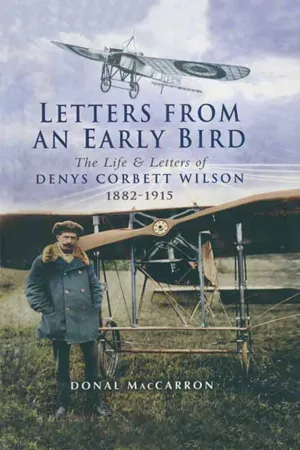
eBook - ePub
Letters from an Early Bird
The Life & Letters of Denys Corbett Wilson 1882–1915
- 224 pages
- English
- ePUB (mobile friendly)
- Available on iOS & Android
eBook - ePub
About this book
This is the story of an early pioneer aviator who took to the air just a few years after the Wright Brothers proved that man was capable of controlled powered flight. Corbett Wilson (CW) was the only son of a wealthy family and was educated at Eaton from 1896 to 1899. He was commissioned into the Dorset Regiment and served in the South African War, by the end of which he had transferred to the Royal Artillery and became a Lieutenant in 1908. CW enrolled at the Bleriot Flying School at Pau in southern France and upon gaining his wings purchased a Bleriot XI aeroplane. Later he flew from Hendon Aerodrome and from there he made the first flight across the Irish Sea. When World War I loomed CW joined the military division of the newly formed Royal Flying Corps and in August 1914 he took off from Dover for France with No. 3 Squadron. It is this point that the vividly written letters sent to his mother give an enthralling insight into the developing war and the early military use of aircraft in battle. He lasted just ten months before being shot down by enemy flack on 15 May 1915.
Information
Topic
HistoriaSubtopic
Historia militar y marítimaContents
| Acknowledgements | |
| Foreword Base | |
| Preface | |
| 1 | The Corbett Wilsons |
| 2 | Gaining his Wings |
| 3 | The Man and his Machine |
| 4 | The Challenge |
| 5 | The Crossing |
| 6 | Another Rival: Vivian Hewitt |
| 7 | In Irish Skies |
| 8 | CW Joins Up |
| 9 | European Adventures |
| 10 | The RFC Flies Off to War |
| 11 | Letters: 13 August to 4 November 1914 |
| 12 | Forward Base |
| 13 | Letters: 5 to 24 November 1914 |
| 14 | Lt-Col Robert Loraine, RFC |
| 15 | Letters: 25 November to 25 December 1914 |
| 16 | Silent Night – Hilarious Day |
| 17 | Letters: 28 December 1914 to 26 January 1915 |
| 18 | Moranes, at Last! |
| 19 | Letters: 6 to 17 February 1915 |
| 20 | The First Battle |
| 21 | Letters: 26 April to 9 May 1915 |
| 22 | The Last Battle |
| 23 | Envoi |
| 24 | Remembrance |
| Index |
Acknowledgements
At the top of this list must come Richard Corbett who lived at East Grinstead in Surrey some forty years ago. He was a first cousin of Denys Corbett Wilson and he generously placed the pioneer’s letters and other ephemera at my disposal.
I also acknowledge Air Marshal Sir Freddie Sowrey, for his help and encouragement and for capturing the spirit of the work in his Foreword. Sir Freddie was for many years the President of Cross & Cockade International, the premier group of historians on the air war of 1914–18.
A special thanks to Paul Williams in Wales who made his photo collection available. Paul produced a commemorative booklet for the 75th anniversary of CW’s crossing but did not include the letters. For his enhancement of illustrations I found an expert in Greg Stockdale. In Ireland, my thanks to Madeleine O’Rourke, aviatrix extraordinaire, and to P.J. Cummins.
Two stalwarts in the Archives of the RAF Museum at Hendon are Peter Elliott and Andrew Renwick whom I couple with Jack Long, the chronicler of No. 3 Squadron RFC/RAF, the premier British squadron, in thanking them for their support.
I send paternal greetings to my son John MacCarron, acknowledging his gentle prodding to get the book done, and for his computer expertise.
Finally, I claim for myself any accidental omissions in the above list, and any errors elsewhere in the book.
DMacC
Gerrards Cross
February 2006
Foreword
Air Marshal Sir Frederick Sowrey KCB, CBE, AFC
(Past President of Cross & Cockade International)
Writing a foreword for an era out of one’s time is never simple. Attitudes, social conventions and even words change and this is particularly so in flying. Here, personal experience is further up the scale of development of a phenomena which is barely one hundred years old. However in any period there is an immediate kinship with the persistent pioneers like Denys Corbett Wilson. He was also a trailblazer. His landmark crossing of the Irish Sea by air and work in introducing flying to Ireland are of historical importance at a time when every flight was a step forward in knowledge.
As an early member of the Royal Flying Corps in 1913 he helped to set the conditions for the expansion to 22,000 aircraft four years later. This growth was only possible for an organisation confident in its own ability to absorb the four generations of aircraft development compressed into the war years.
Descriptions of early flying can be technical but lack the human touch. However these ‘Letters From an Early Bird’ combine both, and add a fascinating relationship between mother and son which contains much of the minutiae of everyday life which is normally absent. What shines from the pages is enthusiasm and courage with the fearless ability to ‘fly anything with wings on it’. Additionally, Corbett Wilson was a strategic thinker with a practical scheme to bomb Berlin – a formative use of air power.
Perhaps the greatest importance is to show the thoughts and feelings of one of the first men at war in a new environment and his relationship in this maelstrom with the woman who bore him. His tenderness for her safety and well-being; his love of animals; his concerns for his own men as well as a realistic approach to his enemies show an individual whose death after ten months of conflict robbed us all of a man who would have continued to chronicle the first war in the air with truth and sensitivity.
Preface
Some forty years ago as a writer with an interest in aviation, particularly anything pertaining to my native Ireland, I became aware of the exploits of Denys Corbett Wilson, a pioneer in the new art of powered flight. Luckily I met one of his nephews who provided me with copies of the letters which the pilot had sent to his widowed mother during the early days of the Great War. This collection forms the corpus of my book for which I take no credit. Thanks to DCW’s keen observations, we are given a unique account of the first air war fought, on both sides, in aircraft which were not very far removed from that of the Wright Brothers a mere decade earlier. I have not attempted to edit the letters other than to include some explanatory notes. I have, however, prepared some chapters as background to the exciting life of an experienced aviation pioneer and his later wartime exploits.
Readers who travel in the comfort of today’s aircraft, even in the sometimes cramped seats of economy class, cannot conceive of the spartan conditions endured in the exposed cockpit of a Bleriot. Perhaps this can be compared to cycling downhill at speed into a strong icy wind? There the comparison ends. Pedal power is unlikely to give out and at a few feet above terra firma is remote from an uncontrollable descent from on high caused by engine or structural failure or bad weather. And cycling is a peaceful pursuit, usually free from hostile firepower!
Of course, a pleasant flight on a bright summer day could also be experienced with the added bonus of sailing over the picturesque landscape at unheard-of speeds. But the hazards faced by early aviators who sought to emulate the birds in the rudimentary flying machines of the early 1900’s were enormous. A robust courage was required.
In CW’s adopted country the new art of aviation was centred on Dublin where a notable air display took place in 1910, followed two years later by ‘The Great Flying Race from Dublin to Belfast – and Back’. The catalogue for this event declared: ‘The Aero Club of Ireland has characteristically seen to it that the profits (from the earlier event) should only be a means to a further end. The monies so made have served to keep together the band of pioneer enthusiasts and believers until they have grown in the brief space of two years to a well-established body …’.
Further south, CW was entertaining huge crowds with his flights – while keeping an eye on developments elsewhere. In August 1913 another pioneer, Harry Hawker had a ‘walkover’ in a somewhat abortive ‘Round Britain Seaplane Race’ which provoked an article by the editor of The Irish Times entitled ‘The Strain of Flight’. CW’s response to this ran as follows: ‘In your leading article of your issue of 19th August, you enumerate various difficulties to be met with in such a contest, and go on to say that the chief of these is the continued strain, to the pilot, in a long flight. For human weakness there is no remedy – this, a propos of Mr. Hawker’s four hours’ flight, with one stop, from Southampton to Yarmouth in a Sopwith Seaplane. Now, I do not wish to belittle a fine performance, but in discussing “long flights” and the strain of such to the pilot, I should like to remind you of, and of necessity compare, flights put up by French aviators …’. CW went on to enumerate a long list of flights on the Continent which had lasted non-stop up to eight hours. He continued: ‘When considering these flights, one must remember that they were over every imaginable kind of country, from the Ardennes to the Pyrenees … I write at length, as in my opinion nothing is gained by writing articles in which a four hours’ flight, with a stop, is cited as an unheard of strain. Look at the map of Europe, and remember what our friends over the water are doing every day’.
Corbett Wilson was giving a wake-up call to Britain which he considered to be over complacent. He was imbued with the hopes and spirit of the true pioneer. A poet encapsulated this attitude in the following lines:
From Icarus to Bacon we dared the deadly quest,With courage never shaken by failure manifest;So strove to sail the glad air, so passed the torch alightFrom Caley unto Ader, to Langley, Roe and Wright.
Donal MacCarron 2006
CHAPTER ONE
The Corbett Wilsons
This is the tale of an early pioneer aviator who took to the air just a few years after the Wright brothers proved that man was capable of controlled powered-flight. He was an Anglo-Irishman named Denys Corbett Wilson – the only child of a wealthy family. He was born on 24 September 1882 at Thames Ditton, Surrey, a prosperous town in the environs of London. His mother was Ada Caroline Wilson, née Corbett, from County Kilkenny. His father was William Henry Charles Wilson, a successful barrister known as ‘Carlos’. The extended family enjoyed a life of Edwardian elegance.
Their Surrey home, Imber Court, had belonged to Carlos’s grandfather since 1861 and remained so until the end of the century. Part of the estate is now the Headquarters of the London Metropolitan Mounted Police, but the house i...
Table of contents
- Cover
- Half Title
- Full Title
- Copyright Page
- Contents
Trusted by 375,005 students
Access to over 1.5 million titles for a fair monthly price.
Study more efficiently using our study tools.
Frequently asked questions
Yes, you can cancel anytime from the Subscription tab in your account settings on the Perlego website. Your subscription will stay active until the end of your current billing period. Learn how to cancel your subscription
No, books cannot be downloaded as external files, such as PDFs, for use outside of Perlego. However, you can download books within the Perlego app for offline reading on mobile or tablet. Learn how to download books offline
Perlego offers two plans: Essential and Complete
- Essential is ideal for learners and professionals who enjoy exploring a wide range of subjects. Access the Essential Library with 800,000+ trusted titles and best-sellers across business, personal growth, and the humanities. Includes unlimited reading time and Standard Read Aloud voice.
- Complete: Perfect for advanced learners and researchers needing full, unrestricted access. Unlock 1.5M+ books across hundreds of subjects, including academic and specialized titles. The Complete Plan also includes advanced features like Premium Read Aloud and Research Assistant.
We are an online textbook subscription service, where you can get access to an entire online library for less than the price of a single book per month. With over 1.5 million books across 990+ topics, we’ve got you covered! Learn about our mission
Look out for the read-aloud symbol on your next book to see if you can listen to it. The read-aloud tool reads text aloud for you, highlighting the text as it is being read. You can pause it, speed it up and slow it down. Learn more about Read Aloud
Yes! You can use the Perlego app on both iOS and Android devices to read anytime, anywhere — even offline. Perfect for commutes or when you’re on the go.
Please note we cannot support devices running on iOS 13 and Android 7 or earlier. Learn more about using the app
Please note we cannot support devices running on iOS 13 and Android 7 or earlier. Learn more about using the app
Yes, you can access Letters from an Early Bird by Donal MacCarron in PDF and/or ePUB format, as well as other popular books in Historia & Historia militar y marítima. We have over 1.5 million books available in our catalogue for you to explore.