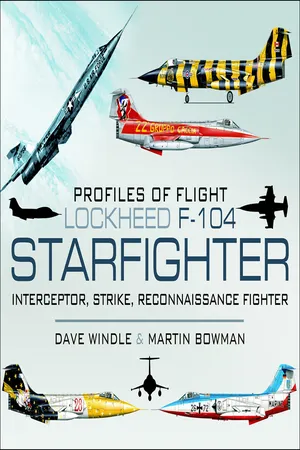
The Starfighter was once described as a delight to fly, but one mistake and it will kill you. It is one of the worlds fastest fighters with a top speed of Mach 2.2 and a service ceiling of 58,000 feet. First delivered to the USAF in 1958 it was also sold to the German, Greek, Italian, Turkish and Italian Air Forces. It could carry a variety of air to air, and air to surface missiles and was powered by a single General Electric J79 turbojet that developed 17,900lbs of thrust with afterburner. The Italian Air Force continued to fly it into the 21st Century.This book contains the world famous color profiles created by Dave Windle of the type in different operational modes, configurations and color schemes. Martin Bowman has written detailed descriptions and photographs to create the perfect enthusiasts' reference.
No other aircraft in the history of aviation has engendered more controversy or such notoriety and suffered such a high a loss rate over a short period as the Starfighter. Known sometimes as the ‘Missile with the Man in It’ the F-104 had such stubby little wings that many inferred that it had ‘no visible means of support’. Early on the Starfighter was beset with a number of operational problems that resulted mainly from the troublesome General Electric J79-GE-7A engine. By the time the F-104 had logged its 100,000th flight hour, in April 1961, 49 out of 296 Starfighters operated by the USAF had been lost and 18 pilots killed–none of them in combat. From 1958 to early 1963 there were forty serious incidents, which resulted in the deaths of nine pilots and the loss of twenty-four aircraft, and the USAF cut back its F-104 orders. Lockheed’s failure to produce F-104s in greater numbers and the loss of so many aircraft looked potentially disastrous for the Burbank, California, company. Yet, within a few years the Starfighter had won a worldwide market with licence production underway in seven countries. Their governments rushed to buy F-104s in great numbers for their air arms, even when they looked ill suited for the role they were chosen for and when other designs offered more for the same money. But the publication in 1975 of a Lockheed company report revealed that $22 million in ‘sales commissions’ had been paid to foreign officials, including at least $1 million to Prince Bernhard of the Netherlands. The bribes scandal forced the chairman, vice-chairman and president of the Lockheed Aircraft Corporation to resign. On 1 September 1977 the Lockheed Aircraft Corporation became Lockheed Corporation. F-104 production continued unabated and two years later worldwide Starfighter production ended at 2,577–1,241 of them having been built in Europe.
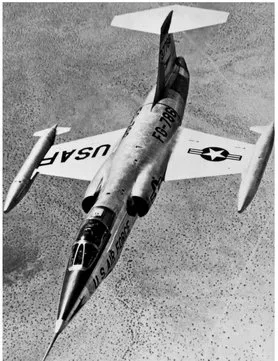
XF-104-LO FG-786 (53-7786), the first of two XF-104 single-seat prototypes ordered on 12 March 1953. (Lockheed)
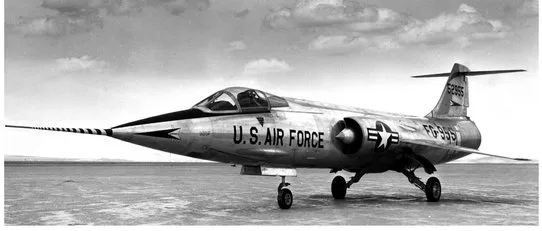
YF-104A FG-955 (55-2955), one of seventeen YF-104As built for service trials with the J79-GE-3 engine. Mach 2 was achieved in an YF-104 on 27 April 1955. (Lockheed)
The F-104 originated in May 1952 when Lockheed were offered a contract for the construction of prototypes of a Wright J67-powered, 16-ton interceptor, but the company, whose Advanced Design Group was already working in secret on a much simpler and considerably lighter proposal (the CL-246), declined. In 1951 Hall Hibbard, Lockheed’s chief engineer, and Clarence L. ‘Kelly’ Johnson, assistant chief engineer and chief designer, were determined to create a successful lightweight, uncomplicated jet-fighter design, especially since American fighter pilots in Korea had told Johnson this was what they required. Both men had worked on the P-80, which had been contracted by the USAAF in June 1943 and was completed in just 143 days. After returning from Korea (following a trip in 1951 to see how his F-80 performed), in November 1952 Johnson (named chief engineer at Burbank that same year) began to design a dedicated air superiority fighter, even though at this time, the USAF had no requirement for such an aircraft. Design was carried out at the famous Advanced Development Projects Section or the Lockheed ‘Skunk Works’ as it was known. This had its origins at the beginning of the P-80 programme when ‘Kelly’ Johnson, then assistant to Hall Hibbard and chief designer, had housed his ADP (Advanced Development Project) Section in temporary accommodation next to a plastics factory. Its location earned the nickname‘Skunk Works’, after the foul-smelling factory in Al Capp’s ‘Lil Abner’ comic strip. (The name stuck and the ADPs later became the Lockheed Advanced Development Company, or LADC, which years later was responsible for building the F-1117A Stealth fighter).
During the development of the F-104, Lockheed drew heavily upon information gleaned during NACA (National Advisory Committee for Aeronautics) wind tunnel tests of the proposed Douglas X-3 Stiletto project, built to investigate the design features of an aircraft suitable for sustained supersonic speeds and which flew on 20 October 1952. Because of adverse drag divergence and pressure shifts at transonic speeds, the Douglas team designed the low-aspect ratio wing for the X-3 with a thickness chord ratio of only 4.5 per cent. The Model 83 (F-104) wing would embody much the same characteristics as the X-3 wing. It would have a sharp leading edge with a thickness ratio of just 3.36 per cent and a maximum thickness of only 4.2 inches adjacent to the fuselage and only 1.96 inches at the tips. At least fourteen completely different designs, including ones with rocket propulsion, wingtip-mounted tail booms, nacelle-retracting landing gear and low-mounted stabilizer were considered before the radical Model 83 design was complete. Considered to be years ahead of its time, it had a long, tapered nose and a short, stubby, unswept, very thin wing, which would encounter little drag. This wing, which the Skunk Works had finally decided upon after first considering delta and swept-wing designs, would extend only
feet from the fuselage and it was angled downwards 10 degrees. The leading edge was so thin it was said that it was sharp enough to cut meat with. Another unique feature was a high T-tail configuration with all-moveable stabilators (stabilizers and elevators), which moved as one unit.
It was believed that the high T-tail posed a hazard in any upward ejection from the aircraft so both XF-104 single-seat tactical fighter prototypes ordered on 12 March 1953 with Wright XJ65-W-6 engines of 7,800lb thrust and 10,200lb with afterburner would be fitted with a Lockheed-built downward-firing rocket-propulsion ejection seat system, the first fully automatic system used on any production fighter aircraft. When these fears proved groundless the Starfighter received an upward-firing rocket-powered Lockheed C-2 ejection seat. Although quoted as ‘zero-zero’-capable (zero speed and altitude), a forward speed of at least 98 knots was required for a successful ground level ejection.
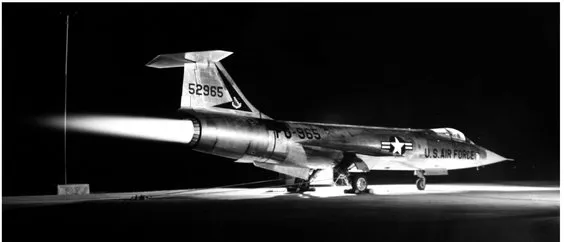
YF-104A-11 55-2965 in full 14,800lb afterburner thrust during a night engine run at Edwards AFB, California, in May 1957. (Lockheed)
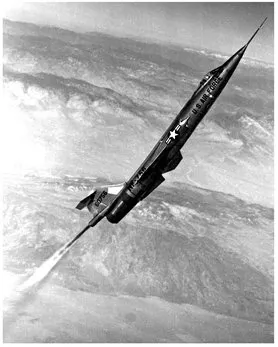
NF-104A-LO 56-0756 zoom-climbing over the Mojave Desert, its Rocketdyne rocket motor at full 6,000lb thrust. (NASA/AFMC History Office)
The Skunk Works created a very lean and lightweight fighter with a high thrust-to-weight ratio to give it an advantage in the supersonic speed regime in which it would fly and fight. At an all-up weight of just 10,500lb the XF-104 was half the weight of its competitors–the Northrop N-102 Fang, North American NA-212 F-100B (J) Ultra Sabre and the Republic AP-55 Thunderwarrior. Colonel Bruce Holloway at the Pentagon was so impressed with Johnson’s proposal, that even though there was no requirement for a design such as the XF-104 he would ‘make one!’ A list of requirements under Weapon System 303A was drawn up for a pure air superiority day fighter with exceptional climb rate, speed, ceiling, agility and manoeuvrability to supplement and, later replace, the F-100 Super Sabre. General Donald L. Putt (commander USAF Systems Command from 30 June 1953 to 14 April 1954) and General Don Yates concurred and a General Operational Requirement was issued for a lightweight air superiority fighter. One of the major headaches confronting the Skunk Works propulsion engineers was the choice of turbojet for the XF-104. The Allison J71 was projected to produce up to 14,000lb thrust, the Pratt & Whitney J75 up to 21,000lb thrust and the General Electric J79, up to 25,000lb thrust, all with afterburning. The J79 offered better specific fuel consumption and lighter dry weight than the two other American engines but it was not expected to be available until early 1956 so Lockheed selected the non-afterburning Wright Aeronautical XJ65-W-6, an Americanized version of the Armstrong-Siddeley Sapphire axial-flow turbojet. This engine, which was built by the Buick Motor Division of the General Motors Corporation, was capable of 7,800lb dry-thrust (later versions developed 10,300lb thrust with afterburning). Lockheed had to design two different airframes because the J65 and J79 each required different engine air inlets and exhaust outlets and the XF-104s were limited in Mach by the inlet temperature of the J65 and J79 power plants.
In January 1953 the Model 83 design was selected under Weapon System WS-303A and on 12 March Lockheed received a Letter Contract for two XF-104-00-LO prototypes (Model 083-92-01). The mock-up was studied and it led to the substitution of a rotary six-barrelled 20mm General Electric M61 30mm Vulcan cannon being mounted in the forward fuselage in place of the two 30mm cannon originally suggested by Lockheed before the mock-up was approved on 30 April.
The end of the Korean War on 27 July 1953 removed the need for a high-performance air superiority fighter from the priority list but subsequent events prompted Lockheed to propose a new career for the Starfighter. Originally, Air Defense Command had anticipated replacing the F-102 Delta Dagger fighter-interceptor with the F-106 Delta Dart by 1954 but the project had been delayed. (The F-106 finally entered service in July 1959.) The XF-104 mission was changed therefore to that of air defence fighter-interceptor with a secondary role as an air superiority fighter. As test pilot Milton O. Thompson once said, the F-104 ‘was designed only to get to high altitude fast and pass by the enemy at high enough speed to avoid a dogfight and a retaliatory missile. It was never intended to be a dogfighter; instead, it was a greyhound built to nip at the butt of the pit bulls as it passed by’.
In January 1954 the first XF-104 was built in such strict secrecy that there was no official roll-out party. 53-7786 (Company designation 1001) and 53-7787 (Company designation 1002) were taken to the top secret North Base Area at Edwards AFB in the Mojave Desert where Lockheed Chief Test Pilot, Tony LeVier, and test pilot Herman ‘Fish’ Salmon flew both prototypes in the test evaluation programme. 53-7786 was used as the aerodynamic test bed while 53-7787 was used to test the armament. Early problems with lateral directional stability revealed a need for a ventral fin. On 28 February 1954, XF-104 53-7786 made an unscheduled short and straight hop before LeVier flew the number one aircraft for the first time on 4 March. 53-7786 experienced undercarriage retraction problems. (This would be rectified later in the YF-104 programme when a forward-retracting undercarriage was installed in place of the rearward-retracting arrangement. (53-7786 was later lost in a crash, on 11 July 1957.)
On 25 March 1955, XF-104-253-7787, now powered by an afterburning Wright J65-W-7 and flown by Lockheed test pilot Ray Goudey, reached a top speed of Mach 1.79 (1,324mph). On 14 April 1955, 53-7787 was lost during a gunnery test flight when ‘Fish’ Salmon was forced to eject because the ejection seat hat...
Access to over 1.5 million titles for a fair monthly price.
Study more efficiently using our study tools.
Frequently asked questions
Yes, you can cancel anytime from the Subscription tab in your account settings on the Perlego website. Your subscription will stay active until the end of your current billing period. Learn how to cancel your subscription
No, books cannot be downloaded as external files, such as PDFs, for use outside of Perlego. However, you can download books within the Perlego app for offline reading on mobile or tablet. Learn how to download books offline
We are an online textbook subscription service, where you can get access to an entire online library for less than the price of a single book per month. With over 1.5 million books across 990+ topics, we’ve got you covered! Learn about our mission
Look out for the read-aloud symbol on your next book to see if you can listen to it. The read-aloud tool reads text aloud for you, highlighting the text as it is being read. You can pause it, speed it up and slow it down. Learn more about Read Aloud
Yes! You can use the Perlego app on both iOS and Android devices to read anytime, anywhere — even offline. Perfect for commutes or when you’re on the go. Please note we cannot support devices running on iOS 13 and Android 7 or earlier. Learn more about using the app
Yes, you can access Lockheed F-104 Starfighter by Dave Windle,Martin W. Bowman in PDF and/or ePUB format, as well as other popular books in Historia & Historia militar y marítima. We have over 1.5 million books available in our catalogue for you to explore.