- 256 pages
- English
- ePUB (mobile friendly)
- Available on iOS & Android
eBook - ePub
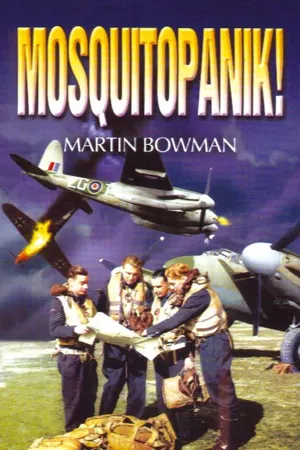
Mosquitopanik!
About this book
Of all the planes that flew in WW2, the 'Wooden Wonder' the two-engined Mosquito, or Mossie as it was affectionately called, was truly the most versatile and feared by the Germans. Fast and manoeuvrable, the Mossie was just as at home in the pathfinder role as she was as a fighter interceptor, particularly of V1s, as a night-fighter, low level bomber.Mosquitopanik tells of the hugely successful war career of this much loved aeroplane that caught the public's and its pilots' imagination. Here we have gripping tales of action in the air thanks to the most meticulous research by a true enthusiast.
Information
Subtopic
Military & Maritime HistoryIndex
HistoryChapter One
Blunting the Blitz on Britain
By early 1942 RAF Bomber Command heavies were waging war on Germany while at home civilians continued to ‘take it’ from a number of night raids by the Luftwaffe on towns and cities in East Anglia. On 22 February Air Chief Marshal Sir Arthur Harris was appointed Bomber Command’s new leader and for the rest of the war his name became synonymous with the attacks on German cities. A new directive calling for ‘area bombing’ of German cities had been sent to Bomber Command seven days before Harris’ appointment. The Air Ministry decided that bombing the most densely built up areas of Germany’s cities would produce such dislocation and breakdown in civilian morale that the German home front would collapse. With the new directive, bomber operations at night entered a new phase that was not restricted to one side of the divide. Following an attack by 234 RAF bombers on the old Hanseatic City of Lübeck on the night of 28–29 March Hitler ordered a series of Terrorangriff (terror attacks) mainly against English cities of historic or aesthetic importance, but little strategic value. In Britain they became known as the Baedeker raids, after the German guidebooks of the same name. Night after night terrified civilians were forced to cower in their cold and stinking Anderson shelters at the bottom of gardens in the weakly defended towns and cities in the west, south and east of the country while overhead the few RAF night fighters available struggled to blunt the terror attacks. Loss of life was heavy.
Though Britain’s battered civilians did not know it, their only effective salvation from Luftwaffe attacks would be AI (Airborne Interception) radar equipped fighters such as the Beaufighter and the Mosquito. Radar equipped night fighters were desperately needed but in early 1942 both were in very short supply and were closely guarded secrets. Existence of the ‘wooden wonder’ would not be public knowledge until the night of 25 September 1942 when listeners to the BBC Home Service heard that this revolutionary new aircraft had made a daring roof-top raid on the Gestapo HQ in Oslo. Next day, the first photo of a Mosquito was published, along with a caption stating that ‘armament may consist of four 20-mm cannon and four .303-in machine guns’. In fact, W4052, the Mosquito night fighter prototype, which was built to Specification F.21/40, had been the second of the de Havilland company prototypes to fly, on 15 May 1941. On 21 June the Air Ministry ordered five prototype Mosquitoes (one bomber, one PR and three fighter), nineteen PR models, and 176 fighters for RAF Fighter Command. 157 Squadron, which reformed at Debden, Essex, on 3 December 1941 under the command of Wing Commander Gordon Slade, became the first to operate the Mosquito night fighter. On 17 January 1942 157 took delivery of its first TIII at Castle Camps to begin work up on the new fighter but only fourteen NFIIs had arrived by the end of March. Six more were delivered in mid-April but three were not fitted with complete AI radar sets and only seven crews were trained to fly the aircraft.
At 20.15 hours on the night of 27–28 April 1942 twenty-eight German raiders were identified on radar heading for the historic city of Norwich and twenty Ju88s of Kampfgeschwader (KG) 30 laid mines off the coast. Only three AI.V radar-equipped NFII Mosquitoes of 157 Squadron and nine Beaufighters and ten Spitfires were available to intercept and the city was not protected by enough anti-aircraft batteries. Though AI radar contacts were made none of the raiders were shot down. This was the first raid by I/KG2 ‘Holzhammer’ since converting to the Do217E. Together with IV/KG30 and II/KG40 from 23.40 hours to 00.45 hours they dropped forty-one tonnes of HE and four tonnes of incendiaries onto the Norfolk capital of over 126,000 inhabitants, killing 162 inhabitants, injuring 600 more and damaging thousands of buildings. Some reports said that the enemy bombers machine-gunned the streets. Anti-aircraft batteries were rushed to Norwich and gradually, more Mosquito IIs equipped with AI were sent to the squadrons.
Both attacks occurred out in the North Sea while the bombers headed for Great Yarmouth. On 30 May, another Do17 of KG2 was almost certainly destroyed south of Dover by Squadron Leader G. Ashfield of 157 Squadron.
In July and August III/KG2, though heavily weakened, continued single daylight low-level bomber sorties or cloud cover ‘pirate’ raids on Britain. Several small-scale night raids also took place but 151 Squadron Mosquitoes destroyed four of the bombers. Off Spurn Head on 21–22 July Pilot Officer Fisher in W4090 accounted for Do217E-4 U5+IH of I/KG2 flown by Oberfeldwebel Heinrich Wolpers. On 27–28 July Squadron Leader Pennington and Pilot Officer Field destroyed bombers flown by Feldwebel Richard Stumpf of I/KG2 and Leutnant Hans-Joachim Mohring of 3./KG2. Two nights later, on 29–30 July, when Birmingham was attacked, Do217E-4 U5+GV piloted by Oberfeldwebel Artur Hartwig of II/KG2 was shot down by Flying Officer A. I. McRitchie and Flight Sergeant E. S. James.
On 22–23 August 157 Squadron was awarded its first confirmed victory when twenty miles from Castle Camps twenty-nine-year-old Wing Commander Gordon Slade, the CO, and his navigator Pilot Officer P. V. Truscott, shot down Do217E-4 U5+LP of 6./KG2. Twenty-nine-year-old Oberleutnant Hans Walter Wolff, Deputy Staffelkapitän, and a pre-war Lufthansa pilot flew the enemy bomber.
In September 151 Squadron destroyed another two Dornier Do217E-4s. On 8–9 September when Bedford was attacked, Australian pilot Ian McRitchie destroyed F8+AP, on loan to 3./KG2 and flown by Feldwebel Alfred Witting. Then on 17 September during a raid on King’s Lynn, Flight Lieutenant H. E. Bodien DFC downed U5+UR of 7./KG2 piloted by Feldwebel Franz Elias, which crashed at Fring where all four crew were made POWs. On 30 September 157 notched its first day combat victory when Wing Commander R. F. H. Clerke shot down Ju88A-4 off Holland. In October 157 Squadron scored three more victories over the Luftwaffe.
On 15–16 January 1943 during a German raid on Lincoln, Sergeants E. A. Knight RCAF and W. I. L. Roberts of 151 Squadron downed Do217E-4 U5+KR of 7./KG2 flown by Leutnant Günther Wolf, which crashed at Boothby Graffoe, killing everyone on aboard.
Over France on 17–18 January a Mosquito Intruder destroyed a Ju88A-14 of I/KG6 (an experienced Pathfinder unit). Wing Commander C. M. Wight-Boycott, in a Beaufighter, destroyed a pair of Ju88s and a Do217 and damaged another Dornier. In October 1943 Wight-Boycott DSO took command of 25 Squadron equipped with the NFI at Church Fenton.
On 18–19 March Fliegerkorps IX attacked Norwich. Flight Lieutenant D. Williams and Pilot Officer P. N. Dalton in a NFII shot down Do217 U5+AH (Werke No. 5523) of I/KG2 flown by Unteroffizier Horst Toifel after the Dornier exploded in a huge ball of fire near Terrington St. Clement.
From 22.55 to 23.30 hours twenty bombers in Fliegerkorps IX dropped 18 tonnes of HE and 19.2 tonnes of incendiaries on Norwich with 3.3 tonnes falling on residential areas and factories. Meanwhile thirteen less experienced crews bombed Great Yarmouth on the coast. Flying Officer G. Deakin and Pilot Officer de Costa of 157 Squadron destroyed a Ju88, which crashed into the sea just off Southwold.
On 28–29 March 1943 Fliegerkorps IX again bombed Norwich. From 22.00 to 22.19 hours eighteen Luftwaffe machines scattered HE and incendiary bombs over Norfolk and Suffolk. Flying Officer J. R. Beckett of 157 Squadron shot down Dornier Do217E-4 U5+NM of 4./KG2 piloted by Feldwebel Paul Huth, which crashed into the sea just north of Yarmouth killing all the crew. The victory was shared with a 68 Squadron Beaufighter piloted by Flying Officer Vopalecky with Flight Sergeant Husar; both Czech.
On 14–15 April 1943 when the Luftwaffe raided Chelmsford, Squadron Leader W. P. Green and Flight Sergeant A. R. ‘Grimmy’ Grimstone of 85 Squadron destroyed Do217E-4 F8+AM of 4./KG40. Off Clacton, Flight Lieutenant Geoff Howitt and Flying Officer George ‘Red’ Irving, shot down Do 217E-4 U5+DP of 6./KG2 piloted by Unteroffizier Franz Tannenberger. South-west of Colchester Flight Lieutenant James Gilles ‘Ben’ Benson DFC and Lewis Brandon DSO DFC of 157 Squadron brought down Dornier 217E-4 U5+KP of 6./KG2 piloted by Unteroffizier Walter Schmurr. The Dornier crashed at Layer Breton Heath near the town, after Schmurr and two of his crew had baled out.
On 16–17 April 1943 London was bombed. Focke Wulf 190A-4/U8 fighter-bombers of Schnelles Kampfgeschwader (SKG) 10 each carrying a 250-kg or 500-kg bomb on its centreline, participated for the first time.
The main German bomber types raiding England were the Ju88 and Do217. On 24–25 April Flying Officer J. P. M. Lintott and Sergeant G. G. Gilling-Lax of 85 Squadron destroyed Ju88A-14 3E+HS of 8./KG6, which fell in pieces at Bromley, Kent.
On 13–14 May 157 Squadron destroyed Do217E-4s of KG2 flown by Leutnant Stefan Szamek and Leutnant Gerd Strufe. Sergeants R. L. Watts and J. Whewell of 157 Squadron destroyed Do217E-4 of II/KG2 and it crashed near Colchester. A Do217K-1 of 4./KG2 piloted by Unteroffizier Erhard Corty was shot down near Norwich.
On 13 May 85 Squadron’s Mosquitoes flew from Hunsdon to their new station at West Malling in Kent where they joined the Typhoons of 3 Squadron. They were replaced by 157 Squadron which moved from Bradwell Bay. During May 85 Squadron claimed eight enemy aircraft destroyed.
On the night of 16–17 May when Fw190A-4/U8 fighter-bombers of I/SKG10 crossed the Straits of Dover the Typhoons were scrambled but the Mosquito crews were forced to wait for almost an hour before they could take off. Squadron Leader Peter Green and Flight Sergeant A. R. ‘Grimmy’ Grimstone shot down one of the Fw190s into the sea off Dover, after it had dropped his centreline bomb and was en route home to France. Geoff Howitt and ‘Red’ Irving destroyed a second Fw190 off Hastings.
Flight Lieutenant Bernard Thwaites and Pilot Officer Will Clemo pursued a Fw190 to the French coast before getting a recall signal but in mid-Channel they shot down a Fw190 and scored hits on another, claiming it as a ‘probable’. Flying Officer I. D. Shaw and Pilot Officer A. C. Lowton flew through a ‘friendly’ searchlight area and destroyed a fifth Fw190 off Gravesend.
At West Malling celebrations continued until well into the early hours.
Soon there were more reasons for celebrations. On 19–20 May Flying Officer J. P M. Lintott and Sergeant G. G. Gilling-Lax, shot down a Fw190A of 2./SKG10. Then, on 21–22 May Squadron Leader Edward Dixon Crew DFC* and Flying Officer Freddie French claimed a Fw190A over the sea twenty-five miles north-west of Hardelot.
On 29–30 May Lintott and Gilling-Lax destroyed Ju88S-1 3Z+SZ of I/KG66 at Isfield, Sussex; the first Ju88S-1 lost over England. Just fifty of these speedy bombers were built; most examples, which first entered service with I/KG66 at Chartres, being rebuilt versions of the A-4 with power-boosted BMW 801G-2 engines fitted with the GM-1 nitrous oxide injection system. Stripped of its ventral gondola and most of its armour and armament, with only a single MG13I machine gun, the Ju88S-1 was almost as fast as the Mosquito.
On 13–14 June Wing Commander John Cunningham DSO* DFC*, CO 85 Squadron, (with sixteen enemy aircraft shot down flying Beaufighters) and C. E Rawnsley scored their first victory in a Mosquito when Fw190A-5 CO+LT of 3./SKG10 flown by Leutnant Ullrich was shot down, The Focke Wulf crashed at Nettlefold Farm, Borough Green near Wrotham; miraculously, Ullrich, who was hurled through the canopy survived and was taken prisoner. On 21–22 June Flight Lieutenant Bill Maguire and Flying Officer W. D. Jones of 85 Squadron shot down Fw190 GP+LA of 2./SKG 10. On 9 July Lintott scored his fourth victory when he and Gilling-Lax destroyed Do217K-1 U5+FP of 6./KG2 flown by Oberleutnant Hermann Zink, which crashed at Detling killing all the crew. Lintott and Gilling-Lax were killed also when they were hit by the flying debris, the Mosquito crashing two miles from where the Dornier crashed.
On 13–14 July 1943 when KG2 bombed Cambridge, Bunting and Freddie French destroyed Me410A-1 U5+KG of 16./KG2 crewed by Feldwebel Franz Zwißler and Oberfeldwebel Leo Raida. The Hornisse (Hornet), the first Me410 to be destroyed over Britain, fell into the sea five miles off Felixstowe.
Also on 13–14 July Do 217M-l U5+EL of 3./KG2 flown by Unteroffizier Willy Spielmanns was destroyed by a 410 (RCAF) Squadron Mosquito over the North Sea near the Humber Estuary. While flying an Intruder over Holland Flying Officer Smart of 605 Squadron shot down Do217M-1 U5+CK of 2./KG2 piloted by Unteroffizier Hauck, which was returning from a bombing raid on Hull and it crashed near Eindhoven. In all, KG2 lost four Dorniers destroyed this night. On 15–16 July Flight Lieutenant Bernard Thwaites destroyed Me410 U5+CJ of V/KG2 crewed by Hauptmann Friederich-Wilhelm Methner and Unteroffizier Hubert Grube off Dunkirk. Hull again was the target for the Luftwaffe on 25–26 July when Flying Officer Knowles of 605 Squadron destroyed Do217M-1 U5+KL of 3./KG2 piloted by Leutnant Manfred Lieddert. On 29–30 July when the Luftwaffe’s target was Brighton, twenty miles south of Beachy Head, Wing Commander Park of 256 Squadron destroyed Me410A-1 U5+BJ crewed by Oberleutnant Helmut Biermann and Unteroffizier Willi Kroger of V/KG2.
KG2 suffered one of its heaviest blows on 15–16 August when seven aircraft, six of them claimed by Mosquitoes, were lost during a raid on Portsmouth. Off Worthing Wing Commander Park destroyed two Do217M-ls flown by Unteroffizier Karl Morgenstern and UnteroffizierFranz Bundgens. He almost made it a hat trick on the night by claiming a Do217M-1, flown by Unteroffizier Walter Kayser. Over France Flight Sergeant Brearley of 256 Squadron destroyed two Do217Ms flown by Feldwebel Theodor Esslinger, and Leutnant Franz Bosbach. Pilot Officer Rayne Dennis Schultz of 410 (RCAF) Squadron claimed Do217M-1 U5+GT of 9./KG2 flown by Unteroffizier Josef Schultes.
On 22–23 August Squadron Leader Geoff Howitt DFC and Pilot Officer J. C. O. Medworth of 85 Squadron destroyed Me410A-1, U5+AF of 15./KG2 crewed by Feldwebel Walter Hartmann and Obergefreiter Michael Meurer. The Hornisse crashed at Chemondiston. Meurer had baled out but Hartman’s body was found in a field, his parachute unopened.
On the night of 24–25 August Captain Johan Räd and Captain Leif Lövestad of 85 Squadron in a NFXII claimed a Me410A-1 destroyed. One of two Hornets lost this night was U5+EG of 16./KG2 crewed by Feldwebel Werner Benner and Unteroffizier Hermann Reimers. This victory was officially shared with Wing Commander R. E. X. Mack DFC of 29 Squadron, which put in claims for two more enemy aircraft this night; the squadron’s first Mosquito victories since converting from the Beaufighter.
On 6 and 8 September 85 Squadron brought down no less than five Fw190A-5s. Off Beachy Head on 15–16 September Flying Officer Jarris of 29 Squadron destroyed Me410A-1 U5+AF of 15./KG2 crewed by Oberfeldwebel Horst Muller and Unteroffizier Wolfgang Dose who raided Cambridge. South-east of Ramsgate Do217M-1 of 9./KG2 piloted by Oberfeldwebel Erich Mosler was destroyed by Flight Lieutenant Watts of 488 (RNZAF) Squadron, while Ju88A-14 3E+FP of 6./KG6 was shot down by Flying Officer Edward Hedgecoe and Pilot Officer J. R. Whitham of 85 Squadron. Their Mosquito was crippled by return fire and they baled out before the aircraft crashed at Tenterden, Kent. Flight Lieutenant Bunting destroyed a Ju88A-14 of II/KG6.
In October 85 Squadron’s Norwegian pilots scored further victories. During a raid on the Humber Estuary on 2–3 October Pilot Officer Tarald Weisteen and Freddie French shot down two Do217Ks.
When the Luftwaffe raided London and Norwich on 7–8 October Flight Lieutenant Bi...
Table of contents
- Title Page
- Copyright Page
- Table of Contents
- Acknowledgements
- Glossary and RAF Slang Terms in Common Everyday Use
- Chapter One - Blunting the Blitz on Britain
- Chapter Two - The Lone Rangers
- Chapter Three - The Hungry Hun Hunters of 100 Group
- Chapter Four - The Gestapo Hunters
- Chapter Five - New Found Offensive
- Chapter Six - Moskitopanik!
- Chapter Seven - Carthage
- Chapter Eight - End Game
- Appendix One
- Appendix Two
- Index
Trusted by 375,005 students
Access to over 1.5 million titles for a fair monthly price.
Study more efficiently using our study tools.
Frequently asked questions
Yes, you can cancel anytime from the Subscription tab in your account settings on the Perlego website. Your subscription will stay active until the end of your current billing period. Learn how to cancel your subscription
No, books cannot be downloaded as external files, such as PDFs, for use outside of Perlego. However, you can download books within the Perlego app for offline reading on mobile or tablet. Learn how to download books offline
Perlego offers two plans: Essential and Complete
- Essential is ideal for learners and professionals who enjoy exploring a wide range of subjects. Access the Essential Library with 800,000+ trusted titles and best-sellers across business, personal growth, and the humanities. Includes unlimited reading time and Standard Read Aloud voice.
- Complete: Perfect for advanced learners and researchers needing full, unrestricted access. Unlock 1.5M+ books across hundreds of subjects, including academic and specialized titles. The Complete Plan also includes advanced features like Premium Read Aloud and Research Assistant.
We are an online textbook subscription service, where you can get access to an entire online library for less than the price of a single book per month. With over 1.5 million books across 990+ topics, we’ve got you covered! Learn about our mission
Look out for the read-aloud symbol on your next book to see if you can listen to it. The read-aloud tool reads text aloud for you, highlighting the text as it is being read. You can pause it, speed it up and slow it down. Learn more about Read Aloud
Yes! You can use the Perlego app on both iOS and Android devices to read anytime, anywhere — even offline. Perfect for commutes or when you’re on the go.
Please note we cannot support devices running on iOS 13 and Android 7 or earlier. Learn more about using the app
Please note we cannot support devices running on iOS 13 and Android 7 or earlier. Learn more about using the app
Yes, you can access Mosquitopanik! by Martin W. Bowman in PDF and/or ePUB format, as well as other popular books in History & Military & Maritime History. We have over 1.5 million books available in our catalogue for you to explore.