This fascinating biography of a Russian flying ace offers a rare glimpse into the role of the Soviet Air Force during the Korean War.
Nikolai Vasil'evich Sutiagin was the top-scoring Soviet flying ace of the Korean War. He flew his MiG-15 in lethal dogfights against American Sabres and Australian Meteors, winning twenty-two victories. For his distinguished service, he was named a Hero of the Soviet Union, the Soviet military's highest honor.
Now, with the opening of the Russian archives, this authoritative biography presents a full account of Sutiagin's life and career. Beyond these official records, the authors draw from the reminiscences of Sutiagin's comrades and his wife's personal diary to present a nuanced and vividly detailed portrait of one of Russia's greatest fighter pilots.
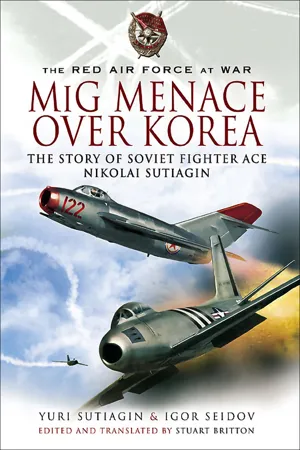
eBook - ePub
MIG Menace Over Korea
The Story of Soviet Fighter Ace Nicolai Sutiagin
- 256 pages
- English
- ePUB (mobile friendly)
- Available on iOS & Android
eBook - ePub
MIG Menace Over Korea
The Story of Soviet Fighter Ace Nicolai Sutiagin
About this book
Information
Chapter One
The Making of an Air Warrior
Nikolai Sutiagin was born in the village of Smagino on the banks of the P’iana River, about 120 kilometers south-east of Nizhegorod (formerly Gor’ky) on 5 May 1923. His father, Vasilii Alekseevich, was a middle-class citizen who had a small farm, and later became a decorated sapper in the Red Army during the Second World War. As the first child, his parents came to rely upon Nikolai to help with the hard labor around the farm and to look after his younger siblings. Nikolai grew up as a strong and healthy son, with a solid sense of personal responsibility and diligence.
In 1934, when Nikolai was eleven years old, he moved to the city of Gor’ky to live with his grandfather, in order to help the family. Life in the city was not easy for him – in addition to his middle school studies, he took jobs wherever he could find them. For a time, he even earned some money on the side by taking small parts in productions put on by the city’s Opera Theater. Nikolai had a decent singing voice, and some people even began to believe that an acting career lay ahead for him.
In the 1930s, the network of flying clubs was growing rapidly in the country, as young men and women were enthusiastically signing up in large numbers in order to emulate famous aviators and national heroes such as Baidukov and Chkalov, and the many Soviet combat fighter pilots who distinguished themselves in dogfights over Spain during the Spanish Civil War. In 1939, when Nikolai reached sixteen years of age, he joined the Komsomol (Young Communists), which gave him access to flying lessons at one of these clubs. In addition to classroom study of flight theory, aerodynamics and navigation, the students were able to make training flights. They trained on the standard Soviet trainer of those years, N.N. Polikarpov’s U–2 biplane, which was cheap to produce and simple to operate and maintain. By 1953, over 33,000 U–2s had been built.
Nikolai quickly became one of the best students, and he seemed destined to become a combat pilot. However, around the time of his call-up for military service, Nikolai was strongly influenced by the popular film The Tractor Drivers, which glorified the Soviet armored forces. Sutiagin decided to enroll in a tank specialist school, but his application was rejected because of his height. At 5 feet 10 inches, Nikolai was too tall to serve in tanks, which were designed for much shorter men. Although perhaps disappointed, Nikolai didn’t hesitate with his next decision, and at the beginning of March 1941 he enrolled in the Chernigov Military Aviation School for Pilots (VAShP).
In connection with the rising military threat, the number of aviation schools and academies in the Soviet Union had been expanding enormously to accelerate the training of pilots. Among the new aviation schools was the Chernigov VAShP, which had been created by order of the People’s Commissar of Defense on 6 November 1940 with five squadrons of I–15bis biplane fighters. The school completed its formation in February 1941, and the first detachment of students began their theoretical studies that month. Those students with previous flying club experience began training flights right away.
The outbreak of the war in June 1941 disrupted the training schedule. School instructors, staff, and I–15bis fighters were repeatedly drawn into active combat duty. Flight training and aerial gunnery practice labored under acute shortages of equipment, spare parts, and fuel and lubricants. The rapid German advance twice forced the relocation of the school, first to Rostov in September 1941, then to the cities of Kyzyl-Arvat and Kazandhik in Turkmenistan in November 1941. Through all of this, Nikolai Sutiagin continued his training, and on 7 November 1941 he took his military oath.
Kyzyl-Arvat was a small city, with a population in those years of approximately 50,000 people. The land around the city is arid and flat like the steppe, bounded by mountains to the north and deserts to the south, and with the exception of the occasional dust storm, the weather is ideal for year-round flying. However, shortages continued to restrict the students’ hours in the air and living conditions were less than ideal due to the near absence of building materials, which forced the majority of students to live in dugouts or tents. The school’s airplane park counted altogether 175 planes (well below its authorized strength of 304 planes), consisting of a mix of UT-1, U-2, UT-2, UTI-4 types, plus several each of I-16, Yak-1 and Yak-7 fighters. Nevertheless the Chernigov VAShP finally had a stable location and could begin to turn out a steady stream of pilots for the Red Army. Already by 1 April 1942, over 2,000 students had passed through the school, though shortages in aircraft, fuel, and spare parts throughout 1942 meant that the school was unable to meet its graduation targets.
Back in 1942, training flights took place in very difficult conditions: the summertime temperatures reached 50 degrees C. (122 degrees F.) and higher; therefore, training flights began at sunrise, ended at 11:00 AM–12:00 PM, and resumed at 5:00 PM. Students diligently studied the parts of the airplane, the theory of flight, how to handle an airplane in flight, tactics, navigation, topography, meteorology, and the silhouettes of their own and enemy airplanes. To be honest, the theoretical training was less than desirable – the primary emphasis was on the practical side of flight training: in flying weather they flew, and in poor weather not suitable for flying, they studied the parts of the airplane. To study the experience gained by combat pilots in the war, they made use primarily of articles published in the newspapers Red Star and Stalin’s Falcon.
Nikolai Sutiagin was a good student and flew with confidence, training on UT–2 and UTI-4 types. By the time of his graduation at the end of August 1942, he had conducted 495 training flights with a total flying time of 83 hours and 36 minutes (including his time with the flying club). The Komsomol reference for the student Nikolai Sutiagin declared that ‘… he showed both initiative and discipline’. His graduation certificate read in part: ‘Superbly disciplined. Carries out orders conscientiously and precisely. Possesses a good standing within his unit.’1
To his deep disappointment, Sergeant Sutiagin didn’t wind up at the front –almost all the pilots who graduated in July–August 1942 were sent to the Far East in exchange for the flight staff there, who in turn were transferred to the front against Germany. Most of the pilots from the Chernigov VAShP’s 7th Aviation Squadron, in which Sutiagin trained, were placed under the command of Major Khoderov and then assigned to one of the Maritime District’s reserve regiments.
In the reserve aviation regiment, the young pilots polished their piloting technique, practiced flying in various formations and analyzed their combat applications – after all, aerial combat was practically not taught at all in any of the aviation schools. However, Sergeant Sutiagin did not have long to brush up on his skills.
In the 582nd Fighter Aviation Regiment in the Far East
In October 1942, Nikolai Sutiagin was assigned to the 582nd IAP with the 9th Air Army’s 249th IAD. The 9th Air Army had been formed in August 1942 with the assignment to protect the Soviet Union’s Far Eastern airspace.
Within just a month, however, in connection with a reorganization of the 582nd IAP, Nikolai was reassigned to the 5th IAP in the same aviation division, where he joined the 1st Aviation Squadron in Novo-Nikol’sk. There, he embarked upon a crash course to master the I-16 fighter in a short period of time. The fact that on 3 December alone, Sergeant Sutiagin conducted eleven training flights with an instructor over the airfield speaks of the intensity of the training. On 4 December, regiment commander Major Manaseev graded Sutiagin’s flying skills and gave him an overall evaluation of ‘4’ (out of a possible ‘5’), and approved him for independent flights in the I-16 fighter.2 The next day the commander of the 1st Aviation Squadron, Senior Lieutenant Didenko, conducted another inspection of Sutiagin’s piloting skills. He observed, ‘With retracted landing gear, he forgot to release the speed brakes in turns,’ and ‘his hand is a little unsteady on the control stick,’ but noted that Sutiagin would quickly eliminate the indicated mistakes. Soon Nikolai was reassigned to the 2nd Aviation Squadron.
In the very same 5th IAP, another pilot with the family name Sutiagin was serving: Nikolai’s own uncle, Aleksandr Alekseevich, who was only a few years older than his nephew and with whom he had previously lived at their grandfather’s in Gor’ky. At one time, Nikolai was even posted to his uncle’s flight. Flight commander A. Sutiagin sometimes deliberately lowered his nephew’s flight evaluations, so that Nikolai could make additional training flights. At that time, units didn’t have enough fuel and lubricants, and flying time was limited. However, Nikolai’s best friends in the regiment were pilots Boris Ivanov and Sergei Bychkov.
Colonel (ret.) Boris Ivanov recalls:
I got to know Sutiagin in the autumn of 1942, when we arrived at the 5th Aviation Regiment of the 9th Air Army, which was based in the Maritime District. What sort of man was Sutiagin? He was tall, well-built, with a round, freckled face. Nikolai stood out on any assignment and in any company. At the time, no one supposed that he would become our first jet ace. But in conversation among ourselves, we didn’t refer to him as anything other than ‘Ace’. Why, you ask?
We weren’t in combat, but we were at the front, where from day to day we anticipated a Japanese attack, so combat training was feverish. And in this, Sutiagin had no equal in flying technique, and he was a superb shot. He never missed the aerial target.
Any serious business in the 5th IAP started with his name. He became part of that team of pilots, who were ready to accept the most difficult assignments. I remember how in 1944 the Yak-9 was coming out, and we had just mastered the Yak-7B. They began to form a group of pilots who would have the first opportunity with the new Yaks, and the first name on the list was Sutiagin’s.
It was in the 5th Aviation Regiment that Nikolai met his future wife Raia [diminutive version of Raisa], who was serving as an armament mechanic in his squadron. Raisa Onufrievna Baranova was born on 10 August 1921, and had been mobilized for service in the Red Army in May 1942. She was sent to the Far East, where she took a sixth-month course for master armament mechanics in the 56th School for Junior Aviation Specialists in Vozzhaevka. The girls were often called upon to help harvest vegetables, unload coal and cut trees, so their preparation in the school was less than desirable.
When Raisa graduated in November 1942, she was sent to the 5th IAP’s headquarters in Novo-Nikol’sk. There they offered Raisa a position in the headquarters as a clerk, but she requested duty as a technician. She was assigned to the 1st Flight of the 3rd Aviation Squadron. At first Raia was troubled by her lack of preparation, but she quickly picked up the necessary skills. The work was physically demanding, dangerous and required long hours. The flight crews headed to the airfield at 6:00 AM each day and labored until 7:00 PM, readying airplanes for sorties. In February 1943 there was a fatal incident, when technician Nadia Omel’chenko accidentally shot her friend Katia Chernous while they were reloading machine guns. Nadia was in the cockpit, while Katia was standing in front of the plane’s right wing. Thinking they were reloading the right outboard machine gun, Nadia flicked the switch for the right inboard machine gun and pressed the trigger to empty it of its remaining rounds. A bullet struck her friend in the head.
At the Sukhaia River and in Pokrovka
At the beginning of June 1943, Raia was transferred to the 2nd Aviation Squadron based at the Sukhaia River. It is there that she became acquainted with Nikolai Sutiagin, and their gradual courtship began. The airfield was located to the west of Vladivostok, on the shore of Peter the Great’s Harbor; the city of Vladivostok was clearly visible from the shoreline next to the airfield. Here, many of the pilots had their first bird’s-eye view of the Pacific Ocean, and they frequently had to fly over it. According to the pilots, flying over the sea at that time, without good navigational instruments, was not a pleasant sensation. There was often a haze or fog, and when the coastline faded from view, it had a strong psychological effect on the pilot. As a result, many of the pilots had a natural desire to cling to the coastline.
As Raisa noted in her diary, the area was unusually beautiful, with the sea on one side and a forest preserve that teemed with game surrounding it on the other sides. Trout could be found in the Sukhaia River itself, so the region was a paradise for hunters and fishermen, but the area bristled with pillboxes and anti-aircraft positions to protect the airfield, while military patrol boats plied the waters of the harbor. The situation in the Far East was tense, as the Japanese frequently violated Soviet airspace and territorial waters. From time to time, alarms and expectations of Japanese attack kept the fighter regiments on a high state of alert, and pilots would spend all day sitting in their cockpits. The constant air patrols kept the ground crews busy.
In between periods of high alert, the regiment would return to routine combat training. Yet even this did not come without cost. Two training accidents in 1943 took the lives of two pilots in the 5th IAP, Senior Lieutenant Fomichev and Senior Lieutenant Karov, who both crashed in their I-16 fighters.
In April 1944, the 2nd Squadron moved to Novo-Nikol’sk in order to trade in their outdated I-16s for the new Yak-7B. However, instead of returning to Sukhaia River, on 18 April the 2nd Squadron relocated to Pokrovka, because the field at Sukhaia River was unsuitable for the new Yaks. Moreover, that summer the Sukhaia River airfield was often hampered by fog and drizzle –conditions totally unsuitable for flying.
After flying the plane, many pilots considered the Yak-7B to be one of the best fighters of the war, on a par with the LaGG-3 and MiG-3, as it was easy to fly and aerodynamically stable.
It was around this time that Raisa Baranova began to notice the attention paid to her by Nikolai Sutiagin. He often lingered around his plane while Raisa cleaned his machine guns, and made sure to be at the airfield whenever Raisa had sentry duty there. Initially, she hadn’t been particularly drawn to the quiet and modest village fellow, but gradually his reliability, helpfulness and sense of responsibility won her over. Of course, she also knew of his reputation as a superb pilot, which didn’t hurt his chances.
By October 1944, Nikolai Sutiagin was now flying as a lieutenant and flight commander. He had repeatedly demonstrated his superior flying skills and good marksmanship in training and competitions. Over the two years he had been with the 5th IAP, Sutiagin had received fourteen commendations from command for his successes in combat training.
In November 1944, the commander of the 9th Air Army Major General Vinogradov inspected the readiness of the 5th IAP and its preparations for the winter. He especially commended the regiment commander and the commander of the 3rd Aviation Squadron in his report. For the year 1944, the 5th IAP was recognized as the finest regiment in the division. The total flight time for the regiment for the year was 1,164 hours, an average of 53 hours and 17 minutes for each pilot. The regiment had staged 999 mock dogfights. There had been, however, two non-fatal crashes and five mechanical failures, and one incident when a pilot became lost while flying.3
On 5 December, the regiment went into its winter quarters. The pilots and ground personnel had to live in canvas tents, and it was a constant struggle to ward off the cold. With the slower pace of operations in the winter, commanders now had time to write annual personal reviews for each pilot. This is what regiment commander Major Manaseev and the 2nd Aviation Squadron commander Senior Lieutenant Olenitsa wrote about flight commander Lieutenant N.V. Sutiagin on 8 January 1945:
At work and in everyday life he is polished, cheerful and tactful. When following the orders of higher command … he is persistent and exacting. He renders great assistance to his squadron commander in forging an iron military discipline in the unit.
As a pilot he is well-trained. He has good piloting technique. He flies confidently and boldly. There are no incidents of pilot error in his record.
...In studying the experience of the current war, he takes particular interest in successful aerial combat tactics as described by Guard Colonel Pokryshkin, and he uses them in his own combat-training missions. [Emphasis in the original.]
Conclusion: Meets the responsibilities of flight commander.4
On 1 January 1945, the 5th IAP had forty pilots on its roster, thirty-six of which had been trained on the Yak-7B. The regiment with a staff of thirty-two crews was capable of conducting a combat mission in simple meteorological conditions.
Preparations for War
In March 1945, the 2nd Aviation Squadron transferred from Pokrovka to Novo-Nikol’sk in order to take part in army-level maneuvers. This was by now a rehearsal before the start of combat operations against Japan. In the meantime, fascist Germany was in its death throes as the Red Army closed upon Berlin from the east, and the Allies were breaching the Rhine River to the west.
Raia was regularly following the events on the Soviet-German front. From day to day she waited for news about the end of the war with Germany. Nevertheless, when it came, the news of the long-awaited victory took her by surprise. In her diary, she wrote:
9.05.45 The war is over! What can be greater than that? I was on duty at the headquarters. Someone called: ‘Tell the commander to prepare some people for a meeting in honor of the end of the war with Germany.’
Oy! … and I dropped the receiver. Boundless joy. I picked up and dropped the phone several times and ran out into the street, to listen to the honks and celebratory gunfire that drifted to us from the city of Voroshilov.
The entire staff of the regiment celebrated. There were meetings in all the squadrons. Speakers poured scorn on German fascism and expressed their pride for our glorious Red Army, navy, and air force, and for our people, who had secured victory through their hard work behind the front. They also swore that the borders of the Far East would be vigilantly defended from any encroachments by Japanese milit...
Table of contents
- Cover
- Title
- Copyright
- Content
- List of Illustrations
- Editor’s Preface
- Authors’ Preface
- Map
- Chapter 1
- Chapter 2
- Chapter 3
- Chapter 4
- Photos section
- Chapter 5
- Chapter 6
- Chapter 7
- Chapter 8
- Appendix
- Notes
- Index
Trusted by 375,005 students
Access to over 1.5 million titles for a fair monthly price.
Study more efficiently using our study tools.
Frequently asked questions
Yes, you can cancel anytime from the Subscription tab in your account settings on the Perlego website. Your subscription will stay active until the end of your current billing period. Learn how to cancel your subscription
No, books cannot be downloaded as external files, such as PDFs, for use outside of Perlego. However, you can download books within the Perlego app for offline reading on mobile or tablet. Learn how to download books offline
Perlego offers two plans: Essential and Complete
- Essential is ideal for learners and professionals who enjoy exploring a wide range of subjects. Access the Essential Library with 800,000+ trusted titles and best-sellers across business, personal growth, and the humanities. Includes unlimited reading time and Standard Read Aloud voice.
- Complete: Perfect for advanced learners and researchers needing full, unrestricted access. Unlock 1.5M+ books across hundreds of subjects, including academic and specialized titles. The Complete Plan also includes advanced features like Premium Read Aloud and Research Assistant.
We are an online textbook subscription service, where you can get access to an entire online library for less than the price of a single book per month. With over 1.5 million books across 990+ topics, we’ve got you covered! Learn about our mission
Look out for the read-aloud symbol on your next book to see if you can listen to it. The read-aloud tool reads text aloud for you, highlighting the text as it is being read. You can pause it, speed it up and slow it down. Learn more about Read Aloud
Yes! You can use the Perlego app on both iOS and Android devices to read anytime, anywhere — even offline. Perfect for commutes or when you’re on the go.
Please note we cannot support devices running on iOS 13 and Android 7 or earlier. Learn more about using the app
Please note we cannot support devices running on iOS 13 and Android 7 or earlier. Learn more about using the app
Yes, you can access MIG Menace Over Korea by Yuri Sutiagin,Igor Seidov, Stuart Britton in PDF and/or ePUB format, as well as other popular books in History & Military Biographies. We have over 1.5 million books available in our catalogue for you to explore.