A concise history and guide to poetry, with short biographies of approximately 250 poets from Homer to Heaney and Dickinson to Dylan.
Starting with a history of poetry and discussions of poets and their work in the context of their times, and overviews of such topics as verse forms and genres, this book goes on to review an extensive list of individual poets, with biographical information and notes on their best works. In addition, a variety of photos and a glossary are included. A delight for anyone interested in poetry,
The Pocket Guide to Poets & Poetry is also useful for those who want to discover new favorites. Those featured include:
Sylvia Plath * Sappho * Geoffrey Chaucer * the Beowulf poet * John Dunne * John Milton * Andrew Marvell * Percy Bysshe Shelley * Edgar Allan Poe * Emily Bronte * Edward Lear * W.B. Yeats * Hilaire Belloc * Marianne Moore * Dylan Thomas * Joseph Brodsky * and many more
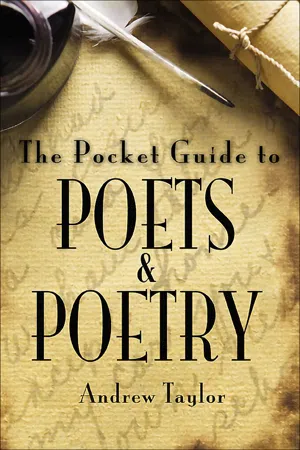
- 176 pages
- English
- ePUB (mobile friendly)
- Available on iOS & Android
eBook - ePub
The Pocket Guide to Poets & Poetry
About this book
Information
Chapter One
What is Poetry?
Poetry and prose
MOST PEOPLE understand that there is a difference between poetry and prose – but they have struggled for centuries, from Aristotle to the present day, to say exactly what it is.
Nobody has succeeded.
The Oxford English Dictionary starts by saying that poetry is ‘the art or work of the poet’, which is less than helpful. It goes on to suggest that it is ‘composition in verse or metrical language’, which might take us a little further, if only we could be sure what verse is. So perhaps it is better to leave the dictionary, and turn to the poets themselves: several of them have tried to define poetry, and surely they should know what it is that they are writing?
William Wordsworth said it was ‘the spontaneous overflow of powerful feelings’, which seems to suggest confusingly that if you sit down and think about what you are writing, you don’t end up with a poem. The American poet Robert Frost, trying to put his finger on the uniqueness and irreducibility of a poem, said that poetry is ‘what gets lost in translation’; Edgar Allan Poe, that it is ‘the rhythmical creation of beauty in words’, which presumably puts paid to the description of blood ‘gargling from the froth-corrupted lungs’ in Wilfred Owen’s Dulce et Decorum Est. Emily Dickinson said, ‘If I feel physically as if the top of my head were taken off, I know that is poetry’; and Dylan Thomas covered pretty well all the bases when he declared that it was ‘what makes me laugh or cry or yawn, what makes my toenails twinkle, what makes me want to do this or that or nothing.’
After all those definitions, it’s almost a relief to come to T.S. Eliot, who said: ‘Genuine poetry can communicate before it is understood’ – so perhaps trying to understand it at all is just a waste of time?
The Line
The problem with trying to reach a cut-and-dried definition is that the difference between poetry and prose is very largely one of degree. Is the King James Bible, for instance, poetry or prose? We have all read poetic prose, and we can imagine a (bad) prosaic poem. Fixing the point at which one becomes the other is like deciding when dark blue becomes light blue, or trying to nail steam to the wall. But if, despite the difficulties, we are determined to sort out which is which, maybe none of the efforts of the poets and wise men has come as close to a really useful working definition as the little girl in just her second year at school, who observed that poetry was easier to read because the lines are shorter.
She didn’t realise it, but she had identified one important fact: the line is the crucial unit of poetry. You can break up Pride and Prejudice or War and Peace however you want: print them out in a single line along a long strip of paper, and you will still have an edition of Jane Austen’s or Leo Tolstoy’s novel. But Shakespeare’s sonnets, or Paradise Lost, or one of Benjamin Zephaniah’s Vegan Poems, demand to be set out, and read, and understood in lines.
Of course, there are other features of poetry which usually distinguish it from prose: it may rhyme, for instance, and there is generally a metrical pattern to the lines – although poems written in free verse, or vers libre, like, for example, those of Walt Whitman, may aim to catch the rhythms and tenor of ordinary speech rather than follow any accepted verse form. Almost always, this handling of rhythm and the stresses on individual words and syllables is a crucial part of the poet’s art, and understanding the skill with which a poem accommodates the specific demands of a particular verse-form may be an important part of appreciating its merit.
An intense language
But more than anything, poetry is about language, and the way that it is used. Generally, whether they are printed on a sign saying ‘Keep off the grass’ or in Bertrand Russell’s History of Western Philosophy, we use words to pass on information: poetry is different.
Thomas Hardy’s famous poem, The Convergence of the Twain, for instance, written after the sinking of the Titanic, tells us that the ship is lying on the bottom of the sea, that an iceberg was formed long before the ship set out on its journey, and that the two collided. If that were all, our response might be ‘So what? We knew all that.’ In addition, though, the poem tells us that the ship’s furnaces have mysteriously turned into musical instruments, that fish swim around the wreckage and speak to each other, and that some mystical character called the Spinner of the Years instructed ship and iceberg to collide. We haven’t heard any of that before, but in a literal sense, it’s all nonsense: so what is true in the poem is not new, and what is new is not true.
But this is a poem, not a newspaper report, and Hardy uses the language in it to evoke powerful emotions that we will all recognise, if only we will let the poem speak to us. The sea forces its way through the wrecked engines, making the huge furnaces vibrate like lyres; sea worms, horrible to our eyes, crawl over the mirrors without any thought of the wealthy passengers who once admired themselves in them; we can imagine the fish wondering how such strange artefacts come to be at the bottom of the sea. And then Hardy’s final line ‘And consummation comes, and jars two hemispheres’ reveals where the poem has been remorselessly heading all the time: the collision is the culmination of forces which are infinitely greater than anything controllable by man, and which have been building unseen for years. That word ‘consummation’ suggests a sense of purpose, of mysterious intent; it has echoes of ‘‘consume’’, but it also stirs in us thoughts of the consummation of a marriage: there is, it seems, a mystical sense in which the disaster was meant to happen. In any case, the shuddering crash of ship and iceberg sends shivers through both Europe and America. (To Hardy, clearly, early Twentieth Century Europe and America represented the two halves of the important world: there is material for a whole new book in the way that contemporary assumptions and prejudices are reflected in poetry.)
There will be many other interpretations of this poem – one of the marks of great poetry is that it can be interpreted and re-interpreted by different readers, and even by the same reader coming to it at different times – but this is certainly one. Instead of simply reporting what happened – which we probably knew already – Hardy is telling a story of how Man’s ingenuity overreached itself, of how the natural world has swallowed the great ship without trace, and of how, frighteningly, all this might have been decreed by Fate from the start.
So what is poetry?
The Twentieth Century American poet Archibald MacLeish famously declared in his poem Ars Poetica that ‘A poem should not mean / But be’ by which he meant that it cannot be paraphrased: if a prose version could explain the meaning of a poem, then the poet would have written a prose version. It cannot, as Robert Frost observed, be translated either: the most successful translations from other languages and cultures – Dryden’s translations of Horace, Ted Hughes’s version of Ovid, Seamus Heaney’s Beowulf, or Simon Armitage’s Sir Gawain and the Green Knight – are poems in their own right, which give a flavour of the original.
A sensitive command of rhythm and metre or the use of devices such as rhyme, alliteration and assonance adds to the overall effect of a poem by evoking a particular atmosphere, or linking individual words or phrases to each other. In The Convergence of the Twain, each stanza is bound together by rhyme, while alliteration and assonance, in phrases such as ‘shadowy, silent distance’ with the sibilant sound of an icy wind, create a sense of the eerie remoteness of the iceberg. But poetry is essentially language used with the greatest possible intensity, with an awareness of the precise meaning and the possible connotations of every word, and with the intent of stirring emotion within the reader. It’s a long way from a complete definition – but it’s about as far as we can go.
Chapter Two
The Growth of English Poetry
The Beginnings
THE HISTORY of poetry goes back far beyond books and manuscripts: the Iliad and the Odyssey, for instance, which we now think of as the poems of Homer, were passed down orally for generations before being written down sometime in the Sixth Century BC. Some 1,400 years later, around the Eighth Century AD, bards were similarly performing the 3,000 lines of Beowulf, generally considered to be the first great poem composed in England.
Its story of self-sacrifice, heroism in battle and violent death belongs recognisably in an epic tradition that stretches from Homer through Milton’s Paradise Lost in the Seventeenth Century and Walter Scott’s The Lay of the Last Minstrel in the Nineteenth, and some scholars believe that the unknown poet may even have read Virgil or other classical models. However, though Beowulf and the other surviving fragments of Old English poetry may have been composed in England, they were not in English: their Anglo-Saxon language is incomprehensible to a modern English speaker.
So, too, are other early poems such as William Langland’s Piers Plowman, which like Beowulf is notable for the alliteration that bind the lines together, and even Geoffrey Chaucer’s famous Canterbury Tales. These Fourteenth Century poems were written down in what is now known as Middle English, but oral poetry remained a powerful contemporary influence: many of the traditional ballads that were collected centuries later originate from around this time.
Poetry we can read today
The development of printing in the late Fifteenth Century began to fix an authoritative version of the language, and, give or take the odd unfamiliar word and the strange spelling, the poetry of the next hundred years, such as Edmund Spenser’s The Faerie Queene, is readily intelligible today. The Sixteenth and Seventeenth Centuries, which included the great flowering of the Elizabethan age, saw an outpouring of poetry that is still considered among the greatest in the language. Many of the Elizabethan poets, like William Shakespeare and Christopher Marlowe, were dramatists by profession who wrote for a wide audience, mixing learned and aristocratic themes and language with rumbustious and earthy vulgarity in much the same way as Chaucer had done. This became an important characteristic of English literature.
Other poets were high-born figures whose work was intended primarily to be circulated by hand around the Court. Spenser was awarded a pension by Queen Elizabeth, and poets such as Sir Thomas Wyatt and Sir Philip Sidney pursued glittering diplomatic and military careers. Their measured and courtly lyrical poetry was the mark of a gentleman of standing. That is not to say that they were careless amateurs, or in any way ill-prepared as poets: the Elizabethan age also saw a fascination with the techniques of poetry. The blank verse – unrhymed iambic pentameters – that was characteristic of Shakespeare’s plays first appeared around this time, and Wyatt and Henry Howard, Earl of Surrey, began experimenting with new verse forms from Italy such as the sonnet.
The Wits of the Seventeenth Century
This intellectual attitude towards poetry reached its peak early in the Seventeenth Century, with the so-called Metaphysical Poets. This description, first used by Samuel Johnson a hundred years later, is now less popular because it disguises important differences between individual poets such as John Donne, Andrew Marvell, George Herbert, and Thomas Traherne, but it does reflect their common interest in science, philosophy, and disputation. They were best known for their extravagant wit and for the imaginative and carefully drawn out similes or conceits which characterise much of their poetry – Donne’s A Valediction, Forbidding Mourning, for instance, compares the poet and his lover to the two legs of a pair of compasses, and Marvell’s To His Coy Mistress pictures his love as a vast and slow-growing vegetable. Many of their poems were about love, but they also focused on matters of religion, particularly in Donne’s so-called Holy Sonnets.
Another group of poets around the same time, including such figures as Robert Herrick and Richard Lovelace, became known as the Cavalier Poets because of their support for King Charles in the Civil Wars. Rather than the subtle wit and convoluted logic of the Metaphysical Poets, the Cavalier Poets wrote simple, direct lyric poetry, often concerned with love, loyalty, and sensuality. It was the relaxed and extravagant verse of a selfconsciously aristocratic elite.
The greatest poet of the age, John Milton, fitted into the lyrical tradition with such works as Lycidas, L’Allegro and II Penseroso, and also into the pattern of religious poetry – his famous epic, Paradise Lost, retold the story of Adam and Eve. However, he remained a passionate supporter of the Parliamentary side in the Civil Wars, and a loyal public servant under Cromwell. Poems such as his sonnet On the Late Massacre in Piedmont reflect the fact that religion was inextricably bound up with politics.
The Eighteenth Century – Looking Back to the Past
Milton, who died in poverty in 1674, 14 years after the Restoration of Charles II, was a noted scholar of Greek and Latin poetry, and this admiration for Classical literature was a key element of the Augustan Age which lasted from the Restoration to the middle of the Eighteenth Century. Poets of this period, such as John Dryden, Jonathan Swift, John Gay, and particularly Alexander Pope, consciously compared themselves with the Roman writers of the time of Caesar Augustus. This, the poetry of the Age of Enlightenment, was the literary expression of a philosophical commitment to the idea of a rational and comprehensible universe.
Stylistically, the Augustans favoured tightly controlled and regular verse forms – this was the age of the heroic couplet – and valued clarity and decorum. Dryden’s prose work An Essay of Dramatic Poesy and Pope’s long poem An Essay on ...
Table of contents
- FRONT COVER
- DEDICATION
- TITLE PAGE
- COPYRIGHT PAGE
- CONTENTS
- PLATES
- ACKNOWLEDGEMENTS
- 1. WHAT IS POETRY?
- 2. THE GROWTH OF ENGLISH POETRY
- 3. THE POET’S ART
- 4. THE POETS
- GLOSSARY
Trusted by 375,005 students
Access to over 1.5 million titles for a fair monthly price.
Study more efficiently using our study tools.
Frequently asked questions
Yes, you can cancel anytime from the Subscription tab in your account settings on the Perlego website. Your subscription will stay active until the end of your current billing period. Learn how to cancel your subscription
No, books cannot be downloaded as external files, such as PDFs, for use outside of Perlego. However, you can download books within the Perlego app for offline reading on mobile or tablet. Learn how to download books offline
Perlego offers two plans: Essential and Complete
- Essential is ideal for learners and professionals who enjoy exploring a wide range of subjects. Access the Essential Library with 800,000+ trusted titles and best-sellers across business, personal growth, and the humanities. Includes unlimited reading time and Standard Read Aloud voice.
- Complete: Perfect for advanced learners and researchers needing full, unrestricted access. Unlock 1.5M+ books across hundreds of subjects, including academic and specialized titles. The Complete Plan also includes advanced features like Premium Read Aloud and Research Assistant.
We are an online textbook subscription service, where you can get access to an entire online library for less than the price of a single book per month. With over 1.5 million books across 990+ topics, we’ve got you covered! Learn about our mission
Look out for the read-aloud symbol on your next book to see if you can listen to it. The read-aloud tool reads text aloud for you, highlighting the text as it is being read. You can pause it, speed it up and slow it down. Learn more about Read Aloud
Yes! You can use the Perlego app on both iOS and Android devices to read anytime, anywhere — even offline. Perfect for commutes or when you’re on the go.
Please note we cannot support devices running on iOS 13 and Android 7 or earlier. Learn more about using the app
Please note we cannot support devices running on iOS 13 and Android 7 or earlier. Learn more about using the app
Yes, you can access The Pocket Guide to Poets & Poetry by Andrew Taylor in PDF and/or ePUB format, as well as other popular books in History & Historical Biographies. We have over 1.5 million books available in our catalogue for you to explore.