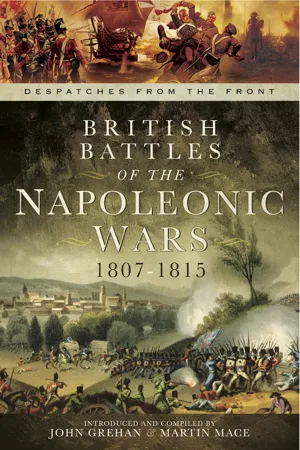
eBook - ePub
British Battles of the Napoleonic Wars, 1807–1815
- 208 pages
- English
- ePUB (mobile friendly)
- Available on iOS & Android
eBook - ePub
British Battles of the Napoleonic Wars, 1807–1815
About this book
The Napoleonic Wars was truly a world-wide conflict and Britain found itself engaged in battles, sieges and amphibious operations around the globe. Following every battle the commanding officer submitted a report back to the Admiralty or the War Office. Presented here together for the first time are those original despatches from some forty generals, captains and admirals detailing more than eighty battles that took place in India, Africa, Europe and the Americas. This unique collection of original documents will prove to be an invaluable resource for historians, students and all those interested in what was one of the most important periods in British military and naval history.The reports include those from some of Britain's most famous battles, the likes of Trafalgar and Waterloo, as well as less well-known but just as important engagements which resulted in the capture of the islands and territories which helped form the greatest empire the world has ever known.
Trusted by 375,005 students
Access to over 1.5 million titles for a fair monthly price.
Study more efficiently using our study tools.
Information
Topic
GeschichteSubtopic
Geschichte des 19. Jahrhunderts1
BATTLE OF MONTEVIDEO
Downing-Street, April 12, 1807.
A DISPATCH, of which the following is a Copy, was received this Morning at the Office of Viscount Castlereagh, one of His Majesty’s Principal Secretaries of state, from Brigadier-General Auchmuty, to the Right Honourable William Windham:
Monte Video, February 6, 1807.
SIR,
I have the Honour to inform you, that His Majesty’s Troops under my Command have taken by Assault, and after a most determined Resistance, the important Fortress and City of Monte Video.
The Ardent, with her Convoy, arrived at Maldonado on the 5th of January; and I immediately took under my Orders the Troops from the Cape, commanded by Lieutenant-Colonel Backhouse. On the 13th, I evacuated that Place without Opposition, leaving a small Garrison on the Island of Gorriti.
On consulting with Rear-Admiral Stirling, it was determined to attack Monte Video; and I landed on the Morning of the 18th, to the Westward of the Caretas Rocks, in a small Bay, about Nine Miles from the Town. The Enemy were in great Force, with Guns on the Heights, when we disembarked; but they did not advance to oppose us, and suffered me to take a strong Position, about a Mile from the Shore. A trifling Cannonade, and some firing at the Outposts, commenced in the Afternoon, and Continued occasionally during our Stay on that Ground.
On the 19th we moved towards Monte Video. The Right Column, under the Honourable Brigadier-General Lumley, was early opposed. About Four Thousand of the Enemy’s Horse occupied Two Heights to his Front and Right. As we advanced, a heavy Fire of Round and Grape opened upon us; but a spirited Charge in Front, from the Light Battalion under Lieutenant-Colonel Brownrigg, dispersed the Corps opposed to him, with the Loss of a Gun. The Enemy on the Flank did not wait a similar Movement, but retreated. They continued retiring before us, and permitted us, without any further Opposition, except a distant Cannonade, to take up a Position about Two Miles from the Citadel. Our advanced Posts occupied the Suburbs, and some small Parties were posted close to the Works; but in the Evening the principal Part of the Suburbs was evacuated.
The next Morning the Enemy came out of the Town, and attacked us with their whole Force, about Six Thousand Men, and a Number of Guns. They advanced in Two Columns; the Right, consisting of Cavalry, to turn our Left Flank, while the other, of Infantry, attacked the Left of our Line; this Column pushed in our Advanced Posts, and pressed so hard on our Out-Picquet, of Four Hundred Men, that Colonel Browne, who commanded on the Left, ordered Three Companies of the 40th, under Major Campbell, to their Support: these Companies fell in with the Head of the Column, and very bravely charged it; the Charge was as gallantly received, and great Numbers fell on both Sides; at length the Column began to give way, when it was suddenly and impetuously attacked in Flank by the Rifle Corps, and Light Battalion, which I had ordered up, and directed to the particular Point. The Column now gave way on all Sides, and was pursued, with Slaughter and the Loss of a Gun, to the Town. The Right Column, observing the Fate of their Companions, rapidly retired, without coming into Action.
The Loss of the Enemy was considerable, and has been estimated at Fifteen Hundred Men; their killed might amount to between Two and Three Hundred; we have taken the same Number of Prisoners, but the principal Part of the wounded got back into the Town; I am happy to add, that ours was comparatively trifling.
The Consequences of this Affair were greater than the Action itself. Instead of finding ourselves surrounded with Horse, and a petty Warfare at our Posts, many of the Inhabitants of the Country separated, and retired to their several Villages, and we were allowed quietly to set down before the Town.
From the best Information I could obtain, I was led to believe that the Defences of Monte Video were weak, and the Garrison by no Means disposed to make an obstinate Resistance; but I found the Works truly respectable, with One hundred and sixty Pieces of Cannon; and they were ably defended.
The Enemy, being in Possession of the Island of Ratones, commanded the Harbour; and I was aware that their Gun Boats would annoy us, as we apprehended. A Two Gun Battery was constructed on the 23d to keep them in Check, and our Posts were extended to the Harbour, and completely shut in the Garrison on the Land Side. Their Communication was still, however, open by Water, and their Boats conveyed to them Troops and Provisions: Even Water for the Garrison was obtained by these Means; for the Wells that supply the Town were in our Possession.
On the 25th we opened Batteries of Four Twenty-four Pounders and Two Mortars, and all the Frigates and smaller Vessels came in, as close as they could with Safety, and cannonaded the Town. But finding that the Garrison was not intimidated into a Surrender, I constructed, on the 28th, a Battery of Six Twenty-four Pounders, within a Thousand Yards of the South East Bastion of the Citadel, which I was informed was in so weak a State that it might be easily breached. The Parapet was soon in Ruins, but the Rampart received little Injury, and I was soon convinced that my Means were unequal to a regular Siege; the only Prospect of Success that presented itself was, to erect a Battery as near as possible to a Wall by the South Gate, that joins the Works to the Sea, and endeavour to breach it. This was effected by a Six Gun Battery within Six hundred Yards, and though it was exposed to a very superior Fire from the Enemy, which had been incessant during the whole of the Siege, a Breach was reported practicable on the 2d instant. Many Reasons induced me not to delay the Assault, though I was aware the Troops would be exposed to a very heavy Fire in approaching and mounting the Breach. Orders were issued for the Attack an Hour before Day break the ensuing Morning, and a Summons was sent to the Governor in the Evening to surrender the Town. To this Message no Answer was returned.
The Troops destined for the assault consisted of the Rifle Corps under Major Gardner, the Light Infantry under Lieutenant-Colonel Brownrigg and Major Trotter, the Grenadiers under Majors Campbell and Tucker, and the 38th Regiment under Lieutenant Colonel Vassal and Major Nugent.
They were supported by the 40th Regiment under Major Dalrymple, and the 87th under Lieutenant-Colonel Butler and Major Miller. The whole were commanded by Colonel Browne, The Remainder of my Force, consisting of the 17th Light Dragoons, Detachments of the 20th and 21st Light Dragoons, the 47th Regiment, a Company of the 71st, and a Corps of 700 Marines and Seamen, were encamped under Brigadier-General Lumley, to protect our Rear.
At the appointed Hour the Troops marched to the Assault. They approached near the Breach before they were discovered, when a destructive Fire from every Gun that could bear upon it, and from the Musketry of the Garrison, opened upon them. Heavy as it was, our Loss would have been comparatively trifling, if the Breach had been open, but during the Night, and under our Fire, the Enemy had barricaded it with Hides, so as to render it nearly impracticable. The Night was extremely dark. The Head of the Column missed the Breach, and when it was approached it was so shut up, that it was mistaken for the untouched Wall. In this Situation the Troops remained under a heavy Fire for a Quarter of an Hour, when the Breach was discerned by Captain Renny of the 40th Light Infantry, who pointed it out, and gloriously fell as he mounted it. Our gallant Soldiers rushed to it, and, difficult as it was of Access, forced their way into the Town. Cannon were placed at the Head of the principal Streets, and their Fire, for a short Time, was destructive: but the Troops advanced in all Directions, clearing the Streets and Batteries with their Bayonets, and overturning their cannon. The 40th Regiment, with Colonel Browne, followed. They also missed the Breach, and Twice passed through the Fire of the Batteries, before they found it.
The 87th Regiment was posted near the North Gate, which the Troops who entered at the Breach were to open for them, but their Ardour was so great that they could not wait. They scaled the Walls and entered the Town as the Troops within approached it. At Day-light every Thing was in our Possession except the Citadel, which made a shew of Resistance, but soon surrendered, and early in the Morning the Town was quiet, and the Women were peaceably walking the Streets.
The Gallantry displayed by the Troops during the Assault, and their Forbearance and orderly Behaviour in the Town speak so fully in their Praise, that it is unnecessary for me to say how highly I am pleased with their Conduct. The Service they have been engaged in since we landed, has been uncommonly severe and laborious, but not a murmur has escaped them: every Thing I wished has been effected with order and cheerfulness.
Our Loss during the Siege was trifling, particularly as we were not sheltered by Approaches, and the Enemy’s Fire of Shot and Shell was incessant. But it is painful for me to add, that it was great at the Assault. Many most valuable Officers are among the Killed and Wounded. Major Dalrymple of the 40th was the only Field Officer killed. Lieutenant- Colonels Vassal and Brownrigg and Major Tucker are among the wounded. I am deeply concerned to say that the Two former are severely so. The Enemy’s Loss was very great, about Eight Hundred killed, Five Hundred wounded, and the Governor Don Pasquil Ruis Huidobro, with upwards of Two Thousand Officers and Men are Prisoners. About Fifteen Hundred escaped in Boats or secreted themselves in the Town.
From Brigadier-General the Honourable W. Lumley and from Colonel Browne, I have received the most able and the most zealous Assistance and Support. The former protected the Line from the Enemy during our March, and covered our Rear during the Siege. The latter conducted it with great Judgement and determined Bravery.
The established Reputation of the Royal Artillery has been firmly supported by the Company under my Orders, and I consider myself much indebted to Captains Watson, Dickson, Carmichael, and Willgress, for their zealous and able Exertions. Captain Fanshaw of the Engineers was equally zealous, and though young in the Service conducted himself with such propriety that I have no doubt of his proving a valuable Officer. Owing to great Fatigue he was taken ill in the midst of our Operations, and Captain Dickson readily undertook his Office, and executed it with the greatest Judgement.
From the Heads of Corps and Departments, from the General Staff of the Army, from the Medical, and from my own personal Staff, I have received the most prompt and cheerful Assistance.
It is insufficient to say, that the utmost Cordiality has subsisted between Rear-Admiral Stirling and myself; I have received from him the most friendly Attention, and every Thing in his Power to grant.
The Captains and Officers of the Navy have been equally zealous to assist us; but I feel particularly indebted to Captains Donnelly and Palmer for their great Exertions. They commanded a Corps of Marines and Seamen that were landed, and were essentially useful to us with the Guns, and in the Batteries, as well as in bringing up the Ordnance and Stores.
This Dispatch will be delivered to you by Major Tucker, who was wounded at the Assault; and as he has long been in my Confidence, I beg Leave to refer you to him for further Particulars.
I have the Honour to be, &c.
S. AUCHMUTY,
Brigadier-General Commanding
Admiralty-Office, April 12, 1807.
CAPTAIN DONNELLY, of His Majesty’s Ship Ardent, arrived this Morning with Dispatches from Rear-Admiral Stirling, commanding a Squadron of His Majesty’s Ships in the Rio de la Plata, of which the following are Copies:
Diadem, off Monte Video, 8th Feb. 1807.
SIR,
I have peculiar Satisfaction in congratulating my Lords Commissioners of the Admiralty on the Capture of Monte Video, as well from the Importance of the Conquest, as from the Honour which has thereby been acquired by His Majesty’s Arms.
Immediately on the Arrival of Brigadier-General Sir Samuel Achmuty, at Maldonado, it was determined to invest this place, and having assembled our Force off the Island of Flores, a Descent was effected on the 16th Ultimo, near Carreta Point, which is about Seven Miles to the Eastward of the Town. The Enemy had assembled in considerable Numbers, and with several Pieces of Artillery seemed determined to oppose our progress.
The Navigation of the Rio de la Plata, with the strong Breezes which we have experienced for several Weeks, rendered the Landing of Troops, and assisting their Operations, very difficult, but the Place chosen was happily adapted to allow the covering Vessels, under the Direction of Captain Hardyman, to approach so close as to command the Beach, and notwithstanding the Weather threatened, and was unfavourable, the Soldiers got all on Shore without a single Accident of any Kind, and were in Possession of the Heights before Six o’Clock, with such Things as the General wanted.
On the 19th the Army moved forwards, and as an Attempt to harass the Rear was expected, I directed Boats to proceed close along Shore to look out for and bring off any wounded Men, whilst the covering Vessels were placed to prevent the Enemy from giving Annoyance, and I had the Happiness to hear that all the Sufferers were brought off, in Despite of well directed Efforts to destroy them.
In the Evening I dropped, with the Fleet, off Chico Bay, near which the Army encamped, within Two Miles of the City.
I had landed about Eight hundred Seamen and Royal Marines, under the Orders of Capt. Donnelly, to act with the Troops; and, as I saw no Advantage could result from any Effort of Ships against a strong Fortress, well defended at all Points, and which, from the Shallowness of the Water, could not be approached within a Distance to allow Shot to be of any use, I disposed the Squadron so as to prevent any Escape from the Harbour, as well as to impede a Communication between Colonna and Buenos Ayres, and confined my whole Attention to give every possible Assistance in forwarding the Siege, by landing Guns from the Line of Battle Ships, with Ammunition, Stores, Provisions, and every Thing required by the Commander of the Forces.
The Distance which the Ships lay from the Shore, with the almost constant high Winds and swell we had, and the great Way every Thing was to be dragged by the Seamen, up a heavy sandy Road, made the Duty excessively laborious. The Squadron had almost daily Fourteen hundred Men on Shore, and this Ship was often left with only Thirty Men on board.
The Defence made by the Enemy protracted the Siege longer than was expected, and reduced our Stock of Powder so low...
Table of contents
- Front Cover
- Title Page
- Copyright
- Contents
- Introduction
- List of Images
- Maps
- The Despatches
Frequently asked questions
Yes, you can cancel anytime from the Subscription tab in your account settings on the Perlego website. Your subscription will stay active until the end of your current billing period. Learn how to cancel your subscription
No, books cannot be downloaded as external files, such as PDFs, for use outside of Perlego. However, you can download books within the Perlego app for offline reading on mobile or tablet. Learn how to download books offline
Perlego offers two plans: Essential and Complete
- Essential is ideal for learners and professionals who enjoy exploring a wide range of subjects. Access the Essential Library with 800,000+ trusted titles and best-sellers across business, personal growth, and the humanities. Includes unlimited reading time and Standard Read Aloud voice.
- Complete: Perfect for advanced learners and researchers needing full, unrestricted access. Unlock 1.5M+ books across hundreds of subjects, including academic and specialized titles. The Complete Plan also includes advanced features like Premium Read Aloud and Research Assistant.
We are an online textbook subscription service, where you can get access to an entire online library for less than the price of a single book per month. With over 1.5 million books across 990+ topics, we’ve got you covered! Learn about our mission
Look out for the read-aloud symbol on your next book to see if you can listen to it. The read-aloud tool reads text aloud for you, highlighting the text as it is being read. You can pause it, speed it up and slow it down. Learn more about Read Aloud
Yes! You can use the Perlego app on both iOS and Android devices to read anytime, anywhere — even offline. Perfect for commutes or when you’re on the go.
Please note we cannot support devices running on iOS 13 and Android 7 or earlier. Learn more about using the app
Please note we cannot support devices running on iOS 13 and Android 7 or earlier. Learn more about using the app
Yes, you can access British Battles of the Napoleonic Wars, 1807–1815 by John Grehan, Martin Mace, John Grehan,Martin Mace in PDF and/or ePUB format, as well as other popular books in Geschichte & Geschichte des 19. Jahrhunderts. We have over 1.5 million books available in our catalogue for you to explore.