- 208 pages
- English
- ePUB (mobile friendly)
- Available on iOS & Android
eBook - ePub
About this book
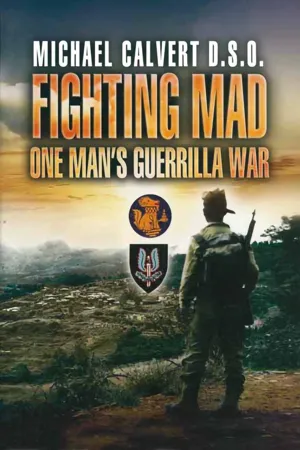
Michael Calvert was one of the legendary figures of the Second World War. He hit the headlines as 'Mad Mike' after the first Chindit campaign in 1943, with a reputation as a tough and daring leader of guerrilla troops. He was one of the first men selected for the Chindits by the controversial General Orde Wingate. He became Wingate's right-hand man - both in fierce jungle fighting and in battles against stick-in-the-mud staff officers. His speciality was penetrating behind enemy lines. Mad Mike fought in the snow and ice of Norway, in the steaming jungles of Burma, and on the battlefields of Europe where in 1945 he commanded the crack Special Air Service Brigade.
Information
Contents
| Author’s Note | |
| 1 | First Step to Adventure |
| 2 | My Coolie Army |
| 3 | Blooded in Shanghai |
| 4 | The ‘Phonev Fifth’ |
| 5 | Avalanche! |
| 6 | The British Guerrillas |
| 7 | Back to the East |
| 8 | Showboat Raid |
| 9 | Wingate |
| 10 | Calvert’s Commandos |
| 11 | The Plans that Never Were |
| 12 | Kill, or be Killed |
| 13 | Rahes in the Wood |
| 14 | Unfit for Heroes |
| 15 | The Lion and the Eagle |
| 16 | Chindits go to War |
| 17 | Ballyhoo |
| 18 | Birthday Party |
| 19 | Steel against Steel |
| 20 | The Headhunters |
| 21 | A Toast to Death |
| 22 | Vinegar Toe |
| 23 | Les Paras |
| 24 | East and West |
| 25 | Who Dares Wins |
This is my personal story, which tells of some of the things that happened to me before and during the war. I have written it down as I saw it and as I remember it, but I realize that others may have different memories of the incidents mentioned. Two minutes after a road accident people who have seen it can give widely differing accounts of what happened; just think how much room for divergency there would be if they were questioned twenty or more years later. Someone once said that truth is a many-sided diamond and we each see a different facet of it. Facts I have been unsure about I have tried to check and I would like to thank Field Marshal Viscount Slim and Lieutenant-Colonel L. E. O. T. Hart for their help. I have also consulted The War Against Japan, Vols. 2 and 3 (H.M. Stationery Office), Orde Wingate, by Christopher Sykes (Collins), Defeat into Victory, by Field Marshal Viscount Slim (Cassell), and Sir Winston Churchill’s The Second World War (Cassell). Most of the pictures are by courtesy of the Imperial War Museum.
Publisher’s Note
The publishers are grateful for the assistance of Philip Chinnery in the preparation of the revised final chapter of this new edition and other editorial advice.
1
First Step to Adventure
When I was twelve I bet a school friend half a crown that I would become a general before he did. Eighteen years later, in 1943, I was promoted brigadier at the age of thirty and won the bet. I felt pleased at the time but, looking back, I know that I did not really deserve to win, for I am more of a rebel than a general at heart.
In the special conditions of wartime, however, the two can sometimes go together, as they most certainly did in the man who was mainly responsible for my promotion, Orde Wingate. No one I have ever met was less like the popular Blimpish image of a general than Wingate, the audacious, moody, highly strung yet ruthless soldier who founded and led the Chindits, the bush-hatted Special Force which operated behind the Japanese lines in the Burma jungle.
Wingate’s unconventional ideas shocked the stick-in-the-mud element among the Army’s senior officers. Many of them regarded him as an outsider. I remember in India, in 1943, a lieutenant-general who was too dim to see where my sympathies lay saying to me: ‘You know, Michael, we Regulars must stick together against people like Wingate.’ Wingate, of course, was a Regular, but as far as this general was concerned his ‘odd’ methods and behaviour put him beyond the pale. Fortunately the brilliant and rebellious ideas Wingate produced outshone all efforts to stifle them and were actively encouraged by men of vision at the top, including Winston Churchill and General Wavell.
Persistent attempts have been made to denigrate Wingate since his death and haughty scorn has been poured on the size of his contribution to the so-called ‘Grand Design’ of victory. But the fact remains that highly mobile units, travelling light and supplied by air, are now widely used in the armies of the West as a whole and are, in fact, the very basis of the modern British Army. These were the methods Wingate pioneered in Burma with the Chindits and I was proud to be able to help in developing this type of warfare.
My own army career had been regarded as distinctly unusual long before I joined forces with Wingate in Burma. I think the reason was that for years, ever since I left school, I had been preparing myself for the war. I claim no great foresight or mystical powers for predicting the future; I just had this feeling that all the experience of fighting and leadership I could acquire would one day be needed. But I was young and at times I probably went about my self-imposed task in a rumbustious sort of way which created a bad impression among my superiors.
I once overheard one of my pre-war commanding officers grumbling to the adjutant about me.
‘Young Calvert always seems to be looking for trouble,’ he said. ‘I suppose it’s the Irish blood in him.’ He may well have been right, for my mother was Irish.
My father was a District Commissioner in India and I was born at a place called Rohtak, about forty miles from Delhi. I spent my early years there but at the age of six I was sent to a boarding preparatory school in England, down by the sea at Eastbourne. I don’t remember objecting to this particularly. It was the usual pattern for the children of the British in India; the schooling facilities out there were extremely limited. My three elder brothers were all at boarding school and I took it for granted the same would happen to me.
I was luckier than some in that my headmaster was a humane type of man and realized that he had to try to take the place of absent fathers. On the other hand he believed in tough spirits and self-reliance. We were encouraged to take plenty of exercise and I can still recall the pleasure of walking across the Sussex downs without shoes or socks and feeling the short, springy grass beneath my bare feet.
When we were nearly due to go on to public school at the age of thirteen the head took a group of us on a cycling tour of France and towards the end of it left us to take ourselves back to England. He knew we could do it if we set our minds to the task and we had great fun finding our way to the ferry, crossing the Channel and riding back to Eastbourne. All in all, it was good training for youngsters and these early tests of initiative stood me in good stead later in life.
I went on to Bradfield College in Berkshire when I was thirteen and a half. I was reasonably good at class work but I lived for sport, particularly boxing, swimming and cross-country running. I liked to win. That feeling of pounding in ahead of everybody else is tremendous. I can still feel the thrill of it, even though my running days are long past.
The rebel in me began to come out at Bradfield and I was given six of the best time and time again. Another boy called Keats and myself found an ancient book in the back of an old cupboard one day. It was dated 1880 and contained about a couple of hundred school rules, everything from scrubbing our nails at night to keeping out of the masters’ gardens. We set out to break each and every one of them and most of my thrashings came as a result of that. I didn’t feel resentful about these canings. They were one of the hazards connected with school life and we regarded them as punishments for being caught rather than for committing a misdemeanour.
My bad behaviour must have reached something of a peak about two years after I went to Bradfield and at fifteen I was publicly beaten with a walking-stick in front of my house. This was almost without precedent and it had more effect on me than all the other beatings put together. I began to realize that I could not go on breaking all the rules all the time. It introduced a note of caution into my life and I was to appreciate later on that I had learned a valuable lesson.
While I was still at school all my brothers joined the Royal Engineers. I knew that I wanted to go into the Forces, where I thought I stood a much better chance of leading an adventurous life than by remaining a civilian. But at seventeen I decided to be contrary and volunteered for the Royal Navy. I was given time off from school to attend a medical examination in London. It was my first step alone into an authoritative establishment of the outside world and I was extremely nervous, but determined not to show it.
The medical was a strict one carried out by a doctor with a red beard assisted by various naval orderlies. He started at my head and worked down slowly to my feet while I stood tensed and alert, trying not to look embarrassed at my state of undress. I wanted to impress and obeyed sharply, and in what I hoped was a seamanlike manner, the various instructions which emerged from the beard.
After what must have been half an hour, though it seemed like half a day to me, the doctor reached my feet and prodded about at my toes. ‘No sign of trouble there,’ he muttered to an orderly who was standing by making notes for him.
I thought that was the end of it but apparently there were still the soles of my feet to examine and the doctor walked round behind me.
‘Raise your right foot,’ he grunted.
I snapped my leg back from the knee, sole upwards, determined to show that I was as wide awake at the end as I had been at the beginning. Unfortunately the doctor was not used to this barrack-square approach and, unknown to me, had knelt down to get a closer look at my foot. My smartly raised heel caught him smack on the nose.
Turning round, appalled at what I had done, I saw the doctor trying desperately to stem the flow of blood which was running down into his beard, making it redder still. One orderly was rushing up with a chair, another with a big roll of cotton wool. And it was then that I burst out laughing.
I suppose it was a nervous reaction after days of getting worked up about whether I would pass, followed by the actual ordeal of the examination itself. Anyway, I laughed, and it was such a relief that I had difficulty in stopping. Nobody else thought it was funny, or if they did they were not prepared to show their amusement in front of the injured doctor.
The upshot was, of course, that I didn’t get into the Navy. The official reason given was that my feet were not up to standard; I have high arches. But I can’t help feeling they would not have taken me at any price after my fit of the giggles.
After the first sharp disappointment I was not too depressed about this. I think I realized that I had volunteered in the first place just to be awkward, knowing that everyone expected me to follow my brothers into the Army.
I stayed on at Bradfield until I was eighteen, then won a place at the old Royal Military Academy at Woolwich, which was later absorbed into Sandhurst. It was a tough life but I enjoyed it. I remember I made friends mainly with the cadets from overseas, Australians, New Zealanders and Canadians. My parents were still abroad and could not get back to England very often, so the chaps from the Dominions and myself had in common the fact that we could not go home on leave like the others.
Tactics and strategy were my good subjects at the R.M.A. but I never won any prizes for smartness on parade. I am rather short and stocky, which isn’t a good shape for the barrack square, and in any case my rebelliousness at the time was directed against what I considered to be excessive spit-and-polish. My objection to this remained throughout my army career. I maintain that a good soldier should be a trained fighting man, smart and proud of his appearance certainly, but not dressed up and bulled up like a tailor’s dummy. I am glad to see that this is the attitude now being adopted throughout the Services.
I kept up with my sports at Woolwich, particularly boxing and swimming. I was put in for the pentathlon at the trials held to pick the British Olympics team. I got through at swimming, running and revolver shooting but I wasn’t good enough at riding and épée fencing.
I passed out seventh in my year at the R.M.A. and went on to Cambridge University to study mechanical science, as I had decided after all that I wanted to follow my brothers into the Royal Engineers. The feeling that I needed to prepare myself for war was very strong in those days. I studied hard but I also went on with my sport to keep fit. I was awarded my half-blue for swimming and water polo and boxed for Cambridge and the Army, including a couple of fights at the Albert Hall.
Another step I took seems rather gruesome, looking back, but it played its part in my private preparation. I got a medical student friend to take me as often as possible into the medical school. There I could watch the students carving up bodies during their classes. My aim was to steel my mind to this type of thing so that I wouldn’t be too shocked and sickened on the battlefield.
Of course, when it came to the point, the terrible and pathetic sights of war were far removed from the clinical and impersonal atmosphere of the medical school. But I felt that I was tougher, that my mind had been hardened; and the thought that I would no longer be quite as scared at seeing these things as I would have been without the surgical indoctrination helped a little, even though I was partly fooling myself.
It was 1936 when I won my honours degree and really started out as a Sapper officer; I had been commissioned before going to Cambridge. I was as proud as a peacock. I liked the life, there was plenty of time for sport and I was told I would be sent abroad very soon. A few months later I was on my way to Hong Kong and I felt that the adventurous life I had decided to lead was off to a good beginning.
2
My Coolie Army
The first men I commanded without let or hindrance in the British Army were Chinese coolies. I had set out in life deliberately seeking the unexpected but this was something I had never imagined, which made it entirely acceptable as far as I was concerned.
It happened in Hong Kong when, soon after I arrived, I was given the task of bringing up the strength of the Hong Kong Royal Engineers from 70 to 250. It was the sort of job many officers would treat with scorn, which is why it was handed to me as the junior subaltern. This never occurred to me at the time and I regarded it as a wonderful opportunity so early in my army career. And it really was a fine experience, as I had to plan a comprehensive programme which started with recruitment and went through all the training phases necessary to turn a raw recruit into a soldier. I was very much helped by a considerate Company Commander, Major Rollo Gillespie, and several others.
With my Chinese sergeant-major, named Yip Fuk, I selected the recruits from the Chinese volunteers. They flocked in when they heard there was a chance of joining the British Army and getting good pay and working conditions for several years if they were lucky enough to be accepted. I used to get up at six every morning and spend an hour studying Cantonese so that I could at least make an attempt to understand what my men were saying, and try to give them simple answers myself, instead of working all the time through an interpreter. I eventually passed an examination in Cantonese for which I received fifty pounds.
All the men had to have a trade before we signed them on and the majority of them took to army life at once. However hard they found the training I suppose they were living better than they had ever done, or could ever hope to do, in their overcrowded homes. Their cheerful willingness made them easy to work with and patience and persuasion worked wonders. The respect they accorded me in return was heady stuff for a youngster and I remember shoving my head into the lion’s mouth several times on their behalf.
Our local paymaster was a rather peppery major nearing retirement, the sort of officer that young subalterns normally tried to avoid. But I had to see him once or twice about general pay matters for the unit and when a special problem arose over one of my men I plucked up courage and asked for another interview.
‘Well, what is it?’ he barked, after I had saluted as if he was the Governor himself.
‘It’s about one of my men, sir.’ I hesitated. The night before I had rehearsed exactly what to say and how to say it, brisk and to the point, but now I funked it and played for time. ‘About … about his marriage allowance, sir.’
‘Well, what about it, man? He gets one, doesn’t he? If not there’s a perfectly simple form you can fill in for him. Can’t you write?’
‘Yes, sir,’ I said hastily. ‘The trouble is … I was wondering … I mean, can a man have two marriage allowances?’
‘Two marriage allowances!’ The major turned red, then purple and for a moment seemed incapable of further speech.
I carried on quickly: ‘You see, sir, one of my chaps has two wives and he finds it very difficult to keep them on one allowance, so I wondered if there was some special regulation…’
‘Get out.’ The major had found his tongue again but was using it with difficulty, ...
Table of contents
- Cover
- Half Title
- Full Title
- Copyright Page
- Table of Content
Trusted by 375,005 students
Access to over 1.5 million titles for a fair monthly price.
Study more efficiently using our study tools.
Frequently asked questions
Yes, you can cancel anytime from the Subscription tab in your account settings on the Perlego website. Your subscription will stay active until the end of your current billing period. Learn how to cancel your subscription
No, books cannot be downloaded as external files, such as PDFs, for use outside of Perlego. However, you can download books within the Perlego app for offline reading on mobile or tablet. Learn how to download books offline
Perlego offers two plans: Essential and Complete
- Essential is ideal for learners and professionals who enjoy exploring a wide range of subjects. Access the Essential Library with 800,000+ trusted titles and best-sellers across business, personal growth, and the humanities. Includes unlimited reading time and Standard Read Aloud voice.
- Complete: Perfect for advanced learners and researchers needing full, unrestricted access. Unlock 1.5M+ books across hundreds of subjects, including academic and specialized titles. The Complete Plan also includes advanced features like Premium Read Aloud and Research Assistant.
We are an online textbook subscription service, where you can get access to an entire online library for less than the price of a single book per month. With over 1.5 million books across 990+ topics, we’ve got you covered! Learn about our mission
Look out for the read-aloud symbol on your next book to see if you can listen to it. The read-aloud tool reads text aloud for you, highlighting the text as it is being read. You can pause it, speed it up and slow it down. Learn more about Read Aloud
Yes! You can use the Perlego app on both iOS and Android devices to read anytime, anywhere — even offline. Perfect for commutes or when you’re on the go.
Please note we cannot support devices running on iOS 13 and Android 7 or earlier. Learn more about using the app
Please note we cannot support devices running on iOS 13 and Android 7 or earlier. Learn more about using the app
Yes, you can access Fighting Mad by Michael Calvert in PDF and/or ePUB format, as well as other popular books in History & Military Biographies. We have over 1.5 million books available in our catalogue for you to explore.