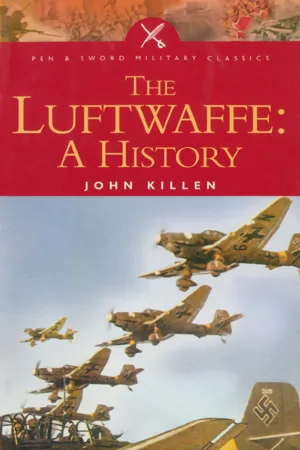
An extensive history of the rise and fall of Nazi Germany's air force.
In his thoroughly researched study, John Killen examines German air power between 1914 and 1945, from the early days of flying when Immelmann, Boelke, Richtofen, and other First World War aces fought and died to give Germany air supremacy, to the nightmare existence of the Luftwaffe as the Third Reich plunged headlong to destruction.
Here are the aircraft: the frail biplanes and triplanes of the Kaiser's war; the great Lufthansa aircraft and airships of the turbulent Thirties; the monoplanes designed to help Hitler in his conquest of Europe. Here are the generals who forged the air weapon of the Luftwaffe: the swaggering Goering, the playboy Udet, the ebullient Kesselring, and the scapegoat Jeschonnek. Here, too, are the pilots who tried to keep faith with their Fatherland despite overwhelming odds: Adolf Galland, Werner Molders, Joachim Marseille, and Hanna Reitsch. Not least are the actions fought by the Luftwaffe from the Spanish Civil War to the Battle of Britain, through the bloody struggle for Crete, and the siege of Stalingrad to the fearful twilight over Berlin.
"A good, readable account of the rise and fall of the Luftwaffe that covers all of the main fronts on which it fought, and examines the reasons for the eventual failure as well as providing a readable narrative." —History of War
- 310 pages
- English
- ePUB (mobile friendly)
- Available on iOS & Android
eBook - ePub
The Luftwaffe: A History
About this book
Information
CONTENTS
| Foreword | |
| I | Aircraft and Aces; 1914–1916 |
| II | Year of Attrition: 1917 |
| III | The Broken Wings: 1918 |
| IV | Phoenix Rising: 1918–1926 |
| V | Awaiting Events: 1926–1933 |
| VI | Air Force in Embryo: 1933–1935 |
| VII | Into the Arena: Spain, 1936 |
| VIII | The End of the Airships: 1936 |
| IX | Austria to Poland: 1938–1939 |
| X | Blitzkrieg! Poland, 1939 |
| XI | The Battering Ram: France, 1940 |
| XII | A Fortress Besieged: The Battle of Britain |
| XIII | Heinkels Over London: September, 1940 |
| XIV | Sunshine and Slaughter: Crete, 1941 |
| XV | Red Star Burning: Russia, 1941 |
| XVI | The Unconquerable Island: Malta, 1942 |
| XVII | Airlift to Disaster: Stalingrad, 1943 |
| XVIII | “You can call me Meier!” Cologne, 1943 |
| XIX | Bombing Round the Clock: 1943 |
| XX | Disintegration: 1944 |
| XXI | Fighters, Bombers or Fighter-Bombers? 1944 |
| XXII | Dresden and Berlin: 1945 |
| XXIII | Cry Havoc to the End: May, 1945 |
| Bibliography | |
| Index |
FOREWORD
by Marshal of the Royal Air Force,
Sir John Slessor, G.C.B., D.S.O., M.C.
THE Germans are exceedingly efficient men of war—temperamentally, tactically and technically, and on land, at sea and in the air—as we know to our bitter cost in two world wars. Fortunately for us there have been fatal flaws in their system for higher strategic direction in both wars, but especially the second. Field Marshal Smuts, in a moment of relaxed rumination, once said to me, “You know—it’s the greatest mistake to imagine that it’s great victories that win wars. On the contrary—it’s the great blunders. We ought to put up a statue in Trafalgar Square to Hitler for having been such a fool as to attack Russia.”
Readers of this book may reflect that in the air war Hitler was indeed our secret weapon—ably abetted by Hermann Goering. After our near-fatal blindness and prevarication in the locust years before 1939, it would have gone ill with us had not the efforts of the RAF been supplemented by the colossal blunders of the egregious Reichsmarschall and his crazy master. One’s heart almost bleeds for the senior commanders of the Luftwaffe—many of them very capable Generals as well as brave fighting men—subject as they were to the follies and misjudgements of the man who had been a fine fighter leader in the First World War but was such an unbelievably incompetent Commander-in-Chief in the second.
It was as well for us that the basic German concept of war was still rooted in Army tradition. The battle of Britain might have been a very different story had the Nazis followed up and developed the astonishingly advanced techniques of “strategic” air warfare initiated by the old Imperial Air Force in their attacks on Britain a quarter of a century earlier. The personnel of the Luftwaffe were brave and determined; the scientific and technical backing was excellent; the organisation, with its emphasis on mobility and flexibility, was basically sound. Its tactics as the spearhead of Blitzkrieg in France in 1940 and in Russia in 1941 were devastatingly effective; this sort of thing wins battles: it does not in itself win wars.
The Luftwaffe had too much to contend with—and not only, in the end, a World in Arms. From Goering’s first fatal decision to switch from attacks on our radar stations during the Battle of Britain, to Hitler’s God-sent inspiration to transform the ME 262 jet fighter into a bomber four years later, it was constantly thwarted and frustrated by almost unbelievable ineptitude at the highest levels.
All this is well described in Mr. Killen’s most readable book, which should certainly find a place on the shelves of all senior officers of the Nato Air Forces.
J. C. SLESSOR
CHAPTER I
AIRCRAFT AND ACES: 1914–1916
ON a bright August morning in 1915 a young German airman dived his single-seater scout monoplane out of the summer clouds over the Western Front. The English biplane beneath him swerved away at once, but too late; the single fixed machine-gun of the Fokker monoplane stammered briefly, stopped, then stammered again. The acrid scent of cordite fumes in his nostrils, the German pilot turned in his seat, watching with surprise as the enemy machine faltered in the air. Slowly at first, then rapidly gaining speed, it drifted lazily towards the earth below. Leutnant Max Immelmann, the German pilot, saw the biplane land heavily in a field, and knew then that he had gained his first victory. Later, he would have many other victories, and still later become known as the Eagle of Lille, but Immelmann would never equal his first achievement as a fighting airman. On that day in 1915 he unwittingly fulfilled the true purpose of a German fighter aircraft for the first time.
When the assassination of Archduke Franz Ferdinand of Austria and his consort in Sarajevo on 28th June, 1914, precipitated Europe into the wholesale slaughter that was to last for four long and weary years, Germany, in common with her opponents, was totally unprepared for war in the air. Eleven years after Orville and Wilbur Wright had made history at Kitty Hawk the aeroplane still remained something of a novelty to the narrow military mind. It was considered to be of little use except perhaps in a reconnaissance or observation role, secondary even to the splendid cavalry that would play such an unimportant part in this modem war.
Nevertheless, an Austrian, Igo Etrich, had already provided the basis for the future Imperial German Air Force. In 1908, he designed an attractive monoplane which became known as the Taube—or Dove—because of its graceful sweeping form and the remarkable resemblance it bore to a bird in flight. After various early flying successes, including an altitude record of 20,000 ft., Etrich sold the rights of his monoplane to the German Government, who handed the design to the Rumpler factory at Berlin-Litchtenberg for development. The twenty Taubes produced by the Rumpler concern proved to be such outstanding aircraft that eventually a number of other factories began manufacturing the little monoplanes, and by 1914 more than half of the total aeroplanes assigned for use with the German armies were of that type.
When von Kluck’s forces surged across Belgium and northeast France during the night of 4th August, 1914, Germany could muster some thirty-eight airships and about eight hundred assorted aeroplanes, all unarmed, and including the cumbersome L.V.G., Albatros and D.F.W. two-seater biplanes, which were later to prove so slow and unwieldy in action. These air units were distributed along the front in batches of six aircraft, known as Feldfliegerabteilungen, and were reserved for use in a reconnaissance or photography role, as had been anticipated. The Feldfliegerabteilungen were organised within the German Army on a basis of one to each Army H.Q., and also one to each Army Corps. Various experiments to provide a successful aircraft armament continued to be ignored by the German High Command, who simply failed to envisage the aeroplane as a fighting weapon. The carrying of pistols or rifles into the air thus became a normal practice during the first year of war.
The two-seater heavy biplanes, carrying a pilot and observer, and known as “B” machines, were the aircraft commonly used for reconnaissance purposes during 1914. Later, when these mounted a Parabellum machine-gun for rearward defence, they were designated as “C” machines. The little single-seater “A” machines, mostly Taube monoplanes, were particularly suitable for reconnaissance when advantage was taken of their fast, high-flying qualities, and Max Immelmann flew over Paris in a Rumpler model in the autumn of 1914 and dropped a note on the city calling upon the people to surrender. Strange as it may seem, history records that on both sides a well-aimed rifle bullet would occasionally find a target—Oberleutnant Reinhold Jahnow, Germany’s first pilot to be killed in action, fell on 12th August, 1914—but in those early days of military aviation casualties in the air were the exception rather than the rule.
Then, in 1915, the Fokker E.1 monoplane appeared over the Western Front, and immediately the fighter aircraft was born. As used by Max Immelmann, Oswald Boelcke, and later a number of other famous German airmen, the small 80-h.p. Eindecker monoplane designed by a young Dutch engineer named Anthony Fokker created a milestone in the history of aviation. Of surprisingly conventional appearance, but with an excellent performance, the true secret of the Fokker monoplane’s amazing success lay in its armament, which completely revolutionised aerial fighting and achieved within the space of a few weeks unlimited supremacy for the German air forces in the field.
After examining a captured French Morane monoplane fitted with a primitive form of interrupter gear invented by an engineer named Eugene Gilbert, and used with some success by the pilot of the Morane, Roland Garros, Fokker designed a greatly improved mechanism which enabled a rigid forward-firing machine-gun to fire through the arc of an aeroplane airscrew without the bullets striking the blades. For the first time, a pilot could aim his aircraft directly at the enemy, using it as a steady gun platform; consequently the unsuspecting Allied reconnaissance biplanes with their clumsy rearward-firing Lewis guns were bound to suffer increasing losses. The peaceful early months of the war in the air had abruptly ended, and the unarmed Taubes and Aviatiks of 1914 were already fading away into the mists of time.
The new single-seater Fokker monoplanes were carefully allotted to only the most experienced German pilots, and originally distributed on a basis of two fighters to each existing Fliegerabteilungen for protection of the slow two-seater observation biplanes. However, the Aviation Staff Officer of the 6th Army, Major Stempel, quickly saw that the monoplanes could be used to better purpose if they were formed into definite fighter units, and, on his own initiative, commenced a reorganisation of the machines in his own area. At about the same time that Major Stempel ordered the formation of three units of fighter monoplanes at Douai, General Ludendorff decided that the air forces had now grown to such an extent that it was time for them to break away from the Army; this eventually led, with the Kaiser’s approval, to the establishment of the Deutschen Luftstreitkrafte, or German Air Force, with General von Hoeppner placed in command. Slowly but surely, military aviation was coming into its own.
The three single-seater fighter units, or Kampfeinsitzerkommandos, organised by Major Stempel, immediately began to prove their worth in action, and two Fokker monoplane pilots, Max Immelmann and Oswald Boelcke, began the steady rise to fame later to earn them Germany’s highest award for valour, the Ordre Pour le Mérite, while operating from Douai. During the long winter of 1915 and the spring of 1916, they and the other Eindecker pilots waged a bitter and unceasing war against the depleted Allied observation aircraft; yet the persistently offensive policy of the Royal Flying Corps continued to carry its machines relentlessly into the enemy skies, regardless of the odds that faced them. In the early months of 1916 two new British aircraft, the De Havilland 2 scout and the F.E.2b two-seater fighter, appeared on the Western Front to challenge the German air supremacy. Both were pusher-engined machines, fitted with free forward-firing Lewis guns, a partial answer to the yet unsolved mystery of Anthony Fokker’s interrupter mechanism. A little French sesquiplane scout, the Nieuport 17, came into action about the same time, and in the hands of such outstanding airmen as Albert Ball and Georges Guynemer fought, outflew, and gradually destroyed the Fokker menace. With it, in the summer of 1916, passed Max Immelmann, the Eagle of Lille, the monoplane he was flying shaken to pieces by a faulty engine.
On the morning of 1st July, 1916, the incredible weight of shellfire that had pounded the German trenches for a full week reached a climax of fire and steel, raining down death and destruction at a rate hitherto unequalled in war. As the British infantry went over the top, wave after wave, and the German machine-guns broke the brief silence with their heavy repeating clamour, the Royal Flying Corps rose to find an unchallenged sky. Ten thousand feet below, the running khaki figures struggled forward until they fell like com before the scythe, their voices drowned for ever by the merciless hammering of the guns; but that first day of the tragic Somme offensive remained unforgettably quiet and serene for the men who fought in the air.
It could not last, of course. Oswald Boelcke, the young Saxon schoolmaster’s son who had achieved such success with the Fokker monoplane over Verdun, had already suggested the formation of new units, to be known as Jagdstaffeln, elite squadrons whose only purpose would be to invite combat and regain the initiative from the Allies. Boelcke was much more than an outstanding fighter pilot; he was also a brilliant strategist, whose tactics for waging a successful air war would later prove as sound in the Battle of Britain as they did during the weary struggle of the Somme. After an inspection of the Southeastern Front, he returned to Douai to find that his suggestions had been fully approved by the High Command, and he was ordered to supervise the formation of two fighting squadrons. Jagdstaffel 1, commanded by a Hauptmann Zander, came into being on 23rd August, 1916, and a week later Jagdstaffel 2, under Boelcke, was formed at Lagaicourt. The man who had fought at the side of Max Immelmann lost no time in turning his pupils into expert fighter pilots; Werner Voss, Erwin Boehme, and young Leutnant Manfred von Richthofen were three of the novices who listened to the wisdom of Boelcke and later found glory because they remembered it. Two new types of single-seater biplane fighter aircraft were introduced almost simultaneously to the new Jagdstaffeln, or Jasta, as they were often known. The Halberstadt D.II, the first German biplane to be fitted with twin synchronised machine-guns, was destined to be brilliantly but only temporarily successful. Faster than the D.H.2 it opposed, it was nevertheless not easy to control, and required the skilful hands of an experienced pilot, yet at the same time it did much to regain Germain air supremacy in the autumn of 1916. The Albatros D.I was faster and more manoeuvrable than any Allied aircraft in service at the time. Fitted with the same armament as the Halberstadt, the Albatros was a much more attractive design, with a streamlined fuselage remarkable for the period, a rounded airscrew spinner, and powered by a 160 h.p. Mercedes engine. In later versions, which were the backbone of the German fighter forces until 1918, the struts were altered to the famous Vee layout already in use on the French Nieuport 17, and to be seen a year later on ...
Table of contents
- Cover
- Half Title
- Full Title
- Copyright Page
- Contents
Trusted by 375,005 students
Access to over 1.5 million titles for a fair monthly price.
Study more efficiently using our study tools.
Frequently asked questions
Yes, you can cancel anytime from the Subscription tab in your account settings on the Perlego website. Your subscription will stay active until the end of your current billing period. Learn how to cancel your subscription
No, books cannot be downloaded as external files, such as PDFs, for use outside of Perlego. However, you can download books within the Perlego app for offline reading on mobile or tablet. Learn how to download books offline
Perlego offers two plans: Essential and Complete
- Essential is ideal for learners and professionals who enjoy exploring a wide range of subjects. Access the Essential Library with 800,000+ trusted titles and best-sellers across business, personal growth, and the humanities. Includes unlimited reading time and Standard Read Aloud voice.
- Complete: Perfect for advanced learners and researchers needing full, unrestricted access. Unlock 1.5M+ books across hundreds of subjects, including academic and specialized titles. The Complete Plan also includes advanced features like Premium Read Aloud and Research Assistant.
We are an online textbook subscription service, where you can get access to an entire online library for less than the price of a single book per month. With over 1.5 million books across 990+ topics, we’ve got you covered! Learn about our mission
Look out for the read-aloud symbol on your next book to see if you can listen to it. The read-aloud tool reads text aloud for you, highlighting the text as it is being read. You can pause it, speed it up and slow it down. Learn more about Read Aloud
Yes! You can use the Perlego app on both iOS and Android devices to read anytime, anywhere — even offline. Perfect for commutes or when you’re on the go.
Please note we cannot support devices running on iOS 13 and Android 7 or earlier. Learn more about using the app
Please note we cannot support devices running on iOS 13 and Android 7 or earlier. Learn more about using the app
Yes, you can access The Luftwaffe: A History by John Killen in PDF and/or ePUB format, as well as other popular books in History & German History. We have over 1.5 million books available in our catalogue for you to explore.