An "interesting and highly informative personal memoir . . . a much-needed addition to the body of work covering the air war over the Falklands."—
IPMS/USA
During the Falklands War, Jerry Pook, a pilot in No. 1(F) Squadron RAF, flew air interdiction, armed reccon, close-air-support and airfield attack as well as pure photo-reccon missions. Most weapons were delivered from extreme low-level attacks because of the lack of navigation aids and in the absence of Smart weapons. The only way he could achieve results was to get low down and close-in to the targets and, if necessary, carry out re-attacks to destroy high-value targets.
Apart from brief carrier trials carried out many years previously, there had been no RAF Harriers deployed at sea. The RAF pilots were treated with ill-disguised contempt by their naval masters, their professional opinions ignored in spite of the fact that the RN knew next to nothing about ground-attack and reccon operations. Very soon after starting operations from the aircraft carrier HMS
Hermes, the squadron realized that they were considered as more or less expendable ordnance.
The Harriers lacked the most basic self-protection aids and were up against 10,000 well-armed troops who put up an impressive weight of fire whenever attacked.
"Prior to this book, very little had been written in detail describing the RAF Harrier GR3 operations during the 1982 Falklands War. This book fills that void very well, providing a wealth of detail in describing the lead up, deployment and day-to-day combat operations of the small contingent of Royal Air Force attack Harriers."—
IPMS/USA
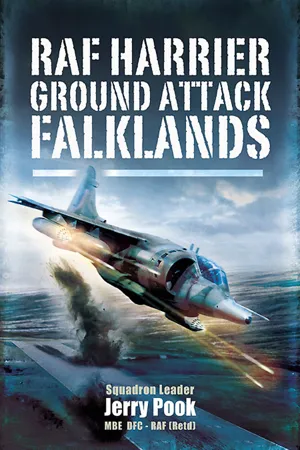
- 256 pages
- English
- ePUB (mobile friendly)
- Available on iOS & Android
eBook - ePub
RAF Harrier Ground Attack: Falklands
About this book
Information
CHAPTER ONE
In at the Deep End
The first time that most of No. 1(F) Squadron pilots became directly involved in the Falklands War was on 13 April 1982. On that day we had ferried eight Harriers across the Atlantic to Goose Bay in Labrador, for use in exercise Maple Flag. It was a Tuesday after a long Bank Holiday weekend and before we had stacked for the weekend I already knew that a lot of our Victor tanker force were tied up with air movements down to Ascension Island. Before the weekend none of us except the Boss had any inkling that we were going to get involved in operations in the South Atlantic. I had laughed like a drain when my brother Robin rang me up on the day of the Argy invasion, singing, ‘Don’t cry for me, Argentina!’ Robin was an infantry Major and his gallows humour always gelled with mine. On that Tuesday the whole cross-Atlantic ferry operation was in doubt for us right up to 0800 hours, which was keeping me pretty annoyed as I had been responsible for our planning. Eventually, 38 Group gave us the go ahead and we set off on the tedious seven-hour flog across ‘The Pond’.
At Goose Bay that night we had a great barbecue party with the Canadians (in the open air, with the air temperature below zero). We fell into conversation with the crew of the Maritime Patrol Nimrod, which had provided Search and Rescue coverage for us across The Pond. They said that they might not be able to take us back to Wittering next day as they were on standby to fly direct to Ascension. Obviously, things were hotting up. We already knew that the Navy was recalling all the Sea Harrier pilots it could lay hands on, to be trained up at Yeovilton to form a reserve squadron as reinforcement for the two squadrons already sailing south aboard Hermes and Invincible. The Navy was also taking on more RAF Harrier GR3 pilots (it already had a few) direct from squadrons, to be given a hasty cross-training on the Sea Harrier, such was its shortage of experienced pilots.
In the morning the weather at Goose Bay was appalling, with heavy snow falling all day. We climbed aboard and taxied out once in the Nimrod, but had to taxy back again as the pilots were only able to see a few feet in the blizzard conditions. Much later, the weather cleared sufficiently for us to take off and, much to our relief, we arrived back at Wittering after midnight. We were met by Pat King, the Station Commander, who immediately cornered the Boss for a private briefing. The Boss said that he couldn’t tell me what was up, but we would all find out the next morning at a briefing in the squadron. Bob Iveson, my fellow flight commander, had been taken off the ferry programme at the last moment and sent off on a secret mission to Liverpool to assess the suitability of a certain container ship for Harrier operations. Later, we discovered the name of the ship - Atlantic Conveyor.
At the briefing at 0900 hours we learned that the plan was for us to embark on the Atlantic Conveyor at Plymouth, with an as yet unspecified number of aircraft and pilots, and sail to the war zone. The Boss described the ship to us: there was obviously going to be a shortage of accommodation as she would be packed full of various stores and weapons for the operation. The immediate task was to start modifying our aircraft to make them suitable for operations at sea, and also to start work-up training for the pilots. The Boss started allocating jobs to various people and it was clear that we were now into a full wartime training mode, the balloon having gone up as far as we were concerned. From now on our destinies were being driven by events in the South Atlantic. As Training Flight Commander I was given responsibility for all the necessary work-up training, which had already begun. The first priority was ski-jump training at Royal Naval Air Station Yeovilton, where the training ramp was located. Two of our pilots had been sent there that morning to try out the ramp. (RAF clearance for this was not given until later in the day.) We were also told that our task in the South Atlantic was to serve as Attrition Replacements for Sea Harriers shot down on operations - a sobering thought. When Sea Harriers were lost from either carrier we would be called forward from the Atlantic Conveyor to operate in the Air Defence role. Although our primary role within the RAF was as a Ground Attack squadron, we included a lot of Air Combat and Low Level Intercept training in our regular squadron routine. We all knew that lookout was only kept at the highest standard if there was a ‘Bounce’ lurking somewhere along the route. The Bounce consisted of one or two fighters (Phantoms, Lightnings etc.), or - if none was available - some of our own squadron aircraft flown by designated Aggressor pilots. As Air Combat Training was my responsibility, it fell to me to train up suitable experienced pilots in this very demanding role (see Appendix 8 - Air Combat). Although we had no air-to-air missile fit, we had always considered missile as well as gun ‘kill’ parameters during our Air Combat training sorties. About a third of our pilots were qualified Aggressors, which meant that they had regular practice at intercepting formations at High and Low Level, in most cases using only the ‘Mk 1 Eyeball’ to achieve a successful interception. Ironically, this was to be by far the most common type of interception carried out by Sea Harrier pilots during the air engagements that began in early May. Because of problems with the Sea Jets’ radar and poor radar coverage over the Falklands, there was to be precious little of the traditional type of radar-assisted fighter interception in the Great South Atlantic Turkey Shoot to come.
I devised a training programme that would sharpen up our skills in all areas of Air Combat as number one priority. With hindsight, most of this effort was to be wasted because of the major change of role allocated to us by the Navy once it was realised how difficult and dangerous the Low Level Ground Attack task would be for its precious few Sea Harriers.
I rang up some contacts at RAF Brawdy and Binbrook, to set up a Dissimilar Air Combat Training (DACT) programme in order to refamiliarise our pilots with the characteristics of Low Wing loading (Hunter), and Supersonic (Lightning) opposition. By now we had been told the secret code name Operation Corporate to be used for the operation. Although I could not mention it by name, it seemed as if everyone I rang knew what was up and, more important, was prepared to give us unlimited co-operation. Later in the day some more pilots flew down to Yeovilton to continue the ski-jump training into the early evening, after which I went home exhausted with the tension and excitement of our first full day of war preparation.
The next day I took a formation of our aircraft up to Binbrook to fly DACT sorties against the Lightning. I briefed up with Squadron Leader Dave Carden, an old Lightning ‘hairy’ of great experience. I felt very out of touch and regretted that I had usually considered the Lightning to be fairly easy meat in combat, especially after a Harrier tour in Germany fighting them at Low Level on exercises. Dave was an ace exponent of the vertical fight: he gave me a very hard time throughout. I landed feeling like a wet rag, the violent physical exertion while severely overdressed in a tiny, overheated cockpit having taken its usual toll. Later I wrote a note in my diary, ‘Must sharpen up!’ After returning to Wittering, I rang Squadron Leader Dave Jackson, our tame Staff Officer at 38 Group, to ask for some live cluster bombs to drop somewhere. I already had some nagging doubts about what we were going to end up doing in the Falklands, and I had a shrewd suspicion that we would end up doing some Ground Attack - whatever the Navy was saying at present. If so, we had to get some realistic practice in with what was our primary Ground Attack weapon: our squadron armourers were also in need of practice at preparing and loading the real thing.
‘How many do you want?’ asked Dave.
‘About thirty - to start with,’ I said, hopefully.
‘You can have them on Monday,’ replied Dave, ‘I’ll fix up a Splash Target2 for you in the North Sea.’ What a player.
After a rather subdued ‘happy hour’ in the bar, we stacked for the weekend in anticipation of much hard work to come. Our planned embarkation date was now 24 April, leaving precious little time for the engineers to complete the aircraft modifications. They would be working through the weekends from now on.
On the following Monday for our first mission of the day I led a four-ship cluster bomb attack on a Splash Target in the North Sea. We each carried three cluster bombs and I managed to get three hits with mine. Like all bombing in the Harrier, it was very much a ‘seaman’s eye’ exercise, and even with the large area of coverage of the bomblet pattern, it was still possible to miss. Over water it was particularly difficult to estimate the ‘Pass Distance’ over the target (see Appendix 8). By making a sharp turn during the pullout off target, it was possible to see your fall of shot: I was to use this tactic later in operations in the Falklands. Our clearance to carry out the cluster bomb attacks came in the form of a written signal from MoD: this was the normal peacetime method of conveying orders. I had launched for this mission even though the signal had not arrived; it was waiting for us on landing. This was to become a running joke for the next couple of weeks as pressure built up on signal traffic, delaying communications more and more. I just carried on doing what I thought was necessary, expecting the relevant clearances to turn up in the fullness of time. Anything really urgent was cleared by phone - if not, we just went ahead and did it anyway. Naturally enough the Boss was heavily engaged on other essential tasks and I tried to disturb him as little as possible.
Next we flew Air Combat training sorties against Hunters from RAF Brawdy. The pilot I flew against was an overconfident lad who thought it all a bit of a waste of time, as the combination of him plus the Hunter was bound to be more than a match for any mere Harrier pilot. As a birthday treat for me I pulled out all the stops and managed to duff him up him quite comprehensively, bringing back lots of gun camera film of his aircraft, and leaving him to slink back to base with his tail between his legs. He had made the elementary mistake of trying to outfight the Harrier in the vertical, and kept on falling out of the fight out of control, with me behind him. At the end of the day I rang the long-suffering Dave Jackson at Group to ask for some more ‘realistic’ training opposition for our Air Combat training, i.e. Super Etendards and Mirage 5s, the principal Argy fighters.
‘Any ideas where I can get them?’ asked Dave.
‘Uuuh, how about the French - they use Mirage 5s and their Navy use the Super E.’
‘OK, I’ll see what I can fix up, but I can’t promise anything.’
Our hard-working squadron engineers had been given instructions to prepare sixteen aircraft with the shipborne operating modifications. By now, the plans for our operations were changing daily. At the end of each day the Boss would brief the Flight Commanders on the latest update on who was going south to the war zone, who would be staying at Ascension etc. Fairly early on in this business I had decided to get blown with the breeze, following my usual reluctance to volunteer for anything. (This was a bit of superstition on my part - my usual experience was that anything I actually volunteered for turned out to be a bit of a shambles!) Naturally, all of these changes of plan were very frustrating for the Boss, as the powers that be could not decide how many of us were going to be sent down south, and how they were going to get there.
In parallel with the engineers’ work, the personnel strength of the squadron was building up day by day as the postings department at RAF Barnwood played a blinder, sending back to us various old hands who had recently been on the squadron. Characters such as Ross Boyens, Tim Smith, Clive Loader and Pete Harris turned up with or without smiles on their faces, depending on their enthusiasm at the prospect of going to war. This presented a bit of a training problem for me as I had little idea of exactly who was going to be on the squadron on any particular day. By this time (much to his disgust) our new Flight Commander, the excellent Pete Moules, had been posted to 18 Maritime Group HQ as their Harrier adviser (and source of sanity) for the duration. This was an essential move as no one else there had the remotest idea of what the Harrier could or could not do. The RAF Maritime Operations people lived in a different world. Operating the large, multi-crewed Nimrod primarily in the Anti-Submarine role, their type of flying bore as much resemblance to ours as Formula One racing does to driving a bus.
On the morning of 22 April six of our pilots travelled to RAF Coningsby, an Air Defence base, to be briefed on the Air Combats with the Mirages and Super Etendards, which, true to form, the ever-resourceful Dave Jackson had fixed up. The previous evening we had been told that it was ‘on’, that the French would provide the opposition, and that the whole thing was terribly secret. We weren’t even allowed to discuss it. To preserve secrecy, we were to go to Coningsby and be briefed there by their Station Commander. Total ballsache really, but our commanders were concerned about the political implications of what we were planning. That night some Air Attaché’s lackey rang me up at home from Paris and proceeded to blab about the whole business on the phone! I had to shut him up quickly and ring off. Most of the day at Coningsby was a waste because of poor weather, although two of us did get in one mission of two versus two combat against a couple of Mirage 5s in the afternoon. We were not even allowed to write what we were doing in the Authorisation Sheets.3 The Mirage pilots weren’t much good at close-in fighting and kept reversing in front of us to give some easy shots. Next day we got in some missions against Super Etendards of the French Navy. These guys were quite sharp and we had some good combats with several ‘kills’ claimed by each side. Their machine seemed to perform like a very fast Hunter, with a good turning performance. That afternoon we all trooped across to Coningsby again - maximum security as usual - to debrief with the French, who had been flown across for the occasion. After a very interesting debrief via an interpreter (during which we were joined by some Navy Sea Harrier pilots who were listening in), we were flown back in style to Wittering aboard the Navy Heron transport. As usual - unlike the RAF - the Navy was prepared to use its communications aircraft as ‘hacks’ to save pilots’ time as and when required. After an exhausting week ,we stacked late in the day for what was to be our last free weekend. For me, the time was spent sorting out the garden and trying to get odd jobs done that I knew would cause problems for my wife while I was away. Today our embarkation date was postponed yet again ...
Later in the morning I flew down to the English Channel with Jeff Glover in the two-seat Harrier in company with Mark Hare, our Electronic Warfare Officer, as wingman to carry out some practice attacks against a Type 42 destroyer. Although I thought it extremely unlikely that the Navy would task us to attack the Argentine Type 42s, I wanted to have a good look at the Radar Warning Receiver indications we would get from them as I suspected that a major hazard in the combat zone would be our own defences. As usual the Navy claimed to have shot us both down with their Sea Dart system before we got anywhere near the ship: typical Navy Bullshit, we thought. In our opinion all these SAM operators were the same: they made outrageous claims for the effectiveness of their particular system, with little thought for the problems they would face in a realistic wartime engagement. Subsequent events were to justify fully our scepticism concerning SAM effectiveness.
Weapon training continued in parallel with these other activities. We had managed to get hold of some Navy 2-inch rocket pods, and one of our Weapon Instructors fired them on Holbeach range. His opinion was: ‘Same sort of firing technique as SNEB rockets (our usual rocket armament), but much more of a shotgun spread.’
Level rocket-firing from 100 feet above ground with level break out had been part of our regular squadron training for over twelve months, and I thought that this would be a very useful means of attacking ships. Hence I got permission to fire some SNEB rockets at the ship target on Holbeach range.4
On 27 April I took off for Holbeach range to try out some level rocket attacks on the ship target. The technique was easy, as the rockets had a natural tendency to level off just above the water, slamming right through the ship and out the other side like a mini-Exocet, to bounce away into the distance. I felt that we had a winner here if we had to do it in anger: it was a pity we couldn’t take the heavier-calibre SNEB with us on the carrier. By the end of the day we heard that our earliest date of movement had by now been set in concrete for 3 May. By now Atlantic Conveyor had already left UK for Ascension, so this meant that we were in for a marathon nine-hour ferry flight over 4,000 miles direct to the island to meet up with her. This was to be the longest ferry flight yet attempted in the Harrier, and was bound to present a few problems. As this was going to be my pigeon to organise from our end, I set about planning the route in conjunction with the Tanker Force Air-to-Air Refuelling experts. Late in the day an RAF Air-to-Air missile expert arrived to give us a briefing on how to use the Sidewinder missile: several aircraft had already completed the modification programme by now, and the next priority was for us to fire some missiles to prove the system. Ross Boyens was about to fly back from Dunsfold, where the first Launcher/Missile system had just been fitted. As usual, we had no clearance to do this, so I rang him up and told him to get on with it: the clearance signal arrived while he was airborne.
One of the certainties was that most operational Ground Attack flying in the Falklands would be at Extreme Low Level, i.e. ‘nap of the earth’ flying (see Appendix 2 - Low Flying). Because of the obvious risks involved, this type of flying had been progressively restricted over the years since I had joined my first fighter squadron in Bahrain in 1970. At that time we were allowed to fly at 100 feet above ground as a matter of course, and towards the end of my tour I was lucky to be selected for a mini Fighter Recce course during which I was authorised to fly at an eye-watering 50 feet above ground over the deserts and mountains of Oman and the Trucial States. The old hands told me, ‘50 feet flying is dead easy - you just try to fly as low as you possibly can and after a couple of sorties you’ll be down around the right height!’
They were right, but it never felt easy. Flying at 7 miles per minute (700 feet per second) puts a lot of pressure on the pilot. Time available for map reading was minimal, and all cockpit tasks had to be done instinctively, with the absolute minimum of time spent looking in. Every second with your head in the office was another moment closer to eternity, you and your machine smeared across the landscape in an obscene orange streak of burning fuel and disintegrating wreckage. The proximity of sudden death concentrated the mind wonderfully; even so, there was no opportunity to look around and cover other members of a formation - the phenomenon of ‘tunnel vision’ was well known during that type of flying. Like a computer close to overload, the brain was unable to take on the simplest extra task; calculating how long your fuel was going to last became almost impossible.
By coincidence most 1(F) Squadron pilots had just completed an intense work-up programme for exercise Maple Flag in the weeks preceding the invasion. This practice had been flown in the Falklands-like terrain of the north of Scotland, and with a liberal interpretation of the low-flying rules - we had got in some excellent training. To train up our newly arrived pilots I asked for some OLF training slots. We were allocated two slots to check out just two of the half dozen or so pilots who needed the training. This was all we were to be allowed initially by HQ Strike Command, on the direct orders of Air Vice-Marshal L.A. Harris, whose response on hearing our request was, ‘No, they’re not having any more – they’re only trying it on!’ Fortunately, the C-in-C overruled this order later on.
We heard about this incident from Squadron Leader Dave Binnie, a Harrier Staff Officer who worked at HQ Strike Command. Dave was doing his best to help our case and was enraged beyond reason because this Senior Officer had assumed that we were going in for some kind of ‘jolly’.
By now the frantic aircraft modification programme was running into some serious problems. The sixteen aircraft involved were being virtually torn apart and rebuilt in order to fit them for seaborne operations. Apart from basic changes such as making them waterproof and proof against sea water corrosion, many time-consuming wiring modifications had to be carried out to fit the various extra bits of radar and Electronic Counter Measures (ECM) gear we needed, on top of the basic Sidewinder wiring. With the relentless approach of our departure date, we bitterly cursed the RAF’s parsimony, which had denied us the Sidewinder wiring as a normal peacetime fit, just to save a few thousand pounds. Our main concern now was how the aircraft were going to perform, having been so extensively modified. There was going to be precious little time to prove that all the new bits of kit worked. While work-up training continued apace, I flew an Air Combat sortie against a Sidewinder-armed Phantom in order to update our tactics and find out some more about our infrared signature.
The Deployment Plan was constantly being revised. Now, because of the ferry distance to Ascension, we were going to have to start from RAF St Mawgan in Cornwall, or else we would be critically short of fuel. As it was, the tankers were going to have to take off 6,000 lb over their normal maximum weight, and go 5,000 lb below their normal minimum peacetime fuel reserves to get us to Ascension. Another slightly chilling piece of news was that the tankers were going to have to abandon us over 1,100 miles short of our destination. This would leave us with only our unreliable Inertial Navigation and useless onboard radio navigation aids to find the tiny volcanic outcrop in the vast wastes of the South Atlantic. At that time, because of their commitments the Nimrods were not able to ...
Table of contents
- Dedication
- Title Page
- Copyright Page
- Table of Contents
- Author’s Preface
- Acknowledgements
- Foreword
- CHAPTER ONE - In at the Deep End
- CHAPTER Two - Ascension
- CHAPTER THREE - A South Atlantic Cruise
- CHAPTER FOUR - Hermes
- CHAPTER FIVE - First Operation – Fox Bay
- CHAPTER SIX - Invasion - 21 May
- CHAPTER SEVEN - Four-ship Attack on Goose Green
- CHAPTER EIGHT - Sea Harrier Night Raid
- CHAPTER NINE - The Counter Air Programme
- CHAPTER TEN - Blue on Blue
- CHAPTER ELEVEN - Exocet Attack
- CHAPTER TWELVE - Routine Operations
- CHAPTER THIRTEEN - En-route Tactics
- CHAPTER FOURTEEN - Goose Green FAC Shambles
- CHAPTER FIFTEEN - Dusk Strike at Goose Green
- CHAPTER SIXTEEN - My Luck Runs Out
- CHAPTER SEVENTEEN - More Navy Cockups
- CHAPTER EIGHTEEN - Bad Weather Sets In
- CHAPTER NINETEEN - Yet More Navy Cockups
- CHAPTER TWENTY - A Crash on the Strip
- CHAPTER TWENTY-ONE - SAM Kill
- CHAPTER TWENTY – TWO - LGBS on Target
- CHAPTER TWENTY – THREE - ENDEX – 14 June
- CHAPTER TWENTY – FOUR - Dry Land at Last
- CHAPTER TWENTY-FIVE - Jeff Comes Back
- CHAPTER TWENTY-SIX - 1(F) Squadron Returns to the Falklands
- CHAPTER TWENTY-SEVEN - Afterthoughts
- Conclusions
- APPENDIX 1 - Harrier GR3 Technical Details
- APPENDIX 2 - Single-seat Low Flying
- APPENDIX 3 - Fighter Ground Attack Weapons
- APPENDIX 4 - Bombing Techniques
- APPENDIX 5 - Rocket-firing Techniques
- APPENDIX SIX - Strafing Techniques
- APPENDIX SEVEN - Forward Air Control Techniques
- APPENDIX EIGHT - Air Combat
- APPENDIX NINE - Maps
- Notes
- Index
Trusted by 375,005 students
Access to over 1.5 million titles for a fair monthly price.
Study more efficiently using our study tools.
Frequently asked questions
Yes, you can cancel anytime from the Subscription tab in your account settings on the Perlego website. Your subscription will stay active until the end of your current billing period. Learn how to cancel your subscription
No, books cannot be downloaded as external files, such as PDFs, for use outside of Perlego. However, you can download books within the Perlego app for offline reading on mobile or tablet. Learn how to download books offline
We are an online textbook subscription service, where you can get access to an entire online library for less than the price of a single book per month. With over 1.5 million books across 990+ topics, we’ve got you covered! Learn about our mission
Look out for the read-aloud symbol on your next book to see if you can listen to it. The read-aloud tool reads text aloud for you, highlighting the text as it is being read. You can pause it, speed it up and slow it down. Learn more about Read Aloud
Yes! You can use the Perlego app on both iOS and Android devices to read anytime, anywhere — even offline. Perfect for commutes or when you’re on the go.
Please note we cannot support devices running on iOS 13 and Android 7 or earlier. Learn more about using the app
Please note we cannot support devices running on iOS 13 and Android 7 or earlier. Learn more about using the app
Yes, you can access RAF Harrier Ground Attack: Falklands by Jerry Pook in PDF and/or ePUB format, as well as other popular books in History & Social Science Biographies. We have over 1.5 million books available in our catalogue for you to explore.